早苗经济学

Search documents
日经突破5万点 “早苗经济学”推动行情
日经中文网· 2025-10-27 03:38
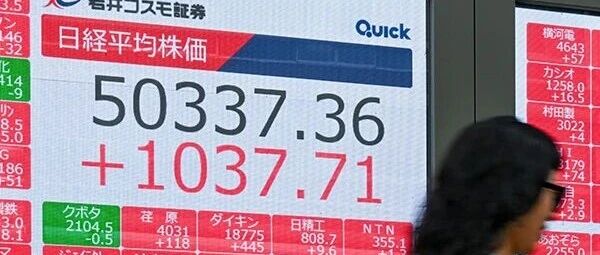
Group 1 - The Nikkei average index rose significantly, reaching 50,337.36 points, marking a historic breakthrough above 50,000 points, driven by expectations surrounding the economic policies of the new Kishida administration and external factors like anticipated interest rate cuts in the US and the expansion of the AI market [2][4]. - The Kishida administration's approval rating stands at 74%, significantly higher than the previous administration's 51%, which is perceived positively by the market as it suggests greater stability for the government [4]. - The "Japan Weeks" event highlighted the shift from savings to investment in Japan, with Finance Minister Shunichi Suzuki noting that the proportion of cash and deposits in personal financial assets remains high compared to the US, indicating substantial room for change [4]. Group 2 - AI and semiconductor-related stocks, such as Advantest and SoftBank Group, contributed to the market's upward movement, while defense-related stocks saw increased buying ahead of the upcoming US-Japan summit [5]. - The Bank of Japan is expected to maintain its current interest rates during the upcoming monetary policy meeting, with market consensus suggesting potential rate hikes could occur in January or as early as December [5]. - The external environment is favorable, with the US CPI for September coming in below expectations, raising the likelihood of interest rate cuts in the US, and easing trade tensions between the US and China, which supports investor sentiment [6].

热点思考 | 早苗经济学:安倍经济学2.0?(申万宏观·赵伟团队)
赵伟宏观探索· 2025-10-26 16:03
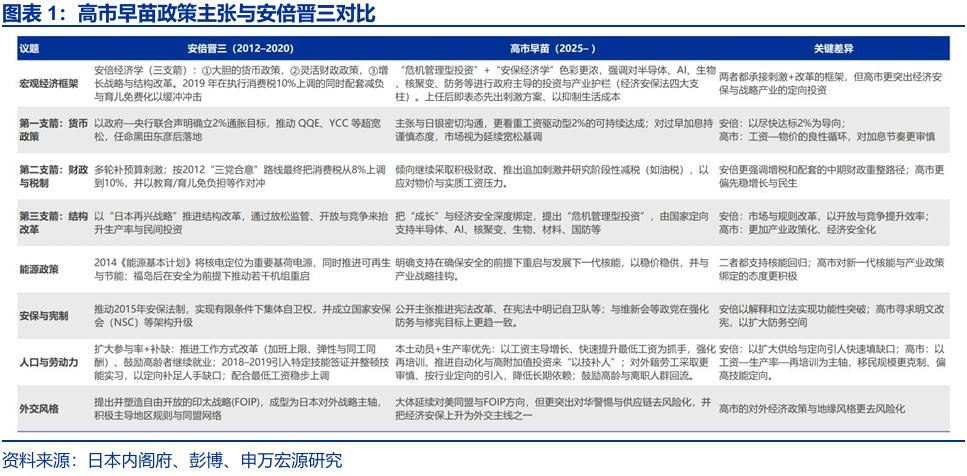
Group 1 - The core viewpoint of the article is that "Sanae Economics" proposed by newly elected Prime Minister Sanae Takaichi is not equivalent to "Abenomics 2.0" due to differing political and economic environments, with a focus on responsible fiscal policy rather than aggressive monetary easing [1][2][9] - Takaichi's economic policy emphasizes proactive fiscal measures, contrasting with Abenomics which prioritized monetary easing to combat deflation. The new approach aims to address inflation while maintaining financial stability [6][17] - Takaichi's government faces significant political constraints, including a lower parliamentary majority and lower public support compared to Abe, which may hinder the implementation of her policies [9][17] Group 2 - Japan's fiscal deficit is projected to rise from 1.3% in FY2025 to around 2.0% in FY2026, indicating a more expansionary fiscal stance compared to other developed economies [20][21] - The expected economic growth rate for Japan is forecasted to slightly increase to 0.9% in FY2026, driven by fiscal stimulus measures, with the supplementary budget potentially exceeding last year's 13.9 trillion yen [27][21] - The Bank of Japan is anticipated to lag in raising interest rates, with market expectations for a 50 basis point increase in 2026, influenced by inflation and currency depreciation pressures [45][47] Group 3 - Takaichi's government plans to implement a comprehensive stimulus package, including energy subsidies and tax relief measures, to support households and businesses amid rising costs [20][21] - The fiscal measures are expected to have a modest impact on GDP growth, with an estimated contribution of around 0.25% from the supplementary budget [27][21] - Japan's debt situation remains manageable, with a high debt-to-GDP ratio but low interest payment pressures due to a long debt duration and low foreign debt exposure [36][21]

申万宏源:早苗经济学与安倍经济学有何异同?
智通财经网· 2025-10-25 23:41
Group 1 - The core viewpoint of the articles is that Kishi Sanae's economic policy, termed "Sanae Economics," is not equivalent to "Abenomics 2.0," as it emphasizes fiscal policy over monetary policy, reflecting a shift in focus from combating deflation to addressing inflation [2][13][15] - Kishi's government plans to implement a stimulus package that may raise Japan's fiscal deficit rate from 1.3% in FY2025 to around 2.0% in FY2026, which is higher than France and the UK but lower than the US, Germany, and Greece [2][16] - Japan's real GDP growth is expected to slightly increase to 0.9% in FY2026, with fiscal stimulus contributing approximately 0.25% to GDP growth [3][19] Group 2 - Kishi's economic policies are characterized by a responsible proactive fiscal policy, which includes a stimulus package, energy subsidies, and tax relief for low-income households, while also aiming to increase defense spending [15][24] - The Bank of Japan (BOJ) is anticipated to face pressure to raise interest rates due to rising inflation and a weak yen, with market expectations for two rate hikes in 2026 [3][34][37] - Kishi's political constraints include a lower approval rating compared to Abe and a weaker parliamentary majority, which may hinder the implementation of her economic policies [7][13]

海外高频 | 黄金价格大幅回调,美国9月CPI弱于市场预期 (申万宏观·赵伟团队)
申万宏源宏观· 2025-10-25 16:54
Group 1: Major Asset Classes & Overseas Events & Data - Equity assets saw a general increase, while gold prices experienced a significant decline. The S&P 500 rose by 1.9%, and the Nasdaq increased by 2.3%. In contrast, COMEX gold dropped by 3.1% to $4104.2 per ounce [1][3][39] - The U.S. initiated a 301 investigation into the first phase of the trade agreement with China, with a meeting scheduled between President Trump and Chinese officials on October 30 [1][48] - The U.S. September CPI was weaker than market expectations, with core CPI rising only 0.2% month-on-month, below the expected 0.3%. The October Markit manufacturing and services PMIs showed improvements, rising to 52.2 and 55.2, respectively, indicating stronger performance compared to Europe, Japan, and the UK [1][65][76] Group 2: U.S. Economic Indicators - The U.S. cumulative fiscal deficit for 2025 reached $1.38 trillion, with total expenditures at $6.59 trillion and tax revenues at $4.16 trillion, marking an increase from the previous year [51][52] - The Federal Reserve's interest rate cut expectations have strengthened due to the weak CPI data, with the market anticipating two rate cuts in 2025 and three in 2026 [60][62] - The U.S. October Markit manufacturing and services PMIs rebounded, indicating that the U.S. economy remains a leader among developed countries [76]

热点思考 | 早苗经济学:安倍经济学2.0?(申万宏观·赵伟团队)
申万宏源宏观· 2025-10-25 16:54
Group 1 - The core argument of the article is that "Sanae Economics" under Prime Minister Takaiichi is not equivalent to "Abenomics 2.0" due to differing political and economic environments, with a focus on responsible fiscal policy rather than aggressive monetary easing [1][2][9] - Takaiichi's government plans to implement a stimulus package that may raise Japan's fiscal deficit rate from 1.3% in FY2025 to around 2.0% in FY2026, which is higher than France and the UK but lower than the US, Germany, and Greece [2][20][21] - The article highlights that Japan's actual GDP growth is expected to slightly increase to 0.9% in FY2026, driven by fiscal stimulus, with the supplementary budget potentially exceeding last year's 13.9 trillion yen [2][27] Group 2 - The Bank of Japan (BOJ) is expected to face pressure to raise interest rates, with market expectations for a 50 basis point increase in 2026, despite Takaiichi's cautious stance on monetary policy [2][45][56] - The article discusses the significant political constraints on Takaiichi's administration, including a lower approval rating and a weaker parliamentary majority compared to Abe's tenure, which may hinder policy implementation [9][17] - The economic environment has changed significantly since Abe's time, with current challenges including rising inflation and a depreciating yen, contrasting with the low inflation and interest rates during Abe's administration [17][47]

早苗经济学:安倍经济学2.0?
Shenwan Hongyuan Securities· 2025-10-25 15:04
Group 1: Economic Policy Comparison - Sanae Takai's economic policy, termed "Takai Economics," emphasizes responsible fiscal policy, contrasting with Abe's focus on aggressive monetary easing[2] - Takai's government faces significant political constraints, with the ruling party holding only 49.7% of seats in the Diet, compared to Abe's 67.9%[2] - Takai's approval rating stands at 44%, significantly lower than Abe's 60% during his tenure[2] Group 2: Fiscal Policy Outlook - Japan's fiscal deficit is projected to rise from 1.3% in FY 2025 to approximately 2.0% in FY 2026, indicating a more expansionary fiscal stance[3] - The fiscal stimulus package under Takai may exceed last year's 13.9 trillion yen, with a GDP impact estimated at around 0.25%[3] - Japan's debt-to-GDP ratio remains high, but interest payment pressures are manageable due to low foreign debt and long maturities[3] Group 3: Monetary Policy and Inflation - The Bank of Japan's interest rate hikes are expected to lag, with market predictions suggesting a 50 basis point increase in 2026[4] - High inflation and a weak yen are significant constraints on the Bank of Japan's monetary policy, with a 10% depreciation of the yen estimated to raise inflation by 0.3 percentage points[4] - The core CPI in Japan rose to 2.9% in September, indicating persistent inflationary pressures[4]
日元起落之间:“高市交易”引发资产再定价
Shang Hai Zheng Quan Bao· 2025-10-24 19:15
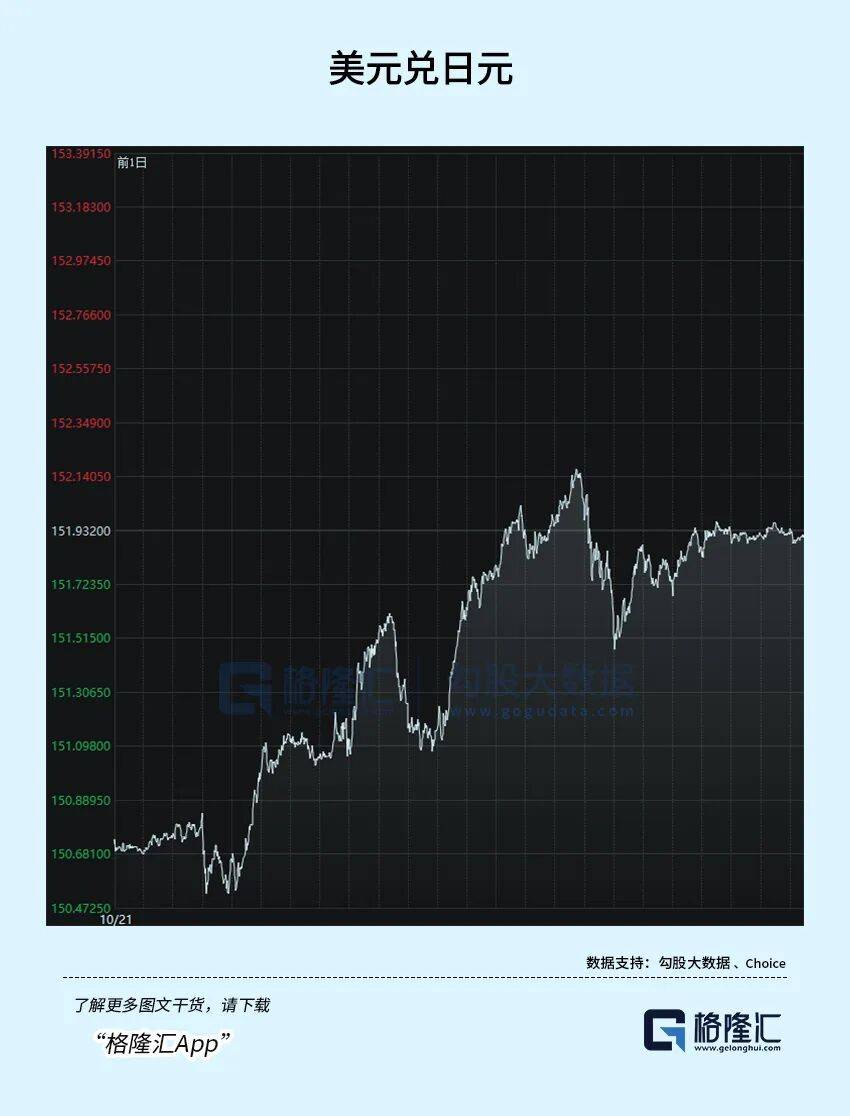
Core Viewpoint - The election of Fumio Kishida as Japan's Prime Minister has led to the emergence of "Kishida Economics," which continues the principles of "Abenomics" with a focus on expansive fiscal and monetary policies [2][3]. Group 1: Election and Policy Framework - Fumio Kishida was elected as Japan's 104th Prime Minister on October 21, 2023, after a tumultuous path that included the withdrawal of the Komeito party from the ruling coalition and subsequent support from the Japan Innovation Party [2]. - Kishida's economic policy, termed "Kishida Economics," emphasizes a continuation and development of "Abenomics," advocating for a combination of loose monetary policy and expansionary fiscal measures [2][3]. Group 2: Economic Challenges - Kishida's administration faces significant challenges, including Japan's high government debt-to-GDP ratio, which is the highest among developed countries, potentially complicating fiscal expansion efforts [3]. - The current inflationary environment is markedly different from the low inflation experienced during the Abenomics era, raising concerns that large-scale stimulus could exacerbate inflation [3]. Group 3: Central Bank Independence - Kishida's approach raises questions about the independence of the Bank of Japan (BOJ), as he has previously advocated for greater government intervention in monetary policy [4][5]. - Despite Kishida's recent comments supporting the BOJ's autonomy, the future path of monetary policy remains uncertain, with market expectations for interest rate hikes being postponed [5]. Group 4: Market Reactions - Following Kishida's election, the market experienced a "Kishida Trade," characterized by rising Japanese stocks and a weakening yen, with the yen falling below the 153 mark against the dollar for the first time since October 10 [1][6]. - Analysts caution that the current market environment differs significantly from the Abenomics period, suggesting that the "Kishida Trade" may not be sustainable in the long term [6][7].
“早苗经济学”如何影响日本经济|全球财经连线
2 1 Shi Ji Jing Ji Bao Dao· 2025-10-23 13:49
Core Points - Japan has elected its first female Prime Minister, Sanae Takaichi, who received a majority of votes in the first round of the House of Representatives' Prime Ministerial election on October 21 [1] - Following Takaichi's election, the Japanese stock market experienced a surge, with the Nikkei 225 index reaching historical highs and approaching the 50,000-point mark from October 20 to 22 [1] - The stock market's rise is attributed to market anticipation of Takaichi's policies, which include a commitment to continue and strengthen loose monetary policy and implement large-scale fiscal stimulus plans to boost economic growth [1] - "Sanae Economics" has emerged as a key term for interpreting Japan's economic policy direction in light of Takaichi's proposed strategies [1] - There are questions about the sustainability of the "Takaichi trade" and the actual impact of "Sanae Economics" on revitalizing the Japanese economy [1]
每日投行/机构观点梳理(2025-10-23)
Jin Shi Shu Ju· 2025-10-23 10:43
Group 1: Gold and Silver Market Insights - Goldman Sachs maintains a target price of $4,900 per ounce for gold by the end of 2026, citing increasing interest in gold as a strategic diversification tool [1] - UBS expects silver prices to rebound to $55 per ounce by June 2026, indicating a positive outlook for silver investments [3] - Swiss Bank analysts suggest that the recent significant drop in gold prices is a short-term oversell, with strong fundamental supply-demand dynamics supporting future price increases [2] Group 2: Currency and Economic Policy Analysis - Analysts from Dutch Bank express concerns that the dollar's ability to sustain its recent gains may be limited, especially if the market does not find reasons to rule out potential Fed rate cuts [4] - German Bank analysts predict that the upcoming U.S. inflation data may not have a lasting impact on the dollar, as the Fed is likely to focus on employment conditions rather than inflation [5] - Goldman Sachs anticipates that the Bank of Japan may maintain its policy rate unchanged due to high uncertainty regarding economic prospects [6] Group 3: Economic Growth Projections - Barclays economists predict that the Bank of Japan may raise its economic growth forecast for FY2025 from 0.6% to 0.8%, based on reduced tariff uncertainties and strong GDP growth [7] - Goldman Sachs forecasts that the Bank of England will likely cut rates in February 2024, with the potential for earlier cuts due to lower-than-expected inflation data [8] - French Bank analysts suggest that the Bank of England may lower rates in December, putting further pressure on the pound [9] Group 4: Sector-Specific Insights - Citic Securities highlights the strategic value of the rare earth industry, driven by export control policies and increasing demand from various sectors [6] - Citic Securities also sees potential bottoming opportunities in the liquor industry, with expectations of a recovery in market demand by Q3 2025 [7] - Citic Securities projects a moderate appreciation of the RMB in 2026, supported by favorable external conditions and domestic economic stability [8]
日本右转
Hu Xiu· 2025-10-23 00:29
Group 1 - The Nikkei index is approaching the 50,000 mark, indicating a bullish sentiment in the Japanese stock market [1] - The Japanese parliament has completed the election of the new Prime Minister, marking a significant political transition [2] - The new Prime Minister, Sanae Takaichi, has become the first female Prime Minister in Japan's constitutional history, which may influence market dynamics [3] Group 2 - The market experienced a brief decline following the announcement of the new Prime Minister, with the yen rapidly depreciating [5] - The financial market in Japan is entering a phase where economic policies are expected to be implemented [6] - There is optimism regarding the potential for stock market growth in the fiscal year 2025, despite a halt in expectations for interest rate hikes [7] Group 3 - The new Prime Minister opposes interest rate hikes by the Bank of Japan, advocating for policy tightening only when wage growth leads to demand-driven inflation [8] - Takaichi aims to restore Japan's economic prosperity reminiscent of the Abe administration [9] - The probability of an interest rate hike in October has plummeted from 68% to 20% following the new Prime Minister's stance [10] Group 4 - Takaichi's supporters have drawn parallels to Trump's MAGA movement, indicating a shift towards a more nationalistic economic policy [12] - The political landscape in Japan is shifting towards the right, reflecting broader global trends [14] Group 5 - The article discusses Japan's historical reliance on the U.S. for economic growth post-World War II, highlighting the impact of currency valuation on trade [16][18] - Japan's trade dynamics have evolved, with significant trade deficits in the 1980s due to a weaker yen, which facilitated exports [22][24] Group 6 - The article outlines the economic policies of former Prime Minister Shinzo Abe, which included aggressive monetary easing and fiscal stimulus [40][41] - Despite a decline in nominal GDP during certain periods, the unemployment rate decreased, and the stock market experienced a prolonged bull run [47][48] Group 7 - The current economic environment differs from the past, with rising inflation and increased political challenges complicating policy execution [79][83] - Japan's public debt has reached unprecedented levels, raising concerns about fiscal sustainability [88][90] Group 8 - The new economic strategy under Takaichi is seen as a revival of Abe's policies, focusing on monetary easing and currency depreciation to stimulate growth [93] - The article concludes that while leveraging a weaker yen may provide short-term benefits, the long-term sustainability of such policies remains uncertain [100][101]