
杠杆投资

Search documents
[11月6日]指数估值数据(A股港股继续上涨;未来还会不会遇到1星级;红利指数估值表更新)
银行螺丝钉· 2025-11-06 14:13
Core Viewpoint - The overall market is experiencing an upward trend, with the index returning to a rating of 4.1 stars, indicating a positive investment environment [1]. Market Performance - Large, medium, and small-cap stocks are all rising, with medium-cap stocks showing slightly higher gains [2]. - Growth styles, particularly in the technology and innovation sectors, have rebounded strongly after recent declines [3]. - In the value style, stocks with strong free cash flow have increased by over 2%, approaching normal valuation levels [4]. - The Hong Kong stock market is also seeing overall gains, with the Hang Seng Index and the Hong Kong Technology Index rising by over 2% [6][7]. Historical Context of Market Ratings - The article discusses the rarity of 1-star market bubbles, which typically occur at the peak of bull markets, such as in 2007 and 2015 for A-shares, where the Shanghai Composite Index reached over 6000 and 5000 points respectively [12][16]. - The article notes that after the 1-star ratings in 2007 and 2015, A-shares experienced significant declines of 70% and 50% respectively [16]. - Comparatively, the Nasdaq experienced a similar bubble in 2000, with a subsequent drop of over 80% until it regained its previous levels in 2017 [17]. Current Market Conditions - The current market is characterized by a recovery in fundamentals, with a single-digit year-on-year profit growth for the CSI index, indicating a modest improvement compared to the previous year [26]. - The global market's rise is primarily driven by the Federal Reserve entering a rate-cutting cycle, leading to increased liquidity [26]. - The current market dynamics resemble those of 2015, with ample liquidity driving small-cap and growth stocks to lead the rally, although personal leverage is being strictly controlled [26]. Valuation Insights - The article provides a valuation table for various dividend and free cash flow indices, indicating the current earnings yield and other financial metrics for reference [28]. - The valuation data suggests that certain indices are currently undervalued and suitable for dollar-cost averaging, while others are overvalued [42]. Future Outlook - The potential for the current bull market to reach a 1-star rating is uncertain, with short-term fluctuations being unpredictable [26]. - The article emphasizes the importance of patience in investment, suggesting that investors should buy during downturns and sell during peaks, while waiting for opportunities in between [26].


金价暴跌,大学生血亏刷屏!这届年轻人咋就被黄金“割韭菜”了?
Sou Hu Cai Jing· 2025-10-27 06:35
Core Viewpoint - The recent decline in gold prices has significantly impacted university students, who are engaging in gold trading without fully understanding the risks involved [1][9]. Group 1: Impact on University Students - Many university students have reported substantial financial losses, with some losing an entire month's living expenses in a single day due to gold trading [3]. - The ease of trading through mobile platforms has led students to invest their living expenses or even borrow money to trade gold, resulting in emotional distress [5][8]. - The use of high leverage in trading has exacerbated the situation, with some students facing severe losses, such as a 75% drop in a single day [8]. Group 2: Understanding of Gold Trading - Many young investors lack a fundamental understanding of gold as an asset, which does not generate interest and relies solely on price fluctuations [9]. - The perception of gold trading as a simple investment is misleading, as there are hidden costs associated with trading, such as fees and potential losses from frequent trading [11]. Group 3: Market Dynamics - The recent drop in gold prices is attributed to several factors, including improved international relations, a hawkish stance from the Federal Reserve, and a strengthening dollar, leading to a collective sell-off by previous investors [11]. - The current market environment has created a sense of urgency among young investors, driven by social media portrayals of quick wealth accumulation, which can lead to reckless trading behavior [13]. Group 4: Investment Philosophy - The distinction between investing and speculating is crucial, as many students confuse the two, leading to risky behaviors such as borrowing money to invest [15]. - A call for a more cautious approach to investing is emphasized, advocating for risk management and long-term planning rather than impulsive trading decisions [15].

韩国基民投资理财新趋势:偏好高杠杆ETF,对中国资产关注度提升
证券时报· 2025-10-20 04:15
Core Viewpoint - The article highlights the growing influence of retail investors, referred to as the "ant army," in South Korea's capital markets, driven by a desire for financial change amid economic challenges like high prices and declining interest rates [1]. Group 1: Retail Investor Behavior - South Korean retail investors are increasingly viewing investment as a means to change their fortunes, leading to a surge in interest in high-risk leveraged products such as ETFs and derivatives [1][5]. - The preference for high-risk assets has been longstanding, with many investors favoring leveraged ETFs and cryptocurrencies despite significant losses [5][6]. - As of October 15, 2023, the credit trading balance in the South Korean stock market reached 23.83 trillion KRW, nearing the historical high of 25.65 trillion KRW set in 2021 [6]. Group 2: ETF Market Growth - The ETF market in South Korea has seen rapid growth, with the number of listed ETFs surpassing 1,000 for the first time in July 2023, driven by retail investor enthusiasm [8]. - As of October 17, 2023, there were 1,028 listed ETFs in South Korea, with a total asset size of 260 trillion KRW and a daily trading volume of 16 billion KRW [8]. - Retail investors have net bought 21.3 trillion KRW worth of ETFs in 2023, while institutional investors have shown a net outflow [8]. Group 3: Product Innovation - To cater to the diverse investment needs of retail investors, South Korean asset management companies have launched various innovative products, including thematic ETFs, leveraged ETFs, and actively managed ETFs [9]. - Recent product launches include five actively managed ETFs and several leveraged and thematic ETFs, reflecting the growing demand for diverse investment options [9]. Group 4: Focus on Chinese Assets - Since 2025, there has been a noticeable increase in South Korean investors' interest in Chinese assets, particularly in Hong Kong tech stocks [10]. - As of October 17, 2023, China has become the second-largest overseas stock market for South Korean investors, with a cumulative transaction amount of 9.019 billion USD [11]. - The net buying of Chinese assets by South Korean investors has turned positive for the first time in three years, with a focus on technology giants and emerging industries [11][12].
关于杠杆投资,巴菲特有这四句忠告 | 猫猫看市
Sou Hu Cai Jing· 2025-10-11 09:46
Core Viewpoint - The article discusses the dual nature of leverage in investment, highlighting both its potential for wealth creation and the significant risks associated with excessive use of leverage, as emphasized by Warren Buffett's insights. Group 1: Buffett's Insights on Leverage - Excessive leverage leads to trouble, similar to alcohol consumption; a little is manageable, but too much can result in severe consequences [2][3] - Leverage is addictive; once investors experience the wealth effect from leverage, they are unlikely to revert to more conservative investment practices [4][6] - Credit is likened to oxygen; when abundant, it goes unnoticed, but its absence creates significant problems, especially during a margin call [7][8] Group 2: Consequences of Leverage - Historical data shows that market indices can experience significant drops, such as the 33% decline of the Hang Seng Index in 1987, which could wipe out leveraged investors' assets in a single day [3] - The allure of quick profits from leverage can lead investors to ignore the associated risks, making it difficult to return to slower, safer investment methods [6][10] Group 3: Buffett's Personal Approach to Leverage - Buffett suggests that avoiding leverage entirely prevents any related issues, stating that smart investors do not need leverage, while less knowledgeable investors should avoid it to prevent financial ruin [9][10] - Despite his warnings about leverage, Buffett himself utilizes it strategically, such as through insurance company float, which mitigates the impact of market volatility [12][13]
波动面前,价值投资者的生存法则:看透、稳住、少看
Xin Lang Cai Jing· 2025-09-27 09:33
Core Insights - The article emphasizes the importance of understanding companies and their fundamentals rather than being swayed by market volatility, highlighting that true value investing is about thriving amidst fluctuations [2][3][4][5] Group 1: Understanding Companies - Value investors view stock price fluctuations as temporary waves, focusing instead on the intrinsic value of companies, akin to a ship's keel [2] - Historical data from the S&P 500 shows that despite 12 bear markets since 1957, the annualized return rate remains at 10.26%, indicating that quality companies endure through cycles [3] - Familiarity with a company's products, research, and cash flow helps investors remain calm during short-term price changes [3] Group 2: Avoiding Leverage - Leverage can amplify both gains and losses, with historical examples like Bear Stearns during the 2008 financial crisis illustrating the dangers of excessive leverage [3][4] - The nature of volatility changes with leverage; a 50% drop can wipe out an investor's capital if leverage is involved, whereas it may only represent a paper loss without leverage [4] - Behavioral finance suggests that leverage can lead to irrational decisions, such as panic selling during downturns, which is contrary to Warren Buffett's investment principles [4] Group 3: Staying Away from Market Noise - The principle of "holding stocks without being emotionally attached" is crucial for managing volatility, as excessive trading can erode returns [5] - Data indicates that investors with a monthly turnover rate exceeding 200% have a median three-year return of -18.7%, significantly lower than the 34.2% return of low-frequency traders [5] - Successful investors focus on analyzing quarterly reports and conducting field research rather than obsessively monitoring market movements, allowing them to make informed decisions without succumbing to market noise [5]


波动面前,价值投资者的生存法则:看透、稳住、少看
美股研究社· 2025-09-27 09:11
Core Viewpoint - The article emphasizes that the essence of value investing lies not in avoiding volatility but in developing a system to survive and profit from it, encapsulated in three key concepts: understanding the business, avoiding leverage, and distancing from the market [1][5]. Understanding the Business - True value investors recognize that daily stock price fluctuations are akin to waves, while the intrinsic value of a company is the foundation. For instance, Warren Buffett's investment in Coca-Cola during the 1987 market turmoil was based on the brand's strong consumer loyalty, which proved to be a solid investment over time [1][2]. - Quality companies can sustain themselves through continuous product innovation and stable profit growth, as evidenced by the S&P 500's annualized return of 10.26% since 1957, despite experiencing 12 bear markets [2][3]. Avoiding Leverage - Leverage can amplify both gains and losses, acting as a trigger for potential destruction during market volatility. The case of Bear Stearns, which collapsed due to excessive leverage during the 2008 financial crisis, illustrates the dangers of high leverage [2][3]. - The article highlights that without leverage, a 50% drop in stock price may only represent a paper loss, allowing time for recovery, whereas with leverage, the same drop could wipe out the principal entirely [3]. Distancing from the Market - Investors should maintain a healthy distance from market noise, focusing instead on analyzing quarterly reports and conducting on-site research. This approach allows them to avoid the pitfalls of overtrading, which can lead to significant losses [5]. - The article notes that investors who frequently trade, such as those with a monthly turnover rate exceeding 200%, tend to have lower median returns compared to those who trade less frequently [3][5].

从梧桐树到全球金融巨擘:纽约证券交易所的两百年风雨路
Guan Cha Zhe Wang· 2025-09-05 10:09
Group 1 - The article discusses the historical significance of the "Buttonwood Agreement" signed in 1792, which laid the foundation for the New York Stock Exchange (NYSE) and marked the transition from chaotic street trading to a structured financial market [1][4][6] - The agreement was a response to market manipulation and instability, particularly following the financial crisis caused by William Duer's failed attempt to monopolize bank stocks, which led to widespread bankruptcies [4][6] - The NYSE evolved from informal trading among brokers to a formal organization, establishing rules and a membership system that enhanced trading efficiency and credibility [6][8] Group 2 - The establishment of the New York Stock and Exchange Board in 1817 marked a significant step towards institutionalization and regulation of the trading environment, coinciding with the rise of New York as a financial center [9][10] - The NYSE faced challenges such as market manipulation and fraud, exemplified by the actions of Jay Gould and Jim Fisk in the late 1860s, which ultimately led to regulatory reforms [9][10] - The introduction of self-regulatory measures, such as a blacklist for defaulters and IPO review mechanisms, contributed to the NYSE's development and the establishment of a more organized trading environment [10][11] Group 3 - The article highlights the impact of major financial crises, including the Great Depression and the 2008 financial crisis, which prompted significant regulatory reforms and the establishment of the Securities and Exchange Commission (SEC) [13][19] - The evolution of technology in trading, from paper-based systems to electronic trading, has transformed the market landscape, particularly following the "paper crisis" of the 1960s [11][19] - The NYSE's history reflects a continuous cycle of market enthusiasm, panic, and recovery, driven by the pursuit of efficiency and trust among market participants [19]

A股两融余额创历史新高,股民是“留”还是“去”?
Hua Xia Shi Bao· 2025-09-04 00:20
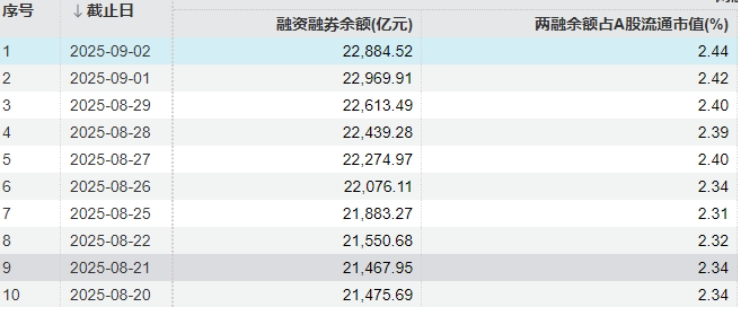
Core Insights - The A-share market has shown strong vitality, with the margin financing balance exceeding 2 trillion yuan since August 5, reaching a historical high of 2.29699 trillion yuan by September 1, surpassing the previous peak of 2.27 trillion yuan in June 2015 [1][5][9] - The technology sector has emerged as the leading performer, with significant inflows into semiconductor, electronics, and computer industries, driven by high growth potential and clear industrial logic [5][6][9] Margin Financing Balance - As of September 2, the margin financing balance was 2.288 trillion yuan, slightly down from the previous day but still at a high level [1][2] - The margin financing balance has remained above 2 trillion yuan for over 20 trading days, indicating heightened market activity [3][5] Sector Performance - The technology sector, particularly semiconductors and electronics, has attracted substantial leverage funds, reflecting investor confidence in high-growth industries [5][6] - A total of 43 stocks have seen net financing purchases exceeding 1 billion yuan since August, with 10 stocks surpassing 2 billion yuan [5][6] Structural Characteristics of Fund Flows - The fund flow is characterized by structural differentiation, with core technology sectors receiving significant inflows while traditional cyclical sectors face cautious investment [6][9] - The top industries for net financing purchases since August 1 include semiconductors, communication equipment, and consumer electronics, highlighting a focus on technology-driven growth [6][7] Market Sentiment and Future Outlook - The current market environment is marked by high trading activity and investor enthusiasm, with total trading volume exceeding 3 trillion yuan on certain days [3][5] - Analysts suggest that while the market is currently active, there is a need for caution regarding high valuations and potential corrections in overbought sectors [8][10]
我们买私募,买的到底是什么?
雪球· 2025-09-03 08:23
Core Viewpoint - The private equity fund industry has seen significant growth over the past decade, with its management scale increasing from 1.73 trillion to over 3 times that amount, indicating a strong demand and interest in this investment category [2]. Group 1: Growth of Private Equity - Ten years ago, there were only 21 private equity firms with over 10 billion in assets, while today that number has increased to 81 [4]. - Despite the high entry barriers for ordinary investors, private equity continues to attract attention and favor due to its flexibility [6]. Group 2: Flexibility of Private Equity - Private equity funds are highly flexible, catering to diverse and personalized investment needs, contrasting with public funds which are more standardized [8]. - The flexibility of private equity is attributed to several key "superpowers" [13]. Group 3: Key Advantages of Private Equity - **Flexible Positioning**: Unlike public funds, which have strict position limits (minimum 80% in stocks), private equity funds can adjust their positions freely, allowing for better performance in volatile or bear markets [15]. - **Broader Investment Scope**: Private equity funds can invest in a wider range of assets, including commodities and foreign exchange, beyond just stocks and bonds [19]. - **Use of Financial Derivatives**: Private equity funds can utilize various financial derivatives, which are often restricted for public funds, allowing for more complex strategies such as hedging and short selling [23]. - **Leverage Investment**: Private equity funds commonly use leverage, enhancing capital efficiency by borrowing to invest, which is less common in public funds [32].

“00后”跑步进股市,佣金杀到“万1”!新一轮开户潮来了
Guo Ji Jin Rong Bao· 2025-08-28 15:06
Market Performance - A-shares have reached new highs, with trading volume nearing 3.2 trillion yuan in a week, indicating a mix of excitement and profit-taking [1] - The margin trading balance has risen to 2.2 trillion yuan, accounting for 2.26% of the circulating market value, reflecting increased investor activity [1][9] Investor Behavior - There is a notable increase in new accounts, with 1.9636 million new accounts opened in July, a 71% year-on-year increase [3] - The demographic of new investors is becoming younger, with significant participation from the "90s" and "00s" generations, indicating a shift in market engagement [4][6] Brokerage Activity - Brokerages are experiencing heightened activity, with a surge in account openings and client consultations, although the intensity is not as extreme as during the "9.24" event last year [4][6] - Competitive pricing strategies are being employed by brokerages, with some reducing commission rates to below 0.1% to attract new clients [6] Margin Trading Insights - The margin trading balance has been driven primarily by financing purchases, with a significant portion of trading activity concentrated in sectors like electronics, computers, and pharmaceuticals [9] - The increase in margin trading reflects a recovery in investor risk appetite, but it also raises concerns about potential market volatility due to high leverage [10] Market Outlook - The A-share market has seen substantial gains, with the Shanghai Composite Index rising over 24% and the ChiNext Index over 56% since April [10] - Analysts caution that the current market conditions may lead to overheating in certain sectors, and investors should remain vigilant regarding potential risks associated with high leverage [10]