
生态化

Search documents
商业银行关停、整合旗下App 为推进数字化减负增效
Zheng Quan Ri Bao· 2025-07-25 15:50
Core Insights - The trend of shutting down and integrating banking apps continues, with Zhuhai China Resources Bank announcing the termination of its "Run Wallet App" service, reflecting a broader industry shift towards digital transformation aimed at reducing operational costs and enhancing efficiency [1][2] Summary by Category App Shutdown and Integration - Zhuhai China Resources Bank will officially stop the "Run Wallet App" service on October 15, 2025, migrating its functions to the China Resources Bank App for a one-stop service [2] - Many banks, including state-owned and joint-stock banks, are accelerating the consolidation of their apps, particularly focusing on credit card and direct banking apps [2][3] - The number of available credit card apps has significantly decreased, with most remaining apps concentrated among major state-owned banks, while city commercial banks and rural commercial banks have seen a decline in their credit card app offerings [2] Industry Trends - The integration of credit card and direct banking apps is driven by the need for banks to adapt to changing industry dynamics, as these apps have overlapping functions and are becoming less relevant [3][4] - The trend began several years ago, with banks starting to optimize channels and integrate apps, which has accelerated since 2023 [4] Reasons for Integration - The primary reasons for app consolidation include a shift from broad operations to more targeted approaches, focusing on enhancing user experience and operational efficiency [4] - Regulatory policies have also played a role, with the National Financial Regulatory Administration issuing guidelines to strengthen the management of mobile applications in the banking sector [4] Future Directions - The future of banking apps is expected to focus on three main trends: scenario-based integration, comprehensive ecosystem development, and intelligent upgrades through technology [6] - Banks aim to create a "financial + scenario ecosystem" that integrates various life services, enhancing user engagement and loyalty [6]


相向而行,共谋发展:这场活动解锁国央企人力资源管理变革新范式
Sou Hu Wang· 2025-07-21 01:53
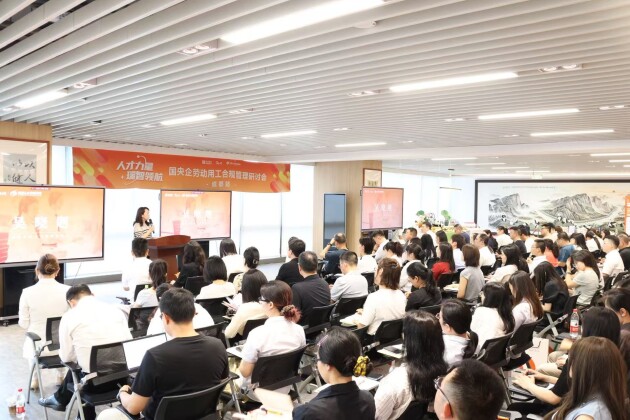
Core Insights - The ongoing reform of state-owned enterprises presents new challenges and opportunities for human resource managers, particularly in balancing efficiency and compliance, activating organizational potential, and leveraging digital transformation for management advancement [1][11] - The "Talent Power, Smart Navigation" seminar aimed to create a platform for experience sharing and wisdom collision among state-owned enterprises in Southwest China, focusing on labor compliance management [1][11] Group 1: Company Overview - Shudao Group, established on May 28, 2021, is a large state-owned enterprise formed by the merger of Sichuan Communications Investment Group and Sichuan Railway Investment Group, with total assets exceeding 1.5 trillion yuan and over 500 subsidiaries [2] - The group has developed a "Transportation+" industrial pattern, integrating comprehensive transportation, energy resources, and finance, and operates in over 60 countries and regions with nearly 60,000 employees [2] Group 2: Seminar Highlights - The seminar attracted nearly 100 leaders from state-owned enterprises, focusing on core topics such as diversified employment, digital transformation, and organizational activation [1][11] - Keynote speeches included insights from Shudao Group's HR department and Chengdu Talent Group, emphasizing the importance of a market-oriented talent service system and the need for innovative human resource management practices [4][5] Group 3: Innovative Practices - Chengyu Company, a core subsidiary of Shudao Group, shared its innovative practices in diversified employment and talent management, including the use of shared employment and outsourcing models to address structural employment challenges [7][11] - Human resources expert Zhang Jianguo presented a new "consulting + technology + employment" solution, highlighting the need for a comprehensive approach to human resource digital transformation [8][10] Group 4: Future Directions - The collaboration among Shudao Group, Chengdu Talent Group, and Renrui Talent aims to reshape the human resource service market and build a comprehensive service platform to attract talent [5][11] - The seminar marked a shift from isolated efforts to collaborative progress among state-owned enterprises in human resource management, emphasizing compliance, efficiency, and flexibility as key areas for future development [13]

天音控股上半年业绩预告发布 消费电子市场下半年将稳中有升
Zheng Quan Ri Bao Wang· 2025-07-14 14:13
Group 1 - Tianyin Communication Holdings Co., Ltd. (Tianyin Holdings) expects revenue for the first half of 2025 to be between 43 billion and 47 billion yuan, indicating stable revenue capacity and ongoing investment in R&D [1] - The consumer electronics market is currently stabilizing at the bottom, with expectations for steady growth in the second half of 2025 driven by policy and AI [1][2] - The smartphone market is entering a period of intensive new product launches, with significant innovations in foldable screens and AI technology integration [1] Group 2 - Canalys predicts that the global penetration rate of AI smartphones will reach 34% in 2025 and 50% by 2027, which will stimulate market demand in consumer electronics [2] - Tianyin Holdings is well-positioned in the smart terminal sales market, benefiting from long-term partnerships with major brands like Apple, Samsung, and Huawei [2] - The company has developed a diverse sales system focusing on mobile phones, complemented by 3C digital products, smart wearables, and smart home devices [2] Group 3 - The consumer electronics industry is expected to evolve towards greater intelligence and ecosystem development, enhancing user experience and market competitiveness [3] - The growth in consumer electronics product volume is anticipated to support the industry's fundamentals, leading to increased sector prosperity [3] - As the largest mobile retail distributor in China, Tianyin Holdings is expected to continue benefiting from the positive trends in the consumer electronics sector [3]

小米YU7预订火爆 A股“小伙伴”齐涨(附名单)
Zheng Quan Shi Bao Wang· 2025-06-27 05:22
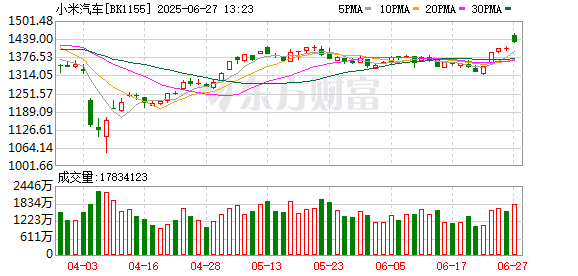
Group 1 - Xiaomi's first SUV, the YU7, was officially launched with a starting price of 253,500 CNY, and pre-orders exceeded 200,000 units within 3 minutes and 289,000 units within 1 hour [4] - The YU7 features a high-performance electric motor with a maximum speed of 22,000 RPM and utilizes an 800V silicon carbide high-voltage platform, allowing for rapid charging from 10% to 80% in just 12 minutes [4] - Analysts believe that Xiaomi's unique ecological advantages will significantly contribute to the surge in YU7 orders, positioning the company to lead the automotive industry towards an interconnected ecological era [4] Group 2 - Xiaomi automotive concept stocks saw a collective rise, with Xiaomi Group-W's stock opening up by 8.96% and closing up by 4.39% on June 27 [3] - A total of 25 Xiaomi automotive concept stocks are tracked, with 9 stocks receiving ratings from 3 or more institutions, indicating strong institutional interest [5] - Forecasts suggest that several Xiaomi automotive concept stocks, including Yachuang Electronics and BYD, are expected to achieve net profit growth rates exceeding 20% from 2025 to 2027 [5][6] Group 3 - QFII holdings in Xiaomi automotive concept stocks showed that 6 stocks were heavily invested by QFII as of the end of the first quarter, with Pengling Co. having the highest QFII holding ratio at 2.87% [6] - Pengling Co. has indicated that Xiaomi Automotive is a significant client, and the company will supply fluid pipeline products for Xiaomi's vehicles [7]

赵福全:得生态者得汽车产业
Zhong Guo Qi Che Bao Wang· 2025-06-10 03:27
Core Insights - The core theme of the forum is the ecological development of the automotive industry, emphasizing that "whoever masters ecology will master the automotive industry" [1][6] Market Trends - The domestic automotive market in China has surpassed 26 million units in sales, with projections estimating total sales to reach approximately 30 million units by 2030 [4] - Domestic brand sales in the commercial vehicle sector are expected to reach 4 million units by 2030, with significant growth in light and medium commercial vehicles [4] - By 2030, domestic brands are projected to achieve sales of 2.22 million units in the passenger vehicle sector, increasing their market share from nearly 67% to 70% [4] - In the overseas market, domestic brands are expected to reach sales of 10 million units by 2030, with 6 million units being exported from China and 4-5 million units produced overseas [4] Industry Transformation - The automotive industry is undergoing a transformation driven by carbon neutrality and the interconnectedness of various sectors, redefining vehicles as not just transportation tools but as intelligent, data-driven entities [5][6] - The concept of "New Automotive" is introduced, which refers to vehicles that are data-driven, self-evolving, and capable of providing intelligent mobility solutions [6][8] Innovation and Collaboration - The future of the automotive industry requires a shift from traditional manufacturing to a focus on technology and service-oriented business models [6][7] - Companies must embrace collaborative innovation, moving away from isolated development to a model that encourages cross-industry partnerships and shared expertise [8] - The role of technology leaders (CTO Plus) is emphasized, combining technical and business acumen to drive innovation and product lifecycle management [7] AI and Future Outlook - AI is identified as a critical driver of change in the automotive industry, with the potential to reshape product forms, collaboration models, and business strategies [8][9] - The industry must prioritize rapid iteration and data-driven decision-making to remain competitive in the evolving landscape [8] - A call for openness and innovation is made, highlighting the importance of intellectual property and sustainable development in the context of AI integration [9]

中国旅游研究院副院长马仪亮:旅游业正向专业化、生态化、轻量化提速
Bei Jing Shang Bao· 2025-05-28 13:48
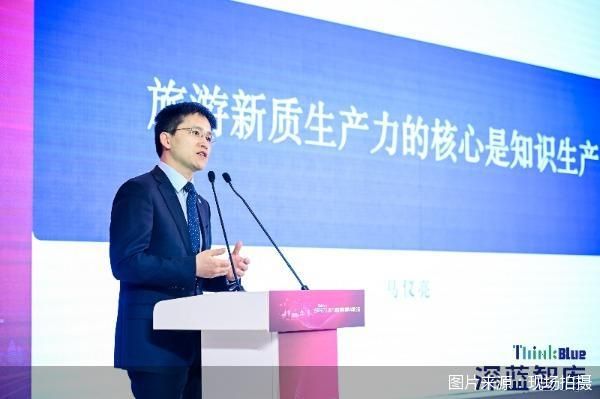
Core Insights - The tourism industry is undergoing a transformation from resource-driven to knowledge-driven development, emphasizing the need for specialized, ecological, and lightweight upgrades to create new consumption scenarios that meet tourists' emotional and meaningful experiences [1][4][5] Group 1: Stages of Tourism Development - The evolution of the tourism market is closely related to tourist preferences, with four distinct stages identified: resource-driven, information and channel advantages, customer scale advantages, and knowledge production advantages [3][4] - The first stage relied on resource endowments, with iconic sites like the Forbidden City and the Great Wall attracting tourists [3] - The second stage saw the emergence of large tourism wholesalers due to improved information and pricing [3] - The third stage highlighted the high-frequency nature of modern tourism, leading to the rise of theme parks [3] - The final stage focuses on knowledge production, where various enterprises are crossing into tourism, leveraging their knowledge advantages [3][4] Group 2: New Quality Productivity - Knowledge production is driving the tourism industry towards professionalization, ecological development, and lightweight operations [5][6] - The professionalization of the industry is leading to higher technical and service standards across various segments [6] - The shift from traditional heavy asset models to knowledge-based lightweight operations is becoming more pronounced, with companies like Haichang Ocean Park focusing on light asset development [6] Group 3: Policy and Consumer Behavior - The development of new quality productivity requires enhanced policy coordination, emphasizing the need for deep collaboration among departments [7] - Understanding the changing consumption patterns of younger generations is crucial, as they seek genuine enjoyment and experiences [7] - The phenomenon of "one ticket leading to eight yuan in comprehensive consumption" among Generation Z reflects a shift from traditional single-point consumption to a more integrated industry ecosystem [7] - Modern tourism consumption has evolved beyond mere utility to encompass symbolic value, fulfilling social and identity recognition needs [7]
趋势研判!2025年中国低空应急救援装备行业政策、行业现状、竞争格局及发展趋势分析:低空经济万亿蓝海领航,应急装备行业前景广阔[图]
Chan Ye Xin Xi Wang· 2025-05-19 00:54
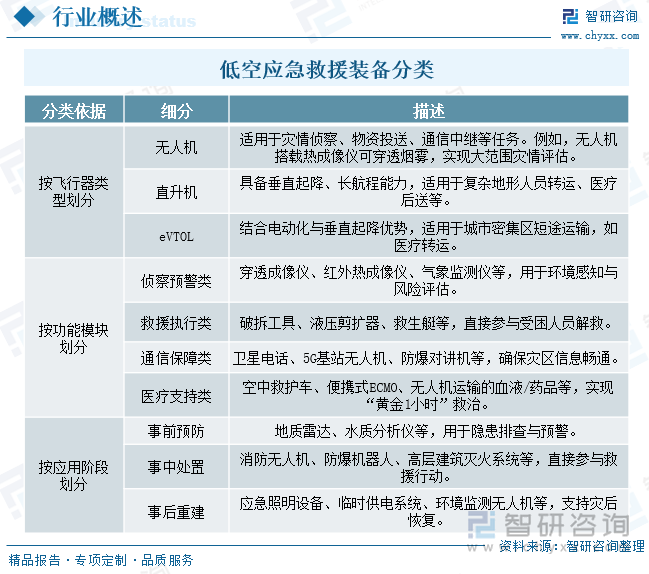
Core Viewpoint - The low-altitude economy is emerging as a representative of new productive forces in the country, achieving deep integration across multiple fields through the "low-altitude +" model, particularly in the "low-altitude + emergency" and "low-altitude + firefighting" sectors, which show strong development momentum [1][10]. Overview of Low-altitude Emergency Rescue Equipment Industry - Low-altitude emergency rescue equipment refers to aircraft and supporting devices operating in low-altitude airspace (typically up to 1,000 meters) for rapid response to natural disasters, accidents, and public health emergencies, aiming to enhance rescue efficiency and reduce casualties and property losses [1][2]. Industry Chain of Low-altitude Emergency Rescue Equipment - The industry chain has formed a complete ecosystem, with upstream raw material supply, midstream manufacturing of aircraft like drones and helicopters, and downstream applications in logistics, tourism, and emergency rescue [4]. Development Background of the Industry - The low-altitude emergency rescue equipment industry is prioritized as a strategic emerging industry, with national policies promoting high-quality development, including the "General Aviation Equipment Innovation Application Implementation Plan (2024-2030)" [6][7]. Current Development Status of the Industry - The low-altitude economy is experiencing rapid growth, with the market size for low-altitude emergency rescue equipment expected to reach approximately 87 billion yuan in 2024, accounting for nearly a quarter of the global market [10][8]. Competitive Landscape of the Industry - The industry is characterized by a competitive landscape where leading companies like DJI and EHang dominate due to their core technologies and comprehensive industry chain layouts, while smaller regional companies focus on niche markets [14][16]. Future Development Trends of the Industry - The future of the low-altitude emergency rescue equipment industry will focus on intelligence, ecological sustainability, and internationalization, with advancements in AI and big data expected to enhance response speed and rescue efficiency [18][19][21].
战略引领赋能销量持续增长 福田汽车开启高质量发展新局面
Zhong Guo Qi Che Bao Wang· 2025-05-13 13:57
Core Insights - Foton Motor has demonstrated strong sales performance in April, achieving a total sales volume of 54,816 units, representing a year-on-year increase of 21.6% [1][3] - The company has consistently outperformed the commercial vehicle industry, with significant growth in heavy trucks (121%), light trucks (16%), and new energy vehicles (203%) [1][3][4] Sales Performance - In April, Foton's heavy truck sales reached 11,883 units, while light truck sales were 37,904 units, and new energy vehicle sales totaled 8,193 units [1][3] - For the first quarter of 2023, Foton sold over 170,000 units, with new energy vehicle sales increasing by 174.2% year-on-year [3][4] Industry Context - The overall commercial vehicle market in China is recovering but at a slower pace, with a 5.1% increase in production and a 1.8% increase in sales in the first quarter of 2023 [3] - Foton's performance highlights its leading position in the commercial vehicle sector, contrasting with the industry's overall sluggish recovery [3][4] Strategic Initiatives - Foton has been proactive in embracing the transition to new energy vehicles, having started its R&D in this area as early as 2003 [6] - The company aims to have over 50% of its sales from new energy vehicles by 2030, aligning with China's carbon neutrality goals [6][7] Global Expansion - Foton has established a strong international presence, with 22 KD factories and products sold in over 130 countries [9] - The company plans to achieve sales of 300,000 units in overseas markets by 2030, with a target of 30% from new energy vehicles [9] Innovation in Business Model - Foton has launched the "Aiyike" brand to integrate various business segments, focusing on energy, leasing, and digital services [10] - This approach aims to provide a comprehensive solution for customers, enhancing competitiveness in the market [10] Historical Development - Foton has undergone four significant phases of development since its inception, establishing itself as a leading brand in the commercial vehicle sector [11][12] - The company's evolution reflects broader trends in the Chinese commercial vehicle industry, showcasing its adaptability and growth [12]


科锐国际20250507
2025-05-07 15:20
Summary of Key Points from the Conference Call of 科锐国际 Company Overview - **Company**: 科锐国际 - **Industry**: Human Resources Services and Technology Financial Performance - **2024 Total Revenue**: 11.787 billion RMB, a year-on-year increase of 20.55% [19] - **2024 Net Profit**: 205 million RMB, a growth of 2.42% [19] - **Q1 2025 Revenue**: 3.302 billion RMB, a year-on-year increase of 21.13% [19] - **Q1 2025 Net Profit**: 57.78 million RMB, a significant increase of 42.15% [19] - **Cash Flow**: Negative cash flow in Q1 2025, but overall financial condition remains good [19] - **Flexible Employment Revenue Growth**: 22.42% year-on-year [19] - **Recruitment Revenue Decline**: 12.52% year-on-year [19] - **Technology Revenue Growth**: 44.18% year-on-year [19] Strategic Focus - **Four Strategic Directions**: Specialization, Internationalization, Digitalization, and Ecological Development [2][5][8] - **Specialization**: Focus on key regions and emerging roles, particularly in new industries [2][5] - **Internationalization**: Established presence in mature markets such as Asia-Pacific, Europe, and North America [2][5] - **Digitalization**: Continuous technological innovation to enhance service efficiency [2][5] - **Ecological Development**: Building an open cooperative ecosystem to address uncertainties and promote long-term growth [2][5] Market and Client Focus - **Target Clients**: Mid-sized enterprises, specialized and innovative companies, "little giant" firms, and unicorns [2][6] - **Emerging Roles**: Focus on new positions and skills in sectors like semiconductor R&D and smart manufacturing [2][11] - **Regional Development**: Successful pilot projects in Shanghai Zhangjiang, Suzhou, and Shenzhen Nanshan, outperforming overall metrics [2][9][10] Challenges and Responses - **Global Economic and Political Uncertainty**: Acknowledgment of challenges in 2024 due to economic fluctuations and political tensions [3][4] - **Response Strategies**: Emphasis on specialization and deepening domestic market engagement to mitigate external risks [3][4] Technological Advancements - **R&D Investment**: Increased investment in R&D, including the development of data and algorithm teams [3][21] - **AI Integration**: Implementation of various matching technologies, including self-developed models to enhance recruitment efficiency [3][25][26] - **Next System**: A new matching system aimed at improving job and candidate alignment [22][23] Future Outlook - **Growth Opportunities**: Identification of new client segments and emerging roles as key growth drivers [6][7] - **2025 Goals**: Continued focus on AI integration and enhancing service quality through technological advancements [51] Additional Insights - **Flexible Employment vs. Outsourcing**: Distinction between flexible employment and traditional outsourcing, with a focus on high-end independent consulting [16][39] - **AI's Role in Recruitment**: AI technology is expected to significantly enhance recruitment processes and HR management systems [40][41] - **Geopolitical Challenges**: Addressing the challenges faced by Chinese enterprises in overseas markets, particularly in talent acquisition [36][37] This summary encapsulates the key points discussed in the conference call, highlighting the company's financial performance, strategic focus, market positioning, technological advancements, and future outlook.

科锐国际(300662) - 300662科锐国际投资者关系管理信息20250507
2025-05-07 11:12
Group 1: Company Strategy and Market Position - The company emphasizes a strategic focus on "Four Transformations": Professionalization, Internationalization, Digitalization, and Ecologicalization to adapt to changing market conditions [3][4]. - The company has established over 10 branches in 8 countries, including the UK, US, and Germany, to enhance its global service capabilities [4]. - The company aims to leverage AI technology to improve service efficiency and client matching, transitioning from "Software as a Service" to "Service as Software" [4][10]. Group 2: Financial Performance - In 2024, the company achieved a revenue of 11.787 billion RMB, a year-on-year increase of 20.55% [6]. - The net profit attributable to shareholders was 205 million RMB, reflecting a growth of 2.42% compared to the previous year [6]. - The company plans to distribute a cash dividend of 1.6 RMB per 10 shares, totaling approximately 31.49 million RMB [8]. Group 3: Business Segments and Growth - The flexible employment business revenue grew by 22.42% in 2024, with over 45,500 outsourced employees and independent consultants [7]. - The technology service revenue saw a significant increase of 44.18% in 2024, indicating strong demand in this sector [7]. - Recruitment business revenue decreased by 12.52% due to a reduction in demand for mid-to-high-end recruitment services [7]. Group 4: Operational Efficiency and Cost Management - The company reduced sales expenses by 8.97% in 2024, optimizing marketing investments [8]. - Management expenses increased by 8.42% primarily due to the expansion of overseas operations and system upgrades [8]. - The company is actively pursuing cost-saving measures, which are expected to yield results in the future [8]. Group 5: Technological Advancements - The company has developed the Match System to enhance client, position, and talent matching efficiency, with significant data resources utilized [9]. - AI technology is being integrated into recruitment processes, with a focus on improving matching efficiency for high-end positions [9][10]. - The company is exploring the application of AI in various HR functions beyond recruitment, aiming for comprehensive service enhancement [10][11].