
经济增速

Search documents
委内瑞拉副总统:2025年本国经济增速超预期
Xin Hua She· 2025-12-05 09:51
Group 1 - The core viewpoint is that despite facing external sanctions, Venezuela's economy is showing a leading growth momentum in the region, with a GDP growth rate of 8.5% year-to-date, surpassing the UN's forecast of 6% for the entire year [1][2] Group 2 - The Central Bank of Venezuela reported year-on-year economic growth rates of 9.32%, 6.65%, and 8.71% for the first three quarters of the year [2] - The Vice President emphasized the resilience and recovery capacity of the Venezuelan economy, highlighting the importance of maintaining sovereignty over oil and gas reserves as a key pillar of the economic model [2] - The proposed budget for 2026 exceeds 5 trillion bolivars (approximately 19.7 billion USD), with nearly 78% allocated for social projects [2]
经济数据变成了目的:美国新增就业人数虚增了2倍,GDP夸大了28%
Sou Hu Cai Jing· 2025-12-04 05:16
Group 1 - Economic data, originally a tool for understanding the economy and formulating macro policies, has become a goal in itself, primarily aimed at boosting GDP [1] - The majority of economic statistical indicators, including GDP, were invented post-World War II, rooted in Keynesian macroeconomic theory [1] - Historical economic systems, such as China's self-sufficient agrarian economy, did not generate GDP as it is understood today, since GDP relies on market transactions [2] Group 2 - Recent adjustments to U.S. non-farm payroll data revealed a downward revision of 910,000 jobs, indicating a significant discrepancy in employment statistics [4] - The U.S. GDP grew from $21.1 trillion in 2020 to $29.7 trillion in 2024, a 41% increase, while China's GDP rose from $14.7 trillion to $18.9 trillion, a 29% increase, leading to a decrease in China's global GDP share [5] - The Consumer Price Index (CPI) in the U.S. increased by a cumulative 23% from 2020 to 2024, compared to only 6% in China, necessitating adjustments to GDP comparisons between the two countries [7] Group 3 - Real GDP growth, which excludes price changes, is a more accurate measure of economic performance, revealing that from 2020 to 2024, the U.S. actual GDP was approximately $23.8 trillion while China's was about $18.3 trillion, indicating a 7 percentage point increase in China's GDP share [8][10] - The article suggests that the manipulation of economic data serves to maintain public confidence and uphold national prestige, particularly in the context of U.S. economic statistics post-pandemic [10]


智利经济增速超预期
Shang Wu Bu Wang Zhan· 2025-12-03 16:38
Core Viewpoint - The Chilean economy is experiencing a moderate recovery, with the October economic activity index (Imacec) showing a year-on-year growth of 2.2%, surpassing market expectations and aligning closely with the government's annual growth target of 2.5% [1] Economic Growth - The economic growth is primarily driven by the service sector and commercial activities, with commercial activity showing a significant year-on-year increase of 8.1% [1] - The service sector also contributed to growth, with a year-on-year increase of 2.5% [1] Sector Performance - In contrast, the goods production sector experienced a year-on-year decline of 0.2%, primarily due to reduced copper extraction and a decrease in electricity value added [1]
阿经济预期增速反映石油产量下降趋势
Shang Wu Bu Wang Zhan· 2025-12-03 03:56
Core Insights - Azerbaijan's economy is experiencing healthy growth, with GDP growth of 1.3% from January to October 2023, and projected growth rates of 3% for 2024 and 2.9% for 2025, reflecting changes in industrial structure and a slowdown in the non-oil sector due to declining oil production [1] Economic Performance - The oil production in Azerbaijan has been influenced by long-term geological and technical factors under the "Contract of the Century," with production increasing from 9 million tons in 1995 to 51 million tons in 2010, followed by a gradual decline starting in 2011, with production at 34 million tons in 2020 [1] - From January to October 2023, Azerbaijan's crude oil (including condensate) production was 23.43 million tons, a year-on-year decrease of 4.6%, while commercial oil production was 22.99 million tons, also down by 4.6% [1] - Natural gas production during the same period was 42.13 billion cubic meters, showing a year-on-year increase of 1.2%, with commercial natural gas production at 32.26 billion cubic meters, up by 1.7% [1] - In October 2023, crude oil production was 2.367 million tons, down by 4.5%, while natural gas production was 4.33 billion cubic meters, a decrease of 3.8% [1]
从货币政策目标视角看降准降息的时机
Sou Hu Cai Jing· 2025-12-03 03:03
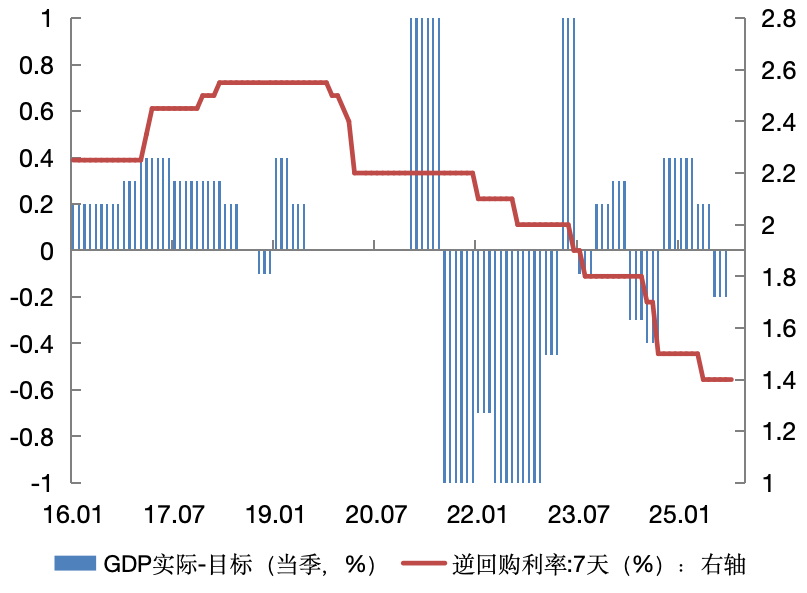
内容提要 文章分析了2018年以来央行降准降息的背景特征,认为经济增长(GDP增速达标情况)、金融稳定(股市表现)对降准降息节奏影响较大,且降准作为中 长期流动性投放工具存在一定的周期性,通胀和汇率等因素对我国降准降息的影响相对有限。 2018年以来,我国进入降准降息周期,大行(中小行)的法定存款准备金率从2018年高点17%(15%)下调到目前的9%(6%),7天期逆回购利率从2018年 高点2.55%降至目前的1.4%。2025年,央行坚持"适度宽松"的货币政策基调,美联储重启降息周期,资本市场则时刻关注我国货币政策走向。本文整理近年 来央行降准降息时货币政策主要目标(经济增速、通胀、国际收支、金融稳定等)所处的状态,分析货币政策目标触发降准降息有无规律可循,为判断货币 政策走向提供参考。 一、经济增速不高于目标值可能是降息的必要条件 2018年以来7天期逆回购利率共下调10次,合计下调1.15个百分点,平均每次下调的时间间隔为7.2个月,最长间隔超过21个月,最短则连续两个月降息。 图1 GDP增速缺口和降息 数据来源:同花顺 这10次降息里,8次降息当季GDP增速低于或等于当年目标值,但有两次例外。一 ...
GCC预测:到2027年经济增速将加快至4.3%
Shang Wu Bu Wang Zhan· 2025-11-17 16:12
Core Insights - The Gulf Cooperation Council (GCC) is projected to experience a real GDP growth of 1.9% in 2024, with a non-oil economy growth of 4.4% and a non-oil value added reaching $1.29 trillion [1] Economic Growth - The transportation and storage, agriculture and fisheries, and accommodation services sectors are expected to lead the growth of the non-oil economy in 2024 [1] - Construction, trade, and finance sectors are also anticipated to perform well [1] Future Projections - By the first quarter of 2025, the total GDP of the GCC is expected to reach $588.1 billion, with the non-oil sector's share rising to 73.2% [1] - GCC-Stat forecasts an economic growth rate of 4.3% by 2027, driven by tourism, logistics, manufacturing, and renewable energy projects, with the non-oil economy projected to grow by 5.2% [1]
信心受挫叠加旅游降温 泰国三季度经济增速跌至四年低点
Xin Hua Cai Jing· 2025-11-17 06:33
Core Insights - Thailand's economy experienced its slowest growth in four years during the third quarter, with a year-on-year GDP increase of only 1.2%, down from 2.8% in the previous quarter and below the expected 1.6% [1] - Seasonally adjusted, the economy contracted by 0.6% quarter-on-quarter, marking the first decline in nearly three years [1] - The NESDC attributes the economic slowdown to weakened tourism and manufacturing, alongside political uncertainty and border conflicts, particularly with Cambodia [1] Economic Performance - The third quarter GDP growth of 1.2% is significantly lower than the previous quarter's growth of 2.8% [1] - The contraction of 0.6% on a seasonally adjusted basis indicates a notable downturn in economic activity [1] Future Outlook - NESDC anticipates a recovery in the current quarter, driven by a rebound in consumer spending and tourism, which could help avoid a technical recession [1] - The chairman of NESDC highlighted that the primary issue in the third quarter was economic confidence, heavily influenced by political instability and external conflicts [1]
多空交织驱动不显,或将维持震荡运行
Hua Long Qi Huo· 2025-11-17 03:35
Report Industry Investment Rating - No information provided in the report. Core View of the Report - The natural rubber market is influenced by a mix of bullish and bearish factors with no clear driving force, and the market is expected to remain range - bound in the short term. Key factors to monitor include Sino - US trade relations, anti - dumping policies in Europe and the US, weather conditions in rubber - producing areas, raw material output, terminal demand changes, and the progress of zero - tariff policies [8][9][84]. Summary by Relevant Catalogs Price Analysis Futures Price - Last week, the price of the natural rubber main contract RU2601 ranged from 14,955 to 15,415 yuan/ton, showing a slightly bullish and upward trend. As of the close on November 14, 2025, it closed at 15,215 yuan/ton, up 220 points or 1.47% for the week [6][13]. Spot Price - As of November 14, 2025, the spot price of Yunnan state - owned whole latex (SCRWF) was 14,800 yuan/ton, up 250 yuan/ton from the previous week; the spot price of Thai RSS3 was 18,300 yuan/ton, down 100 yuan/ton; the spot price of Vietnamese SVR3L was 15,200 yuan/ton, up 150 yuan/ton. The Qingdao natural rubber arrival price was 2,070 US dollars/ton, up 40 US dollars/ton from the previous week [17][20]. Basis and Spread - Using the spot price of Shanghai's Yunnan state - owned whole latex (SCRWF) as the spot reference and the futures price of the natural rubber main contract as the futures reference, the basis narrowed slightly last week. As of November 14, 2025, the basis was - 415 yuan/ton, 30 yuan/ton less than the previous week. The domestic and foreign prices of natural rubber both rose slightly last week [24][27]. Important Market Information - The US government ended its longest - ever "shutdown", which boosted market sentiment. The US economy showed signs of weakness, and there were different views within the Federal Reserve on interest rate cuts. China's October economic data showed a slowdown in growth in multiple indicators, while CPI and PPI showed certain positive changes. The automotive market had mixed performance, with new energy vehicle sales growing and passenger car sales declining in October [28][30][31]. Supply - side Situation - As of September 30, 2025, the monthly output of synthetic rubber in China was 774,000 tons, a year - on - year increase of 13.5%, and the cumulative output was 6.616 million tons, a year - on - year increase of 11.2%. The import volume of new pneumatic rubber tires in China was 10,600 tons, a month - on - month increase of 13.98%. In September 2025, the total output of major natural rubber - producing countries increased by 48,300 tons or 4.89% month - on - month, with varying production trends in different countries [39][44][48]. Demand - side Situation - As of November 13, 2025, the operating rate of semi - steel tire enterprises was 73.68%, up 0.01% from the previous week, and that of all - steel tire enterprises was 65.46%, down 0.96% from the previous week. As of September 30, 2025, China's monthly automobile production and sales increased year - on - year and month - on - month, and the monthly sales of heavy - duty trucks increased significantly year - on - year and month - on - month. The monthly output of Chinese tire casings increased slightly year - on - year, and the export volume of new pneumatic rubber tires decreased month - on - month [54][58][61]. Inventory - side Situation - As of November 14, 2025, the natural rubber futures inventory on the Shanghai Futures Exchange was 108,470 tons, down 10,500 tons from the previous week. As of November 9, 2025, China's natural rubber social inventory was 1.0563 million tons, a month - on - month increase of 0.03%, and the total inventory in Qingdao was 449,500 tons, a month - on - month increase of 0.40% [81]. Fundamental Analysis - On the supply side, the global natural rubber production areas are in the peak season, with cost support. In October 2025, China's imports of natural and synthetic rubber increased slightly year - on - year, and the cumulative imports from January to October increased significantly. On the demand side, the operating rate of tire enterprises changed little last week, with continued inventory accumulation. Terminal passenger car sales declined in October, and tire exports showed a mixed trend. With the cooling weather, demand is expected to weaken. In terms of inventory, the futures exchange inventory decreased last week, while the social and Qingdao total inventories increased slightly [82][83]. Viewpoint and Operation Strategy - This week's view is that the natural rubber futures main contract is expected to remain range - bound in the short term. The operation strategy is to maintain a range - trading approach for single - side trading, consider going long on RU2601 and short on RU2609 for arbitrage, and stay on the sidelines for options trading [86][88].
A500ETF基金(512050)成交额同类第一,单日吸金超2亿,机构预计2025年将实现5%经济增速
Xin Lang Cai Jing· 2025-11-11 03:02
Group 1 - The A500 index components showed mixed performance, with Huashang City A leading the gains at 10.15%, followed by Samsung Medical at 10.02%, and Fangda Carbon at 9.98% [1] - The A500 ETF fund's latest price is 1.18 yuan, with a turnover rate of 6.56% and a trading volume of 1.289 billion yuan [1] - The A500 ETF fund has seen a net inflow of 202 million yuan recently, indicating strong investor interest [1] Group 2 - According to Zhongyin Securities, the market is expected to maintain a震荡上行趋势, with a focus on preparing for year-end performance [2] - The A500 index consists of 500 securities selected from various industries, reflecting the overall performance of the most representative listed companies [2] - As of October 31, 2025, the top ten weighted stocks in the A500 index accounted for 19.36% of the total index, including major companies like Ningde Times and Kweichow Moutai [2]
紧扣合理增速区间 多措并举释放发展潜能
Zheng Quan Shi Bao· 2025-10-29 18:39
Group 1 - The "15th Five-Year Plan" outlines seven major development goals for China's economic and social development, including high-quality development and technological self-reliance [2][3] - The average annual GDP growth rate is projected to be around 4.8% in real terms and at least 5% in nominal terms during the "15th Five-Year Plan" period [1][4] - The plan emphasizes the need to maintain economic growth within a reasonable range to ensure progress towards modernization and improve living standards [2][5] Group 2 - The plan aims to achieve significant improvements in high-quality development, with a focus on enhancing the level of technological self-reliance and deepening reforms [2][6] - The potential GDP growth rate is estimated to be between 4.5% and 5.3%, with optimistic scenarios suggesting it could rise to between 5.1% and 5.8% [3][4] - The plan highlights the importance of fostering new productive forces and transitioning to an innovation-driven growth model, particularly in digital and green industries [5][6] Group 3 - The plan anticipates the creation of approximately 10 trillion yuan in new market space over the next five years, driven by advancements in various sectors such as quantum technology and advanced manufacturing [6] - The emphasis on consumer spending is expected to lead to quantifiable targets for consumption promotion [6] - The plan aims to leverage China's institutional advantages, large market size, complete industrial system, and rich talent resources to achieve high-quality development [6]