
通胀粘性

Search documents
黄金早参丨美国初请失业金人数大增,金价突破4300美元,创近一个月新高
Mei Ri Jing Ji Xin Wen· 2025-12-12 01:25
中金研究分析称,展望未来,鉴于经济与就业数据仍面临下行压力,预计美联储或将在2026年继续降 息;但考虑到通胀粘性犹存,降息节奏趋于放缓。2026年1月可能按兵不动,下一次降息或在2026年3 月。 消息面上,根据美劳工部周四公布的数据,在截至12月6日的一周内,初请失业金人数增加了4.4万人, 达到23.6万人,高于市场预期的22万人,这是自2020年3月以来的最大增幅。而在此前一周,该数字曾 创下三年多来的最低水平。 12月11日,美联储降息落地,金价冲高回落,受鲍威尔鸽派言论及就业市场低迷双重催化,纽约金价尾 盘再度拉升,重新站上4300美元关口,创近一个月新高。截至收盘,COMEX黄金期货涨2.00%报 4309.30美元/盎司;截至亚市收盘,黄金ETF华夏(518850)涨0.17%,黄金股ETF(159562)涨跌持 平。 ...
美国初请失业金人数大增,金价突破4300美元,创近一个月新高
Mei Ri Jing Ji Xin Wen· 2025-12-12 01:05
消息面上,根据美劳工部周四公布的数据,在截至12月6日的一周内,初请失业金人数增加了4.4万人, 达到23.6万人,高于市场预期的22万人,这是自2020年3月以来的最大增幅。而在此前一周,该数字曾 创下三年多来的最低水平。 12月11日,美联储降息落地,金价冲高回落,受鲍威尔鸽派言论及就业市场低迷双重催化,纽约金价尾 盘再度拉升,重新站上4300美元关口,创近一个月新高。截至收盘,COMEX黄金期货涨2.00%报 4309.30美元/盎司;截至亚市收盘,黄金ETF华夏(518850)涨0.17%,黄金股ETF(159562)涨跌持平。 中金研究分析称,展望未来,鉴于经济与就业数据仍面临下行压力,预计美联储或将在2026年继续降 息;但考虑到通胀粘性犹存,降息节奏趋于放缓。2026年1月可能按兵不动,下一次降息或在2026年3 月。 ...
GTC泽汇资本:贵金属强势上行与政策不确定性共振
Xin Lang Cai Jing· 2025-12-10 11:45
Core Viewpoint - The recent strong structure in the precious metals market is being reinforced, with gold and silver experiencing technical buying momentum, indicating a robust upward trend driven by increased capital, rising volatility, and safe-haven demand [1][2]. Market Trends - Gold February contract price has risen to approximately $4244.40, while silver March contract has reached a historic high of $61055 [1][2]. - The short-term and medium-term trend structures remain in a complete upward channel, with technical indicators strengthening and accumulating buying momentum [1][2]. FOMC Meeting Insights - The upcoming FOMC meeting is a focal point for the market, with about 90% of participants expecting a 0.25 percentage point rate cut; however, the key to market volatility lies in the wording of the policy statement and the tone of the subsequent press conference [3][4]. - The unexpected delay in producer price data has heightened uncertainty regarding inflation, prompting the market to reassess policy paths and increasing hawkish expectations [3][4]. External Market Conditions - The U.S. dollar index has slightly strengthened, while crude oil remains stable around $58.25, and the 10-year Treasury yield is stable at approximately 4.15%, indicating a macroeconomic environment in a rebalancing phase [4]. Trading Structure - The price discovery mechanism for precious metals relies on both spot and futures systems, with year-end liquidity tightening making contract switching and position structure changes more pronounced [2][4]. - The December gold futures remain the most liquid contract, reflecting accelerated position management by institutions ahead of the delivery period [4]. Technical Analysis - Gold's bullish target is focused on breaking the historical high of $4433, with key support at around $4100; short-term support and resistance are at approximately $4197.80 and $4285, respectively [2][4]. - Silver shows a more pronounced bullish advantage, with a clear daily flag structure and a target of $6250, while support is found in the range of $5900 to $5685, indicating a stronger trend and greater volatility [2][4]. Overall Market Outlook - The rise in precious metals is attributed to a resonance of fundamental expectations, macroeconomic uncertainties, and technical structures [2][4]. - As the FOMC meeting approaches, market volatility may increase, and the strong structure of precious metals is expected to continue in the short term [2][4].


12月10日金市晚评:美联储今夜恐现“鹰派降息” 黄金谨防凌晨暴击!
Jin Tou Wang· 2025-12-10 09:41
Core Viewpoint - The market anticipates a 90% probability of a 0.25% interest rate cut by the Federal Reserve, but concerns about persistent inflation may lead to a more hawkish tone in the FOMC statement and Chairman Powell's press conference [1][3] Economic Data and Rate Cut Expectations - The October JOLTs job openings data showed 7.67 million positions, exceeding expectations, indicating resilience in the labor market [3] - The probability of a 25 basis point rate cut by the Federal Reserve is currently at 87.4%, but there are risks of a "hawkish cut" where Powell may emphasize inflation risks, raising the bar for future easing [3][4] Geopolitical Risks and Gold Support - Ongoing geopolitical tensions, such as the Russia-Ukraine conflict and Middle East issues, continue to provide safe-haven support for gold [3] - Despite short-term fluctuations in risk sentiment, long-term uncertainties are expected to support gold prices [3] Central Bank Gold Demand - Global central bank demand for gold remains strong, with China's central bank increasing its gold reserves for 16 consecutive months [3] - The World Gold Council projects that global central bank gold purchases will remain high through 2026, providing structural support for gold prices [3] Dollar and Gold Price Dynamics - Weak U.S. economic data and rising rate cut expectations are putting pressure on the dollar, which in turn supports gold prices [3] - However, the risk of profit-taking due to rapid short-term price increases in gold should be monitored [3] Federal Reserve Communication and Market Impact - The upcoming policy statement may emphasize "uncertainty" regarding future paths and reiterate "data dependence," which could signal a more cautious approach to rate cuts [4] - Any new language regarding the "magnitude and timing of adjustments" could indicate a more hawkish stance, potentially supporting the dollar and suppressing gold prices [4] Internal Disagreement within the Fed - There may be a "dual divergence" within the Fed, with some members favoring no change and others advocating for larger cuts, reflecting high uncertainty in policy paths [4] - Powell's communication style post-rate cut will be crucial, as any emphasis on inflation risks could reverse current dovish sentiment, leading to a rebound in the dollar and higher bond yields, which would pressure gold and silver prices [4] Technical Analysis of Gold - Current gold prices are around $4199.29 per ounce, with resistance at $4220 and support near $4150 [2][6] - Short-term trading dynamics indicate a potential for upward movement if key resistance levels are broken, but caution is advised due to the risk of a pullback [6]
哈塞特最有希望接任美联储主席,却最不得人心
Jin Shi Shu Ju· 2025-12-10 06:11
Group 1 - The market widely expects Kevin Hassett to be nominated as the next Federal Reserve Chair, but only 11% believe he should be appointed [1] - Christopher Waller is the preferred candidate with 47% support, followed by Kevin Warsh at 23%, yet only 5% think Trump will nominate either [1] - Concerns about Hassett focus on his commitment to the Fed's dual mandate and independence, with 76% believing the next chair will be more dovish than Jerome Powell [3] Group 2 - There is a significant divide on whether the Fed should cut rates, with 87% expecting a rate cut but only 45% believing it should happen [3] - Economic growth expectations are rising, with GDP growth projected at 2% this year and slightly higher next year, while inflation is expected to remain above the 2% target [5] - "Persistent high inflation" has become the top economic risk, with concerns about the potential stimulus effects of record tax refunds in 2026 [6] Group 3 - Despite concerns about a potential AI bubble, respondents predict a 6% increase in the S&P 500 next year and another 6% in 2027, with 90% believing AI stocks are overvalued [8] - Systemic risk in the U.S. credit market is perceived to have slightly increased, rising from 53% to 60% [8]

全球金融市场价格波动加大,美联储12月降息一旦落地,会否反而让市场在2026年产生流动性紧缩?
Sou Hu Cai Jing· 2025-12-09 06:14
Core Viewpoint - The current volatility in global stock, bond, currency, and precious metal markets indicates a highly concentrated expectation and liquidity, with a potential end to the era of ultra-loose monetary policy, as highlighted by the BIS warning [1][3]. Market Trends - As of December 8, the 10-year U.S. Treasury yield rose by 2.92 basis points to 4.164%, nearing the 4.2% mark, with long-term yields in Japan and Germany also reaching new highs [1]. - The three major U.S. stock indices fell for the third consecutive trading day, with the S&P 500 index down 2.1% from its November peak [1]. - The U.S. dollar index increased by 0.12% to 99.10, while most non-U.S. currencies faced downward pressure [1]. - International precious metal futures generally declined, with COMEX gold futures down 0.54% to $4219.90 per ounce and COMEX silver futures down 0.94% to $58.50 per ounce [1]. Federal Reserve Expectations - Market focus is on the Federal Reserve's December meeting, with an 84.8% probability of a 25 basis point rate cut, while the probability of maintaining the current rate is only 15.2% [3]. - The anticipated rate cut may not signify the expected easing but could represent a tightening signal due to distorted market price signals [3]. Employment Data Impact - The U.S. ADP employment data for November showed a decrease of 32,000 jobs, the largest drop since March 2023, significantly below the expected increase of 40,000 jobs, with small businesses being the hardest hit [4][6]. Analyst Revisions - Following the weak employment data, major Wall Street firms like JPMorgan and Morgan Stanley have revised their forecasts, with Standard Chartered explicitly changing its prediction from "maintaining rates" to "a 25 basis point cut" [6]. - Nomura Securities has also adjusted its reports to support the rate cut, acknowledging previous misinterpretations of Fed Chair Powell's hawkish signals [6]. Market Pricing and Future Projections - The market has already priced in the rate cut, indicating that the anticipated easing may lack additional positive impact, leading to a focus on the 2026 policy path [7]. - The internal division within the Federal Reserve regarding hawkish and dovish stances is becoming more pronounced, with potential voting outcomes indicating a split [7]. - Analysts predict a rare voting pattern of "4 hawkish dissenting votes + 1 dovish dissenting vote" during the upcoming rate decision [7]. Economic Outlook - The National Association for Business Economics (NABE) survey indicates an upward revision of the median growth forecast for the U.S. economy in 2026 to 2%, with inflation expected to decrease to 2.6% and unemployment rising to 4.5% [10]. - The anticipated tightening of monetary policy is reflected in the bond market, with the 10-year Treasury yield rising by 26 basis points since late November [13]. - The stock market, particularly the S&P 500, has shown declines despite rising rate cut expectations, indicating concerns over liquidity tightening [13]. Liquidity Conditions - Recent trends in the U.S. repo market show tightening liquidity, with the Secured Overnight Financing Rate (SOFR) reaching a high of 4.5% [15]. - The market's perception of liquidity measures as "countering liquidity shortages" rather than "active easing" reinforces the notion that a lack of incremental easing equates to tightening [15].
分析师:资产配置风向可能转变 黄金上涨势头面临挑战
Ge Long Hui A P P· 2025-12-03 06:04
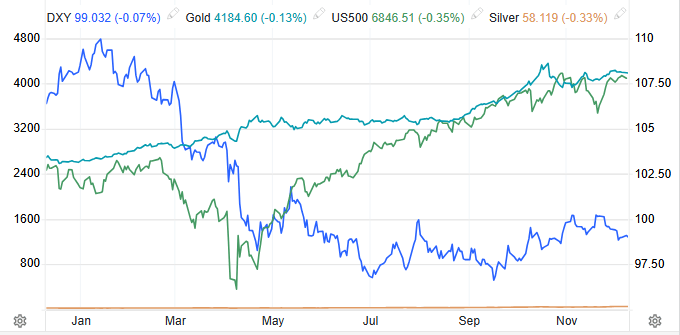
格隆汇12月3日|William Blair的分析师Alexandra Symeonidi表示,黄金的上涨势头可能会受到挑战,如 果明年市场情绪改善,资产配置重新流向风险资产。她表示,虽然黄金期货的持仓量高于长期平均水 平,但远低于今年的峰值,这可能预示着在年初强劲上涨之后,黄金市场乐观情绪有所减弱。这位分析 师在一份报告中指出,在降息周期中通胀仍具粘性的情况下,投资者对黄金的配置可能会增加。 Symeonidi还认为,"央行对黄金的需求更具结构性,因为美国财政赤字一直在增加,而且新兴市场央行 配置黄金占外汇储备的比例偏低。" ...
深观察 | 会议纪要凸显美联储分歧“常态化” 12月降息难测
Sou Hu Cai Jing· 2025-11-20 00:42
Core Viewpoint - The Federal Reserve's internal divisions regarding inflation and unemployment pose significant uncertainty for the December interest rate decision, as highlighted in the minutes from the October FOMC meeting [1][3]. Group 1: Internal Divisions - There is a notable split among Federal Reserve officials on the assessment of inflation threats, with some believing current inflation is near policy targets, while others emphasize persistent inflation above the 2% target [1][3]. - The October meeting saw a rare occurrence of dual dissent, with one member advocating for a 50 basis point cut and another insisting on maintaining current rates, marking the first such division since 2019 [1][3]. Group 2: Economic Indicators and Data Gaps - The government shutdown has resulted in significant data gaps, complicating the Fed's decision-making process for the December meeting, as key employment reports are delayed [5]. - The Labor Department announced that the October employment report would not be released, leading traders to abandon expectations for a December rate cut [5]. Group 3: Market Impact and Future Outlook - The widening divisions within the Fed have led to a sharp decline in market expectations for a December rate cut, with investors now leaning towards rates remaining unchanged [6]. - This situation could hinder consumer spending during the holiday season and limit businesses' access to lower borrowing costs for new investments [6]. - President Trump has expressed dissatisfaction with the Fed's direction, indicating potential political tensions regarding the Fed's independence [6].
智昇:降息or不降?美联储内部吵翻了!分歧程度为32年之最
Sou Hu Cai Jing· 2025-11-19 08:54
Core Viewpoint - The Federal Reserve's anticipated interest rate cut is now uncertain due to diverging views among officials regarding the health of the economy, persistent inflation, and weak job markets [1][3] Group 1: Diverging Opinions Among Federal Reserve Officials - Some policymakers have heightened concerns about persistent inflation, linking it to the recent focus on "affordability" during the elections [3] - Another faction emphasizes the risks of a weak job market, suggesting that low hiring and layoffs could worsen the current employment situation [3] - The internal division within the Federal Reserve reflects a complex economic outlook influenced by tariffs, AI advancements, immigration policy changes, and tax reforms [3] Group 2: Risks of Delayed Rate Cuts - If the Federal Reserve reduces the scale of interest rate cuts, high costs for housing and auto loans will persist, exacerbating public dissatisfaction with living costs [3][4] - Polls indicate that high mortgage and auto loan rates are contributing to widespread discontent among the populace [3] Group 3: Anticipated Opposition Votes in Upcoming Meetings - Analysts predict a significant number of dissenting votes in the upcoming Federal Open Market Committee (FOMC) meeting, regardless of whether a rate cut is decided [4] - If a rate cut occurs, dissenting votes could reach four to five, while maintaining rates could see three dissenting votes, marking a rare occurrence in the Fed's history [4] Group 4: Impact of Government Shutdown on Economic Data - The government shutdown has interrupted the release of economic data, complicating the Federal Reserve's data-dependent decision-making approach [6] - The latest employment data is stuck at August levels, and inflation data is only updated to September, creating challenges for the Fed [6] Group 5: Market Expectations and Stock Market Reactions - The probability of a rate cut in December has dropped to around 50%, down from nearly 94% a month ago, contributing to recent stock market corrections [7] - The current rate cut probability has slightly rebounded to 48.9% [7] Group 6: Diverging Views on Future Rate Cuts - After the Fed's second rate cut in October, Chairman Powell dampened expectations for further cuts, stating that December's cut is "not a foregone conclusion" [8] - Various regional Fed officials have expressed concerns about inflation, emphasizing the need to maintain rates around 3.9% to help bring inflation back to target [8] - Conversely, some officials argue that the weak job market poses a more significant risk and advocate for a December rate cut [8] Group 7: Key Economic Indicators and Political Pressures - The upcoming labor market data will be crucial in shaping the Fed's consensus on rate cuts [9] - Political pressures, including discussions about potential replacements for Chairman Powell, may influence the Fed's policy direction [9] Group 8: Institutional Perspectives - Citigroup predicts that weak labor market data will lead the Fed to initiate a rate cut in December, which is a key variable affecting the current stock market [10] - The end of the government shutdown is expected to improve market liquidity, creating a favorable environment for U.S. equities [10]
美联储传声筒:美联储在 12 月降息问题上的分歧越来越大
Sou Hu Cai Jing· 2025-11-12 02:54
Core Viewpoint - There is a significant division within the Federal Reserve regarding whether to continue interest rate cuts in December, with concerns about persistent inflation and tariff effects versus worries about weak employment and slowing demand [1] Group 1: Federal Reserve's Internal Disagreement - Some officials advocate for pausing interest rate cuts due to concerns over sticky inflation and tariff impacts [1] - Dovish members emphasize the importance of addressing weak employment and declining demand [1] - The government shutdown has interrupted key economic data, exacerbating the division among decision-makers [1] Group 2: Current Interest Rate Context - The current interest rate is in the range of 3.75% to 4% [1] - Market expectations indicate a slightly higher probability of a rate cut in December, despite the internal Fed conflict [1] - The situation reflects a rare "hawk-dove standoff" within the Federal Reserve in recent years [1]