量化选股

Search documents
打卡一家今年收益表现出色、较低回撤的黑马私募!主攻量化CTA与选股
私募排排网· 2025-12-10 03:34
Core Insights - The article highlights the performance and strategies of Zhixin Rongke, a quantitative private equity firm, which has shown impressive returns in the market, particularly in the CTA (Commodity Trading Advisor) category [4][13][24]. Company Overview - Zhixin Rongke Investment Management (Beijing) Co., Ltd. was established in 2013 by PhDs from Tsinghua University and the Chinese University of Hong Kong, focusing on quantitative investment with over 10 years of experience in CTA strategies and 5 years in quantitative stock strategies [13][14]. - The firm has developed a dual-driven strategy system centered on quantitative CTA and quantitative stock selection, aiming for high Sharpe ratios and low drawdowns [13][24]. Performance Metrics - As of October 2025, Zhixin Rongke's products have achieved significant average returns, ranking second among quantitative private equity firms and sixth among those with assets over 5 billion [4][10]. - The "Zhixin Rongke CTA No. 7 A Class" product ranked third in terms of returns and drawdown control among CTA products, showcasing its strong performance [4][8]. Investment Strategies - The firm employs a dual-engine strategy that combines CTA and quantitative stock selection, providing both trend-following returns and tail risk hedging [41][45]. - The strategies have demonstrated crisis alpha, achieving positive returns during market downturns, such as a +***% return when the CSI 300 index fell by 21.6% in 2022 [41][42]. Team and Development - The core team has over 15 years of stable collaboration, previously working at the renowned hedge fund WorldQuant, which enhances their research and investment capabilities [17][21]. - The firm has undergone several strategy iterations since its inception, continuously adapting to market changes and improving performance metrics [46]. Product Lines - Zhixin Rongke offers various product lines, including CTA-enhanced strategies and quantitative stock selection strategies, catering to different investor risk preferences [24][30]. - The "CTA No. 7" product is positioned as a flagship quantitative CTA product, while the "Multi-Strategy No. 8" integrates both CTA and quantitative stock selection for enhanced absolute returns [28][30].


从逆风开局到领涨市场,兴银富利兴易智享量化实现40%净值跃升
2 1 Shi Ji Jing Ji Bao Dao· 2025-12-10 02:01
Core Insights - The article highlights the impressive performance of the "Xingyin Wealth Fuli Xingyi Smart Quantitative Index Growth" product, which achieved a net value increase of 40.42% since its inception, significantly outperforming its benchmark [1][4]. Group 1: Product Performance - As of November 24, 2025, the average net value growth of mixed public wealth management products with a 1-3 month investment period was 4.34%, with the top products coming from four wealth management companies, including Xingyin Wealth [1]. - The "Fuli Xingyi Smart Quantitative Index Growth 3-Month Minimum Holding Period No. 1 Mixed Wealth Management Product A" achieved a net value growth rate of 41.97% over the past two years, ranking first in performance [1][2]. - The product's annualized return since inception reached 19.65%, showcasing its strong performance in a challenging market environment [4]. Group 2: Investment Strategy - The product employs a combination of quantitative stock selection and derivatives, aiming to exceed the returns of a specific index through diversified holdings and flexible trading [2]. - The investment strategy is based on a performance benchmark that combines the returns of the CSI 1000 Index (45%), CSI 500 Index (45%), and the People's Bank of China 7-day notice deposit rate (10%) [2]. - The management team utilizes a multi-factor model to identify stocks with high growth potential and reasonable valuations, optimizing the investment portfolio while controlling style and sector deviations [4]. Group 3: Market Context - The product was launched during a period of market volatility, with the A-share market experiencing a recovery phase, particularly in the technology sector, which later led to a structural bull market [4]. - Following a shift in U.S. Federal Reserve monetary policy and unexpected domestic policy support, market enthusiasm surged, contributing to the product's strong performance [4]. - The management anticipates that the market will maintain high trading volumes and volatility, which will favor the quantitative models adept at capturing short-term mispricing opportunities [4].
市场震荡反弹,指增组合超额收益修复
CAITONG SECURITIES· 2025-12-06 12:27
Core Insights - The report emphasizes the construction of an AI-based low-frequency index enhancement strategy using deep learning frameworks to build alpha and risk models [3][14]. - The performance of various index enhancement funds has been highlighted, showing significant excess returns compared to their respective indices [10][11]. Market Index Performance - As of December 5, 2025, the Shanghai Composite Index rose by 0.37%, the Shenzhen Component Index increased by 1.26%, and the CSI 300 Index gained 1.28% [7][8]. - The year-to-date performance shows the CSI 300 Index up by 16.5%, while the CSI 300 index enhancement portfolio increased by 26.2%, resulting in an excess return of 9.7% [18]. Index Enhancement Fund Performance - For the CSI 300 index enhancement fund, the minimum excess return was -1.28%, the median was 0.11%, and the maximum was 0.95% for the week ending December 5, 2025 [10][11]. - Year-to-date, the CSI 500 index enhancement fund showed a minimum excess return of -10.18%, a median of 3.15%, and a maximum of 13.55% [11]. Tracking Portfolio Performance - The report outlines the construction of enhancement portfolios for the CSI 300, CSI 500, and CSI 1000 indices, utilizing deep learning to optimize alpha and risk signals [14][15]. - The CSI 500 index enhancement portfolio has achieved a year-to-date return of 30.3%, outperforming the CSI 500 index, which rose by 24.0%, resulting in an excess return of 6.4% [23][24]. Specific Index Enhancement Performance - The CSI A500 index enhancement portfolio has increased by 28.4% year-to-date, compared to a 19.6% rise in the CSI A500 index, yielding an excess return of 8.7% [29][32]. - The CSI 1000 index enhancement portfolio has shown a year-to-date increase of 38.0%, significantly outperforming the CSI 1000 index, which rose by 23.2%, leading to an excess return of 14.8% [35][36].

【金工周报】(20251124-20251128):中长期虽看多但不改短期震荡-20251130
Huachuang Securities· 2025-11-30 13:44
- The report discusses multiple quantitative models for A-share and Hong Kong stock markets, including short-term, medium-term, and long-term models. These models are constructed based on price-volume, momentum, acceleration, and trend perspectives, among others. The report emphasizes the importance of combining signals from different models and periods to achieve a balanced strategy[9][12][13] - For A-shares, the short-term models include the "Volume Model" (neutral for all broad-based indices), "Feature Institutional Model" (bearish), "Feature Volume Model" (bearish), and "Smart Algorithm Models" (neutral for CSI 300, bullish for CSI 500)[12][71] - Medium-term A-share models include the "Limit-Up and Limit-Down Model" (neutral), "Up-Down Return Difference Model" (bullish for all broad-based indices), and "Calendar Effect Model" (neutral)[13][72] - The long-term A-share model, "Long-Term Momentum Model," is bullish[14][73] - Comprehensive A-share models, such as "A-Share Comprehensive Weapon V3 Model" and "A-Share Comprehensive Guozheng 2000 Model," are bearish[15][74] - For Hong Kong stocks, the medium-term models include the "Turnover to Volatility Model" (bearish) and "Hang Seng Index Up-Down Return Difference Model" (neutral)[16][74] - The report highlights that the quantitative models are designed to provide market timing signals and are based on historical data, emphasizing simplicity and universality in their construction[9][12] - The backtesting results for the "Double Bottom Pattern" and "Cup and Handle Pattern" show that the double bottom pattern outperformed the Shanghai Composite Index by 1.93% this week, while the cup and handle pattern outperformed by 2.5%[44][50] - The cumulative performance of the double bottom pattern since December 31, 2020, is 13.99%, outperforming the Shanghai Composite Index by 2.02%. However, the cup and handle pattern underperformed the Shanghai Composite Index by -1.14% over the same period[44][50]
这些基金可以抄底了吗?
Sou Hu Cai Jing· 2025-11-25 22:51
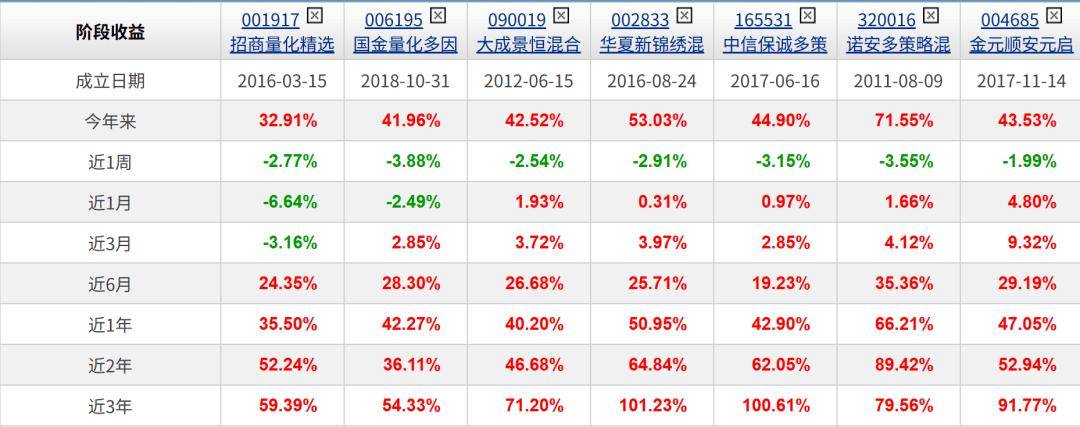
Core Insights - The recent market sentiment has improved, particularly in the artificial intelligence and new energy sectors, which have shown significant gains after previous adjustments [1] - Active quantitative funds have provided opportunities for entry due to recent adjustments, with some funds showing returns exceeding 40% this year [1] - The performance of various active quantitative funds varies, with some experiencing significant drawdowns while others remain relatively stable [1][4][6][8] Fund Performance Summary - **招商量化精选股票A**: Experienced a drawdown of -3.46% on November 21, followed by gains of 1.26% and 1.31% on subsequent days [11] - **国金量化多因子股票A**: Noted a significant drawdown of -4.85% on November 21, with minor recoveries of 0.31% and 2.14% [11] - **大成景恒混合A**: Showed a drawdown of -2.71% on November 21, with recoveries of 0.80% and 0.84% [11] - **华夏新锦绣混合A**: Experienced a drawdown of -3.23% on November 21, followed by recoveries of 0.94% and 1.11% [11] Fund Characteristics - Active quantitative funds typically have diversified holdings across many stocks, with individual stock allocations not exceeding 2% [1] - These funds utilize quantitative models combined with subjective strategies for stock selection, aiming for high returns with low volatility [1] - Some funds, like 神基, have not opened for new purchases despite high returns, indicating limited capacity [1]
指数信号整体中性偏空,短期震荡偏空:【金工周报】(20251117-20251121)-20251123
Huachuang Securities· 2025-11-23 07:44
- The report includes multiple quantitative models for market timing, categorized into short-term, mid-term, and long-term models, such as the "Volume Model," "Feature Volume Model," "Smart Algorithm Model," "Up-Down Return Difference Model," "Calendar Effect Model," and "Long-Term Momentum Model" [1][11][12][13][63][64] - The "Volume Model" is constructed based on trading volume data to predict market trends, while the "Feature Volume Model" incorporates specific volume characteristics to enhance prediction accuracy [11][63] - The "Smart Algorithm Model" uses machine learning techniques to analyze historical data and generate market timing signals [11][63] - The "Up-Down Return Difference Model" calculates the difference between upward and downward returns to assess market sentiment [12][63] - The "Calendar Effect Model" leverages historical seasonal patterns to predict market movements [12][63] - The "Long-Term Momentum Model" focuses on long-term price trends to identify potential upward movements [13][64] - The report evaluates the models as effective tools for market timing, emphasizing their simplicity and universality, aligning with the principle of "大道至简" (great simplicity) [8][63] - The models are tested across various indices, including the Shanghai Composite Index, CSI 300, and CSI 500, with signals ranging from neutral to bearish for short-term models and bullish for long-term models [11][63][64] - The "Volume Model" shows neutral signals across all broad-based indices [11][63] - The "Feature Volume Model" indicates bearish signals for the CSI 500 and All-A indices [11][63] - The "Smart Algorithm Model" provides neutral signals for the CSI 300 and bearish signals for the CSI 500 [11][63] - The "Up-Down Return Difference Model" transitions from bullish to neutral for the CSI 2000 and All-A indices [12][63] - The "Long-Term Momentum Model" maintains bullish signals for long-term market trends [13][64]
择时模型短期偏中性,后市或中性震荡:【金工周报】(20251110-20251114)-20251116
Huachuang Securities· 2025-11-16 13:46
- The report includes multiple quantitative models for market timing, categorized into short-term, medium-term, and long-term models. Short-term models include the "Volume Model" (neutral for all broad-based indices), "Feature Institutional Model" (bullish), "Feature Volume Model" (bearish), and "Smart Algorithm Models" (bearish for CSI 300 and CSI 500 indices) [1][11][62][63]. Medium-term models include the "Limit-Up and Limit-Down Model" (neutral), "Up-Down Return Difference Model" (bullish), and "Calendar Effect Model" (neutral) [12][64]. Long-term models include the "Long-Term Momentum Model" (bullish) [13][65]. Comprehensive models such as "A-Share Comprehensive Weapon V3 Model" and "A-Share Comprehensive CSI 2000 Model" are bearish [14][65]. - The "Volume Model" is constructed based on trading volume data, aiming to capture short-term market sentiment [1][11]. The "Feature Institutional Model" leverages institutional trading patterns observed in the market [1][11]. The "Feature Volume Model" focuses on specific volume characteristics to predict market trends [1][11]. The "Smart Algorithm Models" utilize machine learning algorithms to analyze historical data and predict market movements [1][11][62][63]. The "Limit-Up and Limit-Down Model" analyzes the frequency and impact of limit-up and limit-down events [12][64]. The "Up-Down Return Difference Model" calculates the difference between upward and downward returns to assess market direction [12][64]. The "Calendar Effect Model" incorporates seasonal and calendar-based effects on market performance [12][64]. The "Long-Term Momentum Model" evaluates long-term price trends to predict future movements [13][65]. Comprehensive models combine signals from multiple individual models to provide an overall market outlook [14][65]. - Evaluation of these models indicates that short-term models show mixed signals, with some bullish and others bearish, reflecting market uncertainty [1][11][62][63]. Medium-term models are generally neutral to bullish, suggesting moderate optimism [12][64]. Long-term models are bullish, indicating strong confidence in sustained upward trends [13][65]. Comprehensive models are bearish, signaling caution in the overall market outlook [14][65]. - Backtesting results for the models are not explicitly detailed in the report, but the report mentions the performance of specific indices and their alignment with model predictions. For example, the CSI 300 index showed bearish signals from the "Smart Algorithm Model," aligning with its weekly decline of 1.08% [8][11][63]. Similarly, the "Up-Down Return Difference Model" showed bullish signals, consistent with positive medium-term outlooks [12][64]. - The report also includes quantitative factor-based strategies such as "Double-Bottom Pattern" and "Cup-and-Handle Pattern." The "Double-Bottom Pattern" achieved a weekly return of 4.09%, outperforming the Shanghai Composite Index by 4.61% [40][47]. The "Cup-and-Handle Pattern" achieved a weekly return of 0.6%, outperforming the Shanghai Composite Index by 1.12% [40][41]. These factors are constructed based on technical chart patterns and are evaluated for their relative performance against benchmark indices [40][41][47].
汇成股份股价连续4天下跌累计跌幅8.42%,申万菱信基金旗下1只基金持2.19万股,浮亏损失3.18万元
Xin Lang Cai Jing· 2025-11-04 07:29
Group 1 - The core point of the news is that Huicheng Co., Ltd. has experienced a continuous decline in stock price, dropping 1.38% on November 4, with a total market value of 13.53 billion yuan and a cumulative decline of 8.42% over four days [1] - Huicheng Co., Ltd. is located in Hefei, Anhui Province, and was established on December 18, 2015. It was listed on August 18, 2022. The company specializes in the manufacturing of gold bumping, wafer testing, and various packaging services for display driver chips [1] - The main business revenue composition of Huicheng Co., Ltd. is 90.25% from display driver chip testing and packaging, while other services account for 9.75% [1] Group 2 - From the perspective of fund holdings, one fund under Shenwan Hongyuan has Huicheng Co., Ltd. as its second-largest holding, with 21,900 shares, accounting for 1.97% of the fund's net value [2] - The fund, Shenwan Hongyuan Intelligent Life Quantitative Selection Mixed Fund A, has experienced a floating loss of approximately 48,180 yuan today and a total floating loss of 31,800 yuan over the past four days [2] - The fund was established on March 17, 2023, with a current scale of 19.53 million yuan, and has achieved a return of 30.57% this year, ranking 2,983 out of 8,150 in its category [2]

形态学部分指数继续看多,后市或向上震荡:【金工周报】(20251027-20251031)-20251102
Huachuang Securities· 2025-11-02 09:14
- The report mentions multiple quantitative models for market timing, including short-term, mid-term, and long-term models. Short-term models include the "Volume Model" (neutral for all broad-based indices), "Feature Volume Model" (bearish), "Feature Institutional Model" (bearish), and "Smart Algorithm Model" (bearish for CSI 300, neutral for CSI 500)[1][13][66]. Mid-term models include the "Limit-Up-Limit-Down Model" and "Calendar Effect Model," both neutral[14][67]. The long-term model is the "Long-Term Momentum Model," which is bullish[15][68]. Comprehensive models like "A-Share Comprehensive Weapon V3 Model" and "A-Share Comprehensive CSI 2000 Model" are bearish[16][69]. - The "Volume Model" is constructed based on trading volume trends, while the "Feature Volume Model" and "Feature Institutional Model" focus on specific volume characteristics and institutional trading patterns, respectively. The "Smart Algorithm Model" utilizes machine learning techniques to predict market movements[1][13][66]. The "Limit-Up-Limit-Down Model" analyzes price limits, and the "Calendar Effect Model" incorporates seasonal patterns[14][67]. The "Long-Term Momentum Model" evaluates price trends over extended periods[15][68]. - The "Comprehensive Weapon V3 Model" and "Comprehensive CSI 2000 Model" combine signals from multiple models across different timeframes to provide a holistic market outlook[16][69]. - The report evaluates these models qualitatively, noting that short-term models are generally neutral to bearish, mid-term models are neutral, and long-term models are bullish. Comprehensive models are bearish for A-shares[1][13][66][16][69]. - Testing results for the models are summarized as follows: Short-term models show mixed signals, with bearish predictions for specific indices like CSI 300 and CSI 2000. Mid-term models remain neutral, while the long-term momentum model indicates a bullish outlook. Comprehensive models suggest a bearish trend for A-shares[1][13][66][16][69]. - For Hong Kong stocks, the "Turnover Inverse Volatility Model" is bearish, indicating potential downward movement for the Hang Seng Index[16][70]. - The report also highlights shape-based models like the "Double Bottom Pattern" and "Cup-and-Handle Pattern." The "Double Bottom Pattern" portfolio outperformed the Shanghai Composite Index by 2.57% this week, with cumulative returns of 34.32% since December 31, 2020[43][48]. The "Cup-and-Handle Pattern" portfolio outperformed the Shanghai Composite Index by 1.28% this week, with cumulative returns of 70.89% since December 31, 2020[43][44]. - The report evaluates these shape-based models positively, noting their consistent outperformance compared to the benchmark index over time[43][44][48]. - Testing results for shape-based models: "Double Bottom Pattern" portfolio weekly return of 3.0%, cumulative return of 34.32% since December 31, 2020[43][48]. "Cup-and-Handle Pattern" portfolio weekly return of 1.71%, cumulative return of 70.89% since December 31, 2020[43][44].
红利低波季调组合今年实现7.59%超额收益
Minsheng Securities· 2025-10-31 11:10
Quantitative Models and Construction - **Model Name**: Competitive Advantage Portfolio **Construction Idea**: Incorporates competitive environment and strategic factors into stock selection, focusing on industries with distinct competitive characteristics[10][11] **Construction Process**: 1. Classify industries into four types: "Barrier Shield", "Intense Competition", "Steady Progress", and "Seeking Breakthrough"[10] 2. Focus on "Barrier Shield" industries to identify "dominant leaders" and "cooperative win-win" companies[10] 3. Combine "dominant leaders + cooperative win-win" stocks with "efficient operators" from non-barrier industries to form the portfolio[11] **Evaluation**: Provides a unique value quantification perspective beyond traditional factor investing[10] - **Model Name**: Margin of Safety Portfolio **Construction Idea**: Focuses on internal value estimation and competitive advantage to ensure sustainable profitability[15] **Construction Process**: 1. Calculate intrinsic value using profitability metrics like ROIC and NOPAT[15] 2. Select top 50 stocks with the highest margin of safety from a competitive advantage pool[15] 3. Weight stocks by dividend yield to maximize portfolio safety margin[15][17] **Evaluation**: Emphasizes reliable intrinsic value estimation and sustainable competitive advantage[15] - **Model Name**: Dividend Low Volatility Adjusted Portfolio **Construction Idea**: Avoids "high dividend traps" by considering dividend sustainability and excluding extreme cases[21] **Construction Process**: 1. Predict dividend yield and exclude stocks with extreme price performance or abnormal debt ratios[21] 2. Optimize portfolio by focusing on stocks with stable dividend yields[21] **Evaluation**: Addresses the risks of chasing high dividend yields without considering long-term value[21] - **Model Name**: AEG Valuation Potential Portfolio **Construction Idea**: Utilizes abnormal earnings growth (AEG) to capture valuation potential[25] **Construction Process**: 1. Calculate AEG using the formula: $$\begin{array}{c}{{A E G=Y_{t}-N_{t}=(E_{t}+r*D P S_{t-1})-(1+r)*E_{t-1}}}\\ {{\frac{V_{0}}{E_{1}}=\frac{1}{r}+\frac{1}{r}*\frac{\left(\frac{A E G_{2}}{1+r}+\frac{A E G_{3}}{(1+r)^{2}}+\frac{A E G_{4}}{(1+r)^{3}}+\cdots\right)}}}\\ {{\frac{E_{1}}{E_{1}}}}\end{array}$$[25] 2. Select top 100 stocks based on AEG_EP factor, then narrow down to top 50 with high dividend reinvestment/P ratio[29] **Evaluation**: Captures undervalued growth potential in companies overlooked by the market[25][29] - **Model Name**: Cash Cow Portfolio **Construction Idea**: Evaluates companies' cash generation efficiency using CFOR analysis[32] **Construction Process**: 1. Use CFOR metrics to assess free cash flow stability and operational asset returns[32] 2. Combine high-quality stocks from non-financial sectors with ROE above the 40th percentile[33] 3. Select stocks with low volatility and valuation factors for final portfolio construction[33] **Evaluation**: Provides a comprehensive view of operational performance and financial stability[32] - **Model Name**: Distress Reversal Portfolio **Construction Idea**: Captures valuation-driven short-term fluctuations and recovery potential[39] **Construction Process**: 1. Use inventory cycles to identify distress reversal opportunities[39] 2. Combine factors like accelerated recovery and undervaluation to select top 50 stocks[39] **Evaluation**: Complements momentum strategies by focusing on valuation-driven returns during downturns[39] --- Model Backtesting Results - **Competitive Advantage Portfolio**: Annualized return 20.36%, Sharpe ratio 0.95, IR 0.12, max drawdown -19.32%, Calmar ratio 1.05[14] - **Margin of Safety Portfolio**: Annualized return 23.37%, Sharpe ratio 1.17, IR 0.13, max drawdown -16.89%, Calmar ratio 1.38[19] - **Dividend Low Volatility Adjusted Portfolio**: Annualized return 16.81%, Sharpe ratio 0.98, IR 0.16, max drawdown -21.61%, Calmar ratio 0.78[22] - **AEG Valuation Potential Portfolio**: Annualized return 24.88%, Sharpe ratio 1.13, IR 0.17, max drawdown -24.02%, Calmar ratio 1.04[31] - **Cash Cow Portfolio**: Annualized return 14.15%, Sharpe ratio 0.71, IR 0.10, max drawdown -19.80%, Calmar ratio 0.71[37] - **Distress Reversal Portfolio**: Annualized return 25.17%, Sharpe ratio 1.01, IR 0.15, max drawdown -33.73%, Calmar ratio 0.75[41]