高阶智驾

Search documents
智能汽车系列报告(七):首批L3级自动驾驶车型获准入
Shanghai Aijian Securities· 2025-12-23 12:15
Investment Rating - The report assigns an "Outperform" rating for the automotive industry, particularly focusing on the advancements in L3 autonomous driving technology [3]. Core Insights - The approval of the first batch of L3 autonomous driving vehicles in China marks a significant transition from testing to commercial application, with the responsibility for driving during system activation shifting to the vehicle manufacturers or system suppliers [3][4]. - The L3 level is expected to enhance the value chain within the automotive industry, as it requires advanced perception, computing power, and system integration, leading to increased value per vehicle in components such as cameras, LiDAR, and high-performance driving chips [3][10]. - The report highlights a shift in market focus from L2 penetration rates to the reliability of L3 technology, indicating a new phase characterized by engineering implementation and regulatory oversight [4][7]. Summary by Sections Event Overview - On December 15, the Ministry of Industry and Information Technology officially announced the approval of the first batch of L3 autonomous driving vehicles, specifically the Arcfox Alpha S5 and Changan Deep Blue SL03, for trial operations in designated areas of Beijing and Chongqing [4][10]. Policy Insights - The L3 regulations stipulate that the responsibility during system activation lies with the vehicle manufacturers or system suppliers, addressing the ambiguity present in L2 systems where the driver is the sole responsible party [15][22]. Technical Aspects - The report discusses the technological requirements for L3 autonomous driving, emphasizing the need for enhanced sensor configurations, data transmission capabilities, and computing power, which are critical for the successful deployment of L3 vehicles [23][24]. - The anticipated increase in the number of cameras and the integration of LiDAR technology are expected to significantly elevate the value of components in L3 vehicles, with projections indicating a doubling of the value of high-frequency connectors and chips [25][26]. Global Comparison - The report notes the differentiated progress in L3 development across countries, with Germany leading in legislation and responsibility clarity, while the U.S. focuses on L4 commercial applications, and Japan adopts a more conservative approach [31][34]. Investment Recommendations - The report suggests that companies with leading smart technology, system engineering capabilities, and strong supply chain management are likely to benefit from the commercialization of L3 autonomous driving. Recommended companies include Xpeng Motors, Li Auto, Xiaomi, and Changan Automobile, along with component suppliers like Horizon Robotics and Baolong Technology [3][31].


招商证券:中美同步推高阶智驾 料智驾板块将率先突破低谷
智通财经网· 2025-12-22 02:49
Core Viewpoint - The report from China Merchants Securities indicates that the high-level autonomous driving sector in China and the U.S. is advancing simultaneously, suggesting that the autonomous driving segment is expected to break out of its recent downturn [1] Group 1: Industry Developments - China's L3 production access has achieved institutional implementation, with a cautious and orderly pace of commercialization [1] - Tesla's Robotaxi testing without safety drivers is progressing, indicating rapid evolution in autonomous driving technology [1] Group 2: Investment Recommendations - The report recommends the following companies for investment: Xpeng Motors-W (09868) and Tesla (TSLA.US) for complete vehicles [1] - For components, the report suggests Horizon Robotics-W (09660) and Hesai Technology-W (02525) [1] - For Robotaxi operations, the recommendation is for Pony.ai-W (02026) [1]


L3 普及元年将至?从试点到规模化的产业推进节奏与关键壁垒
2025-12-22 01:45
L3 普及元年将至?从试点到规模化的产业推进节奏与关键 壁垒 20251221 摘要 中国 L3 级自动驾驶进入实际应用测试阶段,长安和北汽车型获准在北京 和重庆进行上路试点,两地选择不同道路条件以全面评估系统在不同环 境下的表现,为后续技术发展和法规完善提供数据支持。 L3 级自动驾驶试点责任主体为整车企业,北京市已颁布地方性法规支持 自动驾驶车辆管理与运营,重庆也制定相关法规,为自动驾驶车辆在特 定区域安全运行提供保障。 自动驾驶车辆需满足严格条件才能获得产品准入,包括在示范区内行驶 至少 10 万公里无重大事故记录,通过封闭式及公开道路测试,并达到 一定标准,以确保安全可靠性。 长安与北汽率先通过审核得益于强大的研发能力、丰富的前期测试经验 以及北京市政府和央企的大力支持,同时配置了先进传感器系统,为其 顺利通过审核奠定基础。 L3 级自动驾驶汽车成本构成中,激光雷达、算力芯片和软件成本占比较 高,预计未来两三年内硬件成本将显著下降,有望在 2028 年实现大规 模普及。 Q&A 工信部最近批准了两款 L3 级车型在北京和重庆的特定路段开展试点,这一举 措对我国自动驾驶技术的发展有何意义? 工信部的这一 ...
中美同步推进高阶智驾,智驾板块将率先突破脱离低谷
招商证券国际· 2025-12-19 11:24
Core Insights - The report highlights the synchronized advancement of high-level autonomous driving in China and the US, indicating that the autonomous driving sector is poised to break out of its recent downturn [1][3] - The approval of L3 level autonomous driving vehicles in China marks a significant step towards commercialization, with a cautious and orderly rollout [1] - Tesla's Robotaxi testing without safety drivers reflects rapid evolution in autonomous driving technology, with plans to expand to 8-10 cities by year-end [2] Summary by Sections Autonomous Driving in China - The Ministry of Industry and Information Technology granted conditional mass production approval for L3 autonomous vehicles on December 15, with the first approved models being Changan Deep Blue SL03 and Arcfox Alpha S [1] - This approval signifies a critical advancement in China's autonomous driving commercialization, establishing a closed loop of risk control, testing technology, responsibility, and business models [1] - Regulatory frameworks and the maturity of the industry chain are laying the groundwork for large-scale commercialization, with future expansions in functionality, regions, and vehicle types anticipated [1] Tesla's Robotaxi Initiative - Tesla has initiated Robotaxi testing in Austin without safety drivers, showcasing a more aggressive evolution path compared to previous plans that included safety drivers [2] - The transition from in-person safety monitoring to remote monitoring is expected to significantly reduce driver costs and enhance the profitability visibility of future fleets [2] Investment Strategy in Autonomous Driving Sector - The report suggests that the L3 rollout will drive the entire industry chain from electrification to intelligent competition, benefiting leading automotive companies [3] - Recommended stocks include: - **Xpeng Motors**: Leading in intelligence among manufacturers, recently obtained L3 license in Guangzhou, with clear Robotaxi product plans and significant valuation upside [3] - **Tesla**: Short-term benefits from Robotaxi and potential SpaceX listing, while facing pressure on core vehicle sales [3] - **Horizon Robotics**: Leading in autonomous driving SoC, with strong growth potential driven by mid-to-high level autonomous driving chip deployment [3] - **Hesai Technology**: Leading in lidar technology with significant growth opportunities in automotive and robotics sectors [3] - **Pony.ai**: Long-term focus on Robotaxi leadership, with validated single-vehicle economic model in Guangzhou [3]

比亚迪:截至2025年11月底,公司驾驶辅助车型累销超230万辆
Zheng Quan Ri Bao Wang· 2025-12-18 14:12
证券日报网讯 12月18日,比亚迪(002594)在互动平台回答投资者提问时表示,公司于2024年成为国 家四部门首批L3级自动驾驶准入及上路通行试点的9家企业之一。今年2月,公司切实落实"整车智能"战 略,构建起"天神之眼"技术矩阵,重磅发布"全民智驾"战略,旗下全系车型将搭载高阶驾驶辅助技术。 凭借中国最大的车云数据库、全球最大的工程师团队和全球最大规模的新能源汽车生产制造基地三大优 势,本集团将高阶智驾带入10万级以内车型,加速高阶智驾普及,让好技术人人可享。此外,通过规模 优势驱动数据快速积累,"天神之眼"算法加速迭代,实现越开越好开,越用越安全。截至2025年11月 底,公司驾驶辅助车型累销超230万辆,每天智驾数据生成超1.5亿公里。 ...

比亚迪:截至11月底天神之眼驾驶辅助车型累销超230万辆
Xin Lang Cai Jing· 2025-12-18 09:21
Core Viewpoint - BYD has been selected as one of the first nine companies to obtain L3-level autonomous driving access and road testing approval from four national departments in 2024 [1] Group 1: Strategic Developments - In February of this year, the company implemented its "whole vehicle intelligence" strategy and established the "Heavenly Eye" technology matrix [1] - The company launched the "Universal Smart Driving" strategy, which will see all its models equipped with advanced driving assistance technologies [1] Group 2: Market Position and Data Accumulation - The company aims to bring advanced intelligent driving features to models priced below 100,000 yuan, accelerating the popularization of high-level intelligent driving [1] - Through its scale advantages, the company is driving rapid data accumulation, with the "Heavenly Eye" algorithm undergoing accelerated iterations [1] - By the end of November 2025, the company expects to have sold over 2.3 million driving assistance vehicles, generating over 150 million kilometers of intelligent driving data daily [1]
从封闭场景到全域覆盖,主线科技如何讲好“高阶智驾”故事?
Zhi Tong Cai Jing· 2025-12-18 02:27
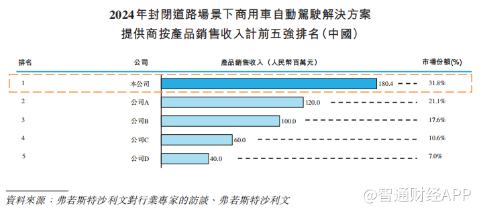
Core Viewpoint - The company, Mainline Technology, is seeking to accelerate its commercialization process in the L4 autonomous truck sector through a public listing on the Hong Kong Stock Exchange, leveraging its first-mover advantage and technological accumulation in closed scenarios [1][2]. Company Overview - Mainline Technology, established in 2017, is a leading provider of L4 autonomous trucks and solutions in China, with a market share of 31.8% in closed road scenarios, significantly surpassing the second-largest competitor at 21.1% [2]. - The company has developed an integrated product ecosystem covering logistics hubs, highway logistics, and urban traffic, with a total delivery of 830 AiTruck smart trucks and 349 AiBox smart terminals as of the last feasible date [2][4]. Financial Performance - Revenue is projected to grow from RMB 112.36 million in 2022 to RMB 254.09 million in 2024, reflecting a compound annual growth rate (CAGR) of over 50% [7]. - The company reported a significant revenue increase of over 1700% in the first half of 2025 compared to the previous year, driven by large projects in highway logistics [7]. - The gross profit margin is expected to improve from 3.7% in 2022 to 22.7% in 2024, reaching 30.3% in the first half of 2025, indicating a positive trend in profitability [8]. Business Structure - The core product matrix includes AiTruck (smart trucks), AiBox (smart terminals), and AiCloud (smart cloud services), corresponding to three main application scenarios: TrunkPort (logistics hubs), TrunkPilot (highway logistics), and TrunkCity (urban traffic) [4]. - Revenue contributions from different segments show that logistics hubs are expected to generate RMB 1.82 billion in 2024, accounting for 71.6% of total revenue, while highway logistics is projected to contribute RMB 421 million, or 16.6% [4]. Market Opportunity - The autonomous commercial vehicle market is experiencing explosive growth, with the closed road scenario market projected to grow from RMB 400 million in 2021 to RMB 1.3 billion in 2024, and the open road scenario market expected to increase from RMB 100 million to RMB 2.3 billion in the same period [14][16]. - Government policies and technological advancements are creating a favorable environment for the development of autonomous driving technologies, with significant support from national and local regulations [17][18]. Challenges - The company is currently in a phase of rapid revenue growth but has not yet achieved profitability, with net losses of RMB 278 million in 2022, RMB 213 million in 2023, and RMB 187 million in 2024 [9][10]. - High customer and supplier concentration poses risks, with the top five customers accounting for 67.9% of revenue in 2024, which could impact negotiation power and operational stability [12]. - The company has a high dependency on external financing, with negative cash flow from operating activities totaling approximately RMB 416 million from 2022 to 2024 [12][13].

新股前瞻|从封闭场景到全域覆盖,主线科技如何讲好“高阶智驾”故事?
智通财经网· 2025-12-18 02:12
Core Viewpoint - The company, Mainline Technology, is poised to become a significant player in the L4 autonomous driving truck sector in China, leveraging its early advantages in closed scenarios and technological accumulation to accelerate commercialization through capital market empowerment [1][2]. Company Overview - Mainline Technology, established in 2017, is a leading provider of L4 autonomous trucks and solutions in China, with a comprehensive "vehicle-edge-cloud" integrated product ecosystem covering logistics hubs, highway logistics, and urban traffic [2][4]. - The company holds a market share of 31.8% in the closed-road scenario for L4 autonomous trucks, significantly surpassing the second-place competitor's 21.1% [2]. Business Structure - The core product matrix includes AiTruck (smart trucks), AiBox (smart terminals), and AiCloud (smart cloud services), corresponding to three main application scenarios: TrunkPort (logistics hubs), TrunkPilot (highway logistics), and TrunkCity (urban traffic) [4]. - Revenue contributions for 2024 are projected at 1.82 billion RMB from logistics hubs (71.6% of total revenue), 421 million RMB from highway logistics (16.6%), and approximately 566 million RMB from urban traffic, which is still in the early commercialization stage [4]. Financial Performance - The company is experiencing rapid revenue growth but has not yet achieved profitability, with revenues increasing from 112 million RMB in 2022 to 254 million RMB in 2024, reflecting a compound annual growth rate (CAGR) of over 50% [5][6]. - The gross profit margin is expected to rise from 3.7% in 2022 to 22.7% in 2024 and reach 30.3% in the first half of 2025, driven by increased adoption of its solutions [6][7]. Investment and Financial Structure - Research and development expenditures totaled 382 million RMB from 2022 to 2024, with 60.9% of the first half of 2025's revenue allocated to R&D [8]. - As of June 30, 2025, the company had total liabilities exceeding 1.3 billion RMB, with net liabilities around 1.08 billion RMB, indicating a high reliance on external financing [9][10]. Market Opportunities - The commercial vehicle autonomous driving industry is entering a golden development period, with the closed-road market projected to grow from 400 million RMB in 2021 to 1.3 billion RMB in 2024, and the open-road market expected to expand from 100 million RMB to 2.3 billion RMB in the same period [12][15]. - Government policies are increasingly supportive of autonomous driving technology, facilitating testing and deployment, which is expected to enhance market growth [15][16]. Challenges - The industry faces challenges such as the complexity of open-road scenarios, varying customer acceptance of new technologies, and ongoing regulatory developments regarding liability and data security [16]. - The company must navigate high customer and supplier concentration risks, with the top five customers accounting for 67.9% of revenue in 2024, which could impact negotiation power and operational stability [10].
【光大研究每日速递】20251218
光大证券研究· 2025-12-17 23:04
Group 1: Macroeconomic Insights - The unemployment rate in the US rose unexpectedly to 4.6% in November, attributed to a "technical" disturbance from the government shutdown, which forced many federal employees into unpaid leave, temporarily inflating the unemployment figures [5] - Despite the rise in unemployment, the private sector showed resilience, with the goods-producing sector adding 19,000 jobs, the highest since May 2025 [5] - The Federal Reserve is expected to maintain a cautious approach to interest rate cuts in the short term, despite the increase in unemployment [5] Group 2: Automotive Industry Developments - The first batch of L3 autonomous driving vehicles in China has received regulatory approval, marking a potential turning point for the commercialization of advanced driving technologies [6] - The approval includes restrictions on the usage functions, regions, and entities for the L3 vehicles, highlighting significant differences between L3 and L2 level driving assistance [6] - There is optimism regarding the growth opportunities for high-level intelligent driving components, with a focus on strong performance in the Alpha+ intelligent driving and robotics sectors [6] Group 3: Company Performance - Chi Zi Cheng Technology (9911.HK) focuses on social networking services, primarily targeting users from diverse cultural backgrounds in the Middle East and North Africa [7] - The company has made significant progress in the social sector since 2022 through mergers and internal incubation, while also expanding into gaming and other innovative businesses [7] - In the first half of 2025, the company reported revenue of 3.181 billion yuan, a year-on-year increase of 40%, with SUGO and TopTop revenues growing over 100% [7] - The company's net profit for the same period was 489 million yuan, corresponding to a net profit margin of 15.4% [7]
【汽车】国内首批L3级自动驾驶车型获准入许可,高阶智驾商业化或迎拐点——汽车和汽车零部件行业跟踪报告(倪昱婧/邢萍)
光大证券研究· 2025-12-17 23:04
Core Viewpoint - The approval of the first L3-level conditional autonomous driving models in China marks a significant step towards the commercialization of L3 autonomous driving technology [4][5]. Group 1: Approval of L3 Autonomous Driving Models - The Ministry of Industry and Information Technology officially announced the first batch of L3-level conditional autonomous driving models, including the Changan Deep Blue SL03 and the Arcfox Alpha S6, which are set to undergo road trials in designated areas of Chongqing and Beijing [4]. - The approval indicates a transition from testing to commercial application for L3 autonomous driving in China [4]. Group 2: Conditions and Limitations of Approval - The approved models have specific limitations: 1. Changan Deep Blue SL03 is designed for congested traffic environments with a maximum speed of 50 km/h, while Arcfox Alpha S6 can operate at up to 80 km/h [5]. 2. The operational areas are restricted to designated routes in Chongqing and Beijing [5]. 3. The usage is limited to specific companies, with Changan Deep Blue SL03 operated by Chongqing Changan Car Networking Technology Co., Ltd. and Arcfox Alpha S6 by Beijing Travel Automobile Service Co., Ltd. [5]. Group 3: Future Prospects and Market Opportunities - The approval process requires strict safety guarantees, suggesting that L3 autonomous driving may expand to more cities and vehicles in the future [5]. - The current focus on B-end applications is expected to gradually shift towards C-end as national legislation evolves [5]. - There is a significant difference between L3 and L2 driving systems, with L3 capable of handling all dynamic driving tasks under certain conditions, leading to increased demand for advanced components such as hands-free detection systems and driving assistance data recording systems [6].