
黄金市场

Search documents
金源灿:黄金市场昨日强势拉升收阳 今日回踩多单布局为主
Xin Lang Cai Jing· 2025-12-24 06:47
Core Viewpoint - The gold market continues its recent upward trend, characterized by a "high pullback and then rebound" pattern, establishing a bullish tone for today's trading [1][4]. Group 1: Market Performance - As of the close, gold settled at 4486.6, forming a large bullish candle with a longer lower shadow than upper shadow, indicating strong bullish dominance and robust support during pullbacks [1][4]. - The gold price opened at 4447.9, showing strong upward momentum, reaching a peak of 4498.0, with an intraday gain exceeding 50 points [1][4]. - After hitting the new high, the market experienced a brief profit-taking phase, leading to a pullback, with the lowest point reaching 4430.2, which became a significant support level [1][4]. Group 2: Technical Analysis - Following the support at 4430.2, gold bulls regained strength, leading to a second rally, with a peak of 4500.3, just shy of the key psychological level of 4500 [1][4]. - The large bullish candle covers part of the previous pullback space, with a long lower shadow indicating strong support below and an upper shadow suggesting some resistance at higher levels, overall favoring a continuation of the bullish trend [1][4]. Group 3: Trading Strategy - The gold market is likely to continue its upward trend today, with a focus on buying on dips, particularly monitoring the effectiveness of the support level at 4455 [2][5]. - If the price retraces to around 4455 and shows signs of stabilization, long positions can be considered, with a stop-loss set at 4445 to mitigate risks of breaking key support [2][5]. - The short-term target is set at 4482, and if this level is breached, the market may aim for the 4500 psychological level, which could trigger a new rally [2][5].
再创新高!金饰克价首破1400元,还会接着涨?
Guang Xi Ri Bao· 2025-12-23 08:28
Group 1 - International gold prices continue to rise, with gold priced in RMB reaching a new high, surpassing 1400 yuan per gram on December 23 [1] - On December 23, spot gold in London approached 4490 USD per ounce, breaking the previous high of 4381 USD per ounce from late October. Shanghai's spot gold price also hit a record of 1014 yuan per gram [2] - Year-to-date, international spot gold has increased by over 70%, while gold priced in RMB has risen by more than 64% [2] Group 2 - Silver prices are also experiencing a strong upward trend due to factors such as the Federal Reserve's interest rate cuts, supply shortages, and increased investment and industrial demand. As of December 22, silver futures closed at 68.565 USD per ounce, with a rise of 1.59% [6] - JPMorgan's 2026 gold market outlook report suggests that the gold market may continue its upward momentum due to strong driving factors [6] - Market analysts expect that silver demand will continue to grow through 2026 [6]


?揭秘2025年“东南亚最强货币”泰铢背后的双引擎:关税“意外助攻”与黄金潮汐
Zhi Tong Cai Jing· 2025-12-22 11:48
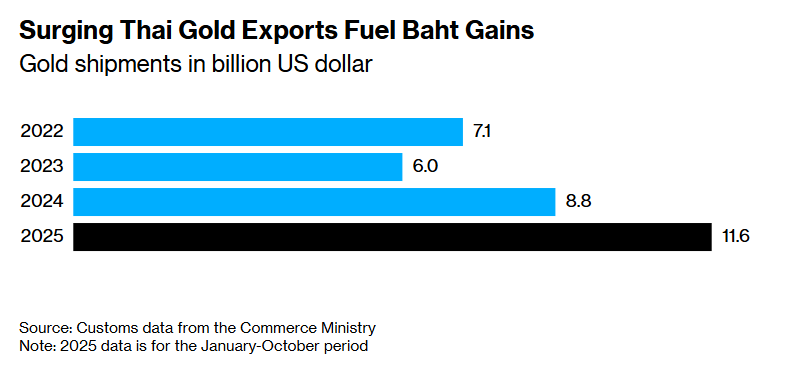
Core Insights - The Thai Baht is experiencing its largest annual appreciation against the US dollar in eight years, with a 10% increase in 2025, outperforming other Southeast Asian currencies [1][2] - The strong performance of the Baht is attributed to rising gold prices and unexpected benefits from US tariff policies, despite Thailand's economic challenges [1][2] - The appreciation of the Baht poses challenges for Thailand's export-driven economy and the new Prime Minister, who faces an election in February [1][5] Group 1: Factors Contributing to Baht Strength - The Baht's strength began in mid-2024, coinciding with government economic stimulus plans and traders selling dollars ahead of the Federal Reserve's interest rate cuts [2] - A significant portion of the Baht's appreciation is linked to a 60% increase in gold prices, driven by a weakening US labor market and seasonal peaks in Thailand's tourism [3] - The US tariffs have inadvertently boosted Thailand's economy by encouraging manufacturers to shift production to Thailand, benefiting from lower tariffs compared to Chinese goods [2][3] Group 2: Economic Implications of a Strong Baht - A strong Baht makes Thai products more expensive in international markets, leading to slower export growth [4] - The tourism sector is under pressure as the strong Baht diminishes Thailand's appeal as a low-cost destination, with a downward revision of foreign tourist arrivals expected [4] - While a stronger Baht reduces import costs for households, the overall impact on an economy reliant on exports and tourism is negative [4] Group 3: Government and Central Bank Responses - The Thai government is addressing concerns from export-oriented businesses regarding the Baht's appreciation, amidst political instability and upcoming elections [5] - The central bank has intervened in the foreign exchange market to manage excessive volatility and has proposed measures to increase flexibility for businesses managing offshore earnings [6] - Discussions are ongoing regarding potential taxation on physical gold transactions to mitigate the impact of gold prices on the Baht's strength [6]
揭秘2025年“东南亚最强货币”泰铢背后的双引擎:关税“意外助攻”与黄金潮汐
Zhi Tong Cai Jing· 2025-12-22 11:40
Core Viewpoint - The Thai Baht is experiencing its largest annual appreciation against the US dollar in eight years, with a 10% increase in 2025, outperforming other Southeast Asian currencies despite economic challenges [1][2]. Group 1: Factors Contributing to Baht Strength - The appreciation of the Baht began in mid-2024, coinciding with government economic stimulus plans and traders selling off the US dollar ahead of the Federal Reserve's latest interest rate cuts [2]. - A significant portion of the Baht's recent gains is attributed to a 60% increase in gold prices, driven by a weakening US labor market and seasonal peaks in Thailand's tourism industry [3]. - The Trump administration's import tariffs have unexpectedly boosted Thailand's economy by encouraging local manufacturing for exports to the US, as tariffs on Thai goods are lower than those on Chinese products [2][3]. Group 2: Economic Implications of a Strong Baht - A strong Baht makes Thai products more expensive in international markets, leading to the slowest export growth in over a year [5]. - The tourism sector is under pressure as the strong Baht diminishes Thailand's appeal as a low-cost vacation destination, with a downward revision of foreign tourist arrivals expected [6]. - While a stronger Baht can reduce inflation for imported goods, the overall impact on an economy heavily reliant on exports and tourism is negative [6]. Group 3: Government and Central Bank Responses - The Thai government is addressing concerns from export-oriented businesses regarding the Baht's appreciation, but political instability complicates fiscal policy direction [7]. - The Bank of Thailand has intervened in the foreign exchange market to manage excessive volatility and has proposed increasing the offshore income retention limit for businesses [8]. - Discussions are ongoing regarding measures to mitigate the impact of gold prices on the Baht, including potential taxation on physical gold transactions [8].
博时基金王祥:黄金市场震荡上行,美联储释放扩表预期
Xin Lang Cai Jing· 2025-12-17 07:53
Core Viewpoint - The gold market experienced a slight increase from December 8 to December 12, driven by the Federal Reserve's announcement of an expansionary monetary policy and a rebound in the gold-silver ratio attracting capital inflows [1][12]. Market Dynamics - The Federal Reserve lowered interest rates by 25 basis points and announced the initiation of a balance sheet expansion program, which will start on December 12, involving the purchase of approximately $40 billion in short-term Treasury bills [2][13]. - Initial jobless claims in the U.S. unexpectedly rose to 236,000 for the week ending December 6, marking the largest increase since July 2021, indicating a weakening labor market [2][12]. Investment Sentiment - The recovery in the gold-silver ratio is one of the factors attracting funds back into gold assets, despite an established downward trend; there is potential for a rebound towards the volatility range observed over the past three years [2][13]. - Overall investment sentiment in precious metals remains high, with varying degrees of upward momentum across different commodities, suggesting that investors should focus on allocation value rather than trading elements [2][13].
美国非农数据“弱而不崩” 金价会否打破僵局?
Jin Tou Wang· 2025-12-17 06:05
Group 1 - The international gold price is currently trading around $4,330, with a recent increase of 0.74%, reaching a high of $4,334.23 and a low of $4,300.39, indicating a short-term oscillating trend in the market [1] - The U.S. non-farm payroll report for November shows a job increase of only 64,000, with the unemployment rate rising to 4.6%, the highest since 2021, highlighting a weakening job market [2] - The healthcare and construction sectors are supporting job growth, while the federal government and transportation sectors are contracting, reflecting mixed industry performance [2] Group 2 - The gold market is experiencing volatility, with silver prices reaching new highs, indicating a divergence in market performance [3] - The non-farm employment data exceeded expectations, but the unexpected rise in the unemployment rate has been a key factor for the increase in gold prices [3] - The market has shown a pattern of early morning upward movements over the past three trading days, but caution is advised as the market remains in a state of oscillation [3]
泽连斯基作出重大妥协!美国宣布:解除制裁!美联储巨变酝酿中?
Sou Hu Cai Jing· 2025-12-17 03:24
Group 1: Ukraine Situation - Ukraine's President Zelensky has softened his stance on NATO membership, now accepting bilateral security guarantees from the West due to lack of support from the US and some European countries [1] - A meeting between US and Ukrainian officials in Berlin resulted in significant progress on peace plans and economic issues, focusing on territorial disputes and security concerns [1] - The shift in Ukraine's position reflects a pragmatic approach amid prolonged conflict and diminishing aid, influenced by changing US policies under a potential Trump administration [1] Group 2: Belarus Sanctions - The US announced the lifting of sanctions on Belarusian potash fertilizer, a key economic sector for Belarus, following negotiations between US envoy John Cole and President Lukashenko [3] - The sanctions were initially imposed in 2021 due to election manipulation, severely impacting Belarus's economy, which has since adapted by shifting export markets [3] - The agreement includes the release of 123 political prisoners, indicating economic pressures on Belarus and a potential shift in US-Belarus relations away from Russia [3] Group 3: Federal Reserve Actions - The Federal Reserve lowered the benchmark interest rate by 25 basis points to a range of 3.5%-3.75%, marking the third rate cut of the year [5] - The Fed's decision reflects internal divisions and a need to balance employment and inflation targets, with a plan to purchase $40 billion in short-term Treasury securities to maintain liquidity [5] - Future rate cuts are anticipated, but market expectations may differ, indicating a complex economic landscape [5] Group 4: Gold Market Dynamics - Gold prices have shown strong performance, with significant inflows into physical gold ETFs, reaching $5.2 billion in November [7] - The recent Fed rate cut has reduced the opportunity cost of holding gold, supporting its price amid fluctuating market conditions [7] - Long-term prospects for gold remain positive due to geopolitical tensions and central bank policies favoring gold accumulation [8]
金价,新消息!
Sou Hu Cai Jing· 2025-12-14 12:23
Core Viewpoint - The international spot gold price has surged, breaking through $4,350 per ounce, drawing market attention as it approaches historical highs [1]. Group 1: Gold Price Trends - As of December 12, the February gold futures price on the New York Mercantile Exchange increased by 0.35% [1]. - On December 13, the price of gold jewelry from Lao Miao reached ¥1,352 per gram, while Chow Sang Sang's price hit ¥1,351 per gram, both surpassing ¥1,350 [3]. - The price of gold jewelry from Chow Tai Fook was reported at ¥1,348 per gram, and from Luk Fook at ¥1,346 per gram [7]. Group 2: Central Bank Activities - Central banks around the world have been increasing their gold reserves, with a net addition of 53 tons in October, marking a 36% month-on-month increase, the highest monthly net purchase this year [11][12]. - The World Gold Council forecasts that gold prices will continue to be influenced by geopolitical and economic uncertainties, with potential for strong performance in 2026 [12]. - Goldman Sachs analysts predict a significant upside for gold prices, forecasting $4,900 per ounce by the end of 2026, with central bank purchases averaging 80 tons in 2025 and 70 tons in 2026 [12].
【黄金etf持仓量】12月10日黄金ETF较上一交易日减少1.15吨
Jin Tou Wang· 2025-12-11 07:07
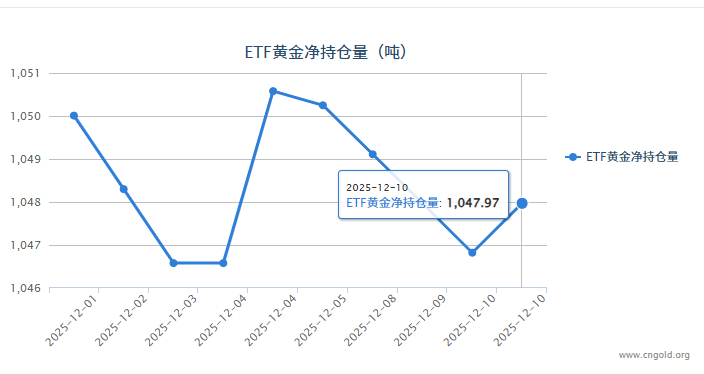
摘要全球最大黄金ETF--SPDRGoldTrust持仓报告显示,12月10日黄金etf持有量为1046.82吨,较上一交 易日减少1.15吨。周三(12月10日)截止收盘,现货黄金报4227.19美元/盎司,涨幅0.48%,日内最高上探 至4238.49美元/盎司,最低触4181.84美元/盎司。 全球最大黄金ETF--SPDR Gold Trust持仓报告显示,12月10日黄金etf持有量为1046.82吨,较上一交易日 减少1.15吨。周三(12月10日)截止收盘,现货黄金报4227.19美元/盎司,涨幅0.48%,日内最高上探至 4238.49美元/盎司,最低触4181.84美元/盎司。 【市场要闻速递】 美联储在内部意见分歧中实施25个基点的降息举措,推动全球黄金市场周四继续上扬。尽管决策者对 2026年进一步宽松政策的前景持谨慎态度,但这一行动仍为贵金属注入强劲动力。而且,美联储主席鲍 威尔在利率决议后的新闻发布会上表示,美联储的下一步行动不太可能是加息。 美联储的最新政策声明显示,此次降息后,他们可能暂时按兵不动,等待就业市场和通胀数据提供更清 晰的指引。官员们强调,当前通胀水平"仍然有些偏高" ...
黄金冲4247 美联储三连降+非鹰派引多头
Jin Tou Wang· 2025-12-11 02:06
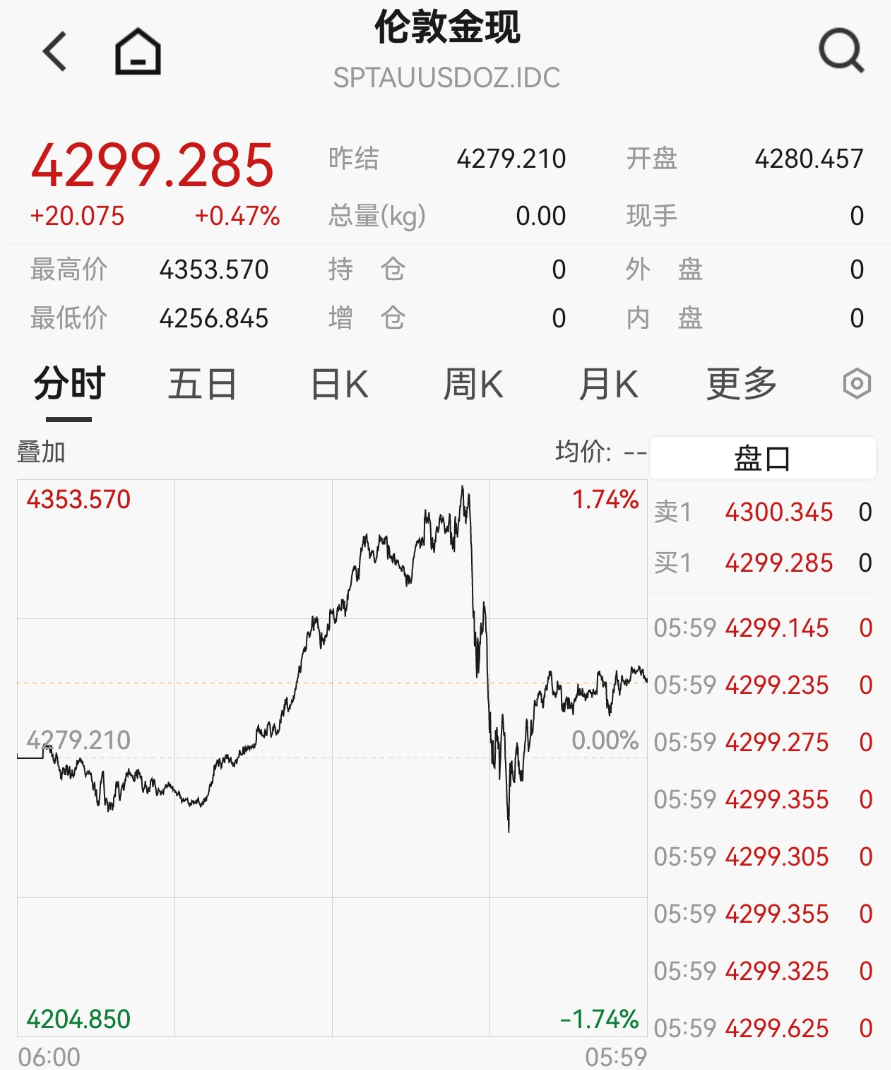
摘要今日周四(12月11日)亚盘时段,美联储2025年最后一次议息会议落下帷幕,如期降息25个基点的决 议与鲍威尔"非鹰派"表态形成共振,为持续震荡的黄金市场注入强心剂。截至国际现货黄金报4237.69 美元/盎司,较决议前上涨0.25%,日内最高触及4247.50美元,创下近一个月以来的新高。 今日周四(12月11日)亚盘时段,美联储2025年最后一次议息会议落下帷幕,如期降息25个基点的决议与 鲍威尔"非鹰派"表态形成共振,为持续震荡的黄金市场注入强心剂。截至国际现货黄金报4237.69美元/ 盎司,较决议前上涨0.25%,日内最高触及4247.50美元,创下近一个月以来的新高。 【要闻速递】 美联储在连续第三次会议上决定降息,但同时释放出将暂时进入观望阶段的信号。此次政策决策过程 中,委员会内部就通胀与就业市场的重要性问题出现了罕见的严重分歧。 当地时间周三,美联储以9票赞成、3票反对的结果通过了降息决议,这是六年来首次有三位官员投下反 对票。芝加哥联储主席古尔斯比和堪萨斯城联储主席施密德认为,此次降息并非必要之举;而美联储理 事米兰则主张进行更大幅度的50个基点降息。 此次降息25个基点,将基准联邦基 ...