
债券市场

Search documents
如何看待增值税新规利率债老券的抢筹行情?
Xinda Securities· 2025-08-03 14:01
1. Report Industry Investment Rating There is no information provided regarding the industry investment rating in the report. 2. Core Viewpoints of the Report - The bond market showed a situation of "all negative factors priced in" this week. After the high - level oscillation in the first half of the week, influenced by factors such as the extension of Sino - US tariff exemptions, lack of unexpected policies in the Politburo meeting in July, significant corrections in the equity market and commodity prices, and poor July manufacturing PMI data, the 10 - year Treasury bond yield returned to around 1.7%. The news of resuming the collection of VAT on the interest income of some bonds on Friday afternoon pushed the 10 - year Treasury bond yield below 1.7% [2][6]. - The tax system for bond investment in China varies according to different bond types, investors, and income sources. The new tax policy exempts the old bonds of Treasury bonds, local government bonds, and financial bonds from VAT on interest income, while new bonds require banks and other institutional investors to pay 6.34% VAT and asset management products to pay 3.26% VAT [2][6]. - After the tax rate adjustment, institutions may prefer to hold old bonds. The new bond issuance may need to provide sufficient interest compensation. The actual yield of old bonds may be between 1.65% - 1.7%, and the new - old bond spread may be between 5 - 10BP [2][13]. - The central bank may support the policy adjustment to increase the nominal level of domestic bond interest rates and reduce the investment and trading willingness of financial institutions. The finance department may aim to expand the tax source. The policy may increase the annual VAT revenue by up to 140 billion, and the annual fiscal interest payment may increase by about 50 billion [2][3]. - In the short term, the bond market may maintain a volatile pattern. After the new tax policy, there may be a short - term trading opportunity for old bonds, but the market may still face disturbances, and the volatile pattern is difficult to break [2][23]. 3. Summary According to Related Catalogs 3.1 China's Bond Investment Tax System Varies by Bond Type, Investor, and Income Source - **VAT**: Interest income from Treasury bonds, local government bonds, financial bonds, and inter - bank certificates of deposit is exempt from VAT. For other bond types, the actual VAT rate for general legal entities is 6.34%, and for asset management products, it is 3.26%. Capital gains from most bonds are subject to VAT, but public funds are exempt. The actual VAT rate takes into account price - exclusive factors and additional taxes [2][6][7]. - **Income Tax**: Financial institutions' interest income from investing in Treasury bonds and local government bonds is exempt from income tax. Interest income from railway bonds is taxed at a reduced rate of 12.5%. Other bond interest income and capital gains are taxed at 25%. Contractual asset management products are not income tax payers, and the tax is borne by product holders. Personal investment in asset management products is currently tax - free, while enterprises and financial institutions are taxable. Public fund dividends are exempt from income tax [2][8]. - **Impact on Yield Difference**: Tax system differences are an important reason for the yield differences among different bond types in China. For example, the implied tax rate between Treasury bonds and policy - financial bonds has an upper limit of 25% [9]. 3.2 Under the New Tax Policy, the Market's Rush for Old Bonds is Mainly Due to Different Tax Rates Among Institutions - **New Tax Policy**: Starting from August 8, 2025, new - issued Treasury bonds, local government bonds, and financial bonds' interest income will be subject to VAT, while old bonds' interest income remains tax - free [11]. - **Pricing of New and Old Bonds**: Assuming the fair - value yield of 10 - year Treasury bonds is 1.7%, new bonds need to provide sufficient interest compensation. For asset management products, the new bond issuance rate only needs to reach 1.755% to be equivalent to old bonds, while for self - operated accounts, it needs to reach 1.808%. The actual new - old bond spread may be between 5 - 10BP [12][13]. - **Actual Situation**: Banks can invest in asset management products to avoid tax impacts, which may narrow the new - old bond spread. For short - duration bonds, the new bond yield may rise more. The demand for non - tax - adjusted bonds such as inter - bank certificates of deposit and credit bonds may increase, but the positive impact is limited [14]. 3.3 The New Tax Policy Can Increase the Nominal Interest Rate of New Bonds, but Commercial Banks May Bear Higher Tax Costs - **Policy Motivation**: The central bank may support the policy to increase the nominal level of domestic bond interest rates, and the finance department aims to expand the tax source [17]. - **Fiscal Revenue and Expenditure**: In the first year of the policy implementation, the additional VAT revenue may be less than 36 billion. Eventually, the annual fiscal VAT revenue increase may be within 140 billion, and the annual fiscal interest payment may increase by about 50 billion. The difference reflects the tax cost borne by banks and other financial institutions [3][19][21]. - **Future Policy Expectation**: There may be further adjustments to the tax system of asset management products, especially the tax - exemption policy for public fund dividends [22]. 3.4 After Repricing the Existing Bonds, the Bond Market May Still Show a Volatile Pattern - **Short - Term Market Trend**: The bond market may maintain a volatile pattern in the short term due to the lack of incremental policies in the Politburo meeting in July, limited inflation - driving ability of production - restriction policies, and the expected maintenance of a loose monetary policy [23]. - **Impact of New Tax Policy**: After the new tax policy, there may be a short - term trading opportunity for old bonds as their yields may decline by 0 - 5BP. However, the market may still face disturbances such as rising bank financing costs and potential tax policy adjustments for public funds, and the volatile pattern is difficult to break [24]. - **Long - Term Outlook**: A further decline in interest rates may require weaker fundamental data to force a policy shift. There is a possibility that the economic growth rate may decline in the second half of the year, and if combined with central bank bond - buying or interest rate cuts, interest rates may reach new lows, which may occur in the second half of the third quarter [24].
陕西债券市场运行平稳
Shan Xi Ri Bao· 2025-08-03 00:16
Group 1 - The total bond issuance scale in Shaanxi province for the first half of the year was 187.09 billion, a year-on-year decrease of 7.64 billion [1] - As of the end of June, the outstanding bond scale in Shaanxi was 854.44 billion, with non-financial corporate credit bonds accounting for 775.55 billion [1] - The issuance scale of non-financial corporate credit bonds in the first half was 158.39 billion, a year-on-year decrease of 1.27% [1] Group 2 - The issuance scale of urban investment bonds was 55.73 billion, a year-on-year increase of 48.04% [1] - The issuance scale of industrial bonds was 102.66 billion, a year-on-year decrease of 16.39% [1] - The issuance scale of financial bonds was 28.7 billion, a year-on-year decrease of 16.33% [1] Group 3 - In the first half of the year, Shaanxi issued 33 guaranteed bonds, with a total issuance scale of 14.4 billion, a year-on-year increase of 39.24% [1] - The issuance of guaranteed urban investment bonds was 11, with a scale of 5.45 billion, accounting for 37.83% of the new guaranteed bond scale [2] - The issuance of guaranteed industrial bonds was 22, with a scale of 8.95 billion, accounting for 62.17% of the new guaranteed bond scale [2]
6月末我国债券市场托管余额188.5万亿元
Xin Hua She· 2025-08-01 11:40
Group 1 - The core viewpoint of the article highlights the stable growth of China's bond market, with a total issuance of various bonds amounting to 87,939.5 billion yuan in June [1] - As of the end of June, the total custody balance of China's bond market reached 188.5 trillion yuan [1] - The issuance breakdown for June includes: 15,903.9 billion yuan in government bonds, 11,753.2 billion yuan in local government bonds, 10,738.7 billion yuan in financial bonds, 14,257.3 billion yuan in corporate credit bonds, 247.2 billion yuan in credit asset-backed securities, and 34,569.3 billion yuan in interbank certificates of deposit [1] Group 2 - The custody balance of foreign institutions in China's bond market was 4.3 trillion yuan by the end of June, accounting for 2.3% of the total custody balance [1] - Among this, the custody balance of foreign institutions in the interbank bond market was 4.2 trillion yuan [1]
债市或“震中带韧”,民生加银鑫享债券以专业管理穿越波动
Jiang Nan Shi Bao· 2025-08-01 03:06
Group 1 - The bond market has experienced adjustments this year due to improved risk appetite and marginally better fundamental expectations, with central bank signals indicating continued support for the bond market [1] - Many institutions hold a positive outlook for the bond market, suggesting that the market may exhibit characteristics of "resilience amid shocks" due to various factors such as declining interest rates and ongoing economic recovery challenges [1] - Bond funds are increasingly favored by investors for asset allocation, as they can complement equity assets and reduce overall portfolio volatility during stock market fluctuations [1] Group 2 - Bond funds have shown impressive performance in terms of returns, with core income derived from bond coupons remaining relatively stable despite short-term market fluctuations [2] - As of July 30 this year, the total index of bond funds has increased by 40.11% over the past decade, significantly outperforming the 5.62% increase of the CSI 300 index during the same period [2] - The Minsheng Jianyin Xinxiang Bond Fund, managed by Xie Zhihua, has demonstrated outstanding performance, with net value growth rates of 19.23% and 18.30% over the past three years and one year, respectively, surpassing their performance benchmarks [2]
6月债券市场共发行各类债券87939.5亿元
Qi Huo Ri Bao Wang· 2025-07-31 18:59
Core Insights - The People's Bank of China released the financial market operation data for June 2025, indicating significant activity in the bond market [1] Group 1: Bond Market Issuance - In June, the total issuance of various bonds reached 87,939.5 billion yuan [1] - The breakdown of bond issuance includes: - Government bonds: 15,903.9 billion yuan - Local government bonds: 11,753.2 billion yuan - Financial bonds: 10,738.7 billion yuan - Corporate credit bonds: 14,257.3 billion yuan - Credit asset-backed securities: 247.2 billion yuan - Interbank certificates of deposit: 34,569.3 billion yuan [1] Group 2: Bond Market Custody Balance - As of the end of June, the total custody balance of the bond market was 188.5 trillion yuan [1] - The custody balance in the interbank market was 166.7 trillion yuan - The custody balance in the exchange market was 21.9 trillion yuan [1]
【金融街发布】人民银行:6月份债券市场共发行各类债券87939.5亿元 同业拆借加权平均利率1.46%
Xin Hua Cai Jing· 2025-07-31 11:50
Core Insights - The People's Bank of China reported the financial market operations for June 2025, highlighting a bond market custody balance of 188.5 trillion yuan as of the end of June [1][2]. Bond Market Issuance - In June, the bond market issued a total of 87,939.5 billion yuan in various bonds, including 15,903.9 billion yuan in government bonds, 11,753.2 billion yuan in local government bonds, 10,738.7 billion yuan in financial bonds, 14,257.3 billion yuan in corporate credit bonds, 247.2 billion yuan in credit asset-backed securities, and 34,569.3 billion yuan in interbank certificates of deposit [2]. Bond Market Operations - The interbank bond market saw a total transaction volume of 34.3 trillion yuan in June, with an average daily transaction of 1.7 trillion yuan, reflecting a year-on-year decrease of 1.2% but a month-on-month increase of 6.2% [3]. Foreign Participation in Bond Market - As of the end of June, foreign institutions held a custody balance of 4.3 trillion yuan in the Chinese bond market, accounting for 2.3% of the total custody balance [4]. Money Market Operations - The interbank lending market recorded a transaction volume of 8.4 trillion yuan in June, representing a year-on-year increase of 11.2% and a month-on-month increase of 26.0% [5]. Commercial Paper Market - In June, the acceptance amount of commercial bills reached 3.5 trillion yuan, while the discount amount was 2.8 trillion yuan, with small and micro enterprises accounting for 93.2% of all bill issuers [6]. Stock Market Performance - By the end of June, the Shanghai Composite Index closed at 3,444.4 points, up 96.9 points or 2.9%, while the Shenzhen Component Index rose to 10,465.1 points, an increase of 424.5 points or 4.2% [7]. Holder Structure in Interbank Bond Market - As of the end of June, there were 3,989 institutional members in the interbank bond market, all of which were financial institutions, with the top 50 investors in corporate credit bonds holding 48.0% of the total [9].

央行:6月份沪市日均交易量环比增加8.6%
Di Yi Cai Jing· 2025-07-31 10:37
Market Overview - In June, the average daily trading volume in the Shanghai Stock Exchange was 510.4 billion yuan, an increase of 8.6% month-on-month; the Shenzhen Stock Exchange's average daily trading volume was 796.9 billion yuan, up 11.5% month-on-month [1][7] Bond Market Issuance - In June, the bond market issued a total of 87,939.5 billion yuan in various bonds, including 15,903.9 billion yuan in government bonds, 11,753.2 billion yuan in local government bonds, 10,738.7 billion yuan in financial bonds, 14,257.3 billion yuan in corporate credit bonds, 247.2 billion yuan in credit asset-backed securities, and 34,569.3 billion yuan in interbank certificates of deposit [2] Bond Market Operation - In June, the interbank bond market had a total transaction volume of 34.3 trillion yuan, with an average daily transaction of 1.7 trillion yuan, a year-on-year decrease of 1.2% but a month-on-month increase of 6.2% [3] Foreign Participation in Bond Market - As of the end of June, the custody balance of foreign institutions in the Chinese bond market was 4.3 trillion yuan, accounting for 2.3% of the total custody balance [4] Money Market Activity - In June, the interbank lending market had a transaction volume of 8.4 trillion yuan, a year-on-year increase of 11.2% and a month-on-month increase of 26.0% [5] Commercial Paper Market - In June, the acceptance amount of commercial bills was 3.5 trillion yuan, and the discount amount was 2.8 trillion yuan [6] Stock Market Performance - By the end of June, the Shanghai Composite Index closed at 3,444.4 points, an increase of 96.9 points or 2.9% month-on-month; the Shenzhen Component Index closed at 10,465.1 points, up 424.5 points or 4.2% month-on-month [7]
中国央行:6月份债券市场共发行各类债券87939.5亿元
智通财经网· 2025-07-31 10:19
Bond Market Issuance - In June 2025, the total issuance of various bonds in the bond market reached 87,939.5 billion yuan, including 15,903.9 billion yuan of government bonds, 11,753.2 billion yuan of local government bonds, 10,738.7 billion yuan of financial bonds, 14,257.3 billion yuan of corporate credit bonds, 247.2 billion yuan of credit asset-backed securities, and 34,569.3 billion yuan of interbank certificates of deposit [3] Bond Market Custody Balance - As of the end of June, the custody balance of the bond market was 188.5 trillion yuan, with 166.7 trillion yuan in the interbank market and 21.9 trillion yuan in the exchange market. The custody balances by bond type included 37.2 trillion yuan of government bonds, 51.7 trillion yuan of local government bonds, 42.7 trillion yuan of financial bonds, 33.7 trillion yuan of corporate credit bonds, 1.0 trillion yuan of credit asset-backed securities, and 21.1 trillion yuan of interbank certificates of deposit [3] Bond Market Trading Activity - In June, the interbank bond market saw a total transaction volume of 34.3 trillion yuan, with an average daily transaction of 1.7 trillion yuan, reflecting a year-on-year decrease of 1.2% but a month-on-month increase of 6.2%. The exchange bond market recorded a transaction volume of 3.8 trillion yuan, with an average daily transaction of 190.5 billion yuan [4] Foreign Participation in Bond Market - By the end of June, the custody balance of foreign institutions in the Chinese bond market was 4.3 trillion yuan, accounting for 2.3% of the total custody balance. Foreign institutions held 2.1 trillion yuan of government bonds, 1.2 trillion yuan of interbank certificates of deposit, and 0.8 trillion yuan of policy bank bonds [5] Money Market Activity - In June, the interbank lending market recorded a transaction volume of 8.4 trillion yuan, a year-on-year increase of 11.2% and a month-on-month increase of 26.0%. The bond repurchase transactions totaled 156.3 trillion yuan, reflecting a year-on-year increase of 32.7% and a month-on-month increase of 20.4% [6] Commercial Paper Market - In June, the acceptance amount of commercial bills was 3.5 trillion yuan, and the discount amount was 2.8 trillion yuan. By the end of June, the acceptance balance of commercial bills was 19.3 trillion yuan, and the discount balance was 14.8 trillion yuan. Small and micro enterprises accounted for 93.2% of the total bill issuers and 69.8% of the total bill issuance amount [7] Stock Market Performance - At the end of June, the Shanghai Composite Index closed at 3,444.4 points, up 96.9 points or 2.9% from the previous month. The Shenzhen Component Index closed at 10,465.1 points, up 424.5 points or 4.2%. The average daily trading volume in the Shanghai market was 510.4 billion yuan, an increase of 8.6% month-on-month, while the Shenzhen market's average daily trading volume was 796.9 billion yuan, an increase of 11.5% month-on-month [9] Bond Market Holder Structure - As of the end of June, there were 3,989 institutional members in the interbank bond market, all of which were financial institutions. The top 50 investors in corporate credit bonds held 48.0% of the total, primarily concentrated in public funds, state-owned commercial banks, and insurance financial institutions [10]
票据利率大幅下行,债券市场早盘呈现修复走势,30年国债ETF涨0.52%
Zheng Quan Zhi Xing· 2025-07-31 03:19
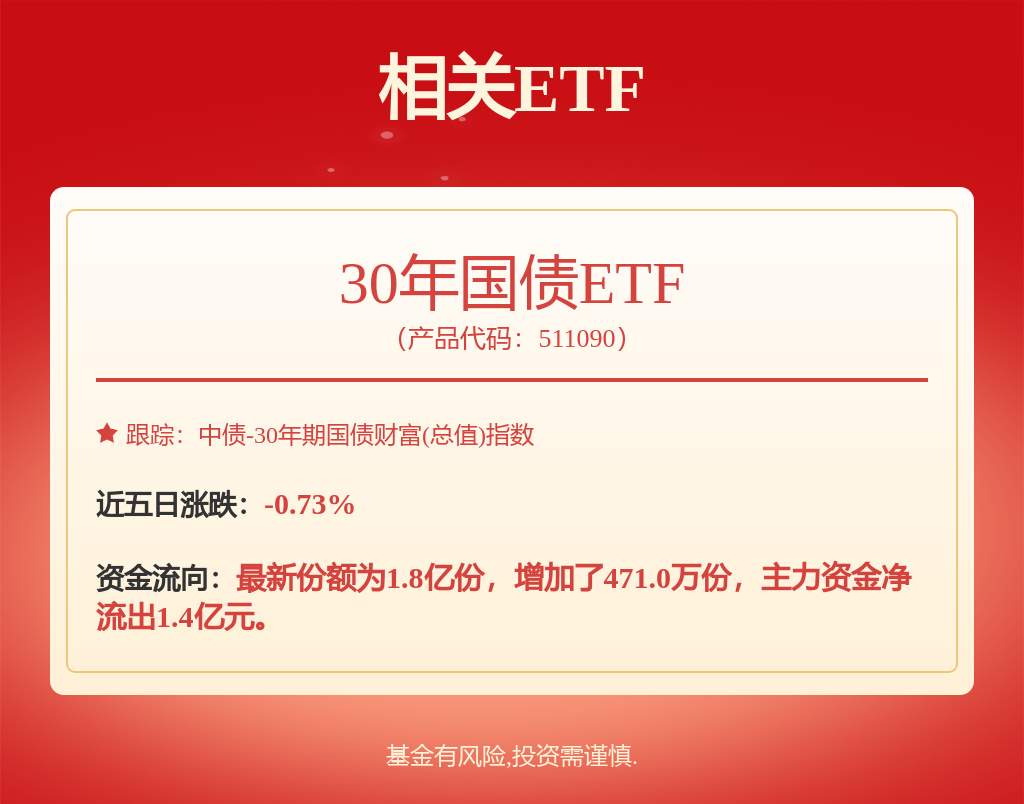
Market Overview - The bond market experienced a significant rise, with the 30-year government bond ETF (511090) increasing by 0.52% as of 10:00 AM [1] - The latest price for the 30-year government bond futures contract (TL2509) was 119.07 yuan, up 0.63%, with a trading volume of 46,165 contracts and a total open interest of 117,716 contracts [1] - Other government bond futures also saw increases, with the 10-year bond (T2509) up 0.16%, the 5-year bond (TF2509) up 0.07%, and the 2-year bond (TS2509) up 0.01% [1] Funding Conditions - The central bank conducted a 7-day reverse repurchase operation of 283.2 billion yuan, maintaining a bid rate of 1.40% [1] - Major interbank interest rates for government bonds generally declined, with the 10-year government bond yield dropping by 3.25 basis points to 1.715% and the 30-year bond yield decreasing by 4 basis points to 1.921% [1] Bond Market Insights - As the end of July approached, bill rates fell sharply, with the 1-month corporate acceptance bill rate dropping to 0.01% [2] - The demand from small and medium-sized institutions, represented by rural commercial banks, was strong, indicating insufficient credit issuance in July [2] - Major banks have been actively purchasing bills, with net purchases exceeding 210 billion yuan from July 21 to 25 and over 500 billion yuan for the entire month, compared to just over 120 billion yuan in the same period last year [2] - The bond market showed signs of recovery, with the 30-year government bond yield declining nearly 4 basis points and other maturities recovering by 2-3 basis points [2] Investment Product Highlight - The Pengyang 30-year government bond ETF (511090) is the first ETF tracking the 30-year government bond index, offering T+0 trading attributes [3] - This product allows investors to engage in day trading for profit and helps in extending portfolio duration or hedging equity positions [3] - It serves as a high-elasticity cash management tool and a duration adjustment tool, making it attractive for investors, especially in a low-interest-rate environment [3]


固定收益点评:会后的修复行情
GOLDEN SUN SECURITIES· 2025-07-31 03:02
1. Report Industry Investment Rating No relevant content provided. 2. Core View of the Report The meeting of the Political Bureau of the Central Committee on July 30 analyzed the current economic situation and deployed economic work for the second half of the year. The subsequent policy direction is expected to further support the economy, and the bond market is expected to enter a recovery phase [11][19]. 3. Summary by Related Catalogs 3.1 Economic Situation - The Political Bureau's statement on the economy is positive, with GDP growing by 5.4% and 5.2% year-on-year in Q1 and Q2 respectively, exceeding the annual target of around 5%. However, the economy still faces structural issues, and policies will further support the economy to prevent systemic risks [11]. 3.2 Fiscal Policy - Fiscal policy continues to be proactive and may increase efforts at appropriate times. The issuance of government bonds in the first half of the year was rapid, and if the net financing rhythm from January to May is maintained, the annual issuance limit may be reached in August [2][12]. 3.3 Monetary Policy - The meeting adheres to a "moderately loose" monetary policy, aiming to maintain ample liquidity and lower the comprehensive social financing cost. Bank deposit rates may be further reduced in the second half of the year [3][13]. 3.4 Industry Clearance - The policy will continue to standardize market competition, specifically targeting over - capacity in key industries and regulating local government investment promotion behaviors [4][14]. 3.5 Consumption and Investment - Consumption policies will support both commodity and service consumption and expand the scope of service consumption support. The "Two - Major" construction will stimulate private investment, as the previous intensive issuance of government bonds did not lead to a rapid increase in infrastructure investment [5][15][17]. 3.6 Real Estate - Real estate policies will focus on stabilizing the market rather than stimulating it. "Urban renewal" may be an important measure to increase potential demand [6][18]. 3.7 Bond Market Strategy - The bond market is expected to enter a recovery phase. With continuous liquidity and stable market expectations, 10 - year and 30 - year government bonds are expected to return to their pre - adjustment levels of 1.65% and 1.85% respectively [7][19].