
美元走弱

Search documents
经典重温 | 美元:“巴别塔”的倒塌?(申万宏观·赵伟团队)
申万宏源宏观· 2025-09-25 05:14
Core Viewpoint - The article discusses the unexpected weakening of the US dollar since the implementation of Trump's tariffs on April 2, while the Chinese yuan remains under pressure. It analyzes the reasons behind the dollar's decline and the potential future trends for both the dollar and yuan [1]. Group 1: Recent Weakness of the US Dollar - Since January 10, the US dollar has been continuously weakening, with the dollar index dropping to 99.4 by April 17, a decline of 9.3%. The dollar's performance has shown a clear divergence against developed and emerging market currencies, with declines of 7.6% and 1.4% respectively [2][7]. - Prior to April 7, the primary reason for the dollar's weakness was the rising expectations of a US recession, as indicated by a drop in the Citigroup Economic Surprise Index from 14.5 to -19.5. This led to an increase in market expectations for interest rate cuts, which rose from 1.2 to 4.2 times by April 4, causing a significant drop of 62 basis points in the 10-year US Treasury yield [2][17]. - After April 7, despite a rebound in Treasury yields, the dollar continued to weaken, possibly due to overseas capital fleeing the US. This shift in market sentiment transitioned from "flight to safety" to "flight to non-US" assets [2][28]. Group 2: Future Outlook for the US Dollar - The uncertainty surrounding tariffs and other policies may continue to exert downward pressure on the US economy, potentially leading to further dollar weakness. The tariffs are expected to increase economic and trade uncertainties, impacting corporate activities and consumer confidence [3][39]. - The GTAP model suggests that the tariffs could reduce US GDP by approximately 3 percentage points. Historical patterns indicate that during recessions, the dollar typically strengthens; however, current concerns about US debt sustainability and Trump's isolationist policies may weaken the dollar's safe-haven status [3][52]. - The outflow of funds from US assets could diminish the likelihood of the dollar's typical "smile curve" behavior during a recession, as capital flows towards non-US assets increase [3][52]. Group 3: Implications for the Chinese Yuan - Despite the weakening dollar, the Chinese yuan has also depreciated, primarily due to the direct impact of tariff policies. Since April 2, while the dollar index fell by 4.1%, the onshore yuan depreciated by 0.4%, reaching a new low since the 2015 reform [4][61]. - Looking ahead, the depreciation pressure on the yuan may ease as external shocks diminish. The ongoing US economic downturn and capital outflows from the US could alleviate external pressures on the yuan [4][92]. - The People's Bank of China (PBOC) has tools to counter cyclical behaviors in the market, and the accumulation of approximately $123.9 billion in pending foreign exchange settlements since 2023 may provide a buffer for the yuan's stability [4][77].


金价,彻底沸了!
Chang Jiang Ri Bao· 2025-09-23 22:46
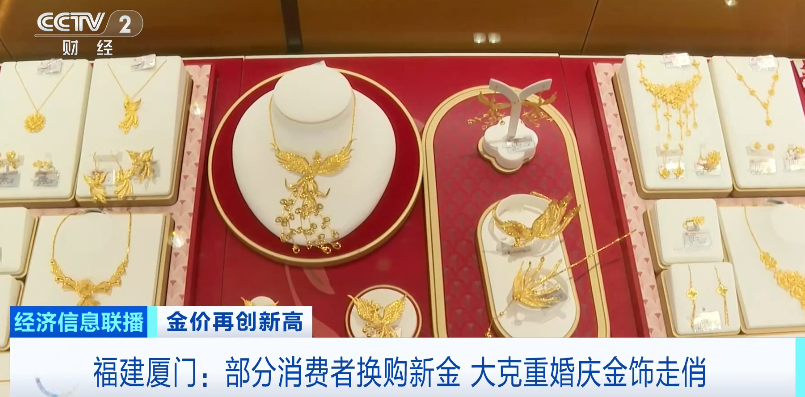
Group 1: Gold Price Trends - The international gold price has risen significantly, leading to an increase in domestic gold jewelry prices, with some brands reaching 1100 yuan per gram as of September 23 [1] - The current high gold prices coincide with the traditional consumption peak season, prompting changes in consumer behavior in the gold market [1] Group 2: Consumer Behavior in Xiamen - In Xiamen, there is a notable trend of consumers opting for larger wedding gold ornaments, with heavier pieces (35-50 grams) currently in high demand and often sold out [5][7] - Many consumers are bringing old gold to exchange for new pieces, taking advantage of promotions that waive additional costs except for labor fees [7] Group 3: Product Offerings and Market Dynamics - Various gold brands are launching co-branded products to capture market share, although these items often come with a premium price and are typically smaller in weight [9] - Products priced between 1000 to 3000 yuan are particularly popular, along with 1-gram gold notes and bars that appeal to younger consumers as gifts [11] Group 4: Factors Influencing Gold Prices - The recent rise in gold prices is attributed to the Federal Reserve's easing monetary policy, with market expectations for two more rate cuts this year [12] - The dollar has weakened significantly, with the dollar index dropping over 10% this year, which has positively impacted gold prices, which have increased by over 40% [12][14] Group 5: Future Market Outlook - Experts predict that the dollar may continue to weaken, as the economic advantages of the U.S. compared to emerging markets are diminishing [14] - There is a growing trend among global investors to diversify away from U.S. assets, which may further support gold prices as central banks increase their gold reserves [16]
金价飙涨原因找到了↓ 冈拉克称金价年底前达4000美元
Sou Hu Cai Jing· 2025-09-23 15:05
Core Insights - Gold prices have surged to record highs, with predictions from investor Jeffrey Gundlach suggesting that prices could reach $4,000 per ounce by the end of the year [1] Group 1: Short-term Factors - The recent increase in gold prices is primarily driven by the Federal Reserve's easing monetary policy, with market expectations for two more rate cuts of 25 basis points each in October and December [1] Group 2: Long-term Factors - The weakening of the US dollar, which has declined over 10% against a basket of six major currencies this year, is positively impacting gold prices, which have risen over 40% year-to-date [1] Group 3: Central Bank Actions - The demand for diversification in reserves among global central banks is also supporting the rise in gold prices [1]
每日机构分析:9月22日
Sou Hu Cai Jing· 2025-09-22 12:56
Group 1 - The core driver of market growth is a loose financial environment, supported by expectations of Federal Reserve rate cuts and fiscal stimulus providing ample buyback funds for companies [1] - The Swedish central bank is expected to maintain its policy rate at 2.0%, indicating that the current rate cut cycle may have ended due to persistent inflation and alleviated economic concerns [1] - Goldman Sachs analysts noted that the weak performance of the Korean won is partly due to domestic retail investors withdrawing funds from the stock market and reduced foreign exchange hedging by the National Pension Service [1] Group 2 - Monex Europe suggests that if the Federal Reserve implements faster and larger rate cuts, the USD/CAD exchange rate may decline in the medium term, driven by risk sentiment and U.S. data in the short term [2] - The Swiss National Bank is taking a cautious approach to negative interest rates, with expectations of a strong Swiss franc supported by progress in U.S.-Swiss trade negotiations [2] - Julius Baer indicates that the Bank of Japan's gradual exit from ETF and REIT holdings will have minimal long-term impact on the stock market due to the small proportion of holdings [2] Group 3 - Historical data shows that emerging market bonds have averaged returns of 6%-8% following Federal Reserve rate cuts, with a current overweight in emerging market assets by JPMorgan Asset Management [3] - The actions of the Federal Reserve have reinforced expectations of a weaker dollar and lower interest rates, benefiting both emerging market equities and bonds [3] - There is a clear demand for non-dollar assets, with investors showing unprecedented interest in emerging market local currency bonds since 2012, indicating a need for diversified allocations [3]


期货收评:沪银涨超3%,沪金、集运欧线涨超2%,沪锡、菜粕、豆二、豆粕涨超1%;多晶硅跌3%,LPG、硅铁跌2%
Sou Hu Cai Jing· 2025-09-22 07:36
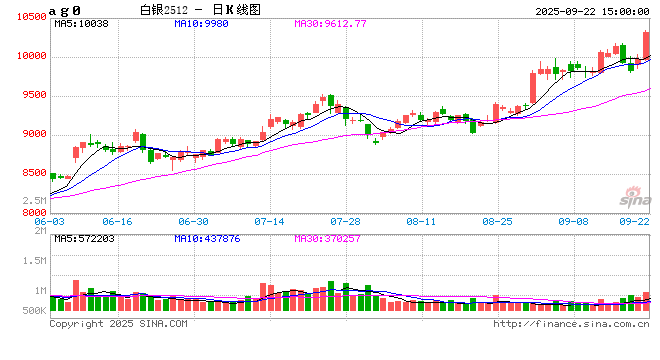
Group 1 - The price of silver has surpassed $43.50 per ounce, reaching a new high since August 2011, while the main contract for silver in Shanghai rose by over 4%, breaking through 10,336.00 yuan per kilogram, setting a historical record [1] - HSBC's precious metals analyst James Steel noted that the price increase has attracted buyers of silver, particularly those who have not fully capitalized on the rise in gold prices [2] - The global trade landscape is shifting, with threats to the independence of the Federal Reserve and a weakening dollar, leading investors to flock to gold and silver markets [2] Group 2 - On September 22, domestic main contracts showed mixed results, with Shanghai silver rising over 3%, while Shanghai gold and European shipping contracts increased by over 2% [3] - Other commodities such as tin, soybean meal, and rubber also saw increases of over 1%, while polysilicon dropped over 3%, and LPG and silicon iron fell by more than 2% [3]
高盛:继续超配中国股票市场
Sou Hu Cai Jing· 2025-09-19 12:55
Group 1 - Goldman Sachs expects the Federal Reserve to continue cutting interest rates, with anticipated cuts in October and December, ultimately reaching a level of 3.0%-3.25% by mid-2026, aligning with market consensus [1] - A weaker US dollar is projected to create a favorable environment for Asian stock markets, leading Goldman Sachs to maintain an overweight position in Chinese stocks [1] Group 2 - Goldman Sachs views the current valuation of the A-share market as supportive, with improved retail investor sentiment and an expected annual profit increase of approximately 2% for companies due to ongoing "anti-involution" policies [2] - The firm has not changed its industry allocation in the past two months, remaining optimistic about the internet sector and has overweighted the insurance and materials sectors since July [2] - Recent liquidity in the A-share market is supported by domestic institutions such as insurance, pension funds, and public funds, as well as participation from emerging markets and Asia-Pacific mutual funds, indicating a more resilient liquidity environment [2]
大和:若美元弱势持续,将在年底前为A股及港股带来支持
Sou Hu Cai Jing· 2025-09-19 08:58
Core Insights - The report from Daiwa emphasizes that the weakening of the US dollar has a more significant impact on emerging markets, A-shares, and Hong Kong stocks than potential interest rate cuts by the Federal Reserve [1] - A "soft landing" for the US economy would be beneficial for emerging market equities, while weak US economic data could prolong dollar weakness, increasing demand for currency hedging and enhancing liquidity support for emerging markets and the Chinese market by the end of 2025 [1] Market Conditions - The Asian market is currently in a risk-on environment, with the MSCI Asia Pacific (excluding Japan) index rising approximately 10% since July [1] - Key drivers for this market performance include easing geopolitical risks, favorable regional policies, and market expectations regarding the potential resumption of the Federal Reserve's interest rate cut cycle [1]
光伏产业发展推动银价上涨趋势
Jin Tou Wang· 2025-09-19 04:20
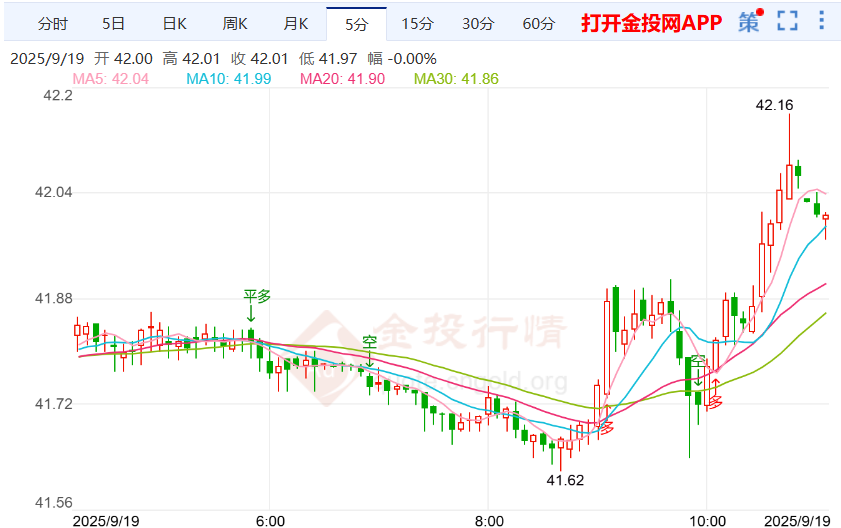
Core Viewpoint - The international silver market is experiencing a bullish trend, supported by lower interest rates and strong demand from the photovoltaic industry, despite some geopolitical risks limiting further price increases [3]. Group 1: Market Conditions - The Federal Reserve announced a 25 basis point interest rate cut in September, the first since December of the previous year, indicating potential further cuts within the year [3]. - Lower interest rates reduce the opportunity cost of holding non-yielding assets, providing support for silver prices [3]. - The international silver is currently trading above $41.95, with a recent high of $42.16 and a low of $41.62 [1]. Group 2: Demand Factors - The rapid development of the photovoltaic industry continues to drive demand for silver, as it is a core material in this sector [3]. - Recent market surveys indicate that the Saudi sovereign wealth fund has been increasing its holdings in silver ETFs, reflecting confidence from large institutional investors in the long-term value of precious metals [3]. Group 3: Geopolitical Influences - A reduction in geopolitical risks has limited the safe-haven premium for silver, with easing tensions in the Russia-Ukraine conflict contributing to a decrease in risk sentiment [3]. - U.S. President Trump expressed that the resolution of the Russia-Ukraine conflict is more complex than expected, but he remains hopeful about recent positive developments [3]. Group 4: Technical Analysis - Key support and resistance levels for silver are identified at $41 and $40.5, with expectations of high-level fluctuations within a bullish trend [3]. - The market is advised to focus on resistance levels at $42.00 and $42.30, while support levels are noted at $41.25 and $40.90 [3].
美联储降息25个基点,年内还有两次降息
Sou Hu Cai Jing· 2025-09-18 00:37
Core Points - The Federal Open Market Committee (FOMC) announced a 25 basis point interest rate cut, lowering the target range for the federal funds rate from 4.25%-4.5% to 4.00%-4.25%, marking the first rate cut of the year [1][2] - The FOMC's dot plot indicates two more rate cuts are expected this year, totaling 50 basis points, which is one more than previously forecasted in June [2][6] - The market reacted sharply to the announcement, with mixed results in major U.S. stock indices [2] Economic Outlook - The FOMC noted a slowdown in economic activity and employment growth, with a slight increase in the unemployment rate, although it remains low [1][4] - The August Personal Consumption Expenditures (PCE) price index rose 2.7% year-over-year, with core PCE up 2.9%, indicating persistent inflationary pressures [5] - The FOMC emphasized its commitment to achieving "maximum employment" and a 2% inflation target, acknowledging increased risks to employment [4][5] Market Reactions - The U.S. dollar index experienced significant volatility, initially dropping to a new low since 2025 before rebounding [3][9] - Investors are increasingly looking to hedge against a weakening dollar, with a survey indicating 38% of fund managers seeking to increase hedging positions [9][10] - The Chinese yuan strengthened against the dollar, reaching a near 10.5-month high, influenced by expectations of further rate cuts by the Fed [10] Federal Reserve Dynamics - The FOMC's decision was passed with 11 votes in favor and 1 against, with the dissenting vote coming from newly appointed member Stephen Milan, who favored a larger cut [6][7] - Concerns about the independence of the Federal Reserve have been raised due to political pressures, particularly from President Trump [6][7] - The FOMC's economic projections show an increase in GDP growth expectations and a decrease in unemployment rate forecasts for the coming years [8]
业内人士:AH溢价处于合理水平
Sou Hu Cai Jing· 2025-09-17 23:58
Group 1 - The Hong Kong stock market continues to rise, while the AH premium has reached a phase low, leading to a divergence in opinions regarding the overvaluation of Hong Kong stocks [1] - Some industry insiders believe that the current AH premium is at a reasonable level based on the existing exchange rate and market environment, with potential for further narrowing of the AH premium amid a mid-term trend of RMB appreciation and USD weakening [1] - Hong Kong assets may benefit from abundant global liquidity and the return of foreign capital, especially if the US further cuts interest rates to improve global liquidity and AI companies continue to deliver strong performance [1]