
红利资产

Search documents
2025年8月电量点评:高基数扰动需求,后续电量有望维持高增
Orient Securities· 2025-09-25 06:20
Investment Rating - The report maintains a "Positive" outlook for the utility sector [7] Core Insights - The report indicates that the decline in electricity consumption growth in August 2025 is primarily due to a high base effect from August 2024, rather than a weakening demand [7] - It is expected that electricity consumption will maintain rapid growth from September to December 2025 as the base effect dissipates [7] - The report highlights that the electricity consumption growth rate for August 2025 was +5.0%, a decrease of 3.6 percentage points from July 2025, with a two-year CAGR of +6.9% [7] - The report notes that the electricity consumption growth rates for different sectors in August 2025 were +9.7% for primary industry, +5.0% for secondary industry, +7.2% for tertiary industry, and +2.4% for residential use [7] - The report anticipates that the growth rate of hydropower generation will improve marginally in the future, despite a decline in August 2025 [7] Summary by Sections Electricity Consumption - Cumulative electricity consumption from January to August 2025 increased by +4.6% year-on-year [10] - The cumulative electricity consumption for the primary industry was +10.6%, secondary industry +3.1%, tertiary industry +7.7%, and residential use +6.6% [13][17] Power Generation - Cumulative power generation from January to August 2025 increased by +1.5% year-on-year [18] - Cumulative thermal power generation decreased by -0.8%, while hydropower generation decreased by -5.5% [20] - Cumulative nuclear power generation increased by +10.1%, wind power by +11.6%, and photovoltaic power by +23.4% [22] Investment Recommendations - The report suggests a positive outlook for the utility sector, emphasizing the attractiveness of dividend assets in the current low-interest-rate environment [7] - Specific recommendations include focusing on thermal power, hydropower, nuclear power, and wind/solar power sectors, with identified stocks for potential investment [7]
多位基金经理热议市场机会,谢治宇、董承非等重磅发声
天天基金网· 2025-09-25 03:00
Core Viewpoint - The article emphasizes the increasing attractiveness of equity assets in the A-share market, driven by favorable policy support, liquidity, and improving market sentiment, suggesting a potential for further market expansion in various sectors such as technology, new energy, and cyclical stocks [3][4][5]. Group 1: Market Performance and Trends - The A-share market has shown significant performance, with active stock funds and mixed equity funds reporting net value growth rates of 58.17% and 56.98% respectively over the past year [4]. - The technology sector has been a leading driver of market recovery, with AI and semiconductor industries highlighted as key areas for investment [6][7]. - The new energy sector, particularly solid-state batteries, is experiencing a strong recovery due to policy support and technological advancements, indicating a favorable investment environment [7]. Group 2: Investment Strategies and Insights - Fund managers suggest that the current low-risk yield environment necessitates the inclusion of risk assets in investment portfolios to achieve higher returns, with equities being particularly attractive [5]. - A focus on companies with strong competitive advantages is recommended to ensure better performance during market fluctuations [8]. - The "fixed income plus" products are highlighted as a strategy to balance stable bond returns with the potential for higher equity returns, aiming for a robust investment experience [9].


港股开盘 | 恒指高开0.07% 奇瑞汽车(09973)上市首日高开超11%
智通财经网· 2025-09-25 01:37
Group 1 - The Hang Seng Index opened up 0.07%, while the Hang Seng Tech Index fell by 0.13%. Chery Automobile saw a first-day increase of over 11%, Zijin Mining rose nearly 4%, and JD Group increased by nearly 2% [1] - Huatai Securities reported that the recent rebound in Hong Kong tech stocks is driven by accelerated domestic AI developments, with the Hang Seng Tech Index and Hang Seng Hong Kong Stock Connect Tech Index rising nearly 20% since July [1] - CITIC Securities indicated that Hong Kong stocks are expected to see a bottoming out of earnings in the first half of 2025, with revenue and profit growth rates recorded at 1.9% and 4.6% respectively as of September 15 [1] Group 2 - CITIC Securities forecasts a turning point in earnings growth for Hong Kong stocks in the second half of 2025, with high growth expected in materials, healthcare, and technology sectors, while sectors like energy and consumer staples may see a turnaround [2] - CITIC Jiantou noted that the anticipated interest rate cuts by the Federal Reserve will directly benefit Hong Kong stocks, with ample liquidity and continued inflow of southbound funds [2] Group 3 - Guotai Junan's report emphasized that dividend assets are characterized by stable performance and sustainable cash flows, providing investors with stable high dividend returns, with Hong Kong stocks offering better value compared to A-shares [3] - The average cash dividend ratio for all Hong Kong stocks from 2017 to 2024 is 44%, higher than A-shares at 36%, and the dividend yield for the Hang Seng Composite Index is 2.9%, compared to 1.9% for the Wind All A Index [3] - Hong Kong's high dividend assets have a lower valuation level, with the Hang Seng High Dividend Yield Index PE and PB at 7.2 times and 0.6 times respectively, lower than the CSI Dividend Total Return Index at 7.9 times and 0.8 times [3]


华创交运|红利资产月报(2025年9月):不乏股息率5%优质标的,重视交运红利投资价值-20250924
Huachuang Securities· 2025-09-24 14:42
Investment Rating - The report maintains a "Buy" recommendation for transportation dividend assets, highlighting the presence of quality stocks with a dividend yield of over 5% [1]. Core Viewpoints - The transportation sector has underperformed relative to the CSI 300 index and the transportation index, with a cumulative decline of 0.3% from September 1 to September 22, 2025 [4][8]. - The report emphasizes the importance of dividend assets in the transportation sector, particularly in a low-interest-rate environment, which has led to a significant increase in trading volumes for ports [25][28]. - The report identifies several high-quality stocks with attractive dividend yields, such as Sichuan Chengyu (5.3%) and Tangshan Port (5.2%) [4][73]. Monthly Market Performance - The transportation sector's performance from September 1 to September 22, 2025, shows declines in highway, railway, and port segments, with cumulative changes of -5.25%, -2.76%, and -0.86%, respectively [4][9]. - Year-to-date performance indicates that highway, railway, and port segments have also underperformed, with cumulative changes of -14.95%, -11.4%, and -3.56% [9]. Market Environment - The report notes a continued low-interest-rate environment, with the 10-year government bond yield at 1.86% as of September 22, 2025, reflecting a slight increase from the previous month [25][28]. - Trading volumes for transportation assets have seen significant growth, with average daily transaction values for highways, railways, and ports increasing by 8.4%, 25.6%, and 104%, respectively [28]. Industry Data - Highway passenger volume in July 2025 was 950 million, a year-on-year decrease of 4.6%, while freight volume increased by 3.3% to 3.699 billion tons [34]. - Railway passenger volume in July 2025 reached 455 million, a year-on-year increase of 6.6%, with freight volume at 45.2 million tons, up 4.5% [46]. - Port cargo throughput for the four weeks ending September 21, 2025, was 1.063 billion tons, a year-on-year increase of 7.0% [54]. Investment Recommendations - The report suggests focusing on high-dividend stocks in the highway sector, particularly Sichuan Chengyu and Anhui Wantong, which have shown stable performance and growth potential [73]. - In the port sector, the report recommends companies like China Merchants Port and Tangshan Port for their high dividend yields and growth prospects [73]. - For the railway sector, it highlights the potential of assets like the Beijing-Shanghai High-Speed Railway and the Daqin Railway, which are expected to benefit from long-term reforms and dividend growth [73].
港股开盘 | 恒指低开0.33% 科网股多数下跌
智通财经网· 2025-09-24 01:35
Group 1: Hong Kong Stock Market Outlook - The Hang Seng Index opened down 0.33%, and the Hang Seng Tech Index fell by 0.54%, with most tech stocks declining [1] - CITIC Securities reports that Hong Kong stocks are expected to stabilize and achieve positive growth in the first half of 2025, with revenue and profit growth rates recorded at 1.9% and 4.6% respectively [1] - The second half of 2025 is anticipated to see a turning point in performance growth, with sectors like materials, healthcare, and technology maintaining high prosperity, while previously underperforming sectors such as energy and consumer staples are expected to rebound [1] Group 2: Monetary Policy Impact - CITIC Jiantou indicates that the Federal Reserve's interest rate cuts will directly benefit the Hong Kong stock market, with ample liquidity and continuous inflow of southbound funds [1] - The AI narrative, particularly in Alibaba Cloud's strong performance and the strengthening of self-developed chips in internet companies, highlights sectors with strong industrial logic that warrant ongoing attention [1] Group 3: Dividend Assets Comparison - According to Guotai Junan, dividend assets are characterized by stable performance and sustainable cash flow, providing investors with stable high dividend returns [2] - Hong Kong stocks offer better value compared to A-shares, with a cash dividend ratio averaging 44% from 2017 to 2024, significantly higher than A-shares' 36% [2] - The dividend yield for the Hang Seng Composite Index is 2.9%, compared to 1.9% for the Wind All A Index, indicating a clear advantage for Hong Kong stocks [2] - Valuation levels for Hong Kong dividend assets are lower, with the Hang Seng High Dividend Yield Index PE and PB at 7.2 times and 0.6 times respectively, compared to 7.9 times and 0.8 times for the CSI Dividend Total Return Index [2] - The proportion of high dividend assets in Hong Kong is higher, with a more diverse industry distribution compared to A-shares, which are primarily concentrated in banking and petrochemical sectors [2]


全国药品集中采购文件发布,可关注哪些机会?
Datong Securities· 2025-09-23 09:38
Market Review - The equity market showed mixed performance last week, with the ChiNext Index rising by 2.34%, while the Shanghai Composite Index fell by 1.30% [4][5] - The bond market experienced a rise in long-term interest rates, with the 10-year government bond yield increasing by 1.19 basis points to 1.879% [7][10] - The consumer medicine sector saw a collective pullback, with several industries experiencing declines, particularly banking and non-ferrous metals [4][5] Equity Product Allocation Strategy - Event-driven strategies include focusing on funds related to the national drug centralized procurement document, which includes 55 drugs and is set to open bidding on October 21 [15][19] - The report highlights specific funds to consider, such as 工银医药健康 A (006002) and 嘉实互融精选 A (006603), which are positioned to benefit from the new procurement policies [19] - The overall asset allocation strategy suggests a balanced core with a barbell approach, emphasizing dividend and technology sectors [20][21] Stable Product Allocation Strategy - The report notes a net injection of 11,623 billion yuan by the central bank, indicating a tight funding environment due to tax periods [24] - The adjustment of the 14-day reverse repurchase mechanism to an American-style bidding process aims to enhance liquidity management [25] - The report also mentions the need to monitor convertible bonds for volatility risks, as their pricing has recently shown increased fluctuations [25][27] Key Focus Products - The report recommends focusing on short-term bond funds while lowering yield expectations, given the current market conditions [27] - Specific funds highlighted include 诺德短债 A (005350) and 国泰利安中短债 A (016947), which are positioned for stable returns [30]
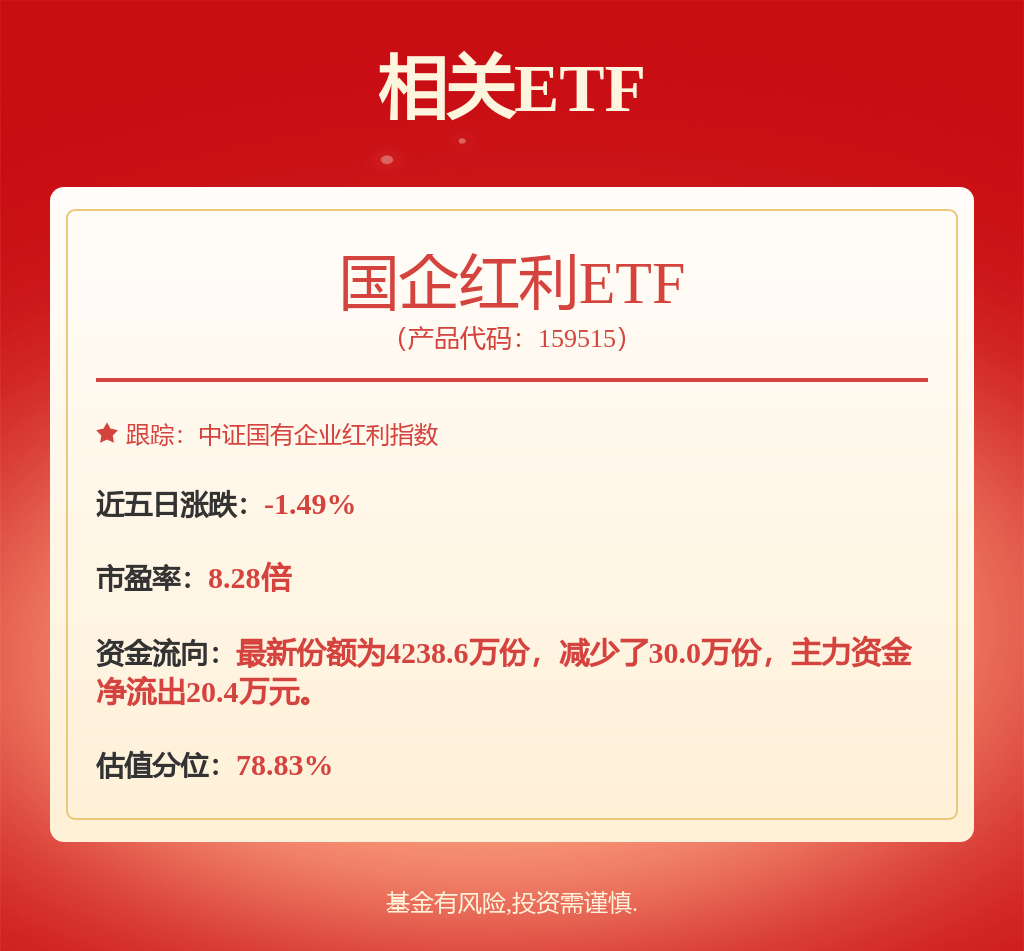
如何看待红利板块本轮调整?国企红利ETF(159515)午后小幅翻红
Sou Hu Cai Jing· 2025-09-23 06:58
Group 1 - The core viewpoint of the articles highlights the contrasting performance of the state-owned dividend sector against the broader market trends, with the dividend ETF showing a slight increase while major indices decline [1] - The dividend index has been a "safe haven" in the market from early this year until mid-May, but has faced significant adjustments since July due to increased market volatility and a shift in investor preference towards growth sectors [1] - Market analysts suggest that the recent adjustments in the dividend sector are influenced by multiple factors, including policy catalysts, defensive demand in a weak market, rising resource prices, and increased allocation from insurance funds [1] Group 2 - Long-term perspectives from institutions remain optimistic about the dividend sector, with a focus on the current low point of PPI and the potential for industry profits to recover [2] - The state-owned dividend index combines themes of state-owned enterprises and dividend strategies, enhancing the effectiveness of investment strategies through a synergistic effect [2] - As state-owned enterprise reforms deepen, improvements in profitability and operational efficiency are expected, making the dividend ETF an attractive investment option for those seeking quality state-owned enterprises with strong earnings and low valuations [2]
市场震荡整理,红利资产获部分资金关注,中证红利ETF(515080)近9日累计“吸金”超4.3亿元
2 1 Shi Ji Jing Ji Bao Dao· 2025-09-23 02:21
Group 1 - The market is currently in a period of fluctuation and consolidation, with dividend assets attracting attention from some funds as the double holiday approaches [1] - The CSI Dividend ETF (515080) has seen a net inflow of over 430 million yuan over the past nine days, indicating strong investor interest [1] - The CSI Dividend Index has a current dividend yield of 4.68%, significantly higher than the 1.876% yield of ten-year government bonds, suggesting a favorable investment opportunity [1] Group 2 - According to Dongfang Securities, the index is expected to experience short-term fluctuations but maintains a medium-term upward trend, with a focus on high-end manufacturing and low-cycle dividend stocks [2] - The macroeconomic environment is currently at a low point for PPI, with expectations of recovery in PPI and industry profitability, indicating potential investment opportunities [2] - Companies with cleared supply and profit elasticity in industries undergoing policy changes may present attractive dividend opportunities [2]
港股开盘 | 恒指高开0.35% 消费电子概念持续活跃
智通财经网· 2025-09-23 01:40
Group 1 - The Hang Seng Index opened up 0.35%, with the Hang Seng Tech Index rising 0.21%, indicating a positive market sentiment in Hong Kong stocks, particularly in the technology sector [1] - Huatai Securities reported that the recent rebound in Hong Kong tech stocks is driven by accelerated domestic AI advancements, with the Hang Seng Tech Index rising nearly 20% since its low in July [1] - Citic Securities forecasts that Hong Kong stocks will see a performance bottoming out in the first half of 2025, with revenue and profit growth rates recorded at 1.9% and 4.6% respectively as of September 15 [1] Group 2 - Citic Securities predicts a turning point in performance growth for Hong Kong stocks in the second half of 2025, with sectors like materials, healthcare, and technology expected to maintain high growth [2] - The report from Citic Jinpu highlights that the anticipated interest rate cuts by the Federal Reserve will directly benefit Hong Kong stocks, with a focus on sectors driven by AI and self-developed chips [2] Group 3 - According to Guotai Junan, dividend assets are characterized by stable performance and sustainable cash flows, providing investors with high dividend returns, with Hong Kong stocks offering better value compared to A-shares [3] - The average cash dividend ratio for Hong Kong stocks from 2017 to 2024 is 44%, higher than A-shares at 36%, and the dividend yield for the Hang Seng Composite Index is 2.9%, compared to 1.9% for the Wind All A Index [3] - Hong Kong's high dividend assets have a lower valuation level, with PE and PB ratios of 7.2 and 0.6 respectively, which are lower than those of the CSI Dividend Total Return Index [3]
煤炭逆势大涨,如何看待此时煤炭投资机会
2025-09-22 01:00
Summary of Coal Industry Conference Call Industry Overview - The coal industry is experiencing a significant increase in prices despite a reduction in production, with national raw coal output in the first half of 2025 decreasing by 80 million tons year-on-year, indicating a contraction in supply [1][2][6] - The overall electricity consumption is expected to maintain at least a 5% growth rate in the coming years, driven by emerging sectors and urban residents' electricity usage [1][7] Key Points Supply and Demand Dynamics - The coal market's fundamentals have exceeded market expectations, with a notable recovery in electricity consumption growth from 2.5% in Q1 to 8.6% in July 2025 [2] - The manufacturing sector's contribution to electricity consumption has decreased to only one-third, while the tertiary sector and urban residents' electricity usage are rapidly increasing [3][4] - The coal industry has seen a significant reduction in overproduction, with only 15 companies reporting overproduction this year, reflecting a large-scale voluntary production cut [8] Price Trends - The average coal price for 2025 is projected to be around 700 RMB per ton, which is better than market expectations, with forecasts suggesting it could rise to 750 RMB in 2026 and potentially exceed 800 RMB in 2027 [1][9] - The coal price has improved as companies have reduced production to enhance the supply-demand balance, alleviating previous downward risks [9] Future Outlook - The competition from thermal power is expected to ease as new energy policies shift focus towards high-quality development, leading to a significant drop in photovoltaic installations [5] - The demand for thermal coal is anticipated to grow due to factors such as extreme weather, increased electrification, and the rising need for energy from sectors like AI and electric vehicles [10][12] - The global energy market is expected to see a rise in natural gas power plant utilization and a resurgence in coal power to meet increasing electricity demands [11][12] Investment Opportunities - Companies such as Jinko Coal, China Coal Energy, Yancoal, Shaanxi Coal, and China Shenhua are recommended as they align with the trends of dividend yield and state-owned enterprise reform [17] - The strategic value of thermal coal is recognized, with expectations that overseas coal prices will drive domestic prices upward, making it a favorable investment area [13] Policy and Regulatory Environment - The National Energy Administration has taken a firm stance against overproduction, indicating a clear intent to stabilize supply and prices [6] - The ongoing state-owned enterprise reforms are expected to create a ripple effect across the industry, with companies likely to follow China Shenhua's lead in asset acquisitions and restructuring [15][16] Additional Insights - The coal sector is positioned to benefit from the global shift towards energy security and the need for reliable power sources amid increasing demand from various sectors [10][11] - The impact of U.S. interest rate cuts has enhanced the attractiveness of global dividend assets, with China Shenhua's stock reaching historical highs [14]