全球化

Search documents
研报掘金丨爱建证券:维持长安汽车"买入"评级,2026年新能源车目标140万辆
Ge Long Hui· 2026-01-08 05:33
Core Viewpoint - Chang'an Automobile's brand enhancement and overseas expansion are expected to drive sales growth in 2026, with a focus on new energy vehicles and globalization as dual main lines for 2025, achieving a sales target completion rate of 97% [1] Sales Targets - The target for new energy vehicles in 2026 is set at 1.4 million units, representing a year-on-year increase of 26.2% [1] - The overseas sales target for 2026 is 750,000 units, reflecting a year-on-year growth of 17.7% [1] Product Development and Investment - Over the next five years, the company plans to launch more than 50 new energy vehicle models, including over 7 models priced above 300,000 yuan [1] - The company will invest over 200 billion yuan in new vehicle development over the next decade and expand its technology innovation team by more than 10,000 personnel [1] Emerging Industries and Future Plans - The company plans to release its first manned flying car in 2026 and achieve solid-state battery installation verification [1] - Full-scale production of solid-state batteries is expected to begin in 2027, with flying cars set for mass production and humanoid robots to roll off the production line in 2028 [1] - Commercial operation of flying cars is anticipated by 2030 [1] Strategic Initiatives - The company is systematically advancing electric intelligence and globalization through three strategic plans, with forward-looking layouts in robotics and flying car businesses, maintaining a "buy" rating [1]

光大证券:维持毛戈平(01318)“买入”评级 与路威凯腾达成战略合作 进一步迈向全球化
智通财经网· 2026-01-08 02:03
Group 1 - The core viewpoint of the article is that 毛戈平 maintains a "buy" rating due to its strategic partnership with global consumer investment giant 路威凯腾, which will assist in expanding overseas high-end channels and establishing a beauty industry investment fund [1] - 毛戈平 signed a strategic cooperation framework agreement with 路威凯腾 on January 7, focusing on global market expansion, acquisitions, strategic investments, capital structure optimization, talent introduction, and governance [1] - 路威凯腾 will leverage its global investment layout and strategic partner network to help 毛戈平 expand its overseas high-end retail channels and jointly establish an equity investment fund focused on the global high-end beauty sector [2] Group 2 - 路威凯腾 has extensive investment experience in the global consumer goods sector, managing approximately $39 billion in equity capital and having invested in over 300 well-known consumer brands globally [2] - 毛戈平 has shown strong sales performance in 2025, with a 32% year-on-year increase in sales across major platforms, with notable growth on 抖音 (50%) and 京东 (70%) [3] - The company is reinforcing its high-end beauty positioning, with a new skincare series set to launch in December 2025 [3]

realme为何在此时回归OPPO?
Tai Mei Ti A P P· 2026-01-08 01:26
"这是为进一步协同作战、整合资源......未来,OPPO与realme、一加将共同为全球用户提供更具创新力 和差异化的产品,以及更便捷周到的服务。"上述人士如此表示。 智通财经也在报道中指出,realme回归OPPO后将与一加合并,realme CEO 李炳忠(Sky Li)将领导整 体子品牌业务,一加中国区总裁李杰职责不变。 此后,一加将专注国内和部分海外线上市场,非中国区海外市场由realme和主品牌OPPO承接。 从现有信息看,realme回归OPPO,尚未涉及到更深层次的高管变动及组织架构调整。 realme新品也将如期发布,同时将全面接入OPPO售后服务体系。真我已于1月5日官宣,其2026年首款 新品真我Neo 8将于本月发布。 文 | 听潮TI,作者 | 许雯雯,编辑 | 张晓 1月7日,多家媒体报道,智能手机品牌realme将回归OPPO,成为旗下子品牌。 听潮TI已向OPPO相关人士证实,此消息属实。 从一加到realme:不同的市场环境、相似的回归剧本 市场对realme回归OPPO不算陌生,一加也走过相似的路径: 不同的市场环境下,核心高管脱离OPPO体系独立创业,做出一定成绩、被市场 ...


中国汽车出海的下半场:长城汽车在CES证明 光有车是不够的
Feng Huang Wang· 2026-01-08 01:20
Core Viewpoint - The article highlights how Great Wall Motors is using the CES platform not only to showcase its products but also to convey a deeper cultural narrative, emphasizing the importance of global dialogue and understanding in the automotive industry [2][6]. Group 1: CES as a Platform - CES serves as a critical platform for Chinese automotive brands, acting as a verification ground for hard and soft strengths, and is considered an essential course for those aiming for global presence [2]. - Great Wall Motors' chairman emphasizes the necessity of engaging with global peers and media, indicating that globalization is a survival issue rather than a choice [2]. - The company aims to present itself not as having arrived but as being on a journey, fostering a mindset of humility and openness [2]. Group 2: Technology and Philosophy - Great Wall Motors showcases its Hi4 technology system, which reflects a philosophy rooted in ancient Chinese wisdom, particularly the principles of the Dujiangyan irrigation system [3]. - The Hi4 technology emphasizes collaboration between different power sources rather than seeking extreme output from a single source, aligning with the idea of guiding energy efficiently [3]. - This approach is seen as transcending mere technical specifications, offering a systemic solution that resonates with global values of efficiency and harmony [3]. Group 3: Cultural Engagement - The inclusion of Yunnan highland coffee at the CES booth serves as a cultural bridge, allowing for informal interactions and discussions beyond just technology [5]. - This initiative aims to break stereotypes about Chinese companies, presenting Great Wall Motors as a brand that understands life and emotions, which is crucial for building brand loyalty [5]. - The overall experience at the CES booth integrates technology, products, and culture, creating a holistic narrative that enhances the brand's appeal [5]. Group 4: Globalization and Wisdom Sharing - The article discusses how Chinese automotive brands are evolving from merely exporting products to sharing cultural and intellectual wisdom on a global scale [6]. - Great Wall Motors' approach illustrates that globalization involves not just market expansion but also deepening civilizational dialogue, requiring both hard and soft strengths [6]. - The interactions at CES signify a new phase in globalization for Chinese brands, moving from cost-effective products to technology and cultural wisdom [6]. Conclusion - The dialogue initiated at CES may have lasting implications, as Great Wall Motors presents a proposal for harmonious coexistence with nature, users, and the world [7]. - The experiences shared at CES reflect a new potential for Chinese automotive brands, characterized by depth and warmth, which may represent the ideal form of globalization [7].


【重磅深度】乘用车电动化复盘:拥抱变化
东吴汽车黄细里团队· 2026-01-07 12:21
Investment Highlights - The automotive market began to show an upward trend in 2020 despite the pandemic, primarily due to a year-on-year increase in industry sales and a significant turning point in the penetration rate of new energy vehicles (NEVs), which led to a notable increase in the market share of domestic brands [2][26] - The core turning point for NEV penetration was driven by the localization of Tesla, with the Model 3 quickly becoming a best-seller, and improvements in the economic viability of the supply chain leading to a diverse supply [2][36] Historical Index Trends - In May 2021, the electric vehicle logic remained strong with a penetration rate of about 10%, and demand did not weaken despite a chip shortage that began in early 2021. The market anticipated a gradual easing of supply issues by July-August [3][45] - By May 2022, the penetration rate had increased to approximately 25%, with the resumption of production in lockdown areas and the implementation of tax reduction policies, which contributed to an upward trend in the index [3][48] - In February 2024, a shift in supply-demand dynamics occurred, leading to a price war initiated by Tesla's significant price cuts. The market began to rebound, with BYD's price reduction strategy proving effective [4][51] Profitability and Valuation Changes - The profitability of the automotive sector under the NEV trend has not significantly improved compared to the traditional fuel vehicle era, as selling NEVs has not altered the industry's business model, which remains rooted in manufacturing logic [5][56] - The valuation center for the automotive sector has shifted upward, with the price-to-sales (PS) ratio moving from a maximum of 2x during the fuel vehicle era to a current center of 1x, driven by increased market share and high-end breakthroughs of domestic brands [5][57] Competitive Factors in the NEV Era - The competition among automotive companies is characterized by a focus on hard power in the early stages, with soft power becoming more relevant later. The core competitive factors have evolved through different phases, including supply chain integration, electric vehicle technology, and marketing capabilities [6][60] - The first phase (2021-2022) emphasized supply chain advantages, while the second phase (2023) shifted towards electric vehicle technology and product definition capabilities, leading to a price war [6][60] - By 2025, the growth rate of NEV penetration is expected to slow down, with the main competitive logic focusing on imitating and surpassing leading NEV companies [7][60] Stock Performance Review - A review of stock performance from 2020 to 2025 indicates that early in the NEV development phase, the market had high expectations for leading companies from the previous cycle, while later periods required identifying emerging players based on changing competitive factors [8][20] - Notable stock performances include Seres as a tenfold stock, Jianghuai with an eightfold increase, and BYD with a fivefold increase, highlighting the importance of recognizing industry trends and selecting the best-performing stocks [8][20]



长安汽车(000625):品牌向上+海外放量助力2026年销量增长
Shanghai Aijian Securities· 2026-01-07 09:40
Investment Rating - The investment rating for the company is "Buy (Maintain)" [4] Core Views - The company is expected to achieve significant sales growth driven by brand enhancement and overseas expansion, with a target of 3.3 million units sold in 2026, representing a year-on-year increase of 13.3% [5] - The company aims to sell 1.4 million new energy vehicles in 2026, a year-on-year increase of 26.2%, and 750,000 units in overseas markets, a year-on-year increase of 17.7% [5] - The company plans to invest over 60 billion yuan in new energy and digital platforms, as well as global R&D capabilities, to accelerate its strategic transformation [5] Financial Data and Profit Forecast - Total revenue (in million yuan) is projected to be 151,298 in 2023, increasing to 203,333 by 2027, with a compound annual growth rate (CAGR) of 11.9% [3] - Net profit attributable to the parent company (in million yuan) is forecasted to decline from 11,327 in 2023 to 4,662 in 2025, before recovering to 8,669 in 2027 [3] - Earnings per share (in yuan) are expected to decrease from 1.14 in 2023 to 0.47 in 2025, then rise to 0.87 in 2027 [3] - The gross profit margin is projected to fluctuate from 18.4% in 2023 to 15.3% in 2027 [3] - Return on equity (ROE) is expected to decline from 15.8% in 2023 to 5.7% in 2025, then recover to 8.9% in 2027 [3] Market Data - The closing price of the stock is 11.85 yuan, with a one-year high of 14.18 yuan and a low of 11.32 yuan [4] - The price-to-earnings (P/E) ratio is projected to be 10.6 in 2023, increasing to 25.6 in 2025, and then decreasing to 13.8 by 2027 [3] - The market capitalization of circulating A shares is approximately 97,983 million yuan [4]
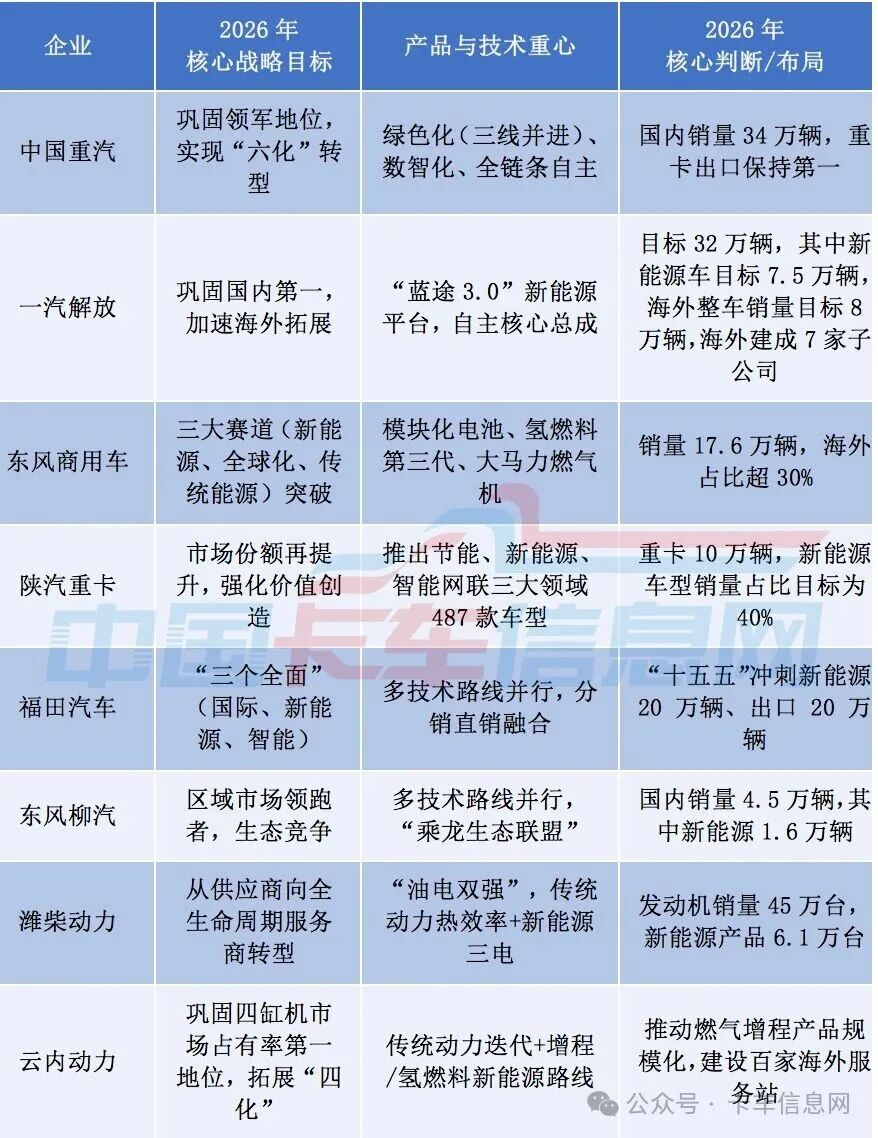
2026头部企业,要在这三个战场“定”胜负!
Xin Lang Cai Jing· 2026-01-07 01:29
Core Insights - The industry consensus indicates a shift from an incremental expansion phase to a new cycle focused on deepening the value of existing assets, with competition evolving from price-based to providing comprehensive lifecycle value (TCO) [1][9] Industry Consensus: Three Deterministic Trends - The market is expected to enter a phase of "high-level consolidation and structural differentiation," with the medium and heavy truck market projected to remain stable at 1.1 to 1.25 million units, similar to 2025, as the driving force shifts from policy stimulus to optimizing existing resources [2][10] - Three major trends have emerged as strategic anchors for all companies: 1. Accelerated penetration of new energy vehicles (NEVs), with a consensus that the penetration rate will exceed 30% and potentially reach 35% or higher by 2026, driven by market demand rather than policy [3][11] 2. Value competition is replacing price wars, with a focus on service and ecosystem as key differentiators, emphasizing the importance of a comprehensive ecosystem that includes finance, used vehicles, and connectivity [3][11] 3. Globalization is becoming a core growth driver, with exports viewed as a crucial growth engine, as companies shift from simple trade to a more integrated approach involving products, technology, services, and finance [3][11] Strategic Differentiation: Paths of Eight Major Companies - Companies are adopting different strategic focuses based on their resources and capabilities: - China National Heavy Duty Truck Corporation aims to consolidate its leading position through a comprehensive transformation strategy [4][13] - FAW Jiefang focuses on accelerating overseas expansion and enhancing its core components [4][13] - Dongfeng Commercial Vehicle targets breakthroughs in new energy, globalization, and traditional energy markets [4][13] - Shaanxi Heavy Duty Truck emphasizes value creation through a diversified product lineup [4][13] - Foton Motor is pursuing a multi-faceted strategy focusing on internationalization and new energy [4][13] - Dongfeng Liuzhou Motor is leading in regional markets through ecosystem competition [4][13] - Weichai Power and Yunnei Power are adopting a pragmatic approach by diversifying their energy technology routes [6][14] Technology Routes: Diverse Approaches Based on Application Scenarios - The commercial vehicle power technology landscape is expected to be diverse, with choices heavily influenced by application scenarios: - Traditional power is evolving towards high-end and specialized applications, focusing on improving thermal efficiency and reducing fuel consumption [7][15] - Pure electric technology is becoming the preferred choice for short-distance fixed routes, with competition centered on battery energy density and lifecycle costs [7][15] - Hybrid and range-extended technologies are seen as key solutions for long-distance logistics, with significant R&D efforts underway [7][15] - Hydrogen fuel technology is being explored as a future strategic reserve, with ongoing commercial exploration [7][15] Ecosystem Construction: From Chain Leaders to Symbiosis - Leading companies are actively reshaping the industry ecosystem, moving beyond simple supplier relationships to create a community that shares risks and values: - China National Heavy Duty Truck Corporation leverages its capabilities for strong collaboration [8][16] - Dongfeng Liuzhou Motor is integrating upstream and downstream through the "Chenglong Ecosystem Alliance" [8][16] - Weichai Power is collaborating with multiple strategic partners to create a comprehensive service system [8][16] Observations: Coexistence of Consensus and Differentiation - The 2026 Chinese commercial vehicle market is characterized by both consensus on the shift to value-based competition and differentiation in strategic paths chosen by companies [9][17] - The upcoming competition will focus on technological depth, ecosystem breadth, and precision in user operations, with companies that effectively reduce operational costs and enhance efficiency poised to lead in this transformative phase [9][17]



市场最前沿丨从车企年报透视中国汽车产业突围密码
Xin Hua Wang· 2026-01-06 15:48
Core Insights - The Chinese automotive industry is focusing on innovation, ecosystem collaboration, and market demand to achieve high-quality development, as evidenced by the recent performance of various companies [1][3]. Company Performance - BYD sold over 4.6 million vehicles in 2025, maintaining its position as the annual sales champion in China, showcasing a comprehensive breakthrough in product strength and global strategy [3]. - China FAW Group achieved over 3.3 million vehicle sales in 2025, with a 3.2% year-on-year growth, leading in both joint venture and fuel vehicle sales [3]. - Geely Automobile exceeded 3.02 million vehicle sales, achieving a historical high and surpassing its annual target [3]. - Changan Automobile, as a new state-owned enterprise, reported 2.91 million vehicle sales, marking a nearly nine-year high [3]. - Chery Group's sales surpassed 2.8 million vehicles, emphasizing innovation and user-centric product development [3]. New Entrants and Growth - Leap Motor emerged as the biggest "dark horse" in 2025, delivering nearly 600,000 vehicles, a 103% year-on-year increase, and achieving over 119% of its annual target [4]. - Huawei, leveraging its ICT expertise, collaborated with various automakers to launch popular models, delivering nearly 590,000 vehicles in 2025 [4]. - XPeng Motors delivered nearly 430,000 vehicles, achieving over 100% growth [4]. - NIO returned to a high growth trajectory in the latter half of 2025, delivering over 320,000 vehicles, a record high [6]. Future Outlook - The Chinese automotive industry is entering a new phase characterized by technological iteration, accelerated electrification, and globalization, aiming to lead in both quantity and quality [6]. - BYD plans to maintain significant R&D and financial investments to strengthen electrification and promote intelligent development, aiming to create a new growth curve [6].

义利天下|数贸新生代:自义乌,向世界
Xin Lang Cai Jing· 2026-01-06 10:13
Group 1 - The core idea of the article highlights the emergence of a new generation in Yiwu, who are not just inheritors of their parents' businesses but are actively seeking innovation and change in the global market [1] - This new generation is leveraging AI tools and integrating offline experiences with online marketing strategies to enhance their business models [1] - They are focused on creating high-quality, aesthetically pleasing products that resonate with consumers worldwide, thereby contributing to the globalization of Chinese goods [1] Group 2 - The young entrepreneurs in Yiwu are incorporating cultural elements into their designs and developing original intellectual properties (IPs) [1] - There is a strong emphasis on the significance of their exports, which are seen as improving the quality of life for consumers in various regions, including Africa [7] - The article suggests that while Yiwu's small commodities are recognized globally, there is a need for a more systematic approach to branding these products [9]

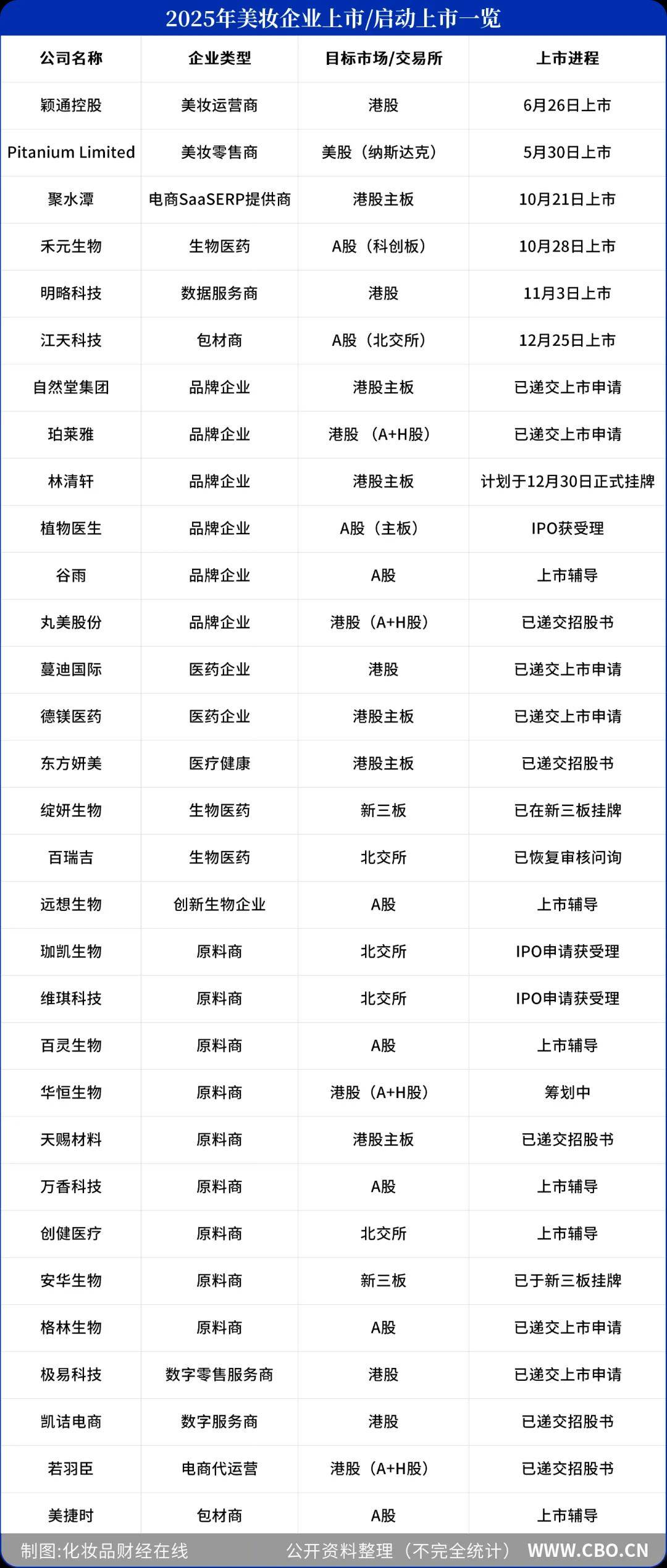
上市大年,30+企业冲刺IPO背后的进与退
Sou Hu Cai Jing· 2026-01-06 08:40
Core Insights - The Chinese beauty industry is undergoing a structural "migration" towards capital markets, with over 30 companies from the entire supply chain seeking listings on global exchanges by 2025, indicating a shift from marketing-driven growth to a focus on "hard technology" and globalization [1][6] Industry Overview - By the end of 2025, five beauty companies have successfully gone public, with over 25 others at various stages of the listing process, showcasing a comprehensive coverage of the entire supply chain [1] - The capital market is reassessing the value distribution in the beauty industry, shifting focus from marketing to upstream technology [3][11] Company Listings - A significant number of companies are targeting the Hong Kong Stock Exchange (HKEX) for their listings, with over half of the firms choosing this market due to its international characteristics aligning with their global ambitions [6][8] - Companies like Pitanium Limited have opted for the Nasdaq, focusing on high-end retail in Hong Kong, indicating a strategic choice based on business alignment and risk management [8] Capitalization Trends - The trend of companies seeking dual listings (A+H shares) reflects a complex capital strategy aimed at optimizing shareholder structure and facilitating cross-border mergers and acquisitions [8][11] - The average R&D investment for companies planning to go public has increased from less than 2% three years ago to 3-5% currently, with leading firms exceeding 5% [9][11] Supply Chain Dynamics - The focus on self-sufficient supply chains has become a priority, with companies recognizing the importance of controlling core raw materials in light of geopolitical changes and supply chain disruptions [11] - The emergence of raw material companies as pioneers in this capital wave indicates a response to industry pain points, aiming to reduce reliance on imported high-end active ingredients [11] Brand Strategies - Companies are increasingly establishing brand barriers through differentiated positioning to attract capital, with notable examples including谷雨 aiming to become the "first domestic whitening stock" and植物医生 targeting the "first single-brand beauty stock" in A-shares [5][11] - The trend of digital transformation in distribution channels is evident, with companies like聚水潭 and凯诘电商 reflecting the urgent need for enhanced operational efficiency and integrated channel systems [11] Sustainability and ESG Factors - Sustainable development and ESG considerations are beginning to influence the capital value of beauty companies, with eco-friendly packaging and green materials becoming competitive advantages [11]