成长风格

Search documents
【公募基金】主动权益基金经理在关注哪些方向?——2025Q2主动权益型基金季报点评
华宝财富魔方· 2025-07-24 09:11
Group 1 - The core viewpoint of the article emphasizes the performance and strategies of active equity funds in Q2 2025, highlighting the market's recovery and the shifting focus of fund managers towards various sectors such as consumption, pharmaceuticals, TMT (Technology, Media, and Telecommunications), and high-end manufacturing [10][23][41]. Group 2 - In Q2 2025, the A-share market experienced a fluctuating upward trend, with significant sector rotation and style switching. The National Index 2000 and ChiNext 50 recorded positive returns of 4.41% and 3.19%, respectively, while the median return of active equity funds was 1.90%, outperforming major indices like CSI 300 and CSI 500 [10][12][14]. - As of the end of Q2 2025, the total scale of active equity funds was 3.29 trillion yuan, a slight decrease from 3.33 trillion yuan in the previous quarter. The net outflow of funds in Q1 2025 was 113.407 billion yuan, with 74.34% of funds experiencing a decline of more than 1% [15][19]. - The average stock position of active equity funds was 87.23%, with 39.57% of funds adjusting their positions by 0 to 5% [19][21]. Group 3 - The top five industries with increased allocations were telecommunications, pharmaceuticals, non-bank financials, banking, and defense industry, while the top five industries with reduced allocations included food and beverage, automotive, retail, electric equipment and new energy, and machinery [23][24]. - The report indicates a significant shift in fund managers' focus towards sectors with growth potential, particularly in AI, innovative pharmaceuticals, and high-end manufacturing, while also noting the challenges faced by traditional sectors [41][62]. Group 4 - Fund managers expressed optimism about the resilience of the Chinese economy and the potential for recovery, with a focus on undervalued assets in traditional sectors and growth opportunities in emerging industries [41][49][62]. - The report highlights the increasing interest in innovative pharmaceuticals, with a notable rise in the number of clinical trials and international collaborations, reflecting a trend towards globalization in the pharmaceutical industry [62][63].


可转债周报:中长期资金如何看待当前可转债-20250723
Changjiang Securities· 2025-07-23 14:41
1. Report Industry Investment Rating No relevant content provided in the report. 2. Report's Core View - From July 14 to July 19, 2025, the convertible bond market continued its gentle recovery, with steadily rising trading activity. The focus of capital allocation shifted towards mid - cap individual bonds with fundamental support and elasticity expectations. The equity market continued its structural differentiation, with the growth style relatively dominant. The science - and - technology innovation sector performed prominently, and there was also capital inflow in the cyclical manufacturing direction. The valuation structure of convertible bonds stretched overall, and the impetus for valuation repair of medium - and high - parity bonds increased. Since 2025, the proportion of convertible bonds held by insurance funds has been continuously rising compared to 2024, reflecting the enhanced preference of stable long - term funds for assets that combine increased returns and high safety margins. It is recommended to balance the layout of high - quality medium - and low - priced convertible bonds with coupon advantages and credit support while paying attention to high - prosperity directions [2][6]. 3. Summary by Relevant Catalogs 3.1 Insurance Funds' Allocation in the Convertible Bond Market - As of June 2025, the proportion of convertible bonds held by insurance funds had steadily increased to 8.1%. Although the absolute face value of holdings decreased slightly due to market shrinkage, it showed an enhanced preference for convertible bond assets with safety margins and stable returns. It is recommended to focus on varieties with low valuations, high coupons, and good credit qualifications as an important supplement to the bottom - position defensive allocation [9]. - From the overall perspective of the two markets, the proportion of convertible bonds held by insurance funds in the market showed a marginal upward trend. Although the face value of convertible bonds held by insurance institutions decreased from 64.58 billion yuan in June 2024 to 57.64 billion yuan in June 2025, mainly due to the simultaneous decline in the overall scale of the convertible bond market, the proportion increased from 7.8% to 8.1%, indicating an enhanced relative allocation willingness [16]. - In the Shenzhen Stock Exchange, the proportion of insurance funds increased significantly, while in the Shanghai Stock Exchange, it was relatively stable. In June 2025, in the Shenzhen Stock Exchange, the proportion of insurance funds increased by 1.2 percentage points year - on - year to 6.7%. In the Shanghai Stock Exchange, the proportion of insurance funds decreased by 0.2 percentage points year - on - year to 9.1%, possibly due to the conversion or maturity of some bank convertible bonds [18][21]. 3.2 Market Theme Weekly Review 3.2.1 Equity Theme Weekly Review - During the week from July 14 to July 19, 2025, the trading themes in the equity market were active. The rare - earth index led the market with a 17.5% cross - week increase, and the first - board index followed with a 15.3% increase. The pharmaceutical technology theme performed well, and the new - energy sector recovered slightly. The digital economy sector showed structural differentiation. Some trading - related indexes showed significant increases, but there were risks of short - term volatility amplification [26]. 3.2.2 Convertible Bond Weekly Review - During the week, the convertible bond market continued to rise, with the increase moderately converging. The trading activity reached a new stage high, and the market style shifted towards small - cap bonds. The valuation structure showed that the low - parity range was repaired, and the high - parity range was compressed. The implied volatility rose, and the market sentiment stabilized and recovered. At the industry level, the home appliance, computer, and communication sectors led the increase. It is recommended to focus on medium - priced bonds with safety margins and catalytic expectations and seize the rotation and repair window [29]. 3.3 Market Weekly Tracking 3.3.1 Main Stock Indexes Strengthened, with High - Prosperity Sectors as the Main Theme of the Week - The main A - share stock indexes continued to strengthen. The ChiNext Index led the rise with a 3.2% cross - week increase. The science - and - technology innovation small - and - medium - cap stocks performed prominently. However, the main funds continued to flow out, and the outflow pressure increased. The average daily trading volume of the whole market was about 1.5 trillion yuan, the same as last week [30]. - The A - share market continued its structural differentiation. The communication sector led the rise with a 7.5% increase, while the bank sector led the decline with a 3.4% decrease. The trading volume of leading sectors expanded with the increase in prices. The market funds continued to concentrate on high - prosperity sectors, and attention should be paid to the sustainability of the high - prosperity sector market [34]. - The market sector congestion showed a differentiated pattern, with funds concentrating on high - elasticity sectors. It is recommended to pay attention to the risk of increased volatility in sectors with continuously high congestion [40]. 3.3.2 Convertible Bond Market Followed and Strengthened, with Small - Cap Convertible Bonds Performing Well - The convertible bond market continued to rise, with small - cap convertible bonds leading the increase. The valuation stretched in each parity range, and the implied volatility continued to rise. The median price of convertible bonds oscillated upward, indicating high market trading sentiment [44][50][53]. - The performance of convertible bonds in each sector was generally strong, with funds becoming more concentrated. The home appliance, computer, and communication sectors led the increase, and the pharmaceutical, basic chemical, and power equipment sectors ranked among the top in terms of trading volume [56]. - Individual convertible bonds generally strengthened. The top - rising convertible bonds were mostly driven by the underlying stocks, while the top - falling ones were dragged down by the underlying stocks [62][63]. 3.4 Primary Market Tracking and Clause Game - During the week from July 14 to July 19, 2025, two convertible bonds were listed, and seven listed companies updated their convertible bond issuance plans. The current total scale of projects in the exchange - acceptance stage and later was 64.96 billion yuan [68][69][71]. - Regarding the downward - revision of convertible bonds, eight convertible bonds announced that they were expected to trigger downward - revision, four announced no downward - revision, and one proposed downward - revision [75][78]. - Regarding the early redemption of convertible bonds, five convertible bonds announced that they were expected to trigger redemption, three announced no early redemption, and five announced early redemption [83].
多策略配置(二):成长风格的三种表达
Changjiang Securities· 2025-07-23 11:36
Group 1: Core Insights - The report emphasizes the importance of growth factors in investment strategies, highlighting various indices that represent growth styles [10][12][24] - It identifies three main expressions of growth styles: absolute growth, relative growth, and cash flow growth, each with specific metrics and methodologies for evaluation [15][24][28] Group 2: Growth Factors - The report defines several growth factors, including net profit growth, operating profit growth, and revenue growth, with specific calculation methods outlined for each [15][18] - Correlation analysis among growth factors shows strong relationships, indicating that net profit growth has a 100% correlation with itself and significant correlations with other factors like operating profit growth (94.22%) and revenue growth (52.02%) [18][21] Group 3: Growth Style Performance - Backtesting results indicate that absolute growth composite strategies yield excess returns across various indices, with the highest information ratio observed in the CSI 300 index [21][28] - The report presents performance metrics for different growth styles, showing that the SUE (Surprise Earnings) factor and analyst forecast growth have significant positive impacts on returns [24][28]
[7月22日]指数估值数据(螺丝钉定投实盘第374期发车;个人养老金定投实盘半年总结;养老指数估值表更新)
银行螺丝钉· 2025-07-22 13:54
Market Overview - The market has shown strong performance recently, with fluctuations in the index where it opened lower but closed higher, maintaining a rating of 4.7 stars [1] - Both large-cap and small-cap stocks have experienced upward movement, with large-cap stocks showing slightly more gains [2][3] Sector Performance - Value styles, particularly dividend stocks, have seen significant increases, despite a recent downturn in the banking sector. The CSI Dividend Index has returned to normal valuation levels [3] - Consumer and pharmaceutical sectors have also risen, with the liquor index showing notable gains, although it remains down approximately 7% year-to-date due to previous declines [4] Investment Strategies - The market is gradually trending upwards due to valuation increases and fundamental recovery, although this process will not be linear and may include corrections of 10-20% [6] - The company offers various investment advisory combinations that have reached new highs, indicating strong performance [6] Personal Pension Investment - The company has initiated a personal pension investment strategy, focusing on index funds, with a combination of A500 and dividend strategies showing profitability in recent months, around 6-7% [21] - The investment approach emphasizes a "periodic but irregular" strategy, where more is invested when valuations are lower [15] Valuation Insights - Recent valuations for various indices indicate that both A500 and CSI Dividend have returned to normal valuation levels, prompting a pause in further investments until lower valuations are observed again [21] - The company has provided a detailed valuation table for personal pension index funds, highlighting key metrics such as P/E ratios and dividend yields [25][26]

尾盘同步放量净流入!1000ETF增强(159680)、中证2000增强ETF(159552)联袂新高
Sou Hu Cai Jing· 2025-07-21 07:19
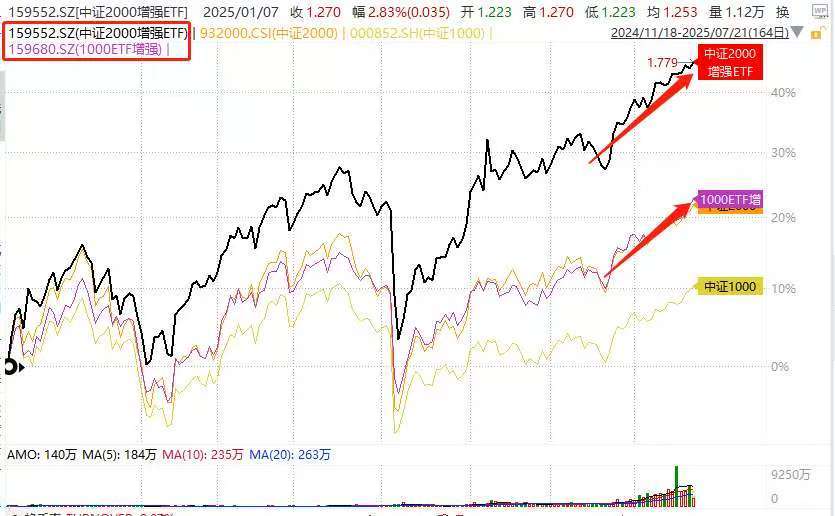
Group 1 - The core viewpoint of the articles highlights the strong performance of small-cap stocks, with the 1000ETF Enhanced (159680) and the CSI 2000 Enhanced ETF (159552) both reaching historical highs, up 19.89% and 37.38% year-to-date respectively [1] - As of July 21, both ETFs recorded net inflows during trading, indicating positive market sentiment towards small-cap stocks [1] - The second quarter reports suggest that while the small-cap style has been strong, there are increasing risks associated with this market segment, and investors should be cautious of potential volatility [1] Group 2 - The outlook for the market remains uncertain due to external factors, which may lead to fluctuations in market confidence [1] - The 1000ETF Enhanced (159680) notes that the anticipated interest rate cuts by the Federal Reserve in the third quarter could benefit growth styles, providing a more accommodative monetary environment [1] - However, both ETFs caution that the current high levels of small-cap stocks necessitate vigilance regarding potential pullback risks [1]
基金研究周报:A股成长风格占优,板块结构分化明显(7.14-7.18)
Wind万得· 2025-07-19 22:25
Market Overview - A-shares experienced narrow fluctuations last week (July 14 to July 18), with the Shanghai Composite Index slightly rising by 0.28%, indicating a defensive advantage in undervalued blue-chip stocks [2] - The CSI 500, CSI 1000, and ChiNext 50 indices all rose over 1%, reflecting investor preference for small-cap and technology stocks [2] - The Wind first-level average index increased by 0.76%, with 80% of the Wind top 100 concept indices showing gains, particularly in the communication, pharmaceutical, and automotive sectors, which rose by 7.56%, 4.00%, and 3.28% respectively [2] Fund Issuance - A total of 30 funds were issued last week, including 20 equity funds, 6 mixed funds, 3 bond funds, and 1 FOF fund, with total issuance of 21.485 billion units [3][4] Fund Performance - The Wind All Fund Index rose by 1.36% last week, with the ordinary equity fund index increasing by 3.00% and the mixed equity fund index rising by 3.06% [4][7] - The performance of major asset classes showed most global assets increased, with the Hang Seng Technology Index leading the gains in the Asia-Pacific region [4] - The domestic bond market remained stable, with the 10-year government bond futures contract declining by 0.02% [11] Industry Performance - The healthcare sector led the gains with a 3.93% increase, followed by information technology at 2.98%, while financials and real estate sectors showed weakness, with declines of 0.76% and 2.00% respectively [10]

[7月16日]指数估值数据(这轮行情跟历史上哪一轮比较相似呢)
银行螺丝钉· 2025-07-16 13:59
Core Viewpoint - The current market is experiencing a rotation between value and growth styles, with growth stocks showing strength during periods of value style weakness [6][7][8]. Market Performance - The large-cap stocks have slightly declined, while small-cap stocks have seen minor gains [2]. - The bank index has shown significant volatility recently, peaking at overvalued levels before a pullback [4][5]. - The overall market rating remains stable at 4.8 stars [1]. Historical Comparison - The current market conditions are reminiscent of the 2013-2014 bear market, characterized by weak fundamentals and high interest rates, which suppressed market performance [10][28]. - In 2014, a significant interest rate cut stimulated the economy, leading to a rapid increase in A-share prices [13]. - The market saw three major uptrends from 2014 to 2017, with financial stocks leading the first surge [14][15]. Style Rotation - The market has shown a tendency to rotate between value and growth styles, with growth stocks often outperforming during periods of value style underperformance [7][8]. - The current market environment has seen a similar pattern, with growth stocks gaining traction as value stocks lag [30]. Economic Indicators - There are signs of fundamental recovery in certain sectors, such as technology and pharmaceuticals, which have shown significant year-on-year profit growth [32][33]. - The overall economic environment remains challenging, with a decline in A-share company profits noted for 2024 [28]. Investment Strategy - The company emphasizes a strategy of buying during market dips and selling during peaks, while maintaining patience during stable periods [41]. - The introduction of new features in the "Today Star" app aims to assist investors in tracking ETF valuations and identifying investment opportunities [42][44].

风格轮动策略周报:当下价值、成长的赔率和胜率几何?-20250713
CMS· 2025-07-13 13:18
Group 1 - The report introduces a quantitative model solution for addressing the issue of value and growth style switching, based on the combination of odds and win rates [1][8] - The recent performance of the growth style portfolio was 2.32%, while the value style portfolio achieved a return of 2.76% [1][8] Group 2 - The estimated odds for the growth style is 1.12, while the value style is estimated at 1.08, indicating a negative correlation between relative valuation levels and expected odds [2][14] - The current win rates indicate that 4 out of 7 indicators favor growth, resulting in a win rate of 53.87% for growth and 46.13% for value [3][16] Group 3 - The latest investment expectation for the growth style is calculated at 0.14, while the value style has an investment expectation of -0.04, leading to a recommendation for the growth style [4][18] - Since 2013, the annualized return of the style rotation model based on investment expectations is 27.19%, with a Sharpe ratio of 1.00 [4][19]
南方基金:是时候亮出这个高弹性工具了!
Sou Hu Cai Jing· 2025-07-10 02:06
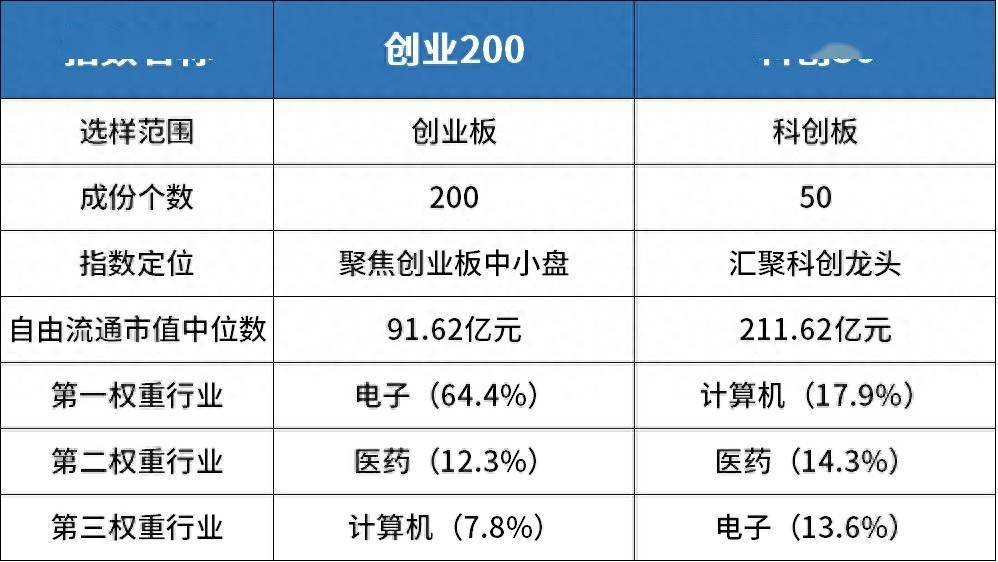
Core Viewpoint - The recent performance of the A-share market has been lively, with the Shanghai Composite Index reaching a new high since November last year, indicating a favorable environment for growth-oriented investments, particularly in high-volatility sectors like the ChiNext [1] Group 1: Index Comparison - The ChiNext 200 Index focuses on small and medium-sized enterprises within the ChiNext board, while the Sci-Tech 50 Index gathers leading companies from the Sci-Tech board [1][2] - The ChiNext 200 Index consists of 200 stocks, whereas the Sci-Tech 50 Index includes only 50 stocks, highlighting a broader selection in the former [1][2] - The median free float market capitalization of the ChiNext 200 is 9.162 billion, significantly lower than the 21.162 billion of the Sci-Tech 50, indicating a focus on smaller companies [1][2] Group 2: Performance Analysis - Since the end of 2019, the ChiNext 200 Index has achieved a cumulative increase of 44.38%, contrasting with a decline of 1.69% for the Sci-Tech 50 during the same period [2] - The ChiNext 200 Index has outperformed both the ChiNext Index and the ChiNext 50 in terms of cumulative growth and annualized returns since its inception, with a cumulative increase of 258% and an annualized return of 10.71% [4][5] - The ChiNext 200's focus on mid-cap growth companies allows it to capture more significant growth potential compared to the larger-cap stocks in the ChiNext Index and ChiNext 50 [6]
[7月8日]指数估值数据(螺丝钉定投实盘第372期发车;个人养老金定投实盘第22期;养老指数估值表更新)
银行螺丝钉· 2025-07-08 13:56
Core Viewpoint - The overall market showed a positive trend with major indices rising, indicating a strong performance in both growth and value styles, particularly in the small and mid-cap sectors [1][2][3][4][5][6]. Market Performance - The CSI All Share Index surpassed 5000 points, nearing the closing levels seen after the last National Day holiday [2]. - All market caps, including large, mid, and small caps, experienced gains, with small-cap indices showing slightly higher increases [3]. - The growth style exhibited strong momentum, while the value style saw modest gains, typically being more resilient during downturns but less aggressive in upward trends [4][6][7]. - The Hong Kong stock market also experienced an overall increase, with technology stocks leading the gains, as evidenced by the Hang Seng Technology Index rising by 1.8% [8][9]. Investment Advisory Promotions - The company is offering a limited-time 50% discount on advisory fees for its investment portfolios, aimed at reducing costs for investors [10][12][13]. - The promotional period for the advisory fee discount is from July 1, 2025, to December 31, 2025, applicable to all shares held during this time [13]. - The fee structure is designed to be investor-friendly, utilizing a "percentage + annual fee cap" model, which automatically selects the most cost-effective option for investors based on their investment amounts [15]. Investment Strategies - The company emphasizes a systematic investment approach, encouraging investors to adopt a "periodic but variable" strategy, investing more when valuations are low [22][33]. - The importance of adhering to a pre-defined investment plan to avoid emotional decision-making during market fluctuations is highlighted [32][33].