
财政政策

Search documents
美国10-12月最新经济数据密集出炉,非农高于预期、社零环比持平、PMI创阶段新低,对此你怎么看?
Sou Hu Cai Jing· 2025-12-17 02:12
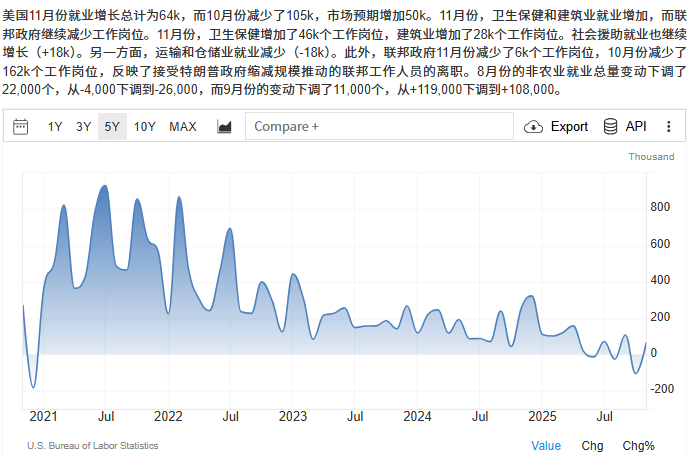
贝森特很乐观,因为美国这么折腾之下,预计2025年全年GDP增速将达到惊人的3.5%!我们先不说通胀、逆差、美债之类的老生常谈的问题,仅就 美国现在这个经济体量,又是消费主导的经济体现况而言,我不得不感慨一句:美国的经济韧性确实是强,有效需求确定是旺,所以投资下去的赚 钱效应明显,这种全世界唱衰,"明天就要崩盘"的预期下,一年下去,GDP涨了3.5%,也算经济史的奇迹2.0! 我们现在一起来看下昨天美国经济数据的一锅炖:美国11月非农就业人口增加6.4万人,高于市场预期的5万人;但失业率却意外升至4.6%,创下 2021年9月以来的新高!美国10月零售销售环比持平,略低于预期的0.1%增长!美国12月标普全球制造业PMI初值下滑至51.8,创5个月新低!这些 数据,似乎都在说:美国经济在高利率环境下"内部疲软因素上升"! 我们接下去就简单分析下: 一、就业市场:结构性问题 美国11月非农看似延续就业市场韧性,但失业率却意外攀升至4.6%,创下2021年9月以来的新高,同时前期数据大幅下修,10月非农就业从初值修正 为减少10.5万人,较预期的下降2.5万超出四倍,8月和9月合计下修3.3万人。这种"新增就业与 ...

明年财政赤字将如何安排?丨落实会议部署 问答中国经济
Zheng Quan Shi Bao Wang· 2025-12-17 02:05
Group 1 - The central economic work conference has outlined the overall requirements and policy orientation for economic work in the coming year, emphasizing the importance of maintaining necessary fiscal deficits and total debt levels [1] - The expected fiscal deficit rate for next year is projected to be no less than 4%, which aligns with the current fiscal expansion trend while avoiding rapid accumulation of debt risks [1][2] - The fiscal deficit serves as a key indicator of the government's spending scale and fiscal policy strength, with a focus on ensuring social welfare, stabilizing employment, and expanding domestic demand [2] Group 2 - The increase in fiscal deficit will primarily be compensated by issuing government bonds, which will help optimize the government debt structure and alleviate local government debt risks in the short term [3] - Maintaining a high fiscal deficit rate may increase fiscal risks; however, the current government debt ratio is significantly lower than that of major economies and emerging markets, indicating ample borrowing space [3] - The expansion of the fiscal deficit will lead to an increase in central budgetary spending, with a focus on enhancing public service supply and supporting consumption and technological innovation [3][4] Group 3 - The emphasis on larger fiscal spending will highlight the "investment in people" approach, necessitating increased expenditures in social security, education, and healthcare to ensure basic living standards and enhance consumer capacity [4] - In the context of stabilizing investment, there will be a need for improved efficiency in traditional infrastructure spending, with local governments relying on special bonds and long-term treasury bonds for funding [4]
明年财政赤字将如何安排?丨落实会议部署 问答中国经济
证券时报· 2025-12-17 01:50
编者按: 日前召开的中央经济工作会议,明确了明年经济工作的总体要求和政策取向,部署了明年经济工 作"八个坚持"的重点任务,抓住关键、纲举目张。为深入学习贯彻会议精神,本报即日起推出"落实 会议部署 问答中国经济"系列述评,围绕发展目标设定、赤字规模安排、推动投资企稳等10个方面 热点问题展开讨论,敬请关注。 财政政策作为宏观调控的主要手段,通过预算、政府债券、税收等工具组合,发挥扩大总需求和定向调结构 的双重优势,实现经济质的有效提升和量的合理增长。在中央经济工作会议提出"保持必要的财政赤字、债务 总规模和支出总量"的总体要求后,市场对明年财政赤字率的设定高度关注。 财政赤字是衡量全年财政政策力度和财政风险水平的重要指标,直接关系到年内政府支出规模。目前,市场 机构与业内人士对财政赤字率的预期较为一致,预计明年赤字率不低于今年水平,即不低于4%。该赤字率水 平既能延续财政扩张态势,又避免了债务风险过快累积。 财政赤字率是社会各界观察宏观政策力度的风向标,从稳定市场预期角度看,"十五五"开局之年的财政赤字 率水平不宜低于上年。2025年,财政政策取向转为"更加积极",赤字率大幅提升1个百分点至4%,为近年最 高 ...

宝城期货资讯早班车-20251217
Bao Cheng Qi Huo· 2025-12-17 01:40
Report Industry Investment Rating No relevant information provided. Core Viewpoints of the Report The overall economic situation shows a mixed picture. The external demand has improved, and prices have generally increased, but domestic demand is still bottom - seeking. Policies are expected to be more active in 2026 to support economic recovery, and the bond market is expected to have opportunities. Multiple institutions are optimistic about the continued rebound of Chinese assets in 2026 [24][25][30]. Summary by Directory 1. Macro Data - GDP in Q3 2025 grew at a 4.8% year - on - year rate, lower than the previous quarter's 5.2% but higher than the 4.6% of the same period last year [1]. - In November 2025, the manufacturing PMI was 49.2%, the non - manufacturing PMI for business activities was 49.5%, both showing certain trends compared to previous periods [1]. - Social financing scale in November 2025 was not provided, with previous values of 24,885 billion yuan and 8,161 billion yuan, and the same - period value last year of 23,288 billion yuan [1]. - CPI in November 2025 increased by 0.7% year - on - year, and PPI decreased by 2.2% year - on - year [1]. - Fixed - asset investment (excluding rural households) from January to November 2025 had a cumulative year - on - year decline of 2.6%, and the social consumer goods retail total had a cumulative year - on - year increase of 4.0% [1]. - Exports in November 2025 increased by 5.9% year - on - year, and imports increased by 1.9% year - on - year [1]. 2. Commodity Investment Reference Comprehensive - In 2026, expanding domestic demand is the top priority, and efforts will be made to boost consumption from both supply and demand sides. The real estate market will be stabilized from both supply and demand ends [2]. - Anti - dumping duties of 4.9% - 19.8% will be imposed on imported pork and pork by - products from the EU starting from December 17, 2025, for a period of 5 years [2]. - On December 16, 2025, 42 domestic commodity varieties had positive basis, and 25 had negative basis [2]. Metals - Copper prices soared to a record high, partly due to the large - scale copper hoarding by the US. The LME's three - month copper price reached a high of $11,952 per ton last Friday, currently around $11,626 per ton, up about 33% this year [4]. - On December 15, 2025, zinc, lead, tin, and copper inventories reached new highs, while nickel and aluminum inventories decreased [5]. - Morgan Stanley expects nickel prices to rebound to around $15,500 per ton in 2026 [5]. - Goldman Sachs raised its forecast for the average copper price in 2026 from $10,650 to $11,400 per ton, and there is a 55% probability that the Trump administration will announce a 15% copper import tariff in the first half of 2026, which may take effect in 2027 and increase to 30% in 2028 [6]. Coal, Coke, Steel, and Minerals - A series of measures to rectify the "involution - style" competition in the steel industry are being implemented, and the upstream coke and iron ore prices have declined [7]. - Yichun plans to cancel 27 mining licenses, including Jiangte Motor's Yifeng County Shiziling Lithium - bearing Porcelain Stone Mine [7]. - Rio Tinto will launch the first phase of a project in Western Australia, with an estimated iron ore production of 50 million tons per year by 2030 [8]. - Japan will cooperate with Malaysia in the exploration and development of rare earth and other mineral resources [8]. - In November 2025, Brazilian steel sales decreased by 3.5% year - on - year to 1.748 million tons. It is expected that in 2026, exports will decrease by 0.6% to 10.18 million tons, and imports will increase by 3.9% to 6.65 million tons [8]. - As of early December 2025, the prices of coke and coking coal in the circulation field declined [8]. Energy and Chemicals - The National Energy Administration will strengthen energy supervision and ensure the safety of the energy and power system in 2026 [9]. - Hungary signed a 5 - year LNG procurement agreement with Chevron for a total of 2 billion cubic meters [9]. - Last week, US API crude oil inventories decreased by 9.322 million barrels, exceeding expectations [9]. - The price discount of Venezuelan Merey crude oil widened to a $21 - per - barrel discount compared to Brent crude oil [9]. - JP Morgan will seek about $14 billion in funds for Argentina's LNG export project [9]. Agricultural Products - The Indian market regulatory body will propose to relax commodity derivatives rules, cancel the ban on agricultural product derivatives trading, and reduce margin requirements [10]. - As of December 14, 2025, EU's 2025/26 soft wheat exports were 10.5 million tons, barley exports were 5 million tons, corn imports were 7.5 million tons, and soybean meal imports were 8.3 million tons [10]. 3. Financial News Compilation Open Market - On December 16, 2025, the central bank conducted 135.3 billion yuan of 7 - day reverse repurchase operations, with a net investment of 18 billion yuan [11]. Key News - In 2026, expanding domestic demand is the top priority, and efforts will be made to boost consumption from both supply and demand sides. The real estate market will be stabilized from both supply and demand ends [12]. - The National Development and Reform Commission will take measures to stabilize bulk consumption, improve the social security system, and promote a fair market order [12]. - Shenzhen will prevent and resolve financial risks, support the reform of the GEM, and enhance the competitiveness of the capital market [13]. - In 2026, the central bank will continue to implement a moderately loose monetary policy and maintain financial market stability [13]. - The market expects the fiscal deficit rate in 2026 to be no less than 4% [14]. - BofA Securities expects the downward trend of the mainland real estate market to bottom out in 2026 [14]. - Vanke will hold a bondholder meeting to discuss the adjusted extension plan for "22 Vanke MTN004" [14]. - On December 16, 2025, the on - shore and off - shore RMB exchange rates against the US dollar reached new highs in 14 months, and the RMB is expected to appreciate moderately in 2026 [15]. - As of December 16, 2025, commercial banks issued 58 green financial bonds, with a total issuance scale of 458.2 billion yuan, a year - on - year increase of over 202% [15]. - The EU plans to issue about 90 billion euros in bonds in the first half of 2026 [15]. - The US Treasury Secretary is optimistic about the US economic outlook, expecting a 3.5% GDP growth in 2025 [16]. - In November 2025, the US added 64,000 non - farm jobs, but the unemployment rate rose to 4.6% [16]. Bond Market Review - Bond market sentiment improved slightly. Yields of major inter - bank interest - bearing bonds mostly declined slightly, and Treasury bond futures showed a differentiated trend [19]. - In the exchange - traded bond market, Vanke bonds generally rose, and the Wande Real Estate Bond 30 Index rose 0.58%, while the Wande High - Yield Urban Investment Bond Index fell 0.06% [19]. - The CSI Convertible Bond Index fell 0.72% to 478.64 points, with a trading volume of 55.556 billion yuan [20]. - On December 16, 2025, most money market interest rates rose, and Shibor short - term varieties showed a differentiated performance [20][21]. - Inter - bank repurchase fixed - rate bonds generally declined, and silver - silver inter - bank repurchase fixed - rate bonds showed a differentiated performance [21]. - The winning yields of Agricultural Development Bank's 2 - year financial bonds were 1.5899% and 1.6039% respectively [22]. - Most European and US bond yields declined [22]. Foreign Exchange Market - On December 16, 2025, the on - shore RMB exchange rate against the US dollar rose 80 points, and the RMB central parity rate against the US dollar rose 54 points [23]. - In New York, the US dollar index fell 0.06%, and most non - US currencies showed mixed performance [23]. Research Report Highlights - Huatai Fixed Income believes that in November 2025, external demand improved, prices rose, but domestic demand continued to bottom - seek. It is recommended to wait for opportunities in the bond market [24]. - Guosheng Fixed Income believes that in November 2025, the economy was weak in both production and demand. The bond market is expected to stabilize and start a trend - like market in the second half of the first quarter of 2026 [25]. - CICC Fixed Income believes that the November 2025 economic data was below expectations, and the bond market is expected to perform well in 2026. It is recommended to pay attention to the allocation opportunities from the end of this year to the first quarter of next year [25]. - CITIC Securities believes that the November 2025 economic data declined in both supply and demand. Policies in 2026 will be more coordinated and focused on implementation effects [26]. - Changjiang Fixed Income believes that the net investment of repurchase in December 2025 decreased. The money market may face some fluctuations due to tax payments [26]. - Xingzheng Fixed Income believes that credit bond ETFs should focus on product returns and consider individual bond attributes in portfolio selection [27]. 4. Stock Market Key News - On the day, the A - share market declined unilaterally, with nearly 4,300 stocks falling. The Shanghai Composite Index fell 1.11% to 3,824.81 points, and the market turnover was 1.75 trillion yuan [29]. - The Hong Kong Hang Seng Index fell 1.54% to 25,235.41 points, and the trading volume decreased slightly [29]. - Multiple institutions believe that Chinese assets have the basis for a continuous rebound in 2026, and overseas long - term funds have been flowing into the Chinese stock market since 2025 [30].
解码中央经济工作会议丨持续聚焦重点领域 财政政策“更加积极”
Xin Hua Wang· 2025-12-17 01:21
Core Viewpoint - The recent Central Economic Work Conference emphasizes a more proactive fiscal policy for the upcoming year, focusing on quality and efficiency while maintaining necessary fiscal deficits and optimizing expenditure structures to support stable economic operation [1][2][8]. Fiscal Policy Direction - The fiscal policy will be more active, with a focus on key areas and critical links, including appropriate deficit arrangements, optimized use of special bonds, and further adjustments to tax policies [1][2]. - The emphasis on "quality and efficiency" indicates a shift towards the effectiveness of policies rather than just total expansion [2]. Expenditure Structure Optimization - The structure of fiscal expenditure has been continuously optimized, with nearly 40% of general public budget allocated to healthcare, education, elderly care, and housing security, indicating a growing investment in human capital [3]. - Future fiscal funding is expected to shift from focusing solely on investment to a balanced approach between investment and consumption, as well as between supply and demand [3]. Implementation of "Two New" and "Two Heavy" Policies - The implementation of "Two New" and "Two Heavy" policies has contributed to the resilience of the economy amid internal and external challenges, with significant sales growth in sectors supported by these policies [4]. - The Ministry of Finance aims to effectively utilize various government bond funds and support the implementation of consumption-boosting actions [4][5]. Local Fiscal Challenges - The conference highlighted the importance of addressing local fiscal difficulties and ensuring the basic "three guarantees" [7]. - Long-term solutions include deepening fiscal and tax system reforms to alleviate local fiscal pressures and enhance spending capabilities [7]. - The need to manage hidden debts and the risks associated with local government financing platforms was also emphasized [7]. Policy Implementation and Coordination - The Ministry of Finance will ensure that the more proactive fiscal policy is implemented effectively, maintaining policy continuity and aligning fiscal and monetary policies [8].
明年财政赤字将如何安排?
Zheng Quan Shi Bao· 2025-12-16 18:11
Group 1 - Fiscal policy serves as a primary tool for macroeconomic regulation, utilizing budget, government bonds, and taxation to enhance both qualitative and quantitative economic growth [1] - The market anticipates that the fiscal deficit rate for next year will not be lower than 4%, maintaining the current fiscal expansion while avoiding rapid accumulation of debt risks [1][2] - The fiscal deficit is expected to increase to 4% in 2025, marking the highest level in recent years, as the government aims to maintain policy continuity and boost market confidence [1][2] Group 2 - The fiscal deficit is projected to rise to meet the demands of key areas such as livelihood protection, employment stabilization, and domestic demand expansion, while also addressing the pressure of government debt repayments [2] - The increase in fiscal deficit will primarily be compensated by issuing government bonds, which will help optimize government debt structure and alleviate local government debt risks [2] - The expansion of fiscal spending will focus on enhancing public services and supporting consumption and technological innovation, with a notable emphasis on social welfare sectors such as education and healthcare [3]
专访朱光耀:看懂宏观经济政策的“积极有为”
Zhong Guo Jing Ji Wang· 2025-12-16 14:31
Group 1 - The core viewpoint of the article emphasizes the need for a more proactive macroeconomic policy in response to current economic challenges, highlighting the importance of both active fiscal policy and moderately loose monetary policy as a combined strategy [1][2] - The former Vice Minister of Finance, Zhu Guangyao, pointed out that the fiscal deficit rate is projected to be around 4% by 2025, with local special bond issuance expected to reach 4.4 trillion yuan, alongside 1.3 trillion yuan in ultra-long-term special government bonds and 500 billion yuan in special bonds for hospitals, which provide a solid foundation for effective policy implementation [1] - Zhu also noted that the core objective of the moderately loose monetary policy is to address price issues, aiming to guide prices towards a reasonable range of around 2% [1] Group 2 - Zhu highlighted that the current Consumer Price Index (CPI) is slightly above 0, while the Producer Price Index (PPI) has been in negative territory for 38 consecutive months, adversely affecting macroeconomic operations, corporate profits, and fiscal value-added tax revenues [2] - The article discusses the importance of integrating short-term and long-term strategies in economic policy, as reflected in the central economic work conference's emphasis on "counter-cyclical" and "cross-cyclical" adjustments, which aim to address immediate issues while also planning for future development [2]
财经慧说丨财政、货币,两大宏观政策明年如何发力?
Xin Hua Wang· 2025-12-16 13:48
策划:邹伟 主编:许晟、李延霞 记者:刘慧、吴雨、申铖 拍摄:陈泽鹏、秦彦娟 制作:贾稀荃 新华社国内部出品 【纠错】 【责任编辑:赵文涵】 ...
X @外汇交易员
外汇交易员· 2025-12-16 12:48
中央财办有关负责同志详解2025年中央经济工作会议精神:扩大内需是明年排在首位的重点任务。今年我国内需总体保持稳健,前三季度内需对经济增长贡献率达到71%。提振消费政策成效明显,扩大有效投资扎实推进。我们也注意到,近几个月消费和投资增速有所放缓,需要持续加力扩内需。外汇交易员 (@myfxtrader):中央经济工作会议12月10日至11日在北京举行(新华社)保持必要的财政赤字、债务总规模和支出总量,加强财政科学管理,优化财政支出结构,规范税收优惠、财政补贴政策。把促进经济稳定增长、物价合理回升作为货币政策的重要考量,灵活高效运用降准降息等多种政策工具。 https://t.co/hg50nWl2V1 ...
施罗德基金资产配置观点
2 1 Shi Ji Jing Ji Bao Dao· 2025-12-16 09:08
Economic Outlook - Global GDP growth from 2025 to 2027 is expected to exceed market consensus, with liquidity already released and fiscal support in place, reducing the probability of a deep economic recession [1] - The implementation of the Inflation Reduction Act is anticipated to have a significant positive impact on the economy [1] - US retail and employment data remain robust, indicating sustained consumer momentum [1] Bond Market - The ten-year government bond yield is fluctuating between 1.65% and 1.90%, with significant adjustments observed from July to September, followed by a slight bullish trend [2] - The market predominantly holds bullish and neutral views, with year-end rush potentially leading to limited downward space for interest rates [2] - Central bank bond purchases and weaker-than-expected real estate and infrastructure volumes provide downward protection for the bond market [2] Real Estate and Infrastructure - Real estate and infrastructure data continue to decline, with significant drops in investment and a surge in second-hand housing listings [3] - Fiscal revenues related to real estate have seen a double-digit decline, and overall fiscal deficits are projected to be around 8.3 trillion yuan for the year [3] - The demand for credit bonds is supported by the increase in bank wealth management products, which have surpassed 32 trillion yuan [3] Stock Market - Cyclical - Demand-side performance remains lackluster, with price increases primarily driven by supply constraints and energy storage [4] - Precious metals, particularly gold, maintain resilience, while industrial metals like copper and aluminum are expected to face supply challenges [4] - Chemical products are experiencing price rebounds due to industry-wide production cuts [4] Stock Market - Manufacturing - The industrial sector's overall rating remains unchanged, with significant price increases in lithium battery materials [5] - The automotive sector shows mixed signals, with wholesale data growing by 6-7%, primarily driven by exports [5] - Valuations in the photovoltaic and lithium battery sectors have returned to above-average levels, while the automotive supply chain remains undervalued [5] Stock Market - Consumer - High-end consumer goods outperform mass-market products, with travel and pet sectors maintaining high growth [6] - The recovery in travel-related prices is notable, with airlines and hotels showing positive year-on-year growth [6] - The pork market is experiencing price declines, with expectations of a weak market in the first half of 2026 [6] Stock Market - Technology - The technology sector remains promising, driven by AI advancements and increasing chip computing power [8] - The semiconductor equipment market is expected to double by 2025, with rising storage prices contributing to this growth [8] - Short-term cash flow concerns in AI applications are present, but new opportunities may arise with future chip iterations [8]