电动化

Search documents
王传福称比亚迪将加大技术研发力度,未来2至3年攻坚电动化智能化
Cai Jing Wang· 2025-12-05 10:01
Core Viewpoint - BYD is committed to enhancing its technological research and development efforts, with significant technology releases expected in the future [1] Group 1: Technological Development - BYD's chairman Wang Chuanfu emphasized the need to address user pain points such as slow low-temperature charging speeds through technological breakthroughs [1] - The company has a team of 120,000 engineers, which is crucial for overcoming technical challenges and maintaining its competitive edge [1][2] Group 2: Future Directions - Over the next 2 to 3 years, BYD plans to focus on advancing electric vehicle technology and smart technology, increasing R&D investment, and launching more leading-edge technological achievements [1][2] - The company aims to strengthen its marketing capabilities to better align with user needs, effectively converting technological advantages into market competitiveness [1][2] - BYD will continue to expand its efforts in overseas markets [1][2]


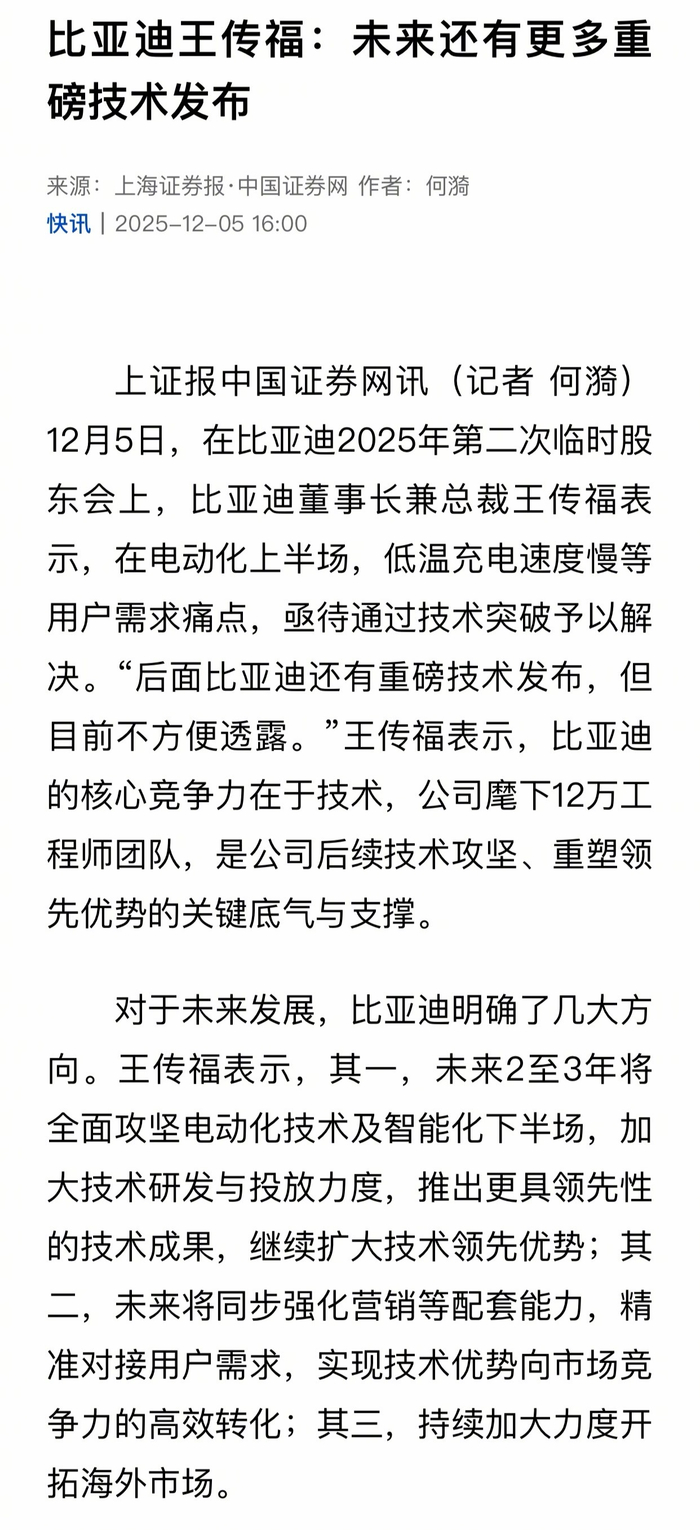
国产版新世代BMW iX3将在2026年下半年上市
Yang Shi Wang· 2025-12-05 09:05
Core Insights - BMW announced that the new generation BMW iX3, specifically designed for the Chinese market, will be launched in the second half of 2026 [1] Group 1: Product Features - The long-wheelbase version of the new generation BMW iX3 is tailored for Chinese customers, featuring customizations in smart cockpit, intelligent driving assistance, and ride comfort [3] - The design of the new generation BMW iX3 embodies the electric era's core principles, combining luxury, technology, and aesthetics, with a distinctive appearance that remains recognizable as a BMW [5] - The vehicle includes innovative features such as a super-sensitive steering wheel, a super-sensitive central control, and a new 3D head-up display, all designed to enhance driver focus [5] Group 2: Technology and Performance - The new generation BMW iX3 is equipped with the latest sixth-generation BMW eDrive technology, featuring a revolutionary cylindrical battery and a self-developed energy management system [7] - It boasts an impressive electric range of over 900 kilometers under CLTC conditions, with a record-setting test showing a range of over 1,007 kilometers on a single charge [7]

三一重工午后涨超4% 工程机械出海大趋势明显 公司国际化布局领先
Zhi Tong Cai Jing· 2025-12-02 06:43
Core Viewpoint - Sany Heavy Industry (600031) shares rose over 4%, reflecting positive market sentiment driven by strong excavator sales data and the company's competitive advantages in the engineering machinery sector [1] Group 1: Sales Performance - In October, a total of 18,096 excavators were sold, marking a year-on-year increase of 7.77% [1] - Domestic sales accounted for 8,468 units, with a year-on-year growth of 2.44% [1] - Export sales reached 9,628 units, showing a significant year-on-year increase of 12.9% [1] Group 2: Market Analysis - CITIC Construction Investment emphasizes the importance of tracking overseas sales data, as many companies derive over 70% of their profits from international markets [1] - The current upward trend in both domestic and international sales is being validated, indicating a robust market environment for engineering machinery [1] Group 3: Company Positioning - Sany Heavy Industry is recognized as a leading player in the engineering machinery sector, with advanced strategies in internationalization and electrification [1] - The company maintains strong competitive advantages in products, channels, and services, particularly in its flagship excavator segment [1] - As domestic industry demand stabilizes and the industry enters a renewal cycle, Sany's revenue and performance are expected to accelerate, particularly in overseas markets [1]

备战2026 宝马亮出两张王牌
2 1 Shi Ji Jing Ji Bao Dao· 2025-12-01 23:13
Core Insights - The luxury automotive market is facing a pivotal moment in 2026, with brands like BMW needing to define luxury in the era of smart electric vehicles [1][4] - BMW is focusing on a new generation of technology, including electric drive systems and smart driving solutions, with the first product being the new generation BMW iX3, set to be produced in Shenyang in 2026 [1][7] - The company is experiencing pressure in the Chinese market, with a 11.2% decline in deliveries, highlighting the importance of electric vehicle sales as a growth engine [1][5] Electric Vehicle Strategy - BMW's electric vehicle sales reached 323,000 units in the first three quarters of 2025, marking a 10% year-on-year increase, but the company recognizes the need for accelerated electrification in China [1][6] - The sixth generation eDrive system will utilize large cylindrical batteries, which offer over 20% improvement in energy density and 30% increase in range compared to previous square batteries [5][7] - BMW has partnered with CATL and EVE Energy for battery supply, establishing a localized supply chain in China and Europe [7][8] Smart Technology Integration - BMW is integrating smart cockpit and driving features tailored for the Chinese market, collaborating with companies like Momenta and Huawei to enhance user experience [8][9] - The new generation smart cockpit system will debut with the iX3 and aims to differentiate BMW's offerings through a unique user interface and localized features [9][10] - The collaboration with Momenta for smart driving technology will utilize AI models to improve vehicle perception and decision-making, maintaining BMW's driving dynamics [10][11] Competitive Landscape - Other luxury brands like Mercedes-Benz and Audi are also focusing on 2026 for key product launches, indicating a competitive race in the electric and smart vehicle segments [3][11] - The automotive industry is witnessing a shift towards leveraging China's advanced supply chain and technology ecosystem to enhance product offerings [11]
乘联分会崔东树:2025年10月中国占世界汽车份额38%
Di Yi Cai Jing· 2025-12-01 13:51
Core Insights - China's global share of the automotive market has increased, reaching 38% in October, up 1 percentage point from last year [1] - Projections indicate that China's share will be 34.2% in 2024 and 34.9% in the first ten months of 2025, with October's share exceeding the annual average by 3 percentage points [1] - Among the world's top 10 automotive companies, three are Chinese, with BYD ranking 6th, Geely 8th, and Chery 10th, reflecting strong growth in their market shares [1] - The shift towards electrification is contributing to the decline of some international automotive brands, despite temporary strength in the U.S. market and positive performance from brands like Suzuki in India [1]

研报掘金丨国海证券:维持柳工“买入”评级,装载机+挖掘机比翼双飞
Ge Long Hui· 2025-12-01 07:36
Core Viewpoint - LiuGong's excavators and loaders are positioned to benefit from market recovery, with a focus on electrification and globalization as key growth strategies [1] Group 1: Product Performance - LiuGong's two main products, excavators and loaders, are expected to significantly benefit from the market recovery [1] - The electric loader is anticipated to continue building a competitive advantage for the company [1] Group 2: Strategic Goals - LiuGong has set a target to achieve an operating revenue of 60 billion yuan by 2030, with international revenue accounting for over 60% [1] - The company aims to maintain a net profit margin of no less than 8% as part of its "15th Five-Year Plan" [1] Group 3: Investment Outlook - The analysis suggests that LiuGong's product advantages and overseas expansion strategy are likely to help achieve the goals outlined in the "15th Five-Year Plan" [1] - The firm maintains a "buy" rating for LiuGong based on these factors [1]

上汽集团纳入上证50透露出什么信号
Zhong Guo Qi Che Bao Wang· 2025-12-01 06:43
Core Viewpoint - The Shanghai Stock Exchange and China Securities Index Co., Ltd. announced adjustments to several indices, including the re-inclusion of SAIC Motor Corporation Limited in the SSE 50 Index, indicating a significant improvement in the company's fundamentals and recognition by the index expert committee [1]. Company Performance - SAIC Motor's core indicators such as revenue and profit margin for the first three quarters of 2025 exceeded those of the same period last year, with R&D expenses reaching 12.61 billion yuan, a year-on-year increase of 9.4% [4]. - The company has focused its investments on electric and intelligent vehicle technologies, achieving a thermal efficiency of 46.3% for its DMH hybrid engine and a low fuel consumption of 2.5 L/100 km for the Roewe M7 DMH [4]. - In the first ten months of 2025, SAIC's cumulative sales of new energy vehicles reached 1.29 million units, a year-on-year increase of 42.5%, outperforming the industry growth rate [4]. Product Strategy - The launch of popular models has significantly supported sales, with the Roewe M7 DMH achieving over threefold sales growth in October compared to the previous month [5]. - The MG4 model has maintained strong sales in both domestic and European markets, while the collaboration with Huawei on the Jiangjie H5 has resulted in rapid sales growth, with over 10,000 units delivered within 43 days of launch [5]. Market Position and Future Outlook - The re-inclusion in the SSE 50 Index is seen as a validation of SAIC's operational quality and profit expectations, which is expected to stabilize its valuation and attract long-term investment [6]. - The competitive landscape in electric and intelligent vehicle sectors remains intense, and the company's ability to maintain its recovery momentum will depend on its continued innovation and product offerings that meet consumer demands [6].


汽车观察 | 大众汽车任命集团战略新负责人、一汽解放拟增资解放时代
Mei Ri Jing Ji Xin Wen· 2025-12-01 01:54
NO.1长安汽车拟参与设立长安机器人公司 11月28日电,长安汽车发布公告称,公司董事会审议通过了《关于投资设立机器人公司的议案》。长安 天枢智能机器人科技有限公司由中国长安汽车集团有限公司、重庆长安汽车股份有限公司、辰致汽车科 技集团有限公司、重庆长安科技有限责任公司(以下简称长安科技)共同投资设立,注册资本4.5亿 元。其中,公司拟以自有资金出资2.25亿元,持股50%;公司全资子公司长安科技拟以自有资金出资 0.45亿元,持股10%。 点评:长安汽车拟设立新机器人公司,进一步推动其向智能制造和自动化领域的扩展。这一战略性投资 不仅标志着长安积极融入机器人产业的决心,也展现了其在创新产品与业务方案上的潜力。此举也为整 个汽车行业的转型升级提供了参考,激励其他企业加速探索新技术与新业态,推动行业整体的变革。 点评:大众汽车集团任命Ludwig Fazel为新战略负责人,凸显其加速电动化与智能化转型的决心。此举 或提振市场对传统车企转型预期的信心,相关零部件及新能源产业链公司估值有望获得重估。整体来 看,该人事变动强化了行业变革信号,或引导市场进一步聚焦汽车产业升级机遇。 NO.4雷军:小米汽车跨年购置税补贴 ...




国海证券晨会纪要-20251201
Guohai Securities· 2025-12-01 01:28
Group 1 - The report discusses the impact of regulatory changes on wealth management strategies and the bond market, highlighting a shift towards defensive asset allocation in response to market volatility and regulatory tightening [3][4][5] - In 2024, wealth management strategies are expected to rebalance with an increased focus on liquidity management through funds and a gradual extension of holding durations under yield pressure [4][5] - By the end of 2024, stricter regulations will limit wealth management strategies, leading to a cautious approach in bond allocations, particularly favoring short-term credit bonds [5] Group 2 - The report on LiuGong (000528) emphasizes the company's strong position in the excavator and loader markets, benefiting from a recovery in domestic demand and a push towards electrification [6][8] - LiuGong's electric loader market is projected to grow significantly, with the market size expected to increase from RMB 2.9 billion in 2023 to RMB 22.4 billion by 2028, reflecting a compound annual growth rate of 50.1% [7][8] - The company aims to achieve RMB 60 billion in revenue by 2030, with over 60% of that coming from international markets, supported by its strong product offerings and export strategies [9] Group 3 - The report highlights the ongoing demand for energy storage, driven by the need for renewable energy integration, with a focus on lithium battery material price recovery [26][30] - The energy storage capacity in Hubei province is projected to reach 8 GW by 2027, with a significant portion coming from new energy storage solutions [29] - The report suggests that the demand for lithium battery materials will continue to grow, with companies like CATL and BYD leading the charge in solid-state battery development [30][31] Group 4 - The report on Deleja (603092) outlines the company's position as the second-largest wind power gearbox supplier in China, with a market share of 16.2% and a focus on high profitability [36][37] - The domestic wind power demand is expected to surge, with an annual average demand of 140 GW projected during the 14th Five-Year Plan, leading to significant market opportunities for Deleja [37][38] - The company anticipates rapid revenue growth, with forecasts of RMB 51.4 billion, RMB 69.5 billion, and RMB 82.75 billion in revenue from 2025 to 2027, reflecting a strong market position and expansion plans [38]
保时捷高管:911暂不推插混车型,因需改动车身布局;特斯拉FSD加速在欧洲推进,已获准在西班牙进行测试丨汽车交通日报
创业邦· 2025-11-30 10:48
Group 1 - Tesla's FSD (Full Self-Driving) project is accelerating in Europe, with Spain becoming a key testing hub due to its newly launched "Spanish Autonomous Vehicle Framework Plan" (ES-AV) [2] - Porsche's executive stated that the 911 model will not introduce a plug-in hybrid variant due to the need to modify the vehicle's body layout, citing size and weight limitations as the main reasons [2] - Zhongchuang Innovation and Leap Motor have commenced construction on a joint venture battery manufacturing base, expected to be operational by June 2026, with an anticipated annual output value exceeding 10 billion yuan [2]