出海

Search documents
来伊份“失速”:上半年扣非净利下滑537%万家灯火照不亮盈利拐点
Xin Lang Cai Jing· 2025-10-17 10:38
Core Insights - The company reported a revenue increase of 8.21% year-on-year to 1.94 billion yuan for the first half of 2025, but faced significant challenges with a 14.2% decrease in total store count to 2,979 stores [1] - The gross profit margin fell below 33%, a decline of 8.66 percentage points, attributed to changes in the business structure and increased promotional activities [1] Group 1: Financial Performance - Revenue increased by 8.21% to 1.94 billion yuan, but the total number of stores decreased by 14.2% [1] - Gross profit margin dropped to below 33%, down 8.66 percentage points, primarily due to the rapid growth of lower-margin new business segments [1] - The company faced a 21% decline in revenue from direct-operated stores, while franchise revenue grew by 19% [1] Group 2: Business Strategy - The company is transitioning from a traditional retail model to a chain management service and supply chain platform, with a focus on increasing the proportion of franchise stores [1] - The "10,000 stores" strategy is now viewed as a long-term vision rather than a short-term operational goal, as the total store count has not increased as expected [1] - The company has entered seven new business segments, including beverages and prepared foods, aiming to create a "second growth curve," but this has negatively impacted overall gross profit [1] Group 3: Market Position and Future Outlook - The company is exploring new consumption areas such as children's snacks, launching 43 new products, but these currently represent a small sales proportion [2] - Management emphasizes a commitment to "high quality and high cost performance," but faces challenges in balancing price reductions with quality improvements amid declining gross margins [2] - The company is investing in AI and overseas expansion, but these initiatives have not yet significantly impacted short-term profitability [1]

消费电子企业出口业务增加,催生深圳办公楼市场新需求
Di Yi Cai Jing· 2025-10-17 09:38
Core Insights - The demand recovery in Shenzhen's commercial office market is driven by the active overseas expansion of consumer electronics companies [1][2] - The technology sector, including AI and digital marketing, continues to show strong demand for office space, contributing approximately 30% of leasing transactions in the third quarter [2] - The overall demand for office space has not significantly expanded, with a slight increase in vacancy rates due to new supply [2][3] Group 1: Consumer Electronics and Overseas Expansion - Shenzhen's consumer electronics companies are actively expanding overseas, leading to increased demand for office space [1] - In the first eight months of 2025, exports of computers and their components grew by 10.5%, while audio and video equipment exports increased by 6.1% year-on-year [1] - Major consumer electronics firms are leasing or upgrading to Grade A office spaces, with a total area exceeding 10,000 square meters for overseas marketing and brand management [1] Group 2: Technology Sector Demand - The technology sector's demand for office space remains high, with significant activity in AI applications and digital marketing [2] - The shift towards high-end value chains is prompting companies to prioritize high-quality office spaces that enhance team collaboration and reflect corporate culture [2] - The third quarter saw six new Grade A office projects entering the market, contributing to a 1.1 percentage point increase in vacancy rates [2] Group 3: Market Dynamics and Strategies - The entry of niche technology companies into the Grade A office leasing market is diversifying tenant structures [3] - Over the next 12 months, more than one million square meters of new Grade A office space is expected to be supplied in Shenzhen [3] - Owners are exploring diverse strategies to enhance property appeal, including adjusting rental terms and collaborating with office service providers for integrated solutions [3]

中信携手42家资产管理机构 共建财富管理新生态
Zheng Quan Ri Bao Zhi Sheng· 2025-10-17 00:57
Core Insights - The conference "Integration and Development: Co-creating New Value in Wealth Management" was held in Beijing, focusing on global asset allocation and social responsibility in wealth management [1] - CITIC Group's wealth management total scale is approximately 31 trillion yuan, with asset management reaching 9.3 trillion yuan, serving over 200 million individual and corporate clients [2] - The asset management market in China has surpassed 170 trillion yuan, making it the second-largest wealth management market globally, with an annual growth rate of 8% over the past five years [3] Group 1 - The conference was attended by over 200 representatives from leading asset management institutions, emphasizing the importance of wealth management in serving the real economy and promoting common prosperity [1][2] - CITIC Group aims to enhance professional capabilities and expand global perspectives in wealth management by collaborating with leading asset management institutions [2] - The investment strategies of asset management institutions are evolving towards multi-asset and overseas allocations, reflecting a shift in market opportunities [3] Group 2 - As of June 2025, CITIC Bank's personal wealth management scale is nearly 5 trillion yuan, ranking second among peers, while CITIC Securities' asset management scale exceeds 1.56 trillion yuan, holding a market share of 12.8% [4] - The collaboration among various asset management institutions is evolving, creating a complementary ecosystem that enhances service offerings [3][4] - CITIC Financial Holdings and its subsidiaries are positioned to seize historical opportunities in the transformation and upgrading of the wealth management industry [4]



出海+低估值高股息梳理 | 投研报告
Zhong Guo Neng Yuan Wang· 2025-10-13 01:08
Core Insights - The report highlights the current trends in the non-metallic building materials sector, including price changes, inventory levels, and production rates across various materials [1][4][5]. Group 1: Price Trends and Market Performance - The national average price for high-standard cement is 349 RMB/ton, down 53 RMB/ton year-on-year and down 2 RMB/ton month-on-month, with an average shipment rate of 44.5%, a decrease of 1.9 percentage points from the previous month [1][4]. - The average price of float glass is 1289.81 RMB/ton, which represents an increase of 65.07 RMB/ton or 5.31% month-on-month [1][4]. - The average price for 2.0mm coated panels remains stable at around 13 RMB/square meter [1][4]. Group 2: Inventory and Production Metrics - The inventory days for key monitored provinces in the glass production sector are approximately 24.8 days, a decrease of 1.38 days from the previous week [1][4]. - The concrete mixing station's capacity utilization rate is reported at 7.48%, down 0.19 percentage points month-on-month [4]. - The average price for domestic 2400tex alkali-free winding direct yarn is 3524.75 RMB/ton, remaining stable, while the mainstream price for electronic cloth is between 4.3-4.5 RMB/m, reflecting a 6% increase [4]. Group 3: Company Developments and Recommendations - China National Materials Technology announced plans to raise no more than 4.48 billion RMB for projects related to low dielectric fiber cloth production and to repay government funds [6]. - Huaxin Cement plans to grant 257,800 restricted stocks to 11 incentive targets and intends to repurchase shares worth between 32.25 million and 64.5 million RMB, with a maximum repurchase price of 25 RMB/share [6]. - The report continues to recommend investment in African building materials, fiberglass, and electrolytic aluminum sectors, highlighting companies like Keda Manufacturing and Huaxin Cement as key players in international competition [2].


出海+低估值高股息梳理-20251012
SINOLINK SECURITIES· 2025-10-12 12:24
Investment Rating - The report highlights several companies with dividend yields exceeding 5%, including Sichuan Road and Bridge, Rabbit Baby, and others, indicating a positive investment outlook for these firms [2][12] Core Insights - The report recommends focusing on overseas markets, particularly in Africa, for building materials, fiberglass, and electrolytic aluminum sectors, suggesting that companies like Keda Manufacturing and Huaxin Cement are well-positioned for international competition [13] - Continued tracking of AI copper foil and AI electronic cloth is advised, as demand remains strong, benefiting from capital expenditure expansion in semiconductor clean rooms and PCB equipment [3] Summary by Sections Weekly Discussion - Companies with a price-to-earnings (PE) ratio below 15x include Sichuan Road and Bridge (8.8x), China Construction (4.8x), and others, indicating potential undervaluation [2][12] - The report emphasizes the importance of cash dividend ratios for 2024 and 2025, with several companies projected to maintain high dividend yields [2][12] Cycle Linkage - The national average price for cement is reported at 349 RMB/t, down 53 RMB/t year-on-year, with an average shipment rate of 44.5% [4][14] - The average price for float glass increased to 1289.81 RMB/t, reflecting a 5.31% rise, while inventory levels decreased [4][14] Market Performance - The building materials index increased by 2.66%, outperforming the Shanghai Composite Index [17] - Cement manufacturing showed a price adjustment of -0.4%, with regional variations in pricing due to demand fluctuations [21][25] Price Changes in Building Materials - The report notes that the price of 2400tex fiberglass remains stable at 3524.75 RMB/t, with no significant changes expected in the short term [56] - The electronic cloth market shows stable pricing, with current rates between 4.3-4.5 RMB/m [57]
家用电器:假期消费专题:出境游、线下演出高景气——25W40周观点-20251012
Huafu Securities· 2025-10-12 10:11
Investment Rating - The report maintains an "Outperform" rating for the industry [7] Core Insights - The report highlights a significant increase in holiday travel and consumption, with an average of 3.04 billion people traveling daily from October 1 to 8, a year-on-year increase of 6.3% [3][11] - Domestic consumption is showing steady improvement, with average daily sales in related sectors increasing by 4.5% during the holiday period, driven by strong performance in digital products, jewelry, and cultural services [3][15] - The offline performance of the entertainment sector is robust, with a 39.5% year-on-year increase in audience numbers for live performances during the holiday [3][20] Summary by Sections Holiday Consumption Trends - The report notes a rise in domestic travel, with 8.88 billion domestic trips taken during the holiday, an increase of 1.23 billion trips compared to the previous year [11][12] - The average spending per person decreased by 13% despite the increase in total expenditure, which reached 809 billion yuan [11][12] Retail and E-commerce Performance - Key retail and catering enterprises saw a 2.7% year-on-year increase in sales during the holiday [19] - E-commerce platforms experienced a surge in sales of green organic foods (up 27.9%), smart home products (up 14.3%), and domestic fashion brands (up 14.1%) [19][20] Investment Recommendations - The report suggests focusing on several sectors for potential investment, including: 1. Major appliances benefiting from trade-in programs, recommending companies like Midea Group, Haier Smart Home, and Gree Electric [4][23] 2. The pet industry, which is expected to remain resilient, with recommendations for companies like Guai Bao Pet and Zhongchong Co [4][23] 3. Small appliances and branded apparel, which may see a rebound in demand, with recommendations for companies like Bear Electric and Anta Sports [4][23] 4. Electric two-wheelers, with a strong outlook for domestic sales improvement, recommending companies like Ninebot and Yadea [4][23] Global Market Opportunities - The report emphasizes the long-term theme of international expansion, recommending companies like Ecovacs and Roborock in the cleaning appliance sector, and Midea and Haier in the major appliance sector [5][24] - It also highlights the potential for motorcycle brands to increase their market share overseas, suggesting companies like Chunfeng Power and Longxin General [5][24] Market Data - The home appliance sector saw a slight decline of 0.4% this week, with specific segments showing varied performance: white goods up 0.8%, black goods down 0.3%, and kitchen appliances down 1.0% [25]




电商平台“抢跑”双11,流量争夺战蔓延至“黄金周”
Xin Lang Zheng Quan· 2025-10-11 09:27
Core Insights - The competition for the upcoming Double Eleven shopping festival has intensified, with platforms like JD.com and Douyin starting promotions earlier than ever, indicating a shift in strategy to capture consumer attention amid declining traffic growth [1][2] Group 1: Simplification of Rules - This year's key promotional strategies include "official discounts," "single item direct discounts," and "no need to meet minimum purchase requirements," aimed at reducing consumer decision fatigue [1][2] - Research indicates that 43% of consumers find promotional rules complex, leading to decision fatigue due to prolonged promotional periods [2] Group 2: Seeking New Growth - Platforms are exploring new avenues for growth, with international expansion and instant retail emerging as significant trends for this year's Double Eleven [2] - Taotian Group is launching a global strategy across 20 countries with a $1 billion marketing subsidy to help 100,000 merchants double their overseas sales [2] - Instant retail is a focal point, with JD.com emphasizing "instant delivery" as a new growth area, while Taotian integrates online and offline retail for faster fulfillment [2][3] Group 3: E-commerce Ecosystem Development - Douyin's e-commerce segment is experiencing rapid growth, with a reported 800% increase in brands and a 500% increase in single product sales on the first day of Double Eleven [4] - Douyin's e-commerce growth is supported by its robust content ecosystem and nearly 1 billion user base, projecting a GMV of 3.5 trillion yuan in 2024 [4] - Kuaishou is focusing on efficiency as a core strategy, utilizing a combination of full-domain collaboration, refined inventory management, and AI enhancements [4][5] Group 4: Return to Commercial Essence - The lengthening of the Double Eleven promotional period has diluted its core value, shifting consumer focus from urgency to a wait-and-see approach for better deals [6] - The evolution from a single-day event to a month-long promotion reflects a broader trend of platforms recognizing the limits of simple price and duration competition [6] - The future success of platforms will depend on their ability to create healthier commercial ecosystems and provide exceptional consumer experiences rather than merely extending promotional periods [6]


程维王兴,旧敌新局
Hu Xiu· 2025-10-11 07:44
Core Viewpoint - Rappi has formally joined the lawsuit against 99Food, accusing it of imposing exclusivity clauses in contracts with restaurants, which restricts competition in Brazil's food delivery market [1][25]. Group 1: Market Dynamics - The Brazilian food delivery market is currently dominated by iFood, which holds over 80% market share, effectively creating a monopoly [10][15]. - The market size of Brazil's food delivery sector is approximately $12 billion, with an expected annual growth rate of 20%, potentially making it the fourth largest food delivery market globally [8]. - Didi's 99Food has been accused of signing exclusivity agreements with restaurants, limiting their ability to partner with competitors like Meituan's Keeta, which has not yet launched in Brazil [2][6][29]. Group 2: Competitive Landscape - Didi's strategy involves categorizing competitors into tiers, with iFood being the most dominant, followed by Rappi, and then Meituan's Keeta, which is still in the pilot phase [3][4][5]. - Rappi's market share is currently in the single digits, making it less impactful in negotiations with restaurants compared to iFood [27]. - Didi's renewed focus on 99Food indicates a strategic shift, as the company aims to capitalize on the regulatory environment that limits iFood's monopolistic practices [18][21]. Group 3: Regulatory Environment - Brazil's antitrust agency, CADE, has imposed certain restrictions on iFood regarding exclusivity agreements, but these do not completely eliminate such practices [20]. - The legal actions taken by Rappi and Keeta against 99Food highlight the ongoing competitive tensions and regulatory challenges in the Brazilian market [19][29]. - Didi's approach to exclusivity agreements reflects a broader trend of leveraging financial investments to secure market position, similar to strategies employed by Meituan in other regions [23][28].

WISE2025开麦啦!我们要找的就是你!
36氪· 2025-10-09 09:59
Core Insights - The WISE 2025 conference is set to take place on November 27-28, showcasing a transformative vision for the future of business in China, emphasizing resilience and innovation amidst global uncertainties [2][4] - The theme "The Scenery Here is Unique" reflects a deep analysis of China's economic resilience, contrasting with prevailing narratives of downturns and challenges [4][6] Economic Performance - China's GDP grew by 5.3% year-on-year in the first half of the year, with high-tech industries increasing their value-added output by 9.5% [8] - R&D investment accounted for nearly 2.7% of GDP, indicating a strong commitment to innovation and technological advancement [8] Technological Advancements - Emerging sectors such as AI, new energy, and biotechnology are becoming the main drivers of growth, with companies transitioning from mere storytellers to key players in these fields [9] - Advanced technologies like brain-computer interfaces and quantum sensing are moving from laboratories to practical applications, marking a significant shift in industrial capabilities [9] Consumer Behavior - Consumers are becoming more rational but are willing to pay for "technological appeal" and "emotional value," indicating a shift in purchasing motivations [10] - Retail is being reshaped by data intelligence, as seen in companies like Pinduoduo, which focus on personalized and engaging customer experiences [10] Conference Structure - The WISE 2025 conference is designed as a seven-act "tech drama," each act addressing different aspects of the evolving business landscape, from technological revolutions to consumer behavior [15][16][17][18][19][20] - The conference aims to foster real dialogue by inviting industry veterans and brand builders to address pressing issues faced in the market [25][27] Conclusion - WISE 2025 is positioned as a celebration for creators and a source of energy for action-takers, encouraging participants to embrace challenges and seek innovative solutions [33][32]

公募齐发声,A股看涨逻辑长期不变
Huan Qiu Wang· 2025-10-09 05:03
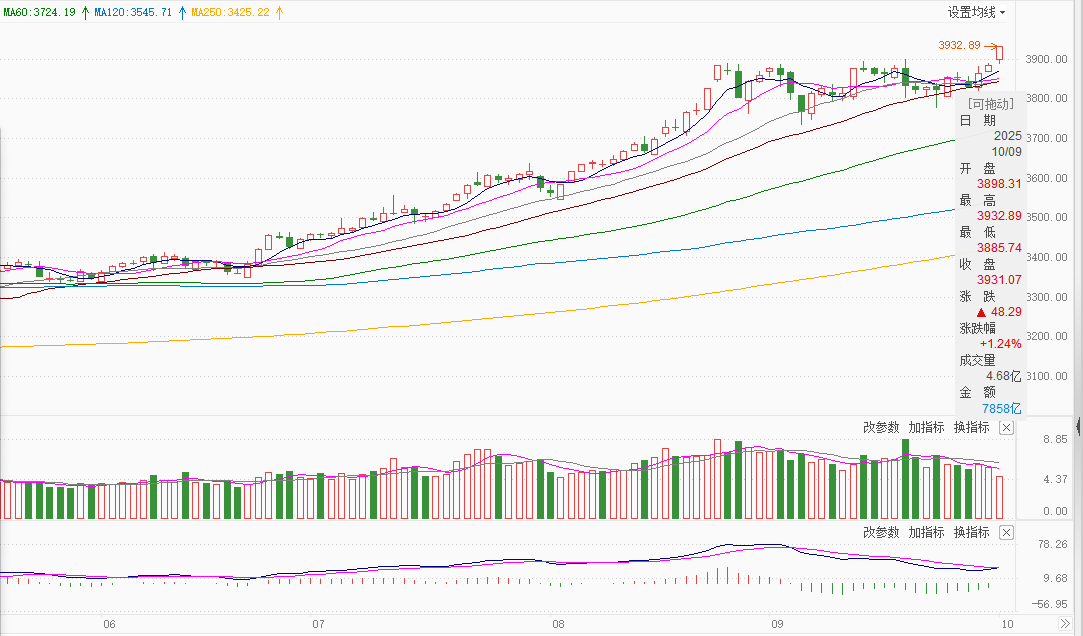
Group 1 - The A-share market has shown strong performance in 2023, with the Shanghai Composite Index surpassing the 3900-point mark on October 9, driven by policy support and increased capital inflow [1][3] - Major institutions maintain an optimistic outlook for the market, citing reasonable overall valuations and potential for upward movement in the medium to long term [3] - Factors contributing to the market's strength include the rise of quality enterprises, active capital participation, and supportive policies, which are seen as the foundation for the revaluation of A-shares [3] Group 2 - Investment focus is shifting towards two core sectors: consumption and technology, with a consensus among public fund institutions [4] - In the technology sector, the AI industry chain is highlighted as a significant opportunity, particularly in software and AI applications, with expectations for domestic computing power to show trends in the fourth quarter [4] - The consumption sector is viewed through the lens of structural opportunities, with an emphasis on "value-for-money consumption" as consumer income expectations improve [4] - Additional investment themes include "new productivity" and the trend of Chinese companies expanding overseas, which are seen as key drivers for future economic growth and opportunities for investors [4]