
绿色低碳转型

Search documents
AI驱动钢铁业范式变革 标准化建设成转型关键
Xin Lang Cai Jing· 2026-01-11 21:22
Core Insights - Artificial intelligence is driving a paradigm shift in the steel industry, transitioning from traditional "experience-driven" methods to "data and model-driven" approaches, aligning with national strategic directives for high-end, intelligent, and green development [1][6] Group 1: Industry Transformation - The steel industry has a solid foundation for intelligent upgrades, having accumulated vast amounts of production, quality, and equipment data, which can meet the training needs of specialized AI models [2] - The application of AI is evolving from isolated attempts to a systematic and integrated approach, although the industry still faces structural challenges such as fragmented application scenarios and insufficient integration of AI models with metallurgical processes [3][4] Group 2: Standardization and Methodology - Conducting intelligent grading and standardization of typical scenarios is crucial for providing clear transformation pathways and assessment benchmarks for enterprises, addressing the issue of fragmented scenarios [4] - A systematic evaluation framework is necessary to guide enterprises in identifying gaps and improvement directions in key areas such as research and design, process control, and operational management [5] Group 3: Green and Efficient Production - AI technologies can facilitate energy and carbon emission management through integrated monitoring platforms, optimizing processes to promote energy conservation and emission reduction [5] - The shift towards efficiency and innovation-driven development is expected to enhance overall operational efficiency, product quality, and core competitiveness in the steel industry [6][7]
【“十五五”开好局起好步】锚定新目标 实干担当促发展
Yang Shi Wang· 2026-01-11 11:57
Group 1 - Hainan is focusing on project reserves and optimizing enterprise lifecycle services, promoting nearly 100 quality projects in areas like low-altitude economy and urban renewal [1] - Hebei is implementing the "Artificial Intelligence +" action plan, aiming for over 50% of intelligent computing power and more than 150,000 cloud enterprises [1] - Sichuan is advancing digital technology transformation across six major industries, including electronic information and advanced materials [1] - Shandong plans to invest approximately 210 billion yuan in nuclear and wind power projects, while fostering new growth points in hydrogen energy and green fuels [1] - Guangdong is building a comprehensive manufacturing empowerment system centered on artificial intelligence, targeting over 200 smart factories and upgrading traditional industries [1] Group 2 - Hubei is implementing 36 actions to accelerate the commercialization of technology innovations in key areas like humanoid robots and quantum technology [2] - Shaanxi is promoting 20 reform measures for technology commercialization, aiming for 300 new products to achieve mass production this year [2] - Heilongjiang has designated this year as the "Year of Breakthrough in Industrialization of Scientific Achievements," focusing on AI and advanced manufacturing [2] - Tianjin is deepening collaborative development in the Beijing-Tianjin-Hebei region through ten high-quality development actions [2] - Zhejiang is leveraging the "Ten Million Project" to promote urban-rural integration and reduce disparities in regions and income [2]
【大宗周刊】港口期现聚新力!2025年大宗商品现货市场大事记
Qi Huo Ri Bao· 2026-01-11 00:43
Core Viewpoint - The construction of a national unified market is a strategic initiative aimed at facilitating domestic circulation, breaking regional barriers, optimizing resource allocation, and enhancing the resilience of industrial and supply chains, with the futures and spot markets playing a crucial role in this process [2]. Group 1: Market Integration and Innovation - Shandong Port Group's investment holding company has aligned with national strategic deployments, focusing on futures-spot integration innovation to enhance market functions and strengthen collaborative empowerment [2]. - The company has achieved a comprehensive futures-spot market system, becoming the first in the nation to implement a full license layout, integrating clearing houses, futures companies, risk management subsidiaries, delivery centers, and spot trading centers [2]. Group 2: Supply Chain Solutions - To address liquidity pressures faced by LPG clients, the company has developed a sales-based procurement model utilizing port inventory and electronic warehouse receipts, successfully activating 21,400 tons of LPG inventory [3]. - The company has explored a comprehensive service model for the rubber industry, helping partners save over 10% in production costs annually by eliminating intermediary trade markups and using futures tools to mitigate price volatility risks [3]. Group 3: Risk Management and Cost Reduction - The company has created an integrated supply chain service plan to manage risks associated with iron ore price fluctuations and variable import costs, effectively lowering overall costs for enterprises [4]. - A collaboration with Xinhua News Agency has led to the establishment of a commodity index system that provides authoritative price benchmarks, enhancing market monitoring and risk prevention capabilities [4]. Group 4: Technological Advancements - The company has launched the "Port Cloud Warehouse" electronic warehouse receipt service platform, leveraging advanced technologies like blockchain and big data, facilitating over 21 billion yuan in financing for clients [5]. - Regular cross-border RMB settlement for crude oil transactions has been established, promoting international market connectivity and resource allocation efficiency [5]. Group 5: Future Development and Strategic Goals - The company aims to continue enhancing its service capabilities and deepen futures-spot integration to support the construction of a national unified market and contribute to high-quality economic development [6].
“经开智造”落地雄安新区
Xin Lang Cai Jing· 2026-01-11 00:40
该项目深度融合绿色发电、节能降耗与智能运维理念,采用BAPV光伏附加安装技术对建筑屋顶空间进 行改造,实现空间资源高效利用。项目运营后,预计每年可节约标准煤约1430吨、减排二氧化碳约3890 吨,不仅优化了建筑用能结构,更将为绿色建筑技术的推广提供了可复制的实践样本。 此次合作是邯郸经开区主动服务国家战略、推动区域产业协同发展的生动实践。通过精准匹配区内绿色 技术供给与雄安新区高标准建设需求,"经开智造"成功落地重大国家战略场景,有效提升了区域产业对 接高端市场的能力。 下一步,邯郸经开区将聚焦构建现代化绿色产业体系,持续优化创新生态,支持企业在零碳园区、智慧 能源、综合节能等前沿领域加大研发与模式创新,培育具有核心竞争力的绿色产业集群,为区域高质量 发展和绿色低碳转型注入强劲动能。 (来源:邯郸日报) 转自:邯郸日报 本报讯(记者佘志娟)近日,邯郸经开区创投集团携手邯郸中建材,在雄安新区协同打造的东部社区服 务中心项目正式投用,标志着两地绿色能源建筑规模化应用迈上新台阶。 ...
让以旧换新政策发挥更大效应
Xin Lang Cai Jing· 2026-01-10 12:18
Core Insights - The "trade-in for new" policy in China is projected to generate over 2.6 trillion yuan in sales by 2025, benefiting more than 360 million people, showcasing its effectiveness in boosting domestic demand and economic growth [1] - The policy is a crucial link between improving people's livelihoods and economic development, facilitating targeted measures to stimulate consumption potential and promote industrial upgrades [1] Group 1: Economic Impact - From January to November 2025, the total retail sales of consumer goods increased by 4.0% year-on-year, with the trade-in policy contributing over 1 percentage point to this growth, effectively converting potential demand into actual purchasing power [2] - The retail sales of home appliances surpassed 1 trillion yuan, indicating strong demand for large consumer goods [2] Group 2: Industry Upgrades - The trade-in policy has led to significant growth across key consumer sectors, particularly in the automotive industry, where 18.3 million vehicles are expected to be traded in from 2024 to 2025, with nearly 60% being new energy vehicles [3] - In the home appliance sector, over 129 million units were traded in, with more than 90% being first-level energy-efficient products, reflecting a shift towards high-quality, energy-efficient goods [3] Group 3: Environmental Benefits - The policy promotes both economic and environmental benefits, driving industrial upgrades and green transitions by encouraging companies to invest in technological innovation and improve product quality [4] - By 2025, the recycling of scrapped vehicles is expected to increase by 24.5%, leading to the recycling of approximately 9.6 million tons of steel and 1.3 million tons of non-ferrous metals, significantly reducing carbon emissions by about 24.5 million tons [4] Group 4: Consumer Benefits - Since the full implementation of the trade-in policy in September 2024, over 480 million subsidies have been distributed directly to consumers, with every second new household vehicle sold benefiting from the trade-in subsidy [5] - The policy has also played a vital role in ensuring public safety, with the number of old electric bicycles being replaced exceeding nine times that of 2024, effectively reducing safety hazards [5]
以确定性转型破局 中国重塑全球气候治理新生态
Zhong Guo Jing Ying Bao· 2026-01-09 15:46
Core Viewpoint - The implementation of the EU Carbon Border Adjustment Mechanism (CBAM) on January 1, 2026, complicates the global climate governance landscape, necessitating China's transition from an "important participant" to an "active leader" in global climate governance [1][2]. Group 1: China's Role in Global Climate Governance - China aims to respond to international climate rules' uncertainties through a systematic transformation towards a green and low-carbon economy, turning external pressures into high-quality development drivers [1]. - The country is positioned as a significant supplier of green production capacity, leveraging its full industrial chain technology advantages in solar, wind, and energy storage sectors [1]. - Projects like the Al Dhafra Solar Power Plant in the UAE, with a capacity of 2.1 GW, exemplify China's commitment to reducing carbon emissions by 2.4 million tons annually and supporting local employment [1]. Group 2: Renewable Energy Cooperation - Through South-South cooperation, China has initiated renewable energy technology transfer projects with countries like Ghana and Zambia, providing clean energy solutions and creating numerous job opportunities [2]. - The De Aar Wind Power Project in South Africa, developed by China National Energy Group, delivers 770 million kWh of clean electricity annually, benefiting 300,000 households and training over 110 local technicians [2]. Group 3: Strategic Responses to CBAM - To address the challenges posed by CBAM, China needs to implement a systematic strategy that includes accelerating the national carbon market's development and establishing a transparent carbon accounting system [3]. - The focus should be on integrating affected industries like steel, aluminum, and cement into carbon market rules and exploring carbon pricing mechanisms to avoid double payments [3]. Group 4: Industry Decarbonization and Competitiveness - The "carbon barrier" represents a competition in green competitiveness, and industries must deeply decarbonize to gain a competitive edge [4]. - Companies like Baosteel and Taiyuan Iron and Steel are leading the way in reducing carbon footprints through innovative processes and clean energy adoption, setting benchmarks for high-energy-consuming industries [4]. - The overall goal is to create a new advantage in green supply chains, making low-carbon practices central to high-quality industrial development [4].
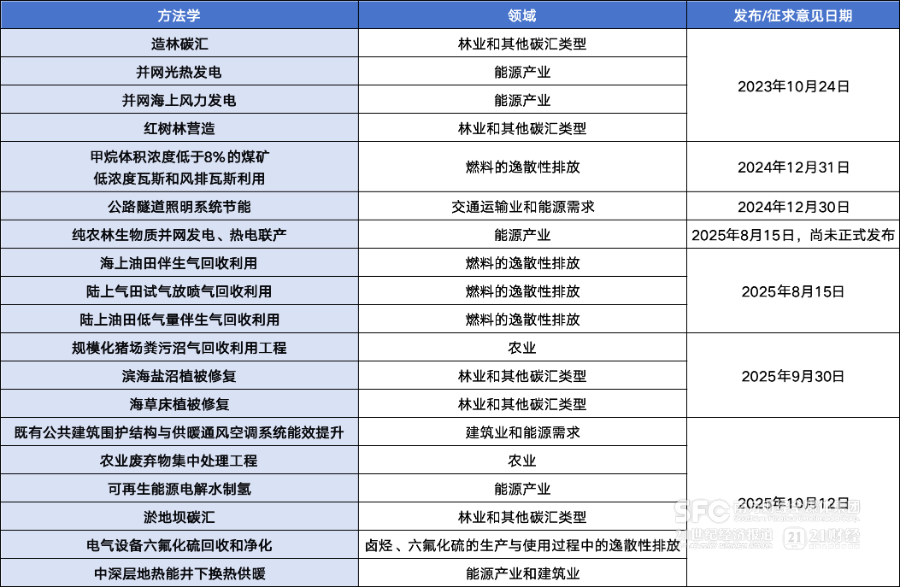
CCER累计成交额6.5亿元,林业碳汇、新能源受青睐
2 1 Shi Ji Jing Ji Bao Dao· 2026-01-09 13:25
Core Viewpoint - The CCER methodology is undergoing significant expansion, with a total of 18 methodologies expected by the beginning of 2026, aimed at addressing key gaps in China's Nationally Determined Contributions (NDC) for greenhouse gas emissions reduction [1][4]. Group 1: Methodology Expansion - The Ministry of Ecology and Environment has introduced 12 new CCER methodologies in 2025, focusing on renewable energy utilization, energy efficiency improvements, agricultural waste resource utilization, ecosystem carbon sinks, and non-CO2 greenhouse gas reductions [1][4]. - The highest number of methodologies pertains to forestry carbon sinks (5), followed by the energy sector (4) and fugitive emissions [1]. Group 2: Market Development - Since its launch in January 2024, the voluntary greenhouse gas reduction trading market has seen over 5,700 accounts opened by various stakeholders, with a cumulative transaction volume of 921.94 million tons and a transaction value of 650 million yuan, averaging about 70 yuan per ton [3][7]. - The market is expected to facilitate the registration of projects that will achieve approximately 125 million tons of voluntary greenhouse gas reductions [3][7]. Group 3: New Fields and Incentives - The new methodologies incorporate six new fields into the voluntary reduction trading market, including oil and gas field recovery, ecosystem carbon sinks, agricultural waste resource utilization, renewable energy utilization, energy efficiency improvements, and sulfur hexafluoride reductions [4][5]. - The methodologies are designed to support green technologies and new business models, providing clear revenue expectations and reducing initial application costs for green technologies [5]. Group 4: Data Quality and Management - A comprehensive data quality management system is being established, ensuring reliable data acquisition, storage, and calculation, with mechanisms for cross-verification and internal management by project owners [6]. - The methodologies aim to focus on economically feasible projects, simplifying the development process and allowing for the bundling of smaller projects to reduce costs [6]. Group 5: Future Directions - The Ministry of Ecology and Environment aims to create a transparent, unified, and widely participatory voluntary greenhouse gas reduction trading market that aligns with international standards, contributing to carbon neutrality goals and the development of a green economy [8].

2026央企重组“第一枪”,巨头崛起!
Zhong Guo Dian Li Bao· 2026-01-09 06:15
Core Viewpoint - The merger between Sinopec and China Aviation Oil marks a significant move in the energy sector, aiming to create a new giant in "green aviation fuel" while enhancing supply security and low-carbon competitiveness in the aviation industry [1][4]. Group 1: Merger Details - The merger was approved by the State Council on January 8, 2026, positioning Sinopec as the world's largest refining company and China Aviation Oil as Asia's largest aviation fuel service provider [1][2]. - China Aviation Oil has been involved in discussions regarding a merger since October 2025, with Sinopec identified as the potential acquirer of all its assets and operations [2][3]. - The merger is expected to streamline operations by reducing intermediaries and lowering supply costs, creating a strategic complementarity between the two companies [3][4]. Group 2: Market Context - The global aviation industry is experiencing a strong recovery, with aviation fuel demand projected to reach 389 million tons in 2025, a 3.9% increase year-on-year [2]. - By 2040, China's aviation fuel consumption is forecasted to grow from 3,928 million tons in 2024 to 7,500 million tons, highlighting the increasing demand for aviation fuel [3][4]. - The merger aims to enhance the competitiveness of China's aviation fuel sector, which currently faces challenges compared to integrated international oil companies like Shell and ExxonMobil [4][5]. Group 3: Green Transition - The merger is seen as a strategic move to strengthen the sustainable aviation fuel (SAF) industry, which is crucial for reducing carbon emissions in the aviation sector [5][6]. - Sinopec is recognized as a pioneer in SAF production in China, with its products already tested on domestic aircraft, offering a potential for over 50% reduction in carbon emissions compared to traditional aviation fuel [5][6]. - The collaboration between Sinopec and China Aviation Oil is expected to enhance R&D, industrialization, and international trade in SAF, promoting its adoption and continuous improvement [5][6].

“绿色航油”巨头崛起!中国石化、中国航油官宣重组
Zhong Guo Dian Li Bao· 2026-01-09 05:50
Core Viewpoint - The merger between China Petroleum & Chemical Corporation (Sinopec) and China Aviation Oil Group (China Aviation Oil) marks a significant strategic move in the energy sector, aiming to create a new giant in "green aviation fuel" while enhancing fuel supply security for the aviation industry and increasing low-carbon competitiveness in international markets [1][5][7]. Group 1: Merger Details - The merger was approved by the State Council and is seen as a collaboration between the world's largest refining company and Asia's largest aviation fuel service provider [1][3]. - China Aviation Oil is the largest integrated aviation fuel service provider in Asia, while Sinopec is the largest aviation fuel producer in China, covering various sectors including oil and gas, logistics, and aviation [3][4]. - The merger is expected to streamline operations and reduce costs by eliminating intermediaries, thus enhancing the efficiency of the entire supply chain from refining to distribution [4][6]. Group 2: Market Context - The global aviation industry is experiencing a strong recovery, with a projected demand for aviation fuel of 389 million tons in 2025, reflecting a year-on-year increase of 3.9% [3][4]. - By 2040, China's aviation fuel consumption is expected to grow from 39.28 million tons in 2024 to 75 million tons, indicating a significant increase in demand [4][6]. - The merger is a strategic response to the competitive landscape dominated by integrated oil and gas companies like Shell and ExxonMobil, which have established advantages in the aviation fuel market [6][7]. Group 3: Green Transition - The merger is positioned as a critical step towards enhancing the competitiveness of China's aviation fuel industry and promoting green transformation [5][7]. - Sustainable aviation fuel (SAF) is recognized as a key pathway for reducing carbon emissions in the aviation sector, with global SAF consumption projected to reach 1.8 million tons by 2030 [7]. - Sinopec is noted for being one of the first companies in China to produce SAF, which can reduce carbon emissions by over 50% compared to traditional aviation fuel [7][8]. Group 4: Strategic Implications - This merger is part of a broader initiative to optimize the layout of state-owned enterprises and concentrate state capital in critical industries related to national security and economic lifelines [8]. - The restructuring aligns with the strategic goals set forth by the State-owned Assets Supervision and Administration Commission (SASAC) to enhance the core functions and competitiveness of state-owned enterprises [8].
威海“2+3”模式引领减污降碳协同创新试点两年成效显著
Qi Lu Wan Bao· 2026-01-09 03:10
Core Viewpoint - Weihai City has developed a distinctive "2+3" model for pollution reduction and carbon reduction, focusing on energy and marine sectors while implementing mandatory actions in industrial, transportation, and lifestyle areas [1][2] Energy Sector - Significant achievements in green and low-carbon transformation, with 8 clean energy infrastructure projects, including nuclear power and offshore wind and solar energy, contributing to substantial emission reductions [1] - Nuclear heating in Rongcheng and Rushan has resulted in low operational costs and high heating capacity, achieving economic, ecological, and social benefits [1] Marine Sector - Continuous enhancement of pollution reduction and carbon sequestration capabilities, with the establishment of China's first regional marine carbon sink intelligent management service platform [1] - Completion of 338.7 tons of blue carbon transactions by 6 financial institutions, and the promotion of a multi-nutrient integrated aquaculture model across 140,000 acres, leading to a 26% increase in industry income [1] - Four marine carbon sequestration projects have collectively stored approximately 31.7 million tons of carbon [1] Industrial Sector - Improvement in the green manufacturing system, with 105 city-level green factories, 4 green parks, and 28 green supply chain management enterprises established [1] - Four industrial green transformation projects have cumulatively reduced carbon dioxide emissions by 38,700 tons, sulfur dioxide by 52.54 tons, and nitrogen oxides by 47.8 tons [1] Transportation Sector - Optimization of transportation structure, with an average annual growth rate of 18% in railway freight volume from 2020 to 2024 [2] - 100% of newly updated taxis and buses are now electric vehicles [2] Lifestyle Sector - Deepening of the zero-waste and low-carbon lifestyle concept, with over 640 city-level "zero-waste cells" cultivated and 24 recommended as provincial-level typical cases [2] - Weihai City received the highest ranking in the provincial "zero-waste city" construction assessment, earning a reward of 3 million yuan [2] - Public green travel remains stable at over 70% [2] Future Plans - Weihai's ecological environment bureau will collaborate with relevant departments to enhance pollution reduction and carbon reduction capabilities and strengthen integrated regulatory mechanisms [2] - Plans to quantify the effectiveness of pollution reduction and carbon reduction efforts and evaluate results across departments and enterprises [2] - Emphasis on summarizing successful experiences and creating the "Weihai model" [2]