
核心CPI

Search documents
8月南京CPI同比下降0.7%,环比上涨0.3%
Yang Zi Wan Bao Wang· 2025-09-10 05:58
Core Insights - In August, Nanjing's consumer price index (CPI) decreased by 0.7% year-on-year, with food prices dropping by 5.1% and non-food prices increasing by 0.3% [1][2] - The core CPI, excluding food and energy, rose by 0.6% year-on-year, marking an increase of 0.4 percentage points from the previous month [2] - Month-on-month, the CPI increased by 0.3%, driven by a 1.7% rise in food prices [3] Year-on-Year Price Changes - Eight categories of prices showed a mixed trend with five categories increasing and three decreasing [2] - Categories that saw price increases include clothing (1.7%), household goods and services (2.6%), education and culture (0.8%), healthcare (2.0%), and other goods and services (10.0%) [2] - Categories with price declines include food and tobacco (3.0%), housing (0.6%), and transportation and communication (3.1%) [2] Month-on-Month Price Changes - Month-on-month, five categories increased while three decreased [3] - Notable increases were seen in food and tobacco (1.2%), healthcare (1.7%), and education and culture (0.4%) [3] - Decreases were observed in clothing (0.8%), housing (0.3%), and household goods and services (0.5%) [3] Food Price Dynamics - Food prices year-on-year decreased by 5.1%, significantly impacting the overall price level by approximately 0.91 percentage points [2] - Specific food items such as fresh vegetables, pork, and shrimp saw declines of 17.4%, 15.7%, and 5.9% respectively, while freshwater fish prices increased by 7.0% [2] - Month-on-month, food prices rose by 1.7%, contributing about 0.28 percentage points to the overall price level [3] Non-Food Price Trends - Non-food prices shifted from a 0.1% decline to a 0.3% increase year-on-year, contributing approximately 0.24 percentage points to the overall price level [2] - Industrial consumer goods prices increased by 0.6%, while service prices remained stable [2] - Month-on-month, industrial consumer goods prices decreased by 0.3%, with notable declines in gasoline and diesel prices [3]
国家统计局:8月CPI、PPI环比持平 核心CPI同比上涨0.9%
Qi Huo Ri Bao Wang· 2025-09-10 05:51
Group 1: Consumer Price Index (CPI) Analysis - In August, the Consumer Price Index (CPI) remained stable month-on-month, with a year-on-year decrease of 0.4%. The core CPI, excluding food and energy, increased by 0.9% year-on-year, marking the fourth consecutive month of growth in this metric [1][2] - The decline in CPI year-on-year was primarily attributed to a high comparison base from the previous year and lower-than-seasonal increases in food prices. The year-on-year impact from previous price changes was approximately -0.9 percentage points [1][2] - Food prices rose by 0.5% month-on-month but decreased by 4.3% year-on-year, with significant declines in pork, eggs, and fresh vegetables, contributing to a greater downward impact on CPI [2] Group 2: Producer Price Index (PPI) Analysis - The Producer Price Index (PPI) showed a month-on-month stabilization after a decline of 0.2% in the previous month, with a year-on-year decrease of 2.9%, which is a narrowing of the decline by 0.7 percentage points compared to the previous month [1][3] - The improvement in supply-demand relationships in certain industries led to price increases in energy and raw materials, with coal processing prices rising by 9.7% month-on-month [3] - The narrowing of the year-on-year decline in PPI is attributed to the implementation of more proactive macroeconomic policies and improvements in market competition [3][4] Group 3: Industry-Specific Price Changes - The ongoing optimization of market competition has led to a reduction in the year-on-year price decline in various industries, supported by the deepening of the national unified market construction [4] - Emerging industries and technological innovations are contributing to price increases in certain sectors, with notable price rises in the manufacturing of arts and crafts, sports equipment, and nutritional foods [4]
业内预计8月份CPI同比或转负 PPI同比降幅收窄
Zheng Quan Ri Bao· 2025-09-05 16:10
Group 1: CPI Analysis - In August, the Consumer Price Index (CPI) is expected to show a month-on-month increase of 0.3% but a year-on-year decrease of 0.1% [1] - Food prices are under dual constraints from weak downstream Producer Price Index (PPI) and overall market demand, leading to a projected year-on-year decline in CPI of 0.4% [1] - Wholesale agricultural product prices increased by 1.9% month-on-month in August, with vegetable prices rising by 8.0% due to adverse weather conditions [1] Group 2: PPI Analysis - The Producer Price Index (PPI) is expected to remain flat month-on-month in August, with a year-on-year decline narrowing to approximately -2.9% [2] - The recovery in commodity prices, along with a low base effect, may support a slight rebound in PPI, with significant increases in the prices of steel and coal observed [3] - However, the decline in international oil prices and low capacity utilization in midstream and downstream sectors may limit the extent of PPI recovery [3]
7月美国核心CPI增速高于预期,平安公司债ETF回撤稳定助力投资者穿越牛熊
Sou Hu Cai Jing· 2025-08-26 05:53
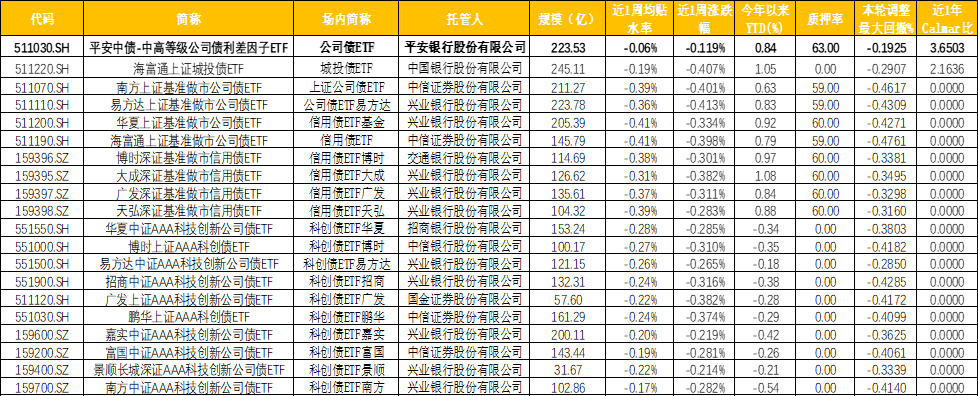
Core Insights - The core inflation rate in the US for July increased to 3.1%, surpassing market expectations of 3.0% and the previous value of 2.9% [1] - The probability of the Federal Reserve lowering interest rates by 25 basis points by September 2025 is 92.1%, while the probability of maintaining the current rate is 7.9% [1] Company and Industry Analysis - The Ping An Company Bond ETF (511030) has shown the best performance in controlling drawdowns during the recent bond market adjustment, with minimal trading discounts and a relatively stable net value [1] - The table provided lists various bond ETFs, including their scale, recent trading discounts, and performance metrics, indicating a competitive landscape among bond funds [1]

能源降价难抵米价狂飙!日本核心CPI居高不下 市场押注央行10月加息
Xin Hua Cai Jing· 2025-08-22 06:42
Core Insights - Japan's core CPI excluding fresh food rose by 3.1% year-on-year in July, slightly down from 3.3% in June, but still significantly above the central bank's 2% target [1] - A deeper inflation indicator, which excludes both energy and fresh food, remained high at 3.4%, indicating persistent price pressures in Japan [1] - Despite a 0.3% year-on-year decline in energy prices due to restored subsidies, rice prices surged by 90.7% year-on-year, and processed food prices saw a monthly increase of 8.3%, the highest in nearly a year [1] - Analysts believe that if inflation remains elevated, the Bank of Japan may end its decade-long ultra-loose monetary policy and initiate gradual interest rate hikes within the year [1] - A survey conducted from August 12 to 19 revealed that 63% of respondents expect the key interest rate to rise from 0.50% to 0.75% later this year, a significant increase from 54% the previous month [1] - Despite expectations of a slowdown in the U.S. economy leading to potential rate cuts by the Federal Reserve, over 70% of economists believe this will not affect the Bank of Japan's policy trajectory [1] - In the short term, 92% of economists anticipate that the interest rate will remain unchanged at the mid-September meeting, but there is a consensus for action in the fourth quarter [1] - Among 40 experts providing timelines, 38% favor October for a potential rate hike, 30% lean towards January next year, and 18% bet on December [1][2]
日本七月核心通胀同比增3.1%,远高于央行2%目标
Hua Er Jie Jian Wen· 2025-08-22 04:09
Core Insights - Japan's inflation remains stubbornly high, with July's core CPI rising 3.1% year-on-year, above market expectations and the Bank of Japan's 2% target [1][3] - The core inflation slowdown is attributed to a 0.3% decline in energy prices, marking the first drop since March 2024, but underlying inflation pressures persist [1][3] - The "core-core" CPI, excluding fresh food and energy, held steady at a 3.4% year-on-year increase, indicating persistent inflationary trends [1][3] Inflation Dynamics - Rice prices surged by 90.7% year-on-year in July, despite a decrease from June's 100.2% increase, causing widespread dissatisfaction among consumers [4][6] - The rise in rice prices has led to a chain reaction, with processed food prices increasing by 8.3%, the fastest rate since September 2023, while service prices remained stable at 1.5% [4][6] - Rising rents and soaring rice prices are contributing to increased costs in processed foods and dining out, putting political pressure on the government [6][7] Market Reactions - Following the inflation data release, Japanese government bond yields rose, and market expectations for a Bank of Japan rate hike by the end of October increased from approximately 42% to 51% [3][7] - Economists suggest that the window for a rate hike is approaching, supported by strong economic growth over five consecutive quarters [7] - The market anticipates that the Bank of Japan will maintain its current policy in September but is closely watching the October meeting for potential changes [7]

英国7月CPI同比上涨3.8%
Xin Hua Wang· 2025-08-20 13:11
Group 1 - The core point of the article is that the UK's Consumer Price Index (CPI) increased from 3.6% in June to 3.8% in July, indicating rising inflation pressures [1] - The core CPI, excluding energy, food, alcohol, and tobacco, also saw a slight increase from 3.7% in June to 3.8% in July [1] - The CPI for services rose from 4.7% to 5.0%, reflecting broader inflationary trends in the service sector [1] Group 2 - Analysts suggest that the rising CPI will put pressure on the Bank of England's monetary policy, making it difficult to further cut interest rates if inflation continues to rise [1] - The Bank of England recently lowered the benchmark interest rate by 25 basis points to 4%, marking the fifth rate cut in a year [1] - The Bank of England forecasts that the inflation rate will peak at 4% in September before gradually returning to the target level of 2% [1]
7月实物商品网上零售额同比增长8.3% 环比加快3.6个百分点
智通财经网· 2025-08-20 07:38
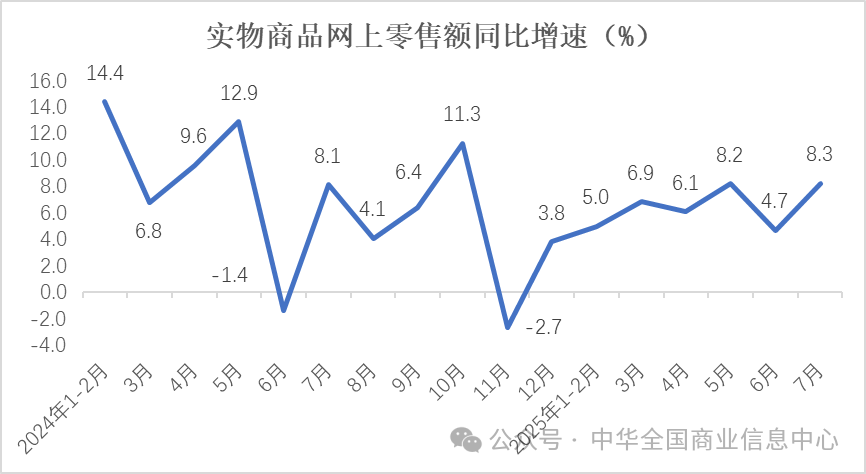
Group 1: Online Retail Performance - In July, the online retail sales of physical goods increased by 8.3% year-on-year, accelerating by 3.6 percentage points compared to June [1] - From January to July, the online retail sales of physical goods reached 707.9 billion yuan, growing by 6.3%, which is 0.3 percentage points faster than the first half of the year [1] - The proportion of online retail sales of physical goods accounted for 24.9% of total retail sales, remaining stable compared to the first half of the year [1] Group 2: Offline Retail Trends - In July, offline retail sales grew by 2.4% year-on-year, a decline of 3.2 percentage points from June [3] - From January to July, offline retail sales accumulated a growth of 4.4%, which is 0.4 percentage points slower than the first half of the year [3] - Retail sales in convenience stores, supermarkets, department stores, specialty stores, and brand stores grew by 7.0%, 5.2%, 1.1%, 5.8%, and 1.9% respectively from January to July [3] Group 3: Overall Retail Market - In July, the total retail sales of consumer goods reached 38.78 billion yuan, with a year-on-year growth of 3.7%, although the growth rate decreased by 1.1 percentage points from June [5] - The growth rate in July was still higher than the average growth rate for the same period over the past three years by 1.1 percentage points [5] Group 4: Urban and Rural Consumption - In July, urban retail sales amounted to 33.62 billion yuan, growing by 3.6% year-on-year, with a decrease of 1.2 percentage points from June [7] - Rural retail sales reached 5.16 billion yuan, with a growth of 3.9%, down by 0.6 percentage points from June [7] - From January to July, urban retail sales grew by 4.8%, while rural retail sales increased by 4.7%, both showing a slight decline compared to the first half of the year [7] Group 5: Retail Sales by Category - In July, total retail sales of goods were 34.276 billion yuan, with a year-on-year growth of 4.0%, down by 1.3 percentage points from June [9] - Retail sales of limited above units reached 13.905 billion yuan, growing by 3.1%, with a decrease of 2.4 percentage points from June [9] - From January to July, retail sales of goods totaled 252.254 billion yuan, with a year-on-year growth of 4.9%, slightly down by 0.2 percentage points from the first half of the year [9] Group 6: Growth in Specific Categories - The "trade-in" policy has positively impacted sales, with retail sales of home appliances, cultural and office supplies, furniture, and communication equipment growing by 28.7%, 13.8%, 20.6%, and 14.9% respectively in July [11] - Sales of basic living goods also saw an increase, with food and daily necessities growing by 6.9% and 8.2% respectively [11] Group 7: Service Sector Growth - From January to July, service retail sales increased by 5.2% year-on-year, outpacing the growth of goods retail sales by 0.3 percentage points [12] - The growth was driven by increased demand in cultural, sports, and tourism sectors during the summer travel season [12] Group 8: Consumer Price Index (CPI) Trends - In July, the CPI remained flat year-on-year, with a decrease of 0.1 percentage points from the previous month, primarily due to falling food prices [14] - Core CPI, excluding food and energy, rose by 0.8%, marking an expansion in growth for three consecutive months [14] Group 9: Restaurant Sector Performance - In July, restaurant revenue reached 450.4 billion yuan, with a year-on-year growth of 1.1%, slightly up by 0.2 percentage points from June [15] - From January to July, restaurant revenue totaled 31.984 billion yuan, growing by 3.8%, which is a decline of 0.5 percentage points compared to the first half of the year [15]
7月份黑龙江省居民消费价格同比再次持平
Zhong Guo Chan Ye Jing Ji Xin Xi Wang· 2025-08-18 22:14
Group 1 - The core viewpoint of the articles indicates that in July 2025, the consumer price index (CPI) in Heilongjiang Province remained stable year-on-year, with industrial prices rising by 0.8%, service prices increasing by 0.3%, while food and energy prices decreased by 2.4% and 3.7% respectively [1][2] - The overall consumer price index showed a "five increases and three decreases" trend among the eight categories of goods and services surveyed, with other goods and services prices rising by 8.4% due to high international precious metal prices, contributing approximately 0.26 percentage points to the overall CPI [1] - The core CPI, excluding food and energy prices, maintained a high level with a year-on-year increase of 1%, contributing about 0.76 percentage points to the overall CPI, while the declines in food and energy prices together pulled down the overall CPI by approximately 0.77 percentage points [1] Group 2 - In July, the year-on-year change in consumer prices in Heilongjiang Province was consistent with the national average, ranking 8th among 31 provinces and regions, higher than Liaoning and Jilin by 0.2 percentage points [2]
波兰7月核心CPI环比增长0.3%,符合预期
Mei Ri Jing Ji Xin Wen· 2025-08-18 12:18
Group 1 - Poland's core CPI in July increased by 0.3% month-on-month, meeting expectations [1] - Year-on-year, the core CPI rose by 3.3%, also in line with forecasts [1]