流动性

Search documents
买断式逆回购释放流动性
Jing Ji Ri Bao· 2025-10-15 22:12
Core Viewpoint - The People's Bank of China (PBOC) is actively injecting medium-term liquidity into the banking system through a series of reverse repurchase operations to maintain a stable and ample liquidity environment amid potential tightening pressures. Group 1: Reverse Repo Operations - On October 15, the PBOC conducted a 600 billion yuan buyout reverse repo operation with a six-month term, following a previous operation of 1.1 trillion yuan for three months on October 9 [1] - The total amount of reverse repos in October, including both operations, indicates a net increase of 400 billion yuan compared to the previous month, marking the fifth consecutive month of liquidity injection through this method [1][2] - The operations are aimed at addressing the upcoming maturity of 5 trillion yuan in six-month reverse repos and 8 trillion yuan in three-month reverse repos due in October [1] Group 2: Market Conditions and Expectations - Analysts suggest that the recent operations are in response to significant government bond issuances and the anticipated impact of new policy financial tools, which are expected to drive loan growth [2][3] - The seasonal increase in cash demand due to holidays and the pressure from fiscal deposits are contributing to a potential liquidity gap, prompting the PBOC's actions [3] - The PBOC's commitment to maintaining ample liquidity is expected to support the smooth issuance of government bonds and meet the credit financing needs of enterprises and households [3] Group 3: Future Monetary Policy Outlook - The PBOC's monetary policy committee has emphasized the need for proactive and effective monetary policy adjustments to align with economic growth and inflation expectations [4] - The expectation is that the PBOC will continue to utilize various monetary policy tools in the fourth quarter to sustain market liquidity [4] - The committee highlighted the importance of flexibility and foresight in policy implementation, considering the ongoing domestic demand shortfall and external uncertainties [4]
加量操作呵护流动性,央行开展6000亿元买断式逆回购
Sou Hu Cai Jing· 2025-10-15 02:15
Core Viewpoint - The People's Bank of China (PBOC) is conducting a significant amount of reverse repos to maintain liquidity in the banking system, indicating a supportive monetary policy stance amid potential tightening of liquidity conditions [1][2][4] Group 1: Reverse Repo Operations - On October 15, 2025, the PBOC will conduct a reverse repo operation of 600 billion yuan with a term of 6 months, marking the second such operation in October [1] - Earlier in October, the PBOC conducted a reverse repo operation of 1.1 trillion yuan with a term of 3 months [1] - The total amount of reverse repos in October is set to increase by 100 billion yuan compared to the previous month, continuing a trend of injecting medium-term liquidity for five consecutive months [1] Group 2: Market Conditions and Government Actions - The increase in reverse repo operations is partly due to the large-scale issuance of government bonds and the acceleration of new policy financial tools, which are expected to boost loan disbursements [2] - The strong performance of the stock market and the phenomenon of "deposit migration" among residents in October are also contributing to a tightening of liquidity, necessitating support from the PBOC [2] Group 3: Future Expectations - Analysts expect the PBOC to continue using reverse repos and Medium-term Lending Facility (MLF) tools to inject liquidity into the market [4] - There is a possibility of a reduction in the scale of medium-term liquidity injections in the future, as the PBOC may implement a new round of reserve requirement ratio (RRR) cuts in the fourth quarter [4] - The anticipated RRR cuts are linked to external volatility, changes in domestic economic growth momentum, price trends, and efforts to stabilize the real estate market [4]

加量操作呵护流动性央行开展6000亿元买断式逆回购
Shang Hai Zheng Quan Bao· 2025-10-14 18:30
Core Viewpoint - The People's Bank of China (PBOC) is conducting a 600 billion yuan reverse repurchase operation to stabilize liquidity, indicating a continued supportive monetary policy stance [1][2]. Group 1: Monetary Policy Actions - The PBOC will conduct a 600 billion yuan 6-month reverse repurchase operation on October 15, 2023, as part of its strategy to maintain market stability [1]. - This operation follows the maturity of 800 billion yuan in 3-month reverse repos on the same day, helping to smooth short-term funding fluctuations [1]. - In October, the total net injection of liquidity through reverse repos is approximately 400 billion yuan, which is an increase of 100 billion yuan compared to September [1]. Group 2: Market Conditions and Expectations - The increase in reverse repo operations is attributed to heightened funding demand due to concentrated government bond issuances and the introduction of new policy financial instruments [2]. - Analysts expect that the PBOC will continue to use both reverse repos and Medium-term Lending Facility (MLF) tools to inject liquidity into the market [2][3]. - There is a possibility of a reserve requirement ratio (RRR) cut in the fourth quarter, which would provide longer-term, lower-cost liquidity to the market [3]. Group 3: Future Outlook - The PBOC is likely to maintain a stable short-term liquidity environment, with interest rates expected to stabilize around 1.5% [3]. - The market is anticipated to experience limited liquidity gaps, with structural tensions being manageable [3].
流动性和机构行为周度观察:10月资金面预计整体宽松-20251014
Changjiang Securities· 2025-10-14 12:49
1. Report Industry Investment Rating No relevant content provided. 2. Core View of the Report - From October 9 - 11, 2025, the central bank significantly net - withdrew funds through short - term reverse repurchases, and the money market generally loosened. The net payment scale of government bonds decreased, most of the maturity yields of inter - bank certificates of deposit declined, and the average leverage ratio of the inter - bank bond market slightly increased. - Looking ahead to the money market trend in October, it is expected to be seasonally loose at the beginning of the quarter. Although it is expected to be generally loose overall, there will be certain volatility pressure at the end of the month due to the overlap of tax payment and cross - month effects [2][8]. 3. Summary by Related Catalogs 3.1 Money Market - **Reverse Repurchase Operations**: From October 9 - 11, 2025, the central bank's 7 - day reverse repurchase had a net withdrawal of 15263 billion yuan. To cope with the pressure of concentrated maturity of funds, the central bank carried out a 3 - month (3M) outright reverse repurchase operation of 11000 billion yuan on October 9, with a net investment of 3000 billion yuan this month. From October 13 - 17, 7 - day reverse repurchases worth 10210 billion yuan and treasury cash deposits worth 1500 billion yuan will mature [7]. - **Money Market Conditions**: From October 9 - 11, 2025, the average values of DR001 and R001 decreased by 3.0 and 10.5 basis points respectively compared with September 29 - 30; the average values of DR007 and R007 decreased by 7.1 and 26.3 basis points respectively. The money market generally loosened. It is expected to be generally loose in October, but with certain volatility pressure at the end of the month [8]. - **Government Bond Net Payment**: From October 9 - 11, 2025, the net payment scale of government bonds was about 7 billion yuan, about 2114 billion yuan less than that from September 29 - 30. From October 13 - 19, the net payment scale of government bonds is expected to be 852 billion yuan [9]. 3.2 Inter - bank Certificates of Deposit - **Maturity Yields**: As of October 11, 2025, the 1 - month (1M) and 1 - year (1Y) inter - bank certificate of deposit maturity yields decreased by 0.3 and 1.5 basis points respectively compared with September 30, while the 3 - month (3M) yield increased by 4.1 basis points [10]. - **Net Financing Amount**: From October 9 - 11, 2025, the net financing amount of inter - bank certificates of deposit was about 823 billion yuan, turning positive from - 1316 billion yuan from September 29 - 30. The maturity repayment amount from October 13 - 19 is expected to be 5049 billion yuan, and the maturity amount in October is expected to be 1.84 trillion yuan, significantly lower than that in September [10]. 3.3 Institutional Behavior - **Inter - bank Bond Market Leverage Ratio**: From October 9 - 11, 2025, the average calculated leverage ratio of the inter - bank bond market was 107.61%, slightly higher than the average of 107.57% from September 29 - 30 [11]. - **Duration of Pure Bond Funds**: On October 10, 2025, the median duration (MA5) of medium - and long - term interest - rate style pure bond funds increased by 0.67 years week - on - week, reaching the 76.8% quantile since the beginning of 2022; the median duration (MA5) of short - term interest - rate style pure bond funds increased by 0.18 years week - on - week, reaching the 28.1% quantile since the beginning of 2022 [11].
9月电解铝产能利用率续创历史新高水平:——金属周期品高频数据周报(2025.10.4-10.10)-20251014
EBSCN· 2025-10-14 12:42
Investment Rating - The report maintains an "Overweight" rating for the steel and non-ferrous metals sectors [5]. Core Insights - The report highlights that the utilization rate of electrolytic aluminum production has reached a historical high in September 2025, indicating strong demand in the sector [2]. - The steel PMI index dropped to 45.2% in September, marking a six-month low, which reflects challenges in the construction and real estate sectors [24][45]. - The report notes that the profitability of titanium dioxide and flat glass remains low, with significant negative margins reported [78]. Summary by Relevant Sections Liquidity Indicators - The London gold spot price reached a historical high of $4018 per ounce, reflecting increased global liquidity and risk appetite [11]. - The BCI small and medium enterprise financing environment index was at 46.37 in August 2025, showing a month-on-month increase of 0.61% [20]. Infrastructure and Real Estate Chain - The national steel PMI index for September was reported at 45.2%, the lowest in six months, indicating a slowdown in construction activity [24][45]. - The average daily crude steel production for key enterprises in late September decreased by 8.88% month-on-month [45]. Industrial Products Chain - The operating rate for semi-steel tires was at a five-year low, with a significant month-on-month decline of 27.07 percentage points [2]. - The price of electrolytic aluminum was reported at 21,020 yuan per ton, with a month-on-month increase of 0.91% [10]. Subsector Performance - The report indicates that the profitability of titanium dioxide was negative at -1,082 yuan per ton, while flat glass had a negative margin of -58 yuan per ton [78]. - The operating rate for flat glass was reported at 76.01% [78]. Price Comparisons - The report notes that the price ratio of London spot gold to silver reached a 14-month low, indicating shifts in market dynamics [3]. - The price of rebar was reported at 3,260 yuan per ton, with a slight increase of 0.6% [10]. Export Chain - The new export orders PMI for China in September 2025 was reported at 47.80%, reflecting a slight month-on-month increase [3].
10月第二次买断式逆回购将落地,合计加量续作4000亿护航流动性
Di Yi Cai Jing· 2025-10-14 10:40
他进一步分析,当前市场面临多重流动性需求:一方面,国家发展和改革委正加快推进5000亿元新型政 策性金融工具,预计将大幅拉动配套贷款投放;另一方面,10月政府债券发行规模较大,二者均可能带 来资金面收紧效应。央行通过买断式逆回购注入中期流动性,既能助力政府债券顺利发行、引导金融机 构加大信贷投放,也释放出数量型政策工具持续加力的信号,彰显货币政策的支持性立场。 招联首席研究员董希淼则认为,3个月期(91天)与6个月期(182天)逆回购的组合,不仅能呵护节后 资金面平稳,更可保障元旦前后市场流动性充裕,为跨年金融市场平稳运行奠定基础。同时,由于买断 式逆回购利率低于同期限中期借贷便利(MLF),加大操作力度有助于降低金融机构资金成本,为后 续信贷投放减负。 值得关注的是,10月仍有7000亿元MLF(中期借贷便利)到期,市场普遍预期央行或采取等量或小幅 加量方式续作。 董希淼预测,未来央行将综合运用逆回购、买断式逆回购调节中短期流动性,通过MLF、降准等工具 释放中长期流动性,优化期限结构以匹配政府债券发行与信贷投放需求,进一步引导金融机构支持重大 战略、重点领域与薄弱环节。 董希淼还提及,四季度作为稳增长政策 ...
6000亿元,央行最新公告
Mei Ri Jing Ji Xin Wen· 2025-10-14 09:45
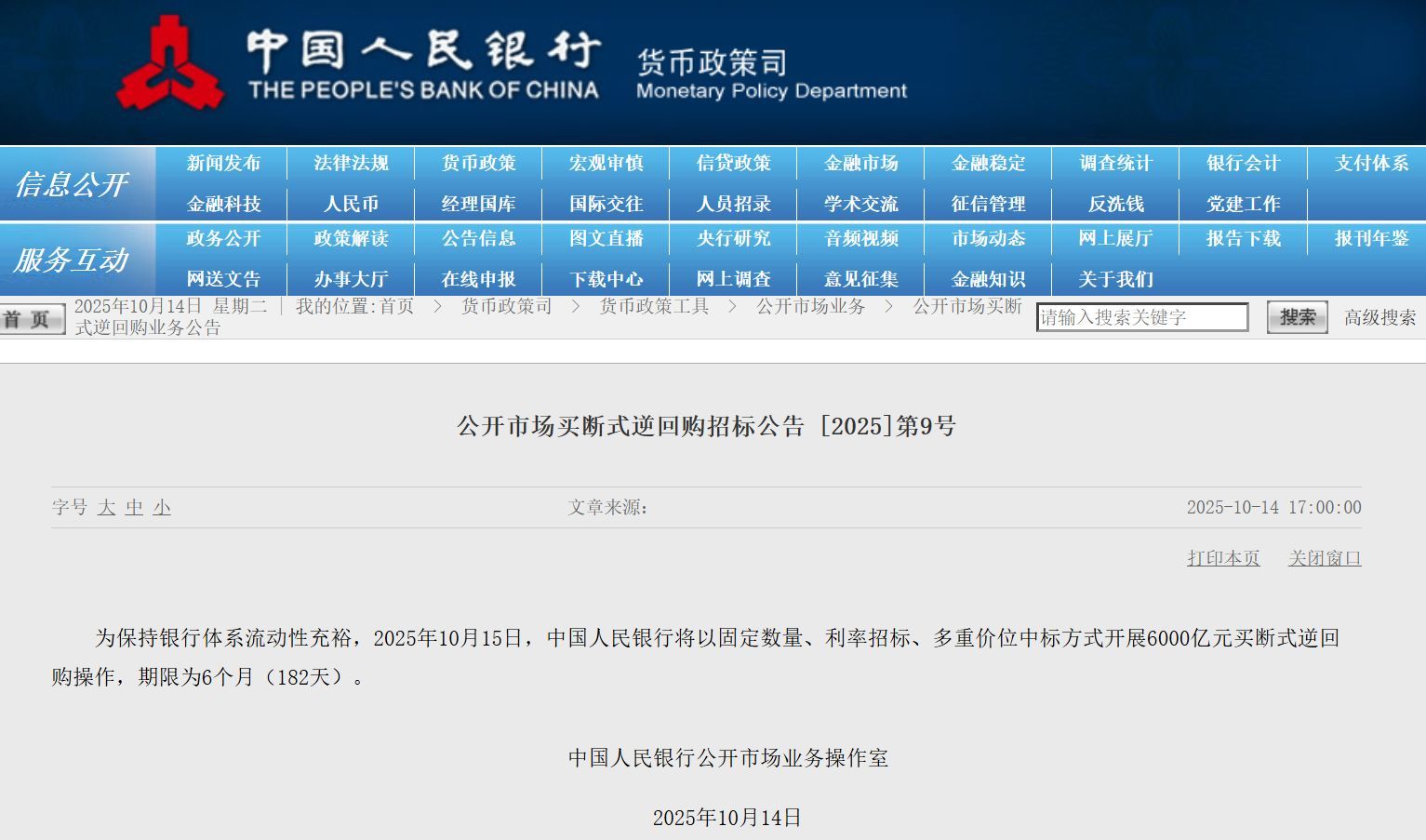
Core Points - The People's Bank of China (PBOC) announced a 600 billion yuan six-month reverse repurchase operation scheduled for October 15, 2025, using a fixed quantity and interest rate bidding method [1] - On the same day, the PBOC conducted a 910 billion yuan seven-day reverse repurchase operation at an interest rate of 1.40% [4] - The liquidity in the financial market showed mixed trends, with the Shanghai Interbank Offered Rate (Shibor) for overnight remaining stable at 1.314% and the seven-day Shibor rising by 4.4 basis points to 1.447% [4] - A report from Huaxi Securities indicated that liquidity is expected to remain stable before the tax period, but the end of October may see increased liquidity pressure due to the overlap of the tax period and month-end [1][4] Summary by Category Monetary Policy - The PBOC will conduct a 600 billion yuan reverse repurchase operation with a six-month term on October 15, 2025, using a fixed quantity and interest rate bidding method [1] - A 910 billion yuan seven-day reverse repurchase operation was conducted on October 14, 2025, at an interest rate of 1.40% [4] Financial Market Trends - The financial market experienced mixed trends, with the overnight Shibor stable at 1.314% and the seven-day Shibor increasing to 1.447% [4] - The weighted average rate of DR007 rose to 1.4495% by the end of trading, while the one-day treasury reverse repurchase rate decreased to 1.416% [4] Liquidity Outlook - Huaxi Securities reported that liquidity is expected to remain stable before the tax period, but the end of October may present challenges due to the overlap of the tax period and month-end [1][4]
流动性、政策面、基本面三位一体框架:牛市走向:流动性和增量政策的博弈
Xinda Securities· 2025-10-14 06:02
Group 1: Liquidity - Institutional funds waiting to enter the market amount to several trillion yuan, with a potential inflow of 1.64 to 5.75 trillion yuan based on equity position increases[2] - As of Q2 2025, the average equity position of various institutional funds is at a historical low of 8.7%[37] - The total balance of wealth management, trust, insurance, and asset management products exceeds 100 trillion yuan, indicating significant room for future market entry[37] Group 2: Policy - The People's Bank of China has not followed the U.S. Federal Reserve's interest rate cuts, maintaining the 7-day reverse repurchase rate at 1.4% and the 1-year LPR at 3%[40] - The Q3 monetary policy meeting did not signal any new incremental policies, emphasizing continuity and stability instead[41] - The introduction of 500 billion yuan in new policy financial tools is underway, with further fiscal policy measures still to be observed[56] Group 3: Fundamentals - The Producer Price Index (PPI) is expected to turn positive by the end of Q1 or early Q2 2026, driven by capacity management measures[2] - Short-term economic pressures remain, but corporate expectations have begun to stabilize, particularly in industries affected by the "anti-involution" policy[71] - The "anti-involution" policy aims to address overcapacity and improve corporate expectations, with specific measures being implemented across key industries[72]
热点思考 | 美元的“十字路口”——“流动性笔记”系列之五(申万宏观·赵伟团队)
申万宏源证券上海北京西路营业部· 2025-10-14 03:29
Core Viewpoint - The article discusses the current state of the US dollar, highlighting its pivotal position in global liquidity and the potential implications for financial markets and economies [2] Group 1: Dollar's Current Status - The US dollar is at a critical juncture, influenced by various macroeconomic factors including interest rates and inflation [2] - Recent data indicates that the dollar's strength has fluctuated, with a notable increase in demand for dollar-denominated assets [2] Group 2: Liquidity and Market Implications - The liquidity conditions in the US are tightening, which may lead to increased volatility in financial markets [2] - The article emphasizes the importance of monitoring Federal Reserve policies, as changes could significantly impact the dollar's value and global liquidity [2] Group 3: Future Outlook - Analysts predict that the dollar may face challenges ahead, particularly if inflation persists and the Fed continues to adjust interest rates [2] - The potential for a shift in global capital flows is highlighted, as investors reassess their positions in response to changing dollar dynamics [2]