AI产业链

Search documents
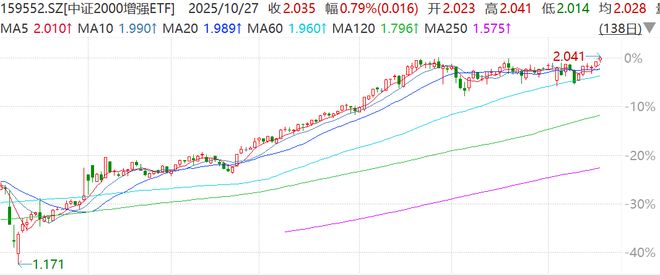
沪指涨超1.1%冲击4000点关口,中证2000增强ETF(159552)盘中刷新上市新高
2 1 Shi Ji Jing Ji Bao Dao· 2025-10-27 06:06
Core Viewpoint - The A-share market is experiencing a strong upward trend, with the Shanghai Composite Index rising over 1.1% and approaching the 4000-point mark, driven by sectors such as electronic chemicals, shipbuilding, steel, and small metals [1] Group 1: ETF Performance - The China Securities 2000 Enhanced ETF (159552) has seen significant inflows, with a net subscription of 9 million units on the day of reporting, following a total net inflow of approximately 69 million yuan over the previous three trading days [2] - The ETF's third-quarter report indicates a net asset value growth rate of 18.22%, outperforming its benchmark (China Securities 2000 Index) which grew by 14.31%, resulting in an excess return of 3.91% [4][5] - Over longer periods, the ETF has shown impressive performance with growth rates of 34.46% over six months, 67.74% over one year, and 98.86% since inception, all significantly surpassing their respective benchmarks [4][5] Group 2: Market Trends and Insights - The third-quarter report highlights a clear divergence in market styles, with growth styles outperforming value styles, while large-cap stocks have rebounded significantly, particularly in the technology sector [6] - Various institutions predict that the market will continue its strong performance, with expectations of improved corporate earnings and resilient domestic demand, particularly in the TMT and advanced manufacturing sectors [7] - The ETF's active investment portion focuses on technology and manufacturing, with significant allocations in manufacturing and information technology services, indicating a strategic emphasis on these sectors [8]

建材行业报告(2025.10.20-2025.10.26):管网新增投资超5万亿,关注低位题材机会
China Post Securities· 2025-10-27 06:03
Industry Investment Rating - The investment rating for the construction materials industry is "Outperform the Market" and is maintained [1] Core Views - The report highlights that during the 14th Five-Year Plan period, China is expected to construct and renovate over 700,000 kilometers of underground pipelines, with new investment needs exceeding 5 trillion yuan. This initiative is a key focus for the government and is expected to significantly boost investment and consumption, creating substantial domestic demand opportunities. Recommended companies to watch include China Liansu, Qinglong Pipeline, and Donghong Co [4] - In the cement sector, the demand recovery is slow, with a year-on-year decline of 8.6% in cement production in August 2025, totaling 154 million tons. The industry is currently in a low demand and price phase, but capacity utilization is expected to improve due to policies limiting overproduction. Companies to focus on include Conch Cement and Huaxin Cement [5][10] - The glass industry is experiencing a downward trend in demand due to the real estate sector's impact, with prices showing signs of weakening post-holiday. The report suggests that while environmental regulations may not lead to a drastic reduction in capacity, they will increase costs and accelerate industry adjustments. Key players to monitor include Qibin Group [5][15] - The fiberglass sector is seeing a positive trend driven by demand from the AI industry, with expectations for explosive growth in low-dielectric products. Companies like China Jushi and China National Building Material are highlighted as potential beneficiaries [5] - The consumer building materials sector has reached a profitability bottom, with no further price declines expected. The report anticipates a recovery in profitability for leading companies in the second half of the year, with firms like Oriental Yuhong and Sanke Tree recommended for attention [5] Summary by Sections Cement - The cement market is gradually entering its peak season, but overall demand recovery is slow. The construction sector's demand has not fully materialized due to weather disruptions and the pace of demand release. The report notes that the industry is currently at a low point in both demand and prices [10] - In August 2025, cement production was 154 million tons, reflecting an 8.6% year-on-year decline [10] Glass - The glass industry is facing weak demand post-holiday, with significant inventory increases affecting price stability. The report indicates that the supply-demand imbalance persists, and future performance will depend on policy changes and downstream inventory replenishment [15] Fiberglass - The fiberglass sector is benefiting from the AI industry's growth, with expectations for a significant increase in demand and prices for low-dielectric products. The report emphasizes a positive outlook for the industry [5] Consumer Building Materials - The consumer building materials sector is expected to see a recovery in profitability, with leading companies actively pursuing price increases. The report suggests that the sector has reached a profitability bottom, and improvements are anticipated in the latter half of the year [5]
除了对荒谬的激情,我已经一无所有|一周荐书
Xin Lang Cai Jing· 2025-10-27 02:34
Group 1 - The publication of "Xin Qi Ji" is described as a reflection on the author's regret for not producing more work, featuring 16 old pieces written around 20 years ago that were initially destroyed but later preserved by a reader [5] - The author expresses a deep emotional engagement in revising these works, highlighting the raw and sincere qualities of youthful writing, characterized by sudden emotional shifts from sadness to joy [5][6] Group 2 - "Extraordinary: Memories of Szymborska" provides a unique perspective on the life of Nobel laureate Wisława Szymborska through the eyes of her secretary, detailing their 15-year relationship and Szymborska's creative process [10] - The book captures Szymborska's whimsical interests, her preference for solitude, and her ability to maintain curiosity about the world despite the chaos following her Nobel Prize win [10][11] Group 3 - "The Commitment to Motherhood" explores the lives of 162 low-income women and their choices regarding motherhood and marriage, emphasizing the need for effective interventions based on understanding their circumstances [15] - The authors argue that societal structures, such as deindustrialization and ineffective education systems, contribute to the challenges these women face in their family choices [15] Group 4 - "The Third Reich" by Thomas Childs offers a chronological account of Nazi Germany's rise and fall, correcting misconceptions from previous historical narratives and emphasizing the dangers of unchecked power [21] - The book serves as a historical warning about the consequences of authoritarianism and the importance of understanding the past to prevent future atrocities [21] Group 5 - "The Trade Policy Disaster" examines the trade policies during the Great Depression and their implications for contemporary economic crises, warning against the potential return to protectionism in times of economic downturn [23][24] - The author highlights the lessons learned from past mistakes and the need for policymakers to resist the allure of high trade barriers during economic challenges [24] Group 6 - "Feeding AI" reveals the hidden labor behind AI technologies, emphasizing the role of human workers in data processing and content moderation, and critiques the power dynamics between global tech giants and low-cost laborers [26][27] - The book raises questions about inequality and the future of labor in the context of AI, urging a reconsideration of the current economic structures [27] Group 7 - "The Wisdom of Owls" presents new scientific insights into the behavior and communication of owls, highlighting their adaptability and role in the ecosystem [28][29] - The author emphasizes the significance of owls in various cultures and their complex behaviors, which have only recently been studied in depth [29]
做科技投资 “进攻者” 以产品思维锻造长期价值——访恒越基金吴海宁
Sou Hu Cai Jing· 2025-10-27 01:27
Core Viewpoint - The investment philosophy of Wu Haining emphasizes the importance of "product power" in selecting companies, focusing on those with either viable technology or management capable of translating strategy into sustained performance [3][4][8]. Group 1: Investment Methodology - Wu Haining's investment approach revolves around two main pillars: industry stage and company quality, with "product thinking" as the central theme [3][8]. - In terms of industry assessment, she prefers the "1-10" growth stage, where the business logic is validated and performance can consistently exceed expectations [3][8]. - The selection criteria for companies include three product-oriented standards: the quality of the sector, competitive barriers, and the management team’s alignment with company interests [3][8]. Group 2: Market Insights - Wu Haining expresses a rational yet optimistic view on the current market, suggesting that the recent pullback in tech stocks is due to high valuations and external events, with risks partially released [9]. - She identifies three main technology themes for the medium to long term: the AI industry chain, semiconductor localization, and energy storage, all driven by technology and demand [9][10]. - The focus on technology-driven growth aligns with the belief that successful products lead to long-term value, similar to Steve Jobs' philosophy at Apple [9][10]. Group 3: Performance and Strategy - Since joining Hengyue Fund in April 2023, Wu Haining has demonstrated a distinctive investment style characterized by aggressive strategies and rigorous risk control, achieving a remarkable return of 124% over the past year [5][6]. - Her strategy integrates the "stock penetration" of private equity with the "portfolio management" of public funds, allowing for dynamic adjustments based on market conditions [6][8]. - The portfolio has shown a significant allocation to hard technology sectors, with over 50% in electronics and communications, reflecting a strong offensive approach while managing risks through diversification [6][8].

周期底部“翻石头” 喧嚣中坚守价值投资
Zhong Guo Zheng Quan Bao· 2025-10-26 21:06
Core Viewpoint - The investment strategy focuses on identifying undervalued assets in forgotten market segments, emphasizing a bottom-up approach to uncover hidden opportunities during market fluctuations [1][2]. Group 1: Investment Philosophy - The company maintains a fully invested position since its inception in June 2017, demonstrating a commitment to long-term value rather than short-term market timing [2]. - The core investment philosophy revolves around finding high-quality stocks with a safety margin, rather than attempting to predict overall market trends [2][3]. - The investment approach is characterized by a focus on valuation and market cycles, with a belief that low prices provide strong safety margins and potential for significant upside when cycles recover [2][4]. Group 2: Current Market Focus - The company is currently exploring opportunities in sectors such as leading liquor brands and the home furnishings industry, which have been temporarily overlooked by the market [3]. - Despite the AI industry's prominence, the company remains cautious, citing high valuations and a lack of deep understanding of the rapidly evolving sector [3][4]. - The company identifies copper mining stocks as attractive investments due to their reasonable valuations and significant growth potential driven by increasing demand from AI infrastructure and renewable energy [4]. Group 3: Long-term Outlook - The long-term market outlook is driven by the entrepreneurial spirit of Chinese businesses, with expectations for the emergence of competitive companies that create new demand [4][5]. - The investment strategy is likened to "turning stones," emphasizing continuous learning and analysis of industry fundamentals, competitive dynamics, and management effectiveness [4][5]. - The company acknowledges the inevitability of mistakes in the investment process, viewing them as part of a learning journey that contributes to long-term value accumulation [5].
做科技投资 “进攻者”以产品思维锻造长期价值——访恒越基金吴海宁
Shang Hai Zheng Quan Bao· 2025-10-26 15:37
Core Viewpoint - The investment philosophy of Wu Haining emphasizes "product thinking" and focuses on companies with strong product capabilities, aiming for long-term value rather than short-term gains [3][4][10]. Investment Strategy - Wu Haining prefers investing in companies at the "1-10" growth stage, where the industry logic is validated and companies can consistently exceed performance expectations [3][8]. - The investment approach combines individual stock selection with portfolio management, integrating insights from private equity and public fund management [5][6]. Selection Criteria - Three product-oriented standards guide company selection: 1. Industry quality with large potential and high demand, such as the energy storage sector [8]. 2. Competitive barriers, focusing on technology and manufacturing capabilities for manufacturing firms, and brand loyalty for consumer companies [8]. 3. Management alignment with company interests and ability to execute strategies [8]. Performance and Market Outlook - Wu Haining's fund achieved a remarkable return of 124% over the past year, demonstrating effective risk management and dynamic portfolio adjustments [7]. - The current market is viewed as a short-term correction, but the long-term growth trend for technology stocks is believed to be only halfway through [10][11]. Focus Areas - Three main technology investment themes are highlighted: 1. The AI industry chain, with domestic hardware companies expected to compete globally [10]. 2. The acceleration of semiconductor localization, enhancing certainty in chip and equipment materials [10]. 3. Energy storage, driven by overseas electricity shortages and domestic economic viability [10]. Investment Philosophy - The philosophy stresses the importance of technology-driven growth and the need for companies to have solid performance backing, aligning with the belief that great products lead to long-term value [10][11].

科技股分歧渐显基金经理详解AI产业链纵深机会
Shang Hai Zheng Quan Bao· 2025-10-26 15:37
Core Insights - The recent market adjustment in A-shares, particularly in the technology sector, is primarily a result of profit-taking after significant gains, rather than a fundamental shift in the long-term growth trajectory of AI and other tech industries [1][2] - The AI industry, along with digital economy and integrated circuits, remains a hot investment area, with many funds reporting substantial net value growth over the past year [1] Group 1: Market Trends - The technology sector, especially AI, has seen a significant rise, with passive index funds related to communication, AI, and chips showing over 50% net value growth in the past year [1] - Active funds focusing on technology, such as China Europe Digital Economy and Huafu Technology Momentum, have reported net value growth exceeding 100% over the same period [1] Group 2: Investment Opportunities - The AI industry chain is identified as a core investment theme, with various segments like large models, GPU chips, and optical modules leading in performance and stock price realization [3] - The demand spillover effect from AI is benefiting midstream sectors such as storage, semiconductor equipment, and new materials, which are now seen as more reasonably valued [3] Group 3: Sector Focus - Key application areas for AI include intelligent driving and humanoid robots, with intelligent driving showing early signs of scalable implementation [3] - The recent energy bottlenecks in the US AI industry present significant opportunities for domestic new energy sectors, including photovoltaics, wind power, and energy storage, aligning strategically with AI's electricity demands [3] Group 4: Market Sentiment - The market is expected to refocus on sectors with favorable economic conditions, particularly in technology, new energy, and pharmaceuticals, as consensus builds around the growth potential in these areas [3]
10月25日,寒武纪大涨9%,超越贵州茅台重登A股股王宝座
Sou Hu Cai Jing· 2025-10-25 16:21
Group 1 - Cambrian's stock price surged by 9%, reclaiming the title of "A-share king," reflecting a shift in market sentiment towards technology stocks [1] - The A-share market reached a nearly ten-year high, with the Shanghai Composite Index closing above 3950 points, indicating strong market performance [3] - The central bank emphasized the importance of maintaining stability in the stock market, marking a significant policy shift [3][13] Group 2 - The technology sector, including Cambrian, has shown strong performance, with many tech stocks experiencing positive momentum [8][10] - QFII has increased its holdings in 30 stocks and raised stakes in 21 stocks, signaling a positive influx of capital into the market [8] - The overall market sentiment is influenced by the government's focus on technological self-reliance as outlined in the "14th Five-Year Plan" [8][11] Group 3 - The recent CPI data in the U.S. has led to increased expectations for interest rate cuts by the Federal Reserve, impacting global capital flows [5][6] - The Nasdaq China Golden Dragon Index saw a 2.4% increase, indicating positive performance among Chinese tech stocks [6] - The market is witnessing a notable shift in investor behavior, with a rise in institutional investor participation and a longer holding period for stocks [10][13] Group 4 - There is a clear divergence in stock performance, with about 30% of stocks underperforming the market index, raising questions about overall market health [15] - The valuation levels of the CSI 300 index are at a historically elevated level, with significant disparities between sectors, particularly between technology and traditional industries [15] - Cambrian's stock fluctuations have sparked discussions about the AI industry chain, highlighting both opportunities and challenges in the domestic AI chip sector [11][17]

三季度银行理财规模大增,特朗普赦免币安赵长鹏 | 财经日日评
吴晓波频道· 2025-10-25 00:30
Group 1: China's Economic and Technological Development - The Fourth Plenary Session of the 20th Central Committee of the Communist Party of China emphasized the goal of significantly enhancing China's economic, technological, and defense capabilities by 2035, aiming for per capita GDP to reach the level of moderately developed countries [2] - The session proposed the development of strategic emerging industries such as new energy, new materials, aerospace, and low-altitude economy, which are expected to create several trillion-yuan markets [2] - The focus on technological self-reliance aligns with recent policies supporting domestic alternatives and AI industry chain development, serving as an effective strategy to address complex international trade situations [2][3] Group 2: Japan's Inflation and Economic Policy - Japan's core CPI rose by 2.9% year-on-year in September, exceeding the Bank of Japan's target of 2%, with food prices increasing significantly by 7.6% [4] - Despite persistent inflation, the Bank of Japan remains cautious about raising interest rates due to economic uncertainties, including the impact of U.S. tariffs [4][5] - The new Japanese government's potential fiscal expansion policies may further fuel inflation, but the Bank of Japan's cautious stance is influenced by slowing growth in the service and manufacturing sectors [5] Group 3: Intel's Financial Performance - Intel reported third-quarter revenue of $13.7 billion, a 3% year-on-year increase, marking its first quarterly revenue growth in over a year and a half [6] - The company achieved an adjusted operating profit margin of 11.2%, recovering from negative margins in previous quarters [6] - Intel's recovery is supported by significant investments from the U.S. government, SoftBank, and NVIDIA, which may help the company capitalize on AI opportunities [7] Group 4: Google's Partnership with Anthropic - Google is set to provide Anthropic with up to 1 million AI chips, valued at several hundred billion dollars, to enhance their collaboration in AI development [8] - Anthropic, a rapidly growing AI startup, has seen a tenfold increase in users since May, generating approximately $500 million in annual revenue [8] - The partnership aims to strengthen Anthropic's AI model performance, positioning it to compete more effectively with OpenAI [9] Group 5: Cryptocurrency Regulation and Market Trends - The recent pardon of Binance founder Zhao Changpeng by President Trump signals a potential shift in U.S. cryptocurrency policy, which may lead to a more favorable regulatory environment for the industry [10][11] - The global trend towards loosening cryptocurrency regulations could usher in a new phase for the industry, although potential risks remain due to the intertwining of policy and business interests [12] Group 6: Bank Wealth Management and Market Trends - As of September, the scale of bank wealth management products exceeded 32 trillion yuan, with a significant increase of approximately 1.4 trillion yuan in the third quarter [15] - The majority of these products are fixed-income types, which have seen declining yields, prompting a shift in market interest towards riskier assets [16] - The ongoing low-interest-rate environment and policies aimed at stabilizing the stock market may lead to increased capital inflows into the equity market [16] Group 7: Stock Market Performance - The stock market experienced a rebound, with the Shanghai Composite Index reaching a new high for the year, driven by strong performance in technology and aerospace sectors [17][18] - The trading volume increased significantly, indicating heightened market activity and investor interest following recent policy announcements [18]


巨额压单 中信证券尾盘突发!科技股强势 AI产业链股集体走高
Zheng Quan Shi Bao· 2025-10-24 10:27
Market Performance - Major stock indices in the A-share market saw significant gains, with the ChiNext Index rising over 3% and the Sci-Tech 50 Index increasing over 4% [1][3] - The Shanghai Composite Index closed up 0.71% at 3950.31 points, while the Shenzhen Component Index rose 2.02% to 13289.18 points [1][3] - Total trading volume in the Shanghai and Shenzhen markets reached 199.18 billion CNY, an increase of over 33 billion CNY compared to the previous day [1] Sector Highlights - The semiconductor and chip sectors experienced a strong rally, with companies like Puran and Xiangnong Chip both hitting the 20% daily limit up, and Jiangbolong rising over 16% [1][5] - AI-related stocks also surged, with companies such as Kexiang and Shengyi Electronics reaching the 20% limit up, and Zhongji Xuchuang continuing to set new highs [1][9] - The satellite navigation sector saw significant gains, with stocks like China Satellite and Guanghe Technology hitting the daily limit up [1] Notable Stock Movements - The newly listed company Super Eagle Electronics saw its stock price soar nearly 400%, closing at 84.99 CNY per share, with an intraday high of 99.77 CNY, resulting in a profit of over 41,000 CNY per lot at the peak [1] - Notably, the stocks of Hanwha and Zhongji Xuchuang had trading volumes exceeding 100 billion CNY, ranking first and second in the A-share market [2] Coal Sector Decline - The coal sector experienced a sharp decline, with companies like Antai Group and Yunmei Energy hitting the daily limit down, and Dayou Energy dropping over 6% [1][12][14] - Dayou Energy had previously seen a cumulative increase of nearly 150% over the last ten trading days, prompting a risk warning from the company regarding potential irrational speculation [13]