
结构性货币政策工具

Search documents
央行邹澜:结构性货币政策工具将突出支持科技创新、提振消费等主线
news flash· 2025-07-14 07:56
人民银行副行长邹澜7月14日在国新办新闻发布会上表示,今年5月,人民银行再次推出一揽子金融政策 措施,这其中有不少结构性货币政策工具,这些结构性政策措施已经在5月底前全部实施启动。截至5月 末,科技创新和技术改造贷款签约合同金额达1.74万亿元,企业随时可以提款使用;科技创新债券风险 分担工具为股权投资机构发债融资提供增进支持。下一步,还将发挥好货币政策工具总量和结构的双重 功能,结构性货币政策工具将继续坚持聚焦重点、合理适度、有进有退的原则,在支持金融五篇大文章 的基础上,突出支持科技创新、提振消费等主线,进一步提升对促进经济结构调整转型升级、新旧动能 转换的效果。(人民财讯) ...
统筹用好金融和政策工具 助力全区加快高质量发展
Sou Hu Cai Jing· 2025-07-13 02:29
Core Points - The "Guangxi Financial Support Action Plan (2025-2027)" aims to utilize various financial tools to promote high-quality development in the region [1] - By 2027, the plan targets to mobilize 7.5 billion yuan of fiscal funds, leading to over 600 billion yuan in fiscal interest loans, more than 100 billion yuan in subsidy financing guarantees, and over 300 billion yuan in credit bonds [1] Group 1: Financing Focus Areas - The plan emphasizes financing for major projects, key industries, and inclusive sectors, prioritizing national key projects and significant regional projects [2] - It aims to support the development of artificial intelligence industries and the transformation of traditional industries, while also promoting rural revitalization and modern agriculture [2] - The plan includes support for the modern service industry, leveraging advantages in logistics, cultural tourism, and trade with ASEAN [2] Group 2: Financing Channel Expansion - The plan proposes to increase bank credit input, streamline corporate listing and refinancing channels, and enhance insurance risk protection services [3] - It aims to utilize structural monetary policy tools to achieve an annual loan input of no less than 100 billion yuan for agricultural and small business support [3] - The plan includes subsidies for guarantee fees for financing guarantee institutions and aims to promote private equity investment funds [3]
货币政策适度宽松 工具箱储备充足
Zheng Quan Shi Bao· 2025-07-11 17:17
Monetary Policy Overview - The People's Bank of China (PBOC) has maintained a supportive policy stance with moderate monetary easing, utilizing various tools to ensure stable financial market operations [1][2] - The PBOC's toolbox is well-stocked, and it will continue to adjust policy measures flexibly based on domestic and external economic conditions [1] Recent Developments - In the first half of the year, the bond market experienced a rapid decline in government bond yields due to excessive anticipation of monetary easing, while the strengthening US dollar put pressure on non-US currencies, leading to depreciation pressure on the RMB [1] - The PBOC implemented measures such as pausing government bond purchases and tightening monetary policy to guide market expectations [1] - Since June, macroeconomic performance has stabilized, and the urgency for aggressive monetary policy has decreased, shifting focus to stabilizing market expectations [2] Future Outlook - The PBOC has identified "promoting reasonable price recovery" as a key consideration for monetary policy, with plans to increase the intensity of monetary policy adjustments [3] - If the Federal Reserve lowers interest rates, it may create more room for China to implement further easing measures [3] - Expectations suggest potential cuts in reserve requirements and interest rates in the second half of the year, with a possibility of a 50 basis point reserve requirement cut and a 20 basis point interest rate cut [3]


特别报道 |形成担保合力 精准施策赋能消费经营主体
Sou Hu Cai Jing· 2025-07-09 09:31
Core Viewpoint - The recent policy issued by the People's Bank of China and six other departments aims to enhance financial support for consumption, focusing on improving consumer confidence and spending capacity through targeted financial measures [1][2][3]. Financial Support for Consumption - The policy encourages financial institutions to increase support for first loans, renewals, credit loans, and medium to long-term loans for eligible consumption industry entities [2][3]. - Financial institutions are urged to enhance their specialized service capabilities and collaborate with government financing guarantees to empower consumption entities [2][5]. Challenges in Financial Services for Consumption - The consumption sector is characterized by a wide distribution of small and micro enterprises, which often lack complete financial records, making it difficult for banks to assess their creditworthiness [3][4]. - There are significant challenges in risk control due to the diverse and fluctuating financial needs of consumption entities, which often require short-term, small, and urgent funding [3][4]. Improving Service Quality in Financial Sector - Enhancing the quality of financial services for small and micro enterprises in the consumption sector is crucial for economic recovery and job stability [5][6]. - The policy emphasizes the need for financial institutions to innovate and optimize credit products tailored to the unique characteristics of the consumption industry [5][6]. Infrastructure and Technological Integration - Financial institutions are encouraged to explore suitable financial products and service models to support the construction of consumption infrastructure [6][7]. - The integration of advanced technologies in financial services is highlighted as essential for improving efficiency and responsiveness to consumer needs [6][7]. Growth Potential in Service Consumption - With China's per capita GDP exceeding $13,000, there is significant potential for growth in service consumption, which is projected to account for 46.1% of total consumer spending by 2024 [8][24]. - The policy aims to address the supply-side constraints in service consumption, particularly in sectors like home care, tourism, and healthcare, which currently face quality and professional service gaps [8][9]. Structural Monetary Policy Tools - The establishment of a 500 billion yuan special loan for service consumption and elderly care is intended to direct financial resources to key areas, enhancing service supply quality [20][32]. - The policy includes mechanisms to ensure that financial institutions are incentivized to support service consumption sectors effectively [20][21]. Collaborative Efforts and Recommendations - Experts suggest that financial policies should be closely linked with bank incentives to ensure effective implementation and support for consumption sectors [10][19]. - Recommendations include developing customized financial products that align with the seasonal and cash flow characteristics of the consumption industry [10][19].
上市公司回购增持月度跟踪(2025年6月):前期预案集中落地,回购增持实施金额大幅增长-20250703
Shenwan Hongyuan Securities· 2025-07-03 07:43
Group 1 - The report highlights a significant increase in stock repurchase and shareholding increase activities in June 2025, with a total repurchase amount of approximately 177.8 billion, representing an 88% increase compared to May 2025 [10][21] - The report notes that the number of repurchase plans announced in June decreased by 44% compared to May, with only 21 new plans amounting to 43.6 billion [10][21] - The report indicates that 52% of the funds used for repurchases were from self-raised or borrowed funds, while 48% came from special loans [10][21] Group 2 - In June 2025, the total amount of shareholding increases reached 63.2 billion, marking a 20% increase from May, with 21 transactions recorded [15][21] - The report mentions that 73% of the funds for shareholding increases were sourced from special loans, while 27% were from self-raised funds [15][21] - The report identifies the top three companies with the largest proposed shareholding increases: Dongfang Shenghong, Funen Co., and Blue Sky Gas, with amounts ranging from 1 billion to 10 billion [15][21] Group 3 - The report discusses the implementation of structural monetary policy tools by the State Council to support capital market stability, with a total combined quota of 800 billion for stock repurchase and shareholding increase loans [3][6] - The report tracks the application status of these loans, noting that as of the end of June, there were 681 transactions totaling approximately 1342.6 billion, with 64% allocated for repurchases and 36% for shareholding increases [6][8] - The report emphasizes the potential for these tools to reshape the A-share ecosystem, with a 52.4% increase in the application amount compared to the previous month [3][6]
★六部门发布金融支持扩消费"19条" 支持生产、渠道、终端等消费产业链上优质企业上市、挂牌融资
Zheng Quan Shi Bao· 2025-07-03 01:55
Group 1 - The core viewpoint of the news is the release of a joint guideline by several Chinese financial authorities aimed at boosting and expanding consumption through 19 specific measures [1] - The guideline emphasizes enhancing the professional service capabilities of financial institutions and expanding financial supply in the consumption sector [1][2] - It highlights the importance of credit support, urging financial institutions to improve risk management and expand customer support while ensuring sustainable business practices [1] Group 2 - A notable measure includes the establishment of a 500 billion yuan re-loan for service consumption and elderly care, which is part of a broader financial policy announced in May [1][2] - The guideline encourages financial institutions to increase support for service consumption sectors such as accommodation, dining, entertainment, and education, aiming to meet high-quality consumer demands [2] - It also calls for innovation in consumer credit products to cater to diverse consumer needs and emphasizes the importance of trade-in financing for consumer goods like automobiles [2] Group 3 - The guideline stresses the need for improved financial services for residents, including support for consumer credit and the development of pension insurance finance [3] - It aims to strengthen the macroeconomic financial foundation by implementing entrepreneurial guarantee loan policies and optimizing insurance systems [3] - The guideline identifies the need to enhance consumption infrastructure, particularly in logistics and supply chain efficiency, to facilitate market expansion [3]
银河证券晨会报告-20250630
Yin He Zheng Quan· 2025-06-30 05:58
Macro Overview - In the first five months of 2025, the total profit of industrial enterprises above designated size in China decreased by 1.1% year-on-year, with total revenue increasing by 2.7% [7][12] - The monetary policy is expected to remain "moderately loose," with potential interest rate cuts and reserve requirement ratio reductions anticipated in the second half of the year [5][4] - The focus of structural monetary policy tools will be on technology, consumption, foreign trade, real estate, and the stock market [5][4] Industrial Profit Analysis - The profit margin for industrial enterprises recorded a cumulative 4.97% from January to May, showing a year-on-year decline of 0.22 percentage points [8] - The equipment manufacturing sector saw a profit increase of 7.2%, contributing 2.4 percentage points to the overall industrial profit growth [11] - The automotive manufacturing sector experienced a significant profit decline of 11.9% year-on-year, indicating challenges in the consumer goods manufacturing sector [12] Investment Strategy - The report suggests a positive outlook for the equity market, particularly in sectors related to new consumption and high-tech manufacturing, while maintaining a cautious stance on the bond market [13] - The anticipated decline in interest rates may provide a favorable environment for small-cap stocks, especially in the technology sector [18] - The report emphasizes the importance of monitoring policy continuity and the impact of international trade negotiations on domestic industries [12][13] Company-Specific Insights - Ying Shi Innovation, a leader in the panoramic camera market, is projected to achieve revenues of 5.57 billion yuan in 2024, with a compound annual growth rate (CAGR) of 65.3% from 2022 to 2024 [27] - The company holds a 67.2% market share in the global panoramic camera market, indicating strong competitive positioning [29] - The demand for smart imaging devices is diversifying, with applications in outdoor sports and vlogging, which are expected to drive growth in the sector [28]
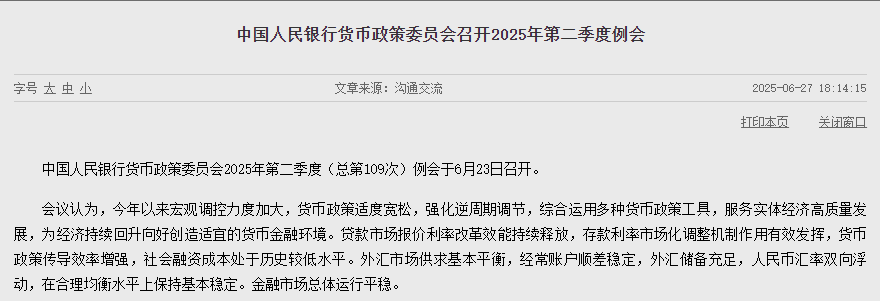
关于货币政策与汇率预期,央行这场例会释放新信号
Di Yi Cai Jing· 2025-06-27 13:55
Core Viewpoint - The People's Bank of China (PBOC) signals a stronger monetary policy adjustment and a stable yet slightly strong yuan exchange rate in the second half of 2025, amid complex domestic and international economic challenges [1][2]. Economic Situation Assessment - The PBOC's second-quarter meeting highlights internal challenges such as insufficient domestic demand and low price levels, while also acknowledging the increasingly complex external environment and rising trade barriers [1][2]. - The meeting indicates that these factors will directly influence the monetary policy direction for the second half of the year [1]. Monetary Policy Direction - The PBOC suggests increasing the intensity of monetary policy adjustments, emphasizing the need for forward-looking, targeted, and effective measures based on economic and financial market conditions [2]. - The meeting reiterates the commitment to a moderately loose monetary policy, enhancing counter-cyclical adjustments, and coordinating monetary and fiscal policies to maintain stable economic growth and reasonable price levels [2][3]. Expectations for Future Policies - Analysts expect the PBOC to continue promoting interest rate cuts and reserve requirement ratio (RRR) reductions in the second half of the year to lower financing costs for the real economy and stimulate internal financing demand [3]. - The PBOC is likely to implement structural monetary policies targeting sectors such as technology, consumption, foreign trade, real estate, and the stock market to drive high-quality economic development [3]. Exchange Rate Outlook - The PBOC's second-quarter meeting shifts focus from emphasizing strict controls to enhancing the resilience of the foreign exchange market and stabilizing market expectations, indicating a stable yuan exchange rate [4]. - Analysts predict that the yuan will maintain a stable yet slightly strong trend in the short term, influenced by factors such as US-China trade negotiations, dollar movements, and domestic macroeconomic policies [5][6]. Conclusion - The PBOC's flexible approach to monetary policy and exchange rate management aims to counter external pressures and support economic stability, with a focus on maintaining the yuan's stability as a key factor for economic growth [5][6].
加力实施增量政策!央行最新发声
Zheng Quan Shi Bao· 2025-06-27 12:04
Core Viewpoint - The People's Bank of China (PBOC) has acknowledged a more complex and severe external environment, indicating a weakening global economic growth momentum and increasing trade barriers, while also highlighting domestic challenges such as insufficient demand and persistent low prices [1][3]. Monetary Policy Adjustments - The meeting suggested increasing the intensity of monetary policy adjustments, enhancing the foresight, targeting, and effectiveness of these policies, and flexibly managing the implementation pace based on domestic and international economic conditions [3][4]. - The PBOC has shifted its stance on the real estate market from "promoting stabilization" to "continuing to consolidate stability," emphasizing the need to revitalize existing housing and land stocks [3][4]. Interest Rate and Financing - The meeting recommended strengthening the guidance of central bank policy rates and improving the market-based interest rate transmission mechanism, aiming to lower overall financing costs [4]. - The PBOC has implemented a comprehensive reduction in various structural policy tool rates, including those for agriculture and small enterprises, as well as for carbon reduction and technological innovation [6]. Structural Policy Focus - The meeting emphasized the need to effectively utilize existing policies while actively implementing new policies to stimulate domestic demand, stabilize expectations, and invigorate economic growth [6]. - There is a call for more structural tools in monetary policy to support domestic demand expansion and facilitate economic restructuring and industrial upgrading [6].
货币政策多维发力稳增长
Zhong Guo Zheng Quan Bao· 2025-06-26 21:25
Core Viewpoint - The People's Bank of China (PBOC) maintains a supportive monetary policy stance, implementing various measures to bolster economic recovery and stabilize financial markets, with expectations for further easing in the second half of the year [1][2][3]. Group 1: Quantity Tools - In May, the PBOC lowered the reserve requirement ratio by 0.5 percentage points, providing approximately 1 trillion yuan in long-term liquidity [1]. - From March to June, the PBOC conducted four consecutive months of excess renewals of the Medium-term Lending Facility (MLF) and utilized reverse repos to manage liquidity [1]. - The PBOC's flexible use of quantity-based monetary policy tools has maintained ample liquidity, supporting the ongoing economic recovery [1]. Group 2: Price Tools - In May, the PBOC reduced the policy interest rate by 0.1 percentage points, leading to a corresponding decrease in the Loan Prime Rate (LPR) [2]. - The average interest rate for newly issued corporate loans was approximately 3.2% in May, down about 50 basis points year-on-year, while the average for personal housing loans was around 3.1%, down about 55 basis points [2]. - The continuous deepening of interest rate marketization reforms has created a favorable environment for price-based monetary policy tools [2]. Group 3: Structural Tools - The PBOC increased the quotas for re-lending to support agriculture and small enterprises by 300 billion yuan each, and established a 500 billion yuan re-lending facility for consumer services and elderly care [3][4]. - The central bank is expected to continue enhancing structural monetary policy tools to support key sectors such as technology innovation and consumption [3][4]. - New policy tools are anticipated to be introduced, focusing on technology, consumption, foreign trade, and real estate [4][5].