人民币汇率

Search documents
汇率高频追踪
Zhong Xin Qi Huo· 2025-12-29 07:51
1. Report's Industry Investment Rating - Not provided 2. Core View of the Report - After the release of the 4.6% unemployment rate data in the US, the threshold for the decline of the long - end US Treasury yield increased again, the US Treasury yield curve continued to steepen, and the US dollar continued to weaken. Against the backdrop of a weakening US dollar, the RMB continued to appreciate to around 7. However, the RMB's appreciation speed may slow down in the short term [2] 3. Summary by Related Contents Exchange Rate Operation Core Logic - After the December FOMC meeting and the release of the US November unemployment rate data, market concerns about the non - linear rise of the US unemployment rate in the future resurfaced, shifting the focus from inflation to the labor market [2] - The reasons for the weakening of the US dollar are the possible statistical problems in the household survey part due to the US government shutdown in October affecting the November data and market concerns about a false signal similar to last year's [2] - The RMB has been appreciating, with the offshore RMB exchange rate performing stronger than the onshore one, indicating increased attractiveness of domestic asset returns and continuous inflow of foreign capital. The enhanced willingness to settle foreign exchange and the year - end seasonal peak also support the RMB, but the central bank's guidance on the mid - price and the rising short - end swap points may slow the RMB's appreciation [2] Economic Indexes and Exchange Rates - The difference between the US and European Citi Economic Surprise Indexes has rebounded [7] - The difference between the US and European long - term inflation expectations has increased [9] - The US long - term inflation expectation has declined [11] - The short - term US interest rate expectation has slightly changed [13] - The VIX index has fallen back to a low level [15] - The difference between the US and European short - term interest rate expectations has slightly decreased [16] Other Indicators and Exchange Rates - The euro swap basis shows that the US dollar cross - border liquidity pressure is limited [20] - The CFTC net position shows that the US dollar maintains a net negative position exposure [24] Exchange Rate and Commodity Prices - The copper price has significantly increased [30] - The crude oil price has remained at a low level [32]
逆袭之路开启!人民币飙升至9月新高,美联储降息周期将如何助推升值狂飙?
Sou Hu Cai Jing· 2025-12-29 07:02
Group 1 - The core viewpoint of the articles indicates that the RMB has shown a strong performance against the USD amid increased volatility in the global foreign exchange market, with a cumulative increase of over 1500 basis points by year-end [1] - As of December 29, the interbank foreign exchange market reported the RMB to USD exchange rate at 7.0331, an increase of 27 basis points from the previous trading day [1] - The recent appreciation of the RMB is primarily driven by changes in the USD environment, particularly following the Federal Reserve's initiation of a rate-cutting cycle, which has suppressed long-term expectations for the USD [1] Group 2 - The People's Bank of China has emphasized the need to enhance the resilience of the foreign exchange market and stabilize market expectations, aiming to maintain the RMB at a reasonable and balanced level [2] - The foreign exchange market in China has been generally balanced since 2025, with the RMB exhibiting two-way fluctuations [2] - Financial institutions and enterprises are advised to avoid blindly following trends in exchange rate movements and to focus on effective risk management strategies [2]
新浪财经早餐:多因素支撑人民币汇率走强 公募基金年度收益新纪录高达236.88%丨2025年12月29日
Xin Lang Zheng Quan· 2025-12-29 06:09
Group 1: National Policies and Economic Outlook - The State-owned Assets Supervision and Administration Commission emphasizes the need for state-owned enterprises to lead in resisting "involution-style" competition and to promote the integrated development of the industrial chain [3] - The Ministry of Finance outlines six key tasks for fiscal work in 2026, focusing on domestic demand, technological innovation, and green transformation [4] Group 2: Market Trends and Investment Opportunities - The China Securities Regulatory Commission is focused on building a healthy capital market ecosystem for artificial intelligence, indicating a positive trend in AI applications within the capital market [5][6] - The recent strengthening of the Renminbi against the US dollar is supported by a weaker dollar index and increased corporate demand for currency exchange [7] - Silver prices have surged to a historic high, driven by speculative inflows and supply imbalances, marking a significant trend in the precious metals market [8][11] Group 3: Corporate Developments and Mergers - Tongye Technology plans to acquire 91.69% of Beijing Silingke Semiconductor Technology Co., Ltd. for 5.61 billion yuan, marking a significant move into the chip sector [14][29] - Leap Motor has entered into an agreement with FAW Holdings to issue domestic shares, raising 37.44 billion yuan for R&D and operational expansion [15] - Aerospace Development's subsidiary, Tianmu (Chongqing) Satellite Technology Co., Ltd., reported that its revenue accounted for less than 1% of the company's total revenue in the first three quarters of 2025 [19] Group 4: Stock Market Dynamics - Several stocks with significant price increases have issued risk warnings, indicating potential volatility and the need for investor caution [9][20][21][26] - The A-share market is experiencing a cross-year rally, with new investment themes emerging, particularly in sectors like commercial aerospace and robotics [1][17]


人民币汇率创15个月新高,双向波动或是常态 | 画说热点
Sou Hu Cai Jing· 2025-12-29 05:23
Core Viewpoint - The offshore RMB to USD exchange rate has broken the "7" mark for the first time since October 2024, reaching a high of 6.9985, marking a 15-month high. The onshore RMB also strengthened, nearing the "7" mark at 7.0066, a new high since September 2024 [2] Group 1 - The RMB exchange rate has entered a significant appreciation phase since late November 2025, driven by a weakening USD [2] - According to Guo Tao, Chief Economist at China International Capital Corporation, the recent RMB appreciation is influenced by short-term positive factors and does not indicate the start of a new appreciation cycle [2] - The RMB exchange rate is expected to fluctuate around the "7" mark in 2024, rather than showing a unilateral trend [2] Group 2 - The future trajectory of the RMB exchange rate will depend on three main factors: the relative strength of economic recovery in China and the US, trends in USD interest rates and exchange rates, and the evolution of China's foreign trade relations and domestic economic recovery [2] - The market should avoid excessive focus on specific exchange rate points and should not form linear expectations of unilateral appreciation or depreciation; instead, two-way fluctuations will become the norm [2]

12月29日人民币兑美元中间价上调27个基点
Sou Hu Cai Jing· 2025-12-29 04:39
Summary of Key Points Core Viewpoint - The People's Bank of China has adjusted the RMB to USD central parity rate, indicating a slight appreciation of the RMB against the USD, which may reflect the central bank's monetary policy stance and market conditions [1][2]. Exchange Rate Adjustments - On December 29, the central parity rate of RMB against USD was set at 7.0331, an increase of 27 basis points from the previous rate [1]. - The CFETS RMB exchange rate index was reported at 97.64 on December 26, showing a weekly decline of 0.24% [1]. Currency Exchange Rates - The central bank provided various exchange rates for different currencies, including: - 1 EUR = 8.2630 CNY - 100 JPY = 4.4833 CNY - 1 HKD = 0.90494 CNY - 1 GBP = 9.4661 CNY - 1 AUD = 4.7061 CNY - 1 NZD = 4.0819 CNY - 1 SGD = 5.4633 CNY - 1 CHF = 8.8904 CNY - 1 CAD = 5.1305 CNY - 1 MOP = 1.1387 CNY - 1 MYR = 0.57609 CNY - 1 RUB = 11.0260 CNY - 1 ZAR = 2.3747 CNY - 1 KRW = 205.28 CNY - 1 AED = 0.52388 CNY - 1 SAR = 0.53490 CNY - 1 HUF = 46.8764 CNY - 1 PLN = 0.51013 CNY - 1 DKK = 0.9045 CNY - 1 SEK = 1.3055 CNY - 1 NOK = 1.4272 CNY - 1 TRY = 6.11954 CNY - 1 MXN = 2.5497 CNY - 1 THB = 4.4316 CNY [2].
高频半月观:关注4大变化
GOLDEN SUN SECURITIES· 2025-12-29 04:33
Group 1: Currency and Policy Changes - The offshore RMB exchange rate surpassed the 7 mark for the first time in 15 months on December 25, 2025, indicating a continuous appreciation since mid-October[1] - The central bank is expected to implement a reserve requirement ratio (RRR) cut and interest rate reduction in Q1 2026, alongside the introduction of more structural tools[1] Group 2: Real Estate and Sales Trends - The average weekly land transaction area in 100 cities increased by 102.8% month-on-month in December, although it remains at a five-year low with a year-on-year decline of 3.4%[1] - New home sales in 30 major cities saw a month-on-month increase of 45.8%, with a year-on-year decline narrowing to 25.6%[3] - Second-hand home sales in 18 key cities increased by 13.7% month-on-month, with a year-on-year decline of 22.7%[3] Group 3: Supply Chain and Production - The operating rate of blast furnaces decreased by 1.0 percentage points to 78.4%, while the operating rate of coking enterprises fell by 2.4 percentage points to 66.1%[2] - The operating rate of asphalt plants increased by 1.6 percentage points to 29.5%, and cement dispatch rates rose by 0.3 percentage points to 31.6%[2] Group 4: Commodity Prices - Prices for copper, rebar, and coking coal have risen, with LME copper prices increasing by 2.7% month-on-month and a year-on-year increase of 33.8%[5] - Brent crude oil prices fell by 2.7% month-on-month, with a year-on-year decline of 17.2%[4] Group 5: Inventory and Logistics - Energy inventories, including coal at coastal power plants, decreased by 1.8% month-on-month, while U.S. crude oil and petroleum product inventories fell by 525,000 barrels to 1.687 billion barrels[6] - The Baltic Dry Index (BDI) fell by 20.6% month-on-month, while the China Containerized Freight Index (CCFI) rose by 1.7%[7]
(经济观察)人民币汇率走强 多重因素交织
Zhong Guo Xin Wen Wang· 2025-12-29 03:04
Group 1 - The recent appreciation of the Renminbi is primarily driven by expectations of interest rate cuts by the Federal Reserve and a weakening US dollar index [1] - The offshore Renminbi to US dollar exchange rate has surpassed the 7.0 mark, indicating a significant shift in currency dynamics [1] - Experts suggest that the future trajectory of the Renminbi remains uncertain due to multiple interwoven factors, including the upcoming leadership transition at the Federal Reserve and the unpredictable nature of US foreign policy [2] Group 2 - The Federal Reserve is expected to face constraints on further interest rate cuts, with predictions of only two rate cuts in the coming year, which may limit the Renminbi's appreciation potential [2] - The current interest rate differential between Chinese and US government bonds remains significant, with a spread of approximately 230 basis points, influencing capital flows [2] - The People's Bank of China has emphasized the need to prevent excessive fluctuations in the exchange rate, indicating potential measures to manage rapid appreciation [3]
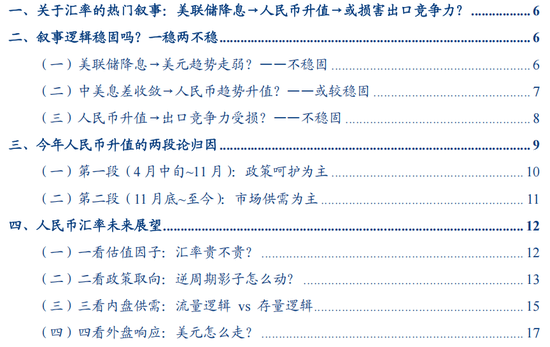
美联储降息≠人民币升值≠出口承压——汇率升值叙事的三重纠偏
Sou Hu Cai Jing· 2025-12-29 02:56
Group 1 - The core narrative regarding the recent appreciation of the RMB is linked to the Federal Reserve's interest rate cuts leading to a weaker dollar, which in turn may harm China's export competitiveness [3][16] - The logic of this narrative is questioned, as a Fed rate cut does not necessarily equate to a weaker dollar, and RMB appreciation does not automatically imply a loss of export competitiveness [1][4] - The RMB exchange rate is currently viewed as fairly valued, with no significant overvaluation or undervaluation issues, supported by internal resilience in exports and policy measures [9][42] Group 2 - The narrative surrounding the RMB's appreciation can be divided into two segments: the first driven by policy support from mid-April to November, and the second driven by market supply and demand from late November to the present [8][34] - In the first segment, the RMB middle rate appreciated from approximately 7.21 to around 7.08, with a monthly average appreciation of about 186 basis points [32] - In the second segment, the RMB middle rate further appreciated to just above 7.04, with a notable increase of over 450 basis points in a month, indicating a shift from policy-driven to market-driven appreciation [34][35] Group 3 - Future RMB exchange rate trends will depend on several factors, including valuation factors, policy direction, internal supply and demand, and external responses [42][58] - The valuation perspective indicates that the RMB is not significantly overvalued or undervalued, remaining within a reasonable pricing range [42][43] - The policy direction has shifted from supporting a stable appreciation to preventing excessive appreciation volatility, reflecting a focus on maintaining stability rather than encouraging a one-sided RMB exchange rate trend [45][47] Group 4 - The internal supply and demand dynamics are crucial, with the flow logic indicating that net settlement depends on trade surplus and corporate settlement intentions, while the stock logic highlights the potential release of accumulated foreign exchange positions [51][53] - The accumulated foreign exchange positions, estimated to be between $737 billion and $1.1 trillion, could significantly impact net settlement if released [53][54] - The external response, particularly the behavior of the US dollar, is also a key factor, with expectations that the dollar may not experience sustained weakness due to underlying economic conditions [58][62]
人民币市场汇价(12月29日)
Xin Hua Wang· 2025-12-29 02:50
Core Viewpoint - The People's Bank of China has announced the exchange rates of the Renminbi (RMB) against various currencies as of December 29, indicating the current market value of the RMB in relation to major global currencies [1] Exchange Rates Summary - The exchange rate for 100 US dollars is 703.31 RMB [1] - The exchange rate for 100 euros is 826.3 RMB [1] - The exchange rate for 100 Japanese yen is 4.4833 RMB [1] - The exchange rate for 100 Hong Kong dollars is 90.494 RMB [1] - The exchange rate for 100 British pounds is 946.61 RMB [1] - The exchange rate for 100 Australian dollars is 470.61 RMB [1] - The exchange rate for 100 New Zealand dollars is 408.19 RMB [1] - The exchange rate for 100 Singapore dollars is 546.33 RMB [1] - The exchange rate for 100 Swiss francs is 889.04 RMB [1] - The exchange rate for 100 Canadian dollars is 513.05 RMB [1] - The exchange rate for 100 Macau patacas is 113.87 RMB [1] - The exchange rate for 100 Malaysian ringgits is 57.609 RMB [1] - The exchange rate for 100 Russian rubles is 1102.6 RMB [1] - The exchange rate for 100 South African rand is 237.47 RMB [1] - The exchange rate for 100 South Korean won is 20528 RMB [1] - The exchange rate for 100 UAE dirhams is 52.388 RMB [1] - The exchange rate for 100 Saudi riyals is 53.49 RMB [1] - The exchange rate for 100 Hungarian forints is 4687.64 RMB [1] - The exchange rate for 100 Polish zlotys is 51.013 RMB [1] - The exchange rate for 100 Danish krone is 90.45 RMB [1] - The exchange rate for 100 Swedish krona is 130.55 RMB [1] - The exchange rate for 100 Norwegian krone is 142.72 RMB [1] - The exchange rate for 100 Turkish lira is 611.954 RMB [1] - The exchange rate for 100 Mexican pesos is 254.97 RMB [1] - The exchange rate for 100 Thai baht is 443.16 RMB [1]
帮主郑重早间观察:今早市场有三件“怪事”值得细品
Sou Hu Cai Jing· 2025-12-29 02:15
Group 1 - The market is experiencing a contradiction period where long-term logic clashes with short-term emotions [5] - The Chinese yuan has strengthened, breaking the 7.0 mark, while public fund annual returns have surged to an impressive 236.88%, driven by short-term factors like a weaker dollar and year-end settlement demand [3][4] - Silver prices have skyrocketed to over $83 due to speculative funds and supply imbalances, while some stocks have issued warnings about their prices deviating significantly from fundamentals [4] Group 2 - The State-owned Assets Supervision and Administration Commission (SASAC) is urging state-owned enterprises to resist "involution-style" competition, while the Ministry of Finance has committed to continuing "national subsidies" next year, indicating a focus on quality and efficiency [4] - There is a trend of listed companies engaging in cross-industry acquisitions and targeted fundraising in the automotive sector, reflecting individual corporate anxiety and survival instincts during macroeconomic transitions [4] - Investment opportunities lie in genuine reforms and innovations, while potential traps exist in companies that tell cross-industry stories but have weak core businesses [5][6]