金银比

Search documents
有色及贵金属周报合集-20250615
Guo Tai Jun An Qi Huo· 2025-06-15 12:31
国泰君安期货·有色及贵金属 周报合集 国泰君安期货研究所·有色及贵金属团队 王 蓉 投资咨询从业资格号:Z0002529 wangrong2@gtht.com 季先飞 投资咨询从业资格号:Z0012691 jixianfei@gtht.com 莫骁雄 投资咨询从业资格号:Z0019413 moxiaoxiong@gtht.com 刘雨萱 投资咨询从业资格号:Z0020476 liuyuxuan@gtht.com 王宗源 (联系人)从业资格号:F03142619 wangzongyuan@gtht.com 2025年06月15日 Guotai Junan Futures all rights reserved, please do not reprint 1 CONTENTS 01 黄金:地缘政治主导金价 白银:金银比重新回升 07 锡:价格修复,供给再出扰动 Special report on Guotai Junan Futures 2 2 02 03 铜:基本面现实海外偏强,但宏观存不确定性,价格持续震荡 铝:本周走势偏强,现实仍不弱,且交易因素助推 氧化铝:短期横盘,波动收敛,重心略小幅下移 04 铸造 ...
白银帝国崛起
Sou Hu Cai Jing· 2025-06-13 06:59
Core Viewpoint - Silver is experiencing a resurgence as a valuable asset, driven by its dual role as a safe-haven investment and an essential industrial material, particularly in the context of rising geopolitical risks and economic uncertainty [1][4][8] Group 1: Investment Dynamics - Silver prices have surged over 20% in 2025, with domestic market funds increasing from 18 billion to 39 billion yuan, indicating a strong inflow of capital [1][2] - The price of silver has reached historical highs, with the Shanghai silver futures contract hitting 8,855 yuan per kilogram and international silver futures rising to $37.03 per ounce, marking a 23% increase year-to-date [2][3] - Institutional investors are beginning to allocate more to silver, as evidenced by the increase in silver ETF holdings, although the current allocation remains low compared to gold [7] Group 2: Industrial Demand - Over 50% of silver demand is now driven by industrial applications, a figure expected to rise to 56% by 2025, with the solar energy sector being a significant contributor [4][5] - The growth of the photovoltaic industry is projected to create a demand of 66,000 tons of silver in 2025, driven by the increased use of silver in solar panels [4][5] - Emerging technologies such as 5G, electric vehicles, and artificial intelligence are further increasing silver consumption, with electric vehicles using significantly more silver than traditional vehicles [5] Group 3: Supply Constraints - The supply of silver is facing challenges, with slow growth in global silver mining output and declining ore grades, leading to a projected shortfall of 117.6 million ounces in 2025 [5] - The low recovery rate of silver, particularly from electronic products, exacerbates the supply-demand imbalance, contributing to rising prices [5] Group 4: Market Outlook - Historical trends suggest that silver performs best during early economic recovery and rising inflation, conditions that are currently present [6] - The silver-to-gold price ratio remains high at around 90, indicating potential for silver to catch up in price relative to gold [6] - Long-term investment value in silver is supported by its financial attributes and industrial demand, suggesting that its upward trajectory may continue [7][8]
研客专栏 | 贵金属上涨对有色板块价格中枢的影响
对冲研投· 2025-06-12 13:08
Group 1 - The metal market has shown significant divergence since the beginning of 2025, with gold rising due to a weaker dollar and increased risk aversion, while silver has recently shown signs of catching up. Prices of copper and aluminum remain resilient, whereas domestic-priced new energy products and the black metal sector have seen declines exceeding 10% [3][18]. - The gold-to-copper ratio is a crucial indicator of the relative value between gold and copper, reflecting changes in global economic cycles, inflation expectations, and risk appetite. Historically, this ratio surged during the 2008 financial crisis and the 2020 pandemic, indicating that gold acts as a safe-haven asset while copper represents risk assets [5][18]. - The gold-to-silver ratio, currently above 90, indicates that silver is still undervalued relative to gold. This ratio reflects market risk appetite, economic cycle positioning, and inflation expectations [6][7][19]. Group 2 - Since 2021, the annual average price of copper has continued to rise, maintaining above 77,000 yuan per ton in 2025. The relatively low inventory levels of copper and aluminum indicate a strong fundamental backdrop for non-ferrous metals, contributing to price resilience [9][19]. - The current supply-demand structure of non-ferrous products differs from that of 2018, with recent years showing lower inventory levels, which supports the overall strength of the non-ferrous sector [13].


研客专栏 | 贵金属上涨对有色板块价格中枢的影响
对冲研投· 2025-06-12 13:08
Group 1 - The metal market has shown significant divergence since the beginning of 2025, with gold rising due to a weaker dollar and risk aversion, while silver has recently shown a rebound, and copper and aluminum prices remain resilient. In contrast, domestically priced new energy products and the black metal sector have seen a decline of over 10% [5][19]. - The gold-to-copper ratio is a crucial indicator of the relative value between gold and copper, reflecting changes in global economic cycles, inflation expectations, and risk appetite. Gold is viewed as a safe-haven asset, while copper represents risk assets, serving as a barometer for global economic conditions [7][19]. - Historical trends show that during the 2008 financial crisis and the 2020 pandemic, the gold-to-copper ratio surged due to falling copper prices and stable gold prices. When inflation rises and market risk appetite increases, the ratio tends to decrease, as seen in 2021 during economic recovery [20][21]. Group 2 - Since 2021, the annual average price of copper has continued to rise, maintaining above 77,000 yuan per ton in 2025, indicating a strong fundamental backdrop for non-ferrous metals. The relatively low inventory levels of copper and aluminum reflect this strength, contributing to price resilience [22]. - The current gold-to-silver ratio exceeds 90, suggesting that silver remains undervalued relative to gold, indicating potential investment opportunities in silver [3][21].

洪灏:中美之间的贸易关系紧张时期可能已经过去
2025-06-12 07:19
Summary of Conference Call Records Industry or Company Involved - The discussion primarily revolves around the **Chinese economy**, **Hong Kong market**, and **real estate sector**. Core Points and Arguments 1. **Tariff Situation**: The worst period regarding tariffs may have passed, with significant market recovery observed post the worst week in April. The speaker believes that Trump's tariff strategies will not fundamentally alter global trade dynamics [1][2][3]. 2. **Consumer and Real Estate Support**: The Chinese economy requires support for consumers and the real estate sector, which are seen as needing more assistance compared to other sectors. The impact of tariffs is expected to be less disruptive in the coming months [2][3]. 3. **Hong Kong Market Performance**: Hong Kong's stock market has shown strong performance, with many newly listed stocks doubling in value. The influx of capital into Hong Kong is noted as a positive trend for the market [3][4]. 4. **Liquidity in Hong Kong**: There is a significant increase in liquidity in the Hong Kong market, with daily trading volumes recovering to levels around 600 billion HKD, compared to previous lows during the pandemic [6][7]. 5. **Real Estate Recovery**: The speaker anticipates a stabilization and potential rebound in Hong Kong's real estate prices, which have declined over the past few years. The current low-interest rates and increased liquidity are expected to support this recovery [9][10][19]. 6. **Market Dynamics**: The discussion highlights the importance of liquidity and market activity in attracting investors to Hong Kong. The speaker emphasizes that a vibrant market can lead to better price discovery and trading opportunities [6][7]. 7. **Stability of Stablecoins**: The role of stablecoins in facilitating cross-border payments is discussed, noting their growing transaction volumes compared to traditional payment systems like Visa and Mastercard [10][11]. 8. **US Debt Concerns**: The US government faces significant cash flow challenges due to high debt servicing costs, which could impact its financial stability. The discussion suggests that tariffs and other measures may not effectively resolve these issues [12][13]. 9. **Silver Market Outlook**: There is a bullish outlook on silver prices, with expectations that they will rise significantly due to market dynamics and the demand from the renewable energy sector [14][15][16]. Other Important but Possibly Overlooked Content 1. **Market Sentiment**: The overall sentiment in the market is shifting positively, with increased investor confidence leading to a potential rise in housing prices and stock market activity [19][20]. 2. **Philosophical Views on Pricing Power**: The discussion touches on the philosophical aspects of pricing power in the market, suggesting that control over pricing is not solely determined by liquidity but also by the nature of the stocks and their trading volumes [8][9]. 3. **Impact of Talent Migration**: The influx of talent from mainland China to Hong Kong is influencing wage dynamics and work culture, which may have long-term implications for the local economy and housing market [18][19].
白银:工业属性渐显,静待价值重估
Ping An Securities· 2025-06-12 02:51
Investment Rating - The industry investment rating is "Outperform the Market," indicating an expected performance that exceeds the market by more than 5% over the next six months [83]. Core Insights - The supply of silver is gradually becoming rigid, with a downward trend in total supply from 2016 to 2024, showing a CAGR of -0.5%. The average cash cost of silver production is expected to rise, with a CAGR of 14.6% from 2018 to 2024 [2][9][21]. - Industrial demand for silver is expected to continue growing, with a projected increase of 3.6% in 2024. The photovoltaic sector is identified as the primary growth driver for industrial demand [2][34][38]. - The price of silver is anticipated to rise due to its industrial properties, with a gradual convergence of the gold-silver ratio expected as economic conditions improve [2][71][73]. Supply Summary - The global silver supply is projected to be approximately 31,574 tons in 2024, reflecting a 1.7% increase year-on-year. The supply structure indicates that mined silver accounts for 80.8% of total supply, with by-product mining contributing significantly [9][15][48]. - The average cash cost of silver production is expected to reach $7.64 per ounce in 2024, with total production costs also on the rise [21][25]. Demand Summary - Industrial demand for silver is projected to account for about 58.5% of total demand in 2024, with significant contributions from the photovoltaic sector, which is expected to see a 2.6% increase in demand [34][38]. - Jewelry demand is expected to remain stable, with a projected increase of 2.8% in 2024, particularly driven by demand from South Asia [42][46]. Price Summary - The silver price is expected to gradually increase, supported by the industrial demand and a favorable monetary environment. The current high gold-silver ratio is likely to trend downwards as silver prices rise [71][73]. Investment Recommendations - The report suggests focusing on companies such as Xingye Silver and Shengda Resources, which are expected to benefit from the anticipated rise in silver prices and demand [80].
白银:工业属性渐显,静待价值重估
Ping An Securities· 2025-06-12 02:20
Investment Rating - The industry investment rating is "Outperform the Market" [83] Core Insights - The supply of silver is gradually becoming rigid, with a cost center trend on the rise. The global silver supply from 2016 to 2024 is expected to have a CAGR of -0.5% [2][8] - Industrial demand for silver continues to grow, with a projected 3.6% year-on-year increase in 2024, driven primarily by the photovoltaic sector [2][33] - The silver price is expected to rise due to its industrial properties, with the gold-silver ratio likely to gradually converge [2][71] Supply Summary - The global silver supply is expected to be approximately 31,574 tons in 2024, a 1.7% increase year-on-year [8] - The structure of silver supply shows that mined silver accounts for 80.8% of total supply, with by-product silver making up about 19.1% [8][14] - The average cash cost of silver production is projected to be $7.64 per ounce in 2024, with a CAGR of 14.6% from 2018 to 2024 [20][24] Demand Summary - Industrial demand for silver is projected to account for about 58.5% of total demand in 2024, with significant contributions from the photovoltaic sector [32][33] - The demand for silver in the photovoltaic sector is expected to grow, with a projected increase of 2.6% in 2024, reaching 6,147 tons [33][37] - Jewelry demand is expected to remain relatively stable, with a projected increase of 2.8% in 2024, reaching 6,491 tons [46] Price Summary - The silver price is anticipated to gradually rise, supported by the industrial demand and a favorable monetary environment [71][78] - The current high gold-silver ratio is expected to trend towards convergence, driven by the industrial attributes of silver [71][73] Investment Recommendations - The report suggests focusing on companies such as Xingye Silver and Shengda Resources, which are expected to benefit from the rising silver price and demand dynamics [80]
白银、铂金强势补涨抢足风头!瑞银:年内有望跑赢黄金 但短期需谨慎追高
Zhi Tong Cai Jing· 2025-06-11 08:04
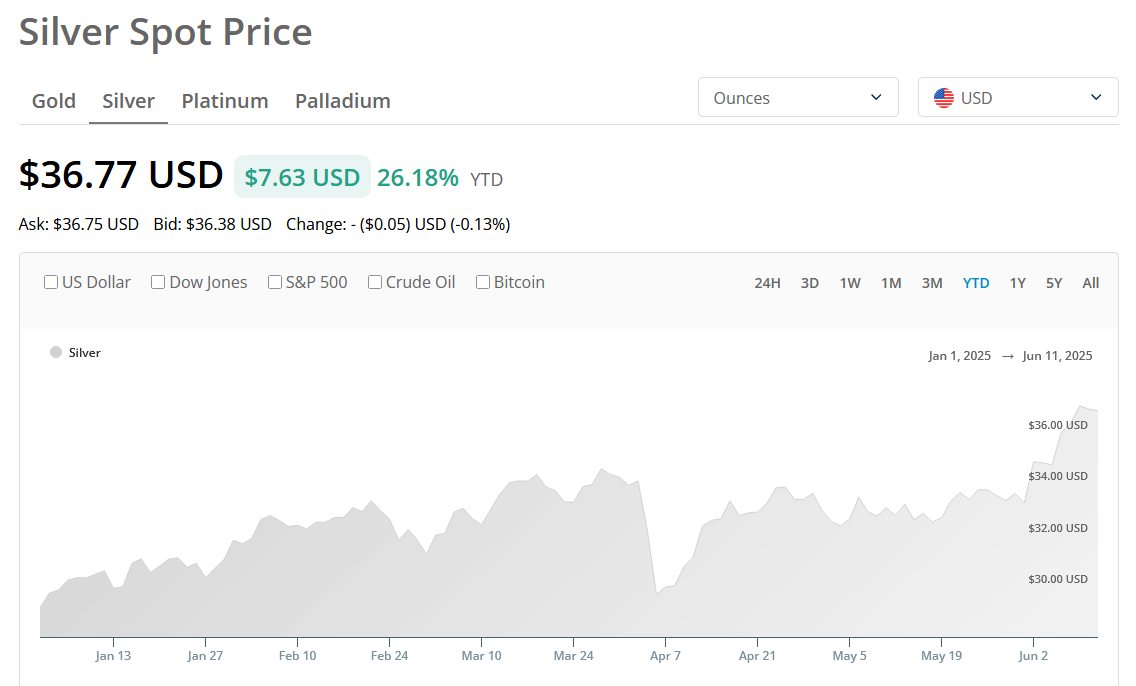
在黄金价格高位震荡之际,近期白银与铂金价格齐飞,抢走了黄金的风头。数据显示,截至发稿,现货白银报36.77美元/盎司,今年迄今累涨超26%;铂金现 货报1287.00美元/盎司,今年迄今累涨逾40%。 瑞银表示,散户投资者(尤其是在中国)对黄金的情绪蔓延至白银也有望成为白银价格的有力支撑。白银价格在2011年接近50美元/盎司的历史高点时,部分驱 动力正是来自中国的散户投资需求。 瑞银补充称,金银比已明显下降,目前为今年第一季度末以来的最低水平。不过,金银比目前在90左右,仍显著高于黄金前一轮上涨周期期间的平均水平、 以及长期均值(约68)。此外,美联储正接近降息。综合来看,该行认为,白银仍有进一步上涨空间,且有望跑赢黄金,但该行同时警告称,全球经济增长放 缓的风险意味着金银比未必能回归到历史均值水平。 铂金 瑞银在近日发布的研报中指出,尽管投资者对黄金的看涨前景依旧坚挺,但过去几周,白色贵金属成为市场焦点。尤其是白银和铂金,这是它们在相当长一 段时间内首次获得如此高度的关注。这两种金属的隐含波动率近期大幅上升,而黄金的波动率几乎没有变化。 瑞银指出,白银和铂金有着多个共同主题,包括:1)市场供应缺口有望从基 ...
兴业期货日度策略-20250610
Xing Ye Qi Huo· 2025-06-10 13:38
Report Industry Investment Ratings - **Equity Index Futures**: Shockingly stronger [1] - **Treasury Bonds**: Range-bound [1] - **Gold**: Shock [1] - **Silver**: Shockingly stronger [1] - **Copper**: Range-bound [4] - **Aluminum and Alumina**: Aluminum - Range-bound; Alumina - Shockingly weaker [4] - **Nickel**: Range-bound [4] - **Lithium Carbonate**: Shockingly weaker [4] - **Industrial Silicon**: Shock [6] - **Steel and Ore (Rebar, Hot - Rolled Coil, Iron Ore)**: Shock [5][6] - **Coking Coal and Coke**: Shockingly weaker [9] - **Soda Ash and Float Glass**: Soda Ash - Bearish; Float Glass - Bearish [9] - **Crude Oil**: Shockingly weaker [11] - **Methanol**: Decline [11] - **Polyolefins**: Decline [11] - **Cotton**: Shockingly stronger [10] - **Rubber**: Shockingly weaker [10] Core Views - The second - round Sino - US trade negotiations have started, with the US releasing positive signals, but no clear information yet. The domestic economy still needs policy support, and there are uncertainties in the overseas macro - environment [1]. - The supply - demand relationship of various commodities is affected by factors such as macro - economy, seasonality, and production capacity changes, resulting in different price trends [1][4][6][9][11] Summary by Related Catalogs Equity Index Futures - The A - share market continued to be strong on Monday, with the science - innovation sector warming up. The trading volume of the two markets increased slightly to 1.31 trillion yuan. The pharmaceutical, comprehensive, and textile and apparel sectors led the gains, while the food and beverage, automobile, and home appliance industries declined slightly. The basis of index futures converged, and the spread increased as the last trading day of the current - month contract approached. However, due to weak domestic demand price signals and overseas uncertainties, the short - term upward momentum may weaken [1] Treasury Bonds - The bond market is affected by macro - uncertainties and cannot form a trend. The short - term liquidity is further relaxed, which boosts the market, but the upward pace of the bond market may be slow due to the simultaneous strength of stocks and bonds and limited expectations of comprehensive and substantial easing [1] Precious Metals - **Gold**: The short - term price is expected to be volatile, while the medium - and long - term price center will move up. Strategies include buying on dips based on long - term moving averages or holding short - put options [4]. - **Silver**: The gold - silver ratio is high, and silver has the driving force to repair its valuation upwards. Conservative investors can hold short - put options, while aggressive investors can lightly test long positions in the AG2508 contract [2][4] Non - Ferrous Metals - **Copper**: The macro - environment has high uncertainties, and the supply of the mine end is tight. The long - term smelting processing fee may be negative, increasing the losses of smelting enterprises. The demand is cautious due to the off - season and uncertainties. The LME inventory is decreasing. Short - term market sentiment and funds may amplify price fluctuations [4] - **Aluminum and Alumina**: The macro - environment is uncertain. For alumina, the supply pressure increases as the production capacity resumes, and the price may run close to the cost line. For aluminum, the supply is constrained, but the demand policy is uncertain, with limited directional drive [4] - **Nickel**: The supply and demand surplus contradiction continues, but there is cost support at the bottom. The fundamental changes are limited, and the price is in a shock pattern, with option strategies being relatively dominant [4] Chemicals - **Lithium Carbonate**: The supply is loose, and the lithium price is in a weak shock at a low level due to factors such as inventory accumulation in the downstream and the recovery of production capacity in the lithium salt production [6] - **Industrial Silicon**: The supply is increasing, and the demand is weak. However, due to the improvement of the macro - sentiment and the digestion of previous negatives, the probability of a deep decline is low. It is recommended to intervene in short - put options [6] Steel and Ore - **Rebar**: The spot price fluctuates narrowly, and the demand has entered the off - season. The raw material price is under pressure, and the probability of the spot price falling to repair the discount of the futures price is high. It is recommended to continue holding short - call options [5][6] - **Hot - Rolled Coil**: The spot price fluctuates narrowly. The plate demand is tough, but the market expectation is cautious. The price center is expected to move down, and it is recommended to continue holding the previously recommended short positions in the 10 - contract [5][6] - **Iron Ore**: The supply will increase seasonally, and the inventory has increased. The medium - and long - term probability of a supplementary decline is high. Conservative investors can hold the 9 - 1 positive spread combination, while aggressive investors can hold short positions in the I2601 contract with a stop - loss line [5][6][9] Coking Coal and Coke - **Coking Coal**: The supply surplus situation has not been alleviated, and the coal price is prone to fall. Attention should be paid to whether there are policy - based production restrictions at the mine end [9] - **Coke**: The third - round price cut has been implemented. The demand is expected to weaken, and the futures price trend is weak [9] Building Materials - **Soda Ash**: The supply is loose, and the inventory is high. It is recommended to maintain a bearish view, hold short positions in the 09 - contract, and short on rebounds based on the ammonia - alkali cash cost line [9] - **Float Glass**: The downstream has entered the off - season, the demand is pessimistic, and the inventory is high. It is recommended to hold short positions in the FG509 contract and consider arbitrage strategies [9] Energy - **Crude Oil**: Affected by macro - and geopolitical factors, the oil price hits the upper resistance area, but the rebound space is limited due to OPEC+ production increase and weak global demand, and it maintains high - volatility characteristics [11] - **Methanol**: Overseas device start - up rates are rising, and imports and production are high. Traditional demand is in the off - season, and the price is prone to fall. It is recommended to short - call options first and short the 09 - contract futures second [11] Polyolefins - New production capacities have been put into operation, and the supply pressure of PP is higher than that of PE. It is recommended to focus on the expansion of the L - PP spread [11] Agricultural Products - **Cotton**: With the improvement of domestic macro - data, the short - term price may be shockingly stronger due to good weather in the main producing areas, improved downstream export data, and a decline in commercial inventory [10] - **Rubber**: The port inventory is slightly decreasing, but the demand is not ideal. The supply is expected to increase while the demand decreases, and the short - term price is difficult to have a trend - type rebound [10]
研客专栏 | 沪银历史新高:上涨只需要一个理由?
对冲研投· 2025-06-10 10:57
以下文章来源于巴顿比格斯 ,作者巴顿比格斯 巴顿比格斯 . 历史不会重复,但是它自然成韵。 文 | 巴顿比格斯 来源 | 巴顿比格斯 编辑 | 杨兰 审核 | 浦电路交易员 近期沪银期货价格创上市以来新高,国际白银ETF连续增仓的情况下,欧美降息预期抬升、叠加宏观市场情绪转暖预期提振白银工业 属性,沪银表现强于黄金、金银比小幅修复。 此前黄金屡创新高,白银被低估,金银比一度逼近105(历史均值60-80),随着避险情绪升温,白银成为"价值洼地",资金涌入推动 其补涨,金银比回落至90。全球最大白银ETF持仓量持续增加,CFTC(美国商品期货交易委员会)净多头持仓攀升,显示出资金对 白银强烈的看涨情绪。 2025年全球货币体系发生深刻变化,美元霸权遭遇挑战。特朗普政府的一系列政策,如强推制造业回流、关税壁垒等,导致全球美元 回流美国,美元流动性减少,且面临 "特里芬难题" 升级版,即美联储在加息抑制通胀与降息刺激经济维持贸易逆差之间两难抉择, 这削弱了美元信用。 投资者对美元信心下降,转而寻求其他避险资产,白银作为传统的避险资产之一,受到投资者青睐。全球政治经济不确定性增加,如 地缘政治冲突、贸易政策不稳定等, ...