
人均GDP

Search documents
中国经济实力:换个角度看世界第一还是第二?
Sou Hu Cai Jing· 2025-07-23 05:53
Group 1 - The World Bank's report indicates that China's GDP, when calculated by purchasing power parity, has surpassed that of the United States, positioning China as the world's largest economy [1][3]. - While China's total GDP is impressive, the per capita GDP remains significantly lower, ranking 77th globally and being less than a quarter of the U.S. figure, highlighting disparities in living standards [3][5]. - China's economic development path differs from that of traditional Western powers, focusing on simultaneous growth and transformation, aiming for both quantity and quality improvements in its economy [3][10]. Group 2 - The shift in global economic ranking is influenced by new metrics that prioritize data flow and technological advancements over traditional GDP calculations, indicating a redefinition of economic strength [6][8]. - China's manufacturing capabilities have evolved beyond low-end production, with companies like BYD and CATL leading in global supply chains for electric vehicles, showcasing China's growing influence in high-tech industries [6][8]. - Future economic assessments will rely on new criteria such as data utilization, green energy efficiency, and overall societal well-being, moving beyond traditional GDP rankings [8][10].

中国终于暴露实力!中美差距究竟有多大?张召忠:我可以负责任讲,别再被误导了!
Sou Hu Cai Jing· 2025-07-22 12:07
Economic Milestone - China's GDP, including Hong Kong, Macau, and Taiwan, has surpassed $20 trillion for the first time, reaching $20,196.39 billion [1] - Macau's economy has shown remarkable growth at 8.8%, leading among all provinces, while Taiwan's economy exceeded expectations with a growth rate of 4.59% [1] GDP Comparison with the US - In 2024, the US GDP is projected to be $29.21 trillion, while China's GDP (excluding Hong Kong, Macau, and Taiwan) is estimated at $18.94 trillion, resulting in a gap of $10.26 trillion [1] - This gap is expected to widen to $11 trillion by 2025, influenced by statistical technical factors [1] Currency and Inflation Impact - The average exchange rate of the RMB against the USD depreciated from 7.12 to 7.18 in the first half of 2025, leading to a "loss" of $160 billion in China's GDP when measured in USD [3] - The inflation difference also plays a significant role, with the US experiencing a CPI of 3% in Q1 2025, inflating nominal GDP, while China's nominal growth was only 4.6% despite a real growth of 5.4% [3] Statistical Methodology Differences - The US employs an expenditure approach to GDP calculation, including credit consumption and government stimulus, which inflates the figures, while China uses a production approach focusing on actual goods and services produced [3] Innovation and Development - During the 14th Five-Year Plan, China has made significant innovations in various fields, including shipbuilding, aerospace, and nuclear power, showcasing its technological advancements [3] - R&D investment in China has increased by nearly 50% compared to the end of the 13th Five-Year Plan, with an intensity of 2.68%, approaching developed countries' levels [4] Economic Structure Differences - The US economy is heavily service-oriented, with services accounting for 80% of its GDP, while China's manufacturing sector constitutes 28% and is enhancing its global competitiveness, particularly in the electric vehicle sector [6] - China's per capita GDP remains over six times lower than that of the US, indicating different stages of economic development [6] Environmental and Market Developments - China has reduced its energy consumption per unit of GDP by 11.6% over four years, equivalent to a reduction of 1.1 billion tons of CO2 emissions [6] - The establishment of a unified national market has led to a growth of over 40% in private enterprises compared to the end of the 13th Five-Year Plan [6]
最富的省,最穷的省,都绷不住了
虎嗅APP· 2025-07-04 13:50
Core Viewpoint - The article emphasizes that measuring economic prosperity should not rely solely on GDP totals, but rather on per capita GDP and per capita income as more accurate indicators of real development levels and wealth distribution in regions [3][4][5]. Summary by Sections Per Capita GDP - Per capita GDP is a measure of wealth creation capacity, while per capita income reflects residents' income levels [5][6]. - Jiangsu province has the highest per capita GDP among provinces, reaching 163,000 yuan, surpassing the threshold of 20,000 USD, while Gansu has the lowest at 53,000 yuan, about one-third of Jiangsu's level [9][10]. - The top five provinces by per capita GDP are Jiangsu, Fujian, Zhejiang, Guangdong, and Inner Mongolia, while the bottom five are Gansu, Heilongjiang, Guangxi, Guizhou, and Jilin [12][13]. - Industrial provinces generally have higher per capita GDP, while agricultural provinces tend to have lower figures, and energy-rich provinces fall in between [18][19]. Per Capita Income - Per capita income is a closer indicator of "people's wealth," with a national average ratio of per capita income to per capita GDP at 43.1%, varying from 35% to 57% across provinces [22]. - Zhejiang leads in per capita disposable income, surpassing Jiangsu, with a significant reduction in urban-rural income disparity [23][24]. - Resource-rich provinces like Inner Mongolia, Shaanxi, and Shanxi show a larger gap between per capita GDP and per capita income, as much of the income is concentrated in government revenues and corporate profits rather than benefiting ordinary workers [25][26]. High-Income Provinces - Only Beijing, Tianjin, Shanghai, Jiangsu, Zhejiang, Guangdong, and potentially Fujian meet the criteria for "high-income provinces," defined as having per capita GDP over 100,000 yuan and per capita income over 50,000 yuan [30][32]. - These provinces share characteristics such as being major economic contributors and having robust private sectors [34]. - The article notes that regions like Tibet and Qinghai benefit from transfer payments, which help improve their per capita metrics, while Gansu and Guizhou require more support from the national level [37][38].

距离我们成为发达国家,其实并不远
Sou Hu Cai Jing· 2025-07-04 09:56
Group 1 - The core idea is that China's economic growth has the potential to elevate the living standards of its 1.4 billion citizens to levels comparable to those in developed countries like the United States, driven by market economy reforms and increasing GDP [1][4][14] - Since the introduction of market economy reforms in the 1980s, over 800 million people have escaped poverty, and the middle class has expanded to approximately 400 million [2][4] - China's per capita GDP has risen from under $200 to $13,400 today, with projections suggesting it could reach $20,000 by 2035, marking a significant economic transformation [4][5][19] Group 2 - Economic growth is expected to continue at an annual rate of 4%-5%, with optimistic scenarios suggesting per capita GDP could reach $21,200 by 2028 if the currency appreciates and economic growth accelerates [5][6] - The current economic landscape shows that while growth has slowed, there are still opportunities for improvement, particularly in the real estate sector, which is viewed as a potential driver for economic advancement [7][10][11] - The middle class is identified as the primary engine of consumption, with a need for income growth to stimulate further economic activity and support the transition to a developed economy [15][19] Group 3 - The definition of the middle class in China differs significantly from that in the U.S., with the Chinese middle-income group having a much lower income threshold, which highlights the potential for growth in consumer spending [17][18] - The current middle-income group in China is approximately 400 million people, with an average annual income of 30,598 yuan, which is significantly lower than the U.S. middle-class income range [18][19] - Stimulating consumption is deemed essential for achieving developed nation status, as increased consumer spending leads to higher corporate earnings, job creation, and ultimately, wage growth [19]
最富的省,最穷的省,都绷不住了
Hu Xiu· 2025-07-04 09:45
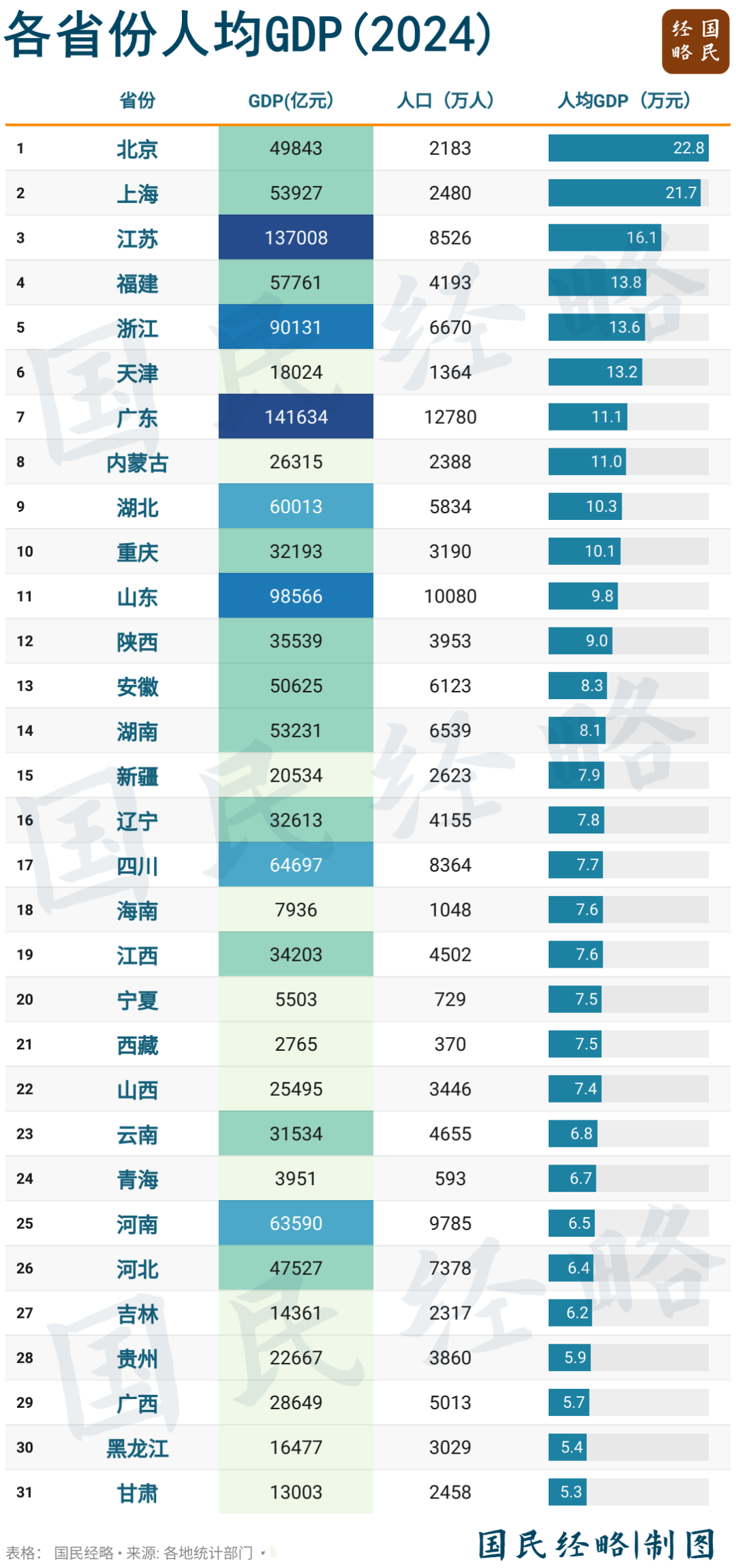
Core Viewpoint - The article emphasizes that measuring a region's true development level should not rely solely on GDP totals, but rather on per capita GDP and per capita income as more accurate indicators of wealth and prosperity [2][4]. Group 1: Per Capita GDP Insights - Per capita GDP is a measure of wealth creation capacity, while per capita income reflects residents' income levels [3]. - Jiangsu has the highest per capita GDP among provinces, reaching 163,000 yuan, surpassing the threshold of 20,000 USD for developed economies [6]. - Gansu has the lowest per capita GDP at 53,000 yuan, approximately one-third of Jiangsu's level, equivalent to the national average from a decade ago [7]. - The top five provinces by per capita GDP are Beijing, Shanghai, Jiangsu, Fujian, and Zhejiang, while the bottom five are Gansu, Heilongjiang, Guangxi, Guizhou, and Jilin [11][12]. Group 2: Per Capita Income Insights - Per capita income is a closer indicator of "people's wealth," with a national average ratio of 43.1% between per capita income and per capita GDP [23]. - The top provinces for per capita disposable income are Shanghai, Beijing, Zhejiang, Jiangsu, and Tianjin, with Shanghai leading at 88,400 yuan [26]. - Coastal provinces dominate the top rankings for per capita income, with Zhejiang surpassing Jiangsu to claim the highest position among non-municipal provinces [28]. Group 3: Economic Characteristics and Comparisons - Jiangsu and Zhejiang are noted for their balanced development, while Guangdong's diverse geography leads to disparities in wealth [13][14]. - Resource-rich provinces like Inner Mongolia and Shanxi have high GDPs but lower per capita incomes due to the concentration of wealth in government and corporate sectors rather than among ordinary workers [31][33]. - Gansu, despite facing geographical and structural challenges, has the lowest rankings in both per capita GDP and income, indicating a need for more national support [36][49]. Group 4: High-Income Provinces - Only Beijing, Shanghai, Jiangsu, Zhejiang, Guangdong, and Fujian meet the criteria for "high-income provinces," defined as having both per capita GDP over 100,000 yuan and per capita income over 50,000 yuan [40][41]. - The article highlights that these provinces share characteristics such as being major economic contributors and having robust private sectors [43].
“苏超”火了,谁才是江苏楼市的“顶流”?
3 6 Ke· 2025-07-02 02:24
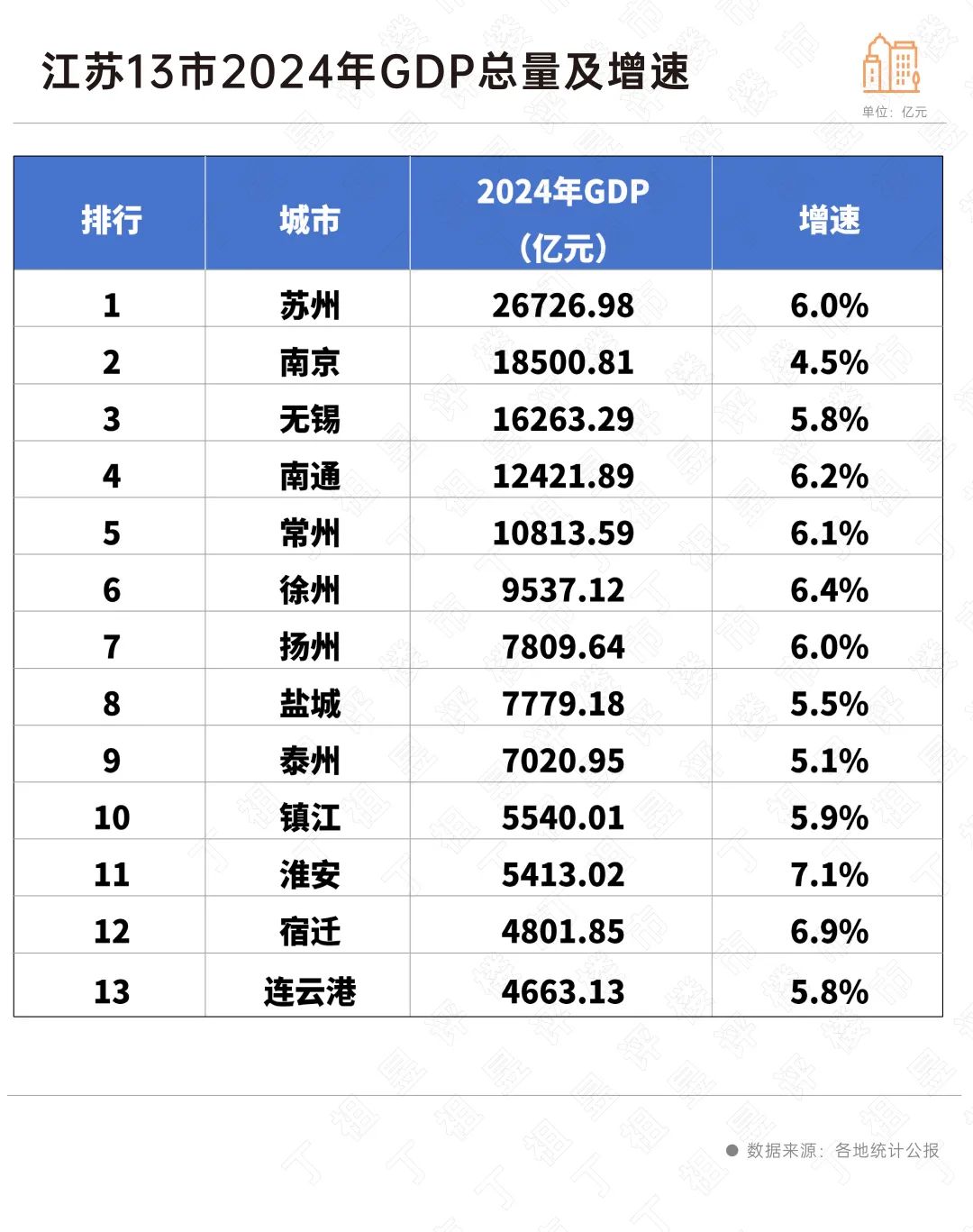
Core Viewpoint - The competition among the 13 cities in Jiangsu Province has evolved beyond sports, encompassing economic and demographic aspects, leading to a comprehensive evaluation of urban strength and real estate performance [2][23]. Economic Performance - Jiangsu Province is home to the most cities with a GDP exceeding 1 trillion yuan, with a total GDP of 13.70 trillion yuan in 2024, ranking second nationally [3]. - Suzhou leads the province with a GDP of 2.67 trillion yuan, followed by Nanjing at 1.85 trillion yuan, indicating a significant economic gap between the two cities [3][7]. - The top five cities in Jiangsu account for over 60% of the province's total economic output [3]. Real Estate Market - In the first five months of 2024, Suzhou's new housing sales volume decreased by 2%, while Nanjing's increased by 8%, indicating a divergence in market recovery [13]. - Salt City recorded the highest year-on-year growth in new housing sales at 30%, while Suzhou's total sales for the first half of the year reached 171.09 million square meters, a slight increase of 0.9% year-on-year [14][15]. - The average new housing price in Nanjing reached 27,329 yuan per square meter, the highest in the province, while cities like Huai'an and Xuzhou had prices below 10,000 yuan per square meter [17][20]. Population Dynamics - Suzhou has the largest permanent resident population in Jiangsu at 12.987 million, surpassing Nanjing's 9.577 million [9][11]. - Nanjing experienced the highest population growth in the province over the past five years, with an increase of 262,300 residents [10]. - The population in several northern Jiangsu cities, including Xuzhou, has been declining, reflecting a trend of out-migration [10][11]. Competitive Landscape - The competition among Jiangsu cities is intensifying, with Suzhou maintaining an advantage in population and GDP per capita, while Nanjing is strengthening its position as the provincial capital through population growth [23]. - Salt City and Nantong have emerged as "dark horses" in terms of new housing sales growth and price increases, respectively [23].
为什么江苏的人均GDP比浙江高?
Hu Xiu· 2025-06-16 02:11
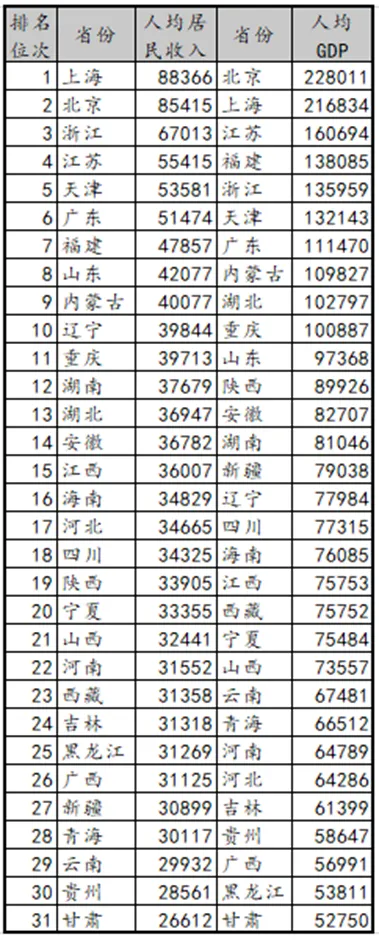
Core Insights - Jiangsu has a per capita GDP of 160,694 yuan in 2024, ranking third among all provinces, while Zhejiang's per capita income is 67,013 yuan, also ranking third, indicating a disparity where Jiangsu's GDP is 1.18 times that of Zhejiang, yet its income is only 82.7% of Zhejiang's [1][3] - The difference in wealth distribution is highlighted by Jiangsu's lower per capita tax contribution (8,963 yuan) and household savings (138,900 yuan) compared to Zhejiang (10,485 yuan and 161,600 yuan respectively) [1] - The contrasting economic models of Jiangsu and Zhejiang are often summarized as "Jiangsu has a higher GDP but lower income," suggesting that Zhejiang's wealth is more distributed among its citizens [1] Provincial Comparisons - In 2024, the rankings for per capita GDP and income show that provinces like Hubei, Xinjiang, and Shaanxi have a higher GDP ranking compared to their income ranking, while provinces like Shandong and Liaoning exhibit the opposite trend [4][5] - The economic structure of provinces with a high GDP but low income often relies heavily on resource industries, which inflate GDP figures without translating to higher income for residents [6] Employment and Economic Structure - The primary factors influencing per capita GDP are the wealth creation ability of non-agricultural employment and the proportion of non-agricultural workers in the total population [7] - The data indicates that provinces with a lower proportion of non-agricultural employment tend to have lower urbanization rates and higher out-migration of labor, contributing to economic stagnation [12] Sector Analysis - The second industry, particularly energy and mining, shows significant disparities in per capita value added, with underdeveloped regions often having higher per capita values due to their reliance on capital-intensive industries [19][21] - The manufacturing sector's productivity varies greatly, with capital-intensive industries yielding higher per capita GDP compared to labor-intensive sectors, which are prevalent in provinces like Guangdong and Zhejiang [20][21]
不要把“板子”打到市场经济的身上:分配的帕累托
Sou Hu Cai Jing· 2025-06-04 01:28
Group 1 - The core argument emphasizes that achieving national wealth is challenging and should not be defined by distant ideals or slogans, as this leads to unrealistic expectations and potential failures in policy implementation [2] - Lin Yifu predicts that by 2050, China's per capita GDP will reach 50% of the current level of the United States, indicating a need for China to focus on improving its economic conditions rather than immediately pursuing common prosperity [2][4] - The article highlights that even if Lin's goal is achieved, the concept of wealth remains distant, as per capita GDP does not reflect actual income levels for residents, with China's social security spending significantly lower than that of Nordic countries [4] Group 2 - Wang Xiaolu, deputy director of the National Economic Research Institute, argues that the focus should be on expanding the economic "cake" before addressing income distribution and public service improvements for low-income and vulnerable groups [6] - The article questions the notion that income disparity is solely a result of market economy dynamics, suggesting that all economic systems can experience polarization, and that competition is essential for efficiency [7] - The discussion includes the idea that progressive taxation could balance income distribution without undermining market principles, emphasizing the importance of effective governance in utilizing tax revenues for public welfare [8]

香槟开早了大半年!GDP超日本“坐四望三”,印度还是太超前
Di Yi Cai Jing· 2025-06-03 14:11
Core Viewpoint - India's GDP is projected to surpass Japan, positioning it as the fourth-largest economy globally, with aspirations to enter the top three within the next few years [1][3][4]. Economic Growth and Projections - The CEO of the National Transformation Council, B. V. R. Subrahmanyam, announced that India's economy has reached $4 trillion, surpassing Japan [3]. - According to the IMF, India's GDP for the fiscal year 2025 is estimated at $41,870.17 billion, slightly exceeding Japan's projected $41,864.31 billion [4]. - India's economic growth has been robust, while Japan has faced stagnation, with a mere $2,000 billion increase in output from 2000 to 2019 [4]. Challenges and Concerns - Despite the growth in GDP, there are concerns regarding the concentration of wealth, with the top 1% of the population holding over 40% of the nation's wealth [5]. - India's per capita GDP is projected to be around $2,800 in 2025, ranking approximately 140th globally, indicating a need for improvement in average income levels [5]. - The Modi government has emphasized the importance of transitioning from a service-oriented economy to a more balanced structure that includes a robust manufacturing sector [8][9]. Manufacturing Sector Initiatives - The "Production Linked Incentive" (PLI) scheme was introduced to boost manufacturing in various sectors, but progress has been slow, with only 37% of the target achieved by 2024 [9]. - Challenges in attracting manufacturing investments include difficulties in finding suitable labor, despite India's young population [9][10]. Future Aspirations - Prime Minister Modi has set ambitious goals for India's economic development, aiming to position the country as a developed nation by 2047 [8]. - Economic experts emphasize the need for improvements in education and job creation to fully leverage India's demographic potential [10].
“印度超日本成世界第四大经济体”?专家称该结论“操之过急”
Huan Qiu Shi Bao· 2025-05-27 22:48
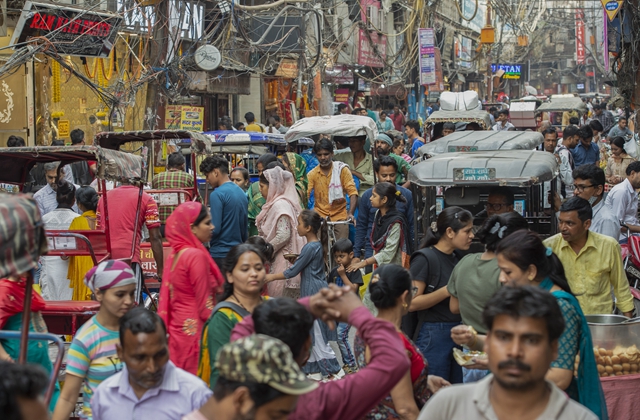
Group 1 - The core viewpoint is that India has reportedly surpassed Japan to become the world's fourth-largest economy, with a GDP of $4 trillion, according to the Indian National Transformation Commission [1] - The CEO of the Indian National Transformation Commission stated that if current plans are maintained, India could become the third-largest economy within the next two and a half to three years [1] - An economist from the same commission expressed skepticism, stating that India has not yet achieved this status and that full-year GDP data is needed to confirm the claim, predicting that this could be realized by the end of 2025 [1] Group 2 - Despite the claim of becoming the fourth-largest economy, India's per capita GDP is only $2,880, which is significantly lower than that of China and Japan, indicating that total GDP alone does not reflect economic strength [2] - Experts emphasize that for India to achieve stable and sustained economic growth, continuous reforms are necessary [2]