
人工智能革命

Search documents
但斌:投资要去大海里打鲸鱼,不要在烂泥塘里挖泥鳅
Xin Lang Zheng Quan· 2025-11-28 08:56
Core Insights - The 2025 Analyst Conference and the 7th Sina Finance "Golden Unicorn" Best Analyst Awards highlighted the significance of the current technological revolution, likening it to the Industrial Revolution, and emphasized the importance of seizing investment opportunities in this era [1][4]. Group 1: Historical Context and Technological Impact - The speaker, Dan Bin, shared his experiences from the past decades, illustrating how technological advancements such as computers, the internet, and mobile internet have created numerous investment opportunities despite challenges like financial crises and high inflation [4]. - A notable example was provided where if investments were made in Tencent during the mobile internet era, returns could have reached six to seven hundred times, showcasing the potential of recognizing and acting on technological trends [4]. Group 2: Global Investment Perspective - Dan Bin emphasized the importance of a global investment perspective by comparing the performance of Japanese and American capital markets, indicating that sticking to Japanese assets would have resulted in losses, while investing in the Nasdaq could yield over ten thousand times growth [5]. - The phrase "Invest in the ocean to catch whales, not in the mud to dig for minnows" was used to stress the necessity of global asset allocation, with a focus on leading companies in the AI sector like Nvidia and Google [5]. Group 3: AI Revolution and Market Dynamics - Addressing concerns about an AI bubble, historical data was cited to demonstrate that significant returns were still achievable during the later stages of previous technological revolutions, such as Tencent's and Apple's investments [6]. - The competition in the AI sector is expected to be more intense than previous technological revolutions, with major tech companies investing hundreds of billions, potentially leading to monopolistic business models [6]. - Google was highlighted as a company that has transitioned from skepticism to being highly valued, with Dan Bin indicating that it is now one of the top holdings for his firm [6]. Group 4: Investment Philosophy and Future Outlook - Dan Bin expressed that this might be the last major technological revolution he experiences in his career, urging investors to think with a long-term perspective and avoid regrets [7]. - The essence of investing is seen as the realization of knowledge, with the current understanding of being at the forefront of an intelligent revolution being the most valuable insight for investors [7].




杨德龙:中国科技牛行情远没有结束 2026年更多板块有望涨起来
Xin Lang Ji Jin· 2025-11-24 10:57
Market Overview - Recent stabilization and rebound in A-shares and Hong Kong stocks have led to a recovery in market confidence, with expectations for a potential rally before the end of the year [1] - The recent market pullback was primarily due to profit-taking in previously high-performing technology stocks, but the overall market trend remains unchanged [1] - The bull market has been ongoing for a year, characterized by significant structural trends and sector rotation [1][2] Sector Performance - After breaking the 4000-point mark, the market is expected to continue upward, with faster sector rotation anticipated [2] - Investors are advised to diversify their portfolios rather than concentrate on technology stocks, which may be experiencing fear of heights among new investors [2] - Traditional sectors, particularly consumer stocks, may see valuation recovery opportunities as new funds enter the market [5] Global Market Influences - The potential for a rate cut by the Federal Reserve in December could lead to a global trend of monetary easing, supporting liquidity in capital markets [4] - The current low-interest-rate environment is favorable for equity asset performance, with expectations for the Fed to lower rates to around 3.5% [4] - Concerns about high valuations in U.S. tech stocks, particularly after significant gains, have led to caution among investors [3][4] Future Outlook - The bull market in A-shares and Hong Kong stocks is expected to continue into 2026, with a shift from a structural bull market to a more comprehensive bull market [6] - The Chinese technology sector, despite recent adjustments, is not expected to end its bullish trend, as it has significant growth potential in AI applications [6] - Increased foreign investment interest in the Chinese market, particularly in the technology and AI sectors, is anticipated, supported by positive outlooks from major international investment banks [6]
智昇:降息or不降?美联储内部吵翻了!分歧程度为32年之最
Sou Hu Cai Jing· 2025-11-19 08:54
Core Viewpoint - The Federal Reserve's anticipated interest rate cut is now uncertain due to diverging views among officials regarding the health of the economy, persistent inflation, and weak job markets [1][3] Group 1: Diverging Opinions Among Federal Reserve Officials - Some policymakers have heightened concerns about persistent inflation, linking it to the recent focus on "affordability" during the elections [3] - Another faction emphasizes the risks of a weak job market, suggesting that low hiring and layoffs could worsen the current employment situation [3] - The internal division within the Federal Reserve reflects a complex economic outlook influenced by tariffs, AI advancements, immigration policy changes, and tax reforms [3] Group 2: Risks of Delayed Rate Cuts - If the Federal Reserve reduces the scale of interest rate cuts, high costs for housing and auto loans will persist, exacerbating public dissatisfaction with living costs [3][4] - Polls indicate that high mortgage and auto loan rates are contributing to widespread discontent among the populace [3] Group 3: Anticipated Opposition Votes in Upcoming Meetings - Analysts predict a significant number of dissenting votes in the upcoming Federal Open Market Committee (FOMC) meeting, regardless of whether a rate cut is decided [4] - If a rate cut occurs, dissenting votes could reach four to five, while maintaining rates could see three dissenting votes, marking a rare occurrence in the Fed's history [4] Group 4: Impact of Government Shutdown on Economic Data - The government shutdown has interrupted the release of economic data, complicating the Federal Reserve's data-dependent decision-making approach [6] - The latest employment data is stuck at August levels, and inflation data is only updated to September, creating challenges for the Fed [6] Group 5: Market Expectations and Stock Market Reactions - The probability of a rate cut in December has dropped to around 50%, down from nearly 94% a month ago, contributing to recent stock market corrections [7] - The current rate cut probability has slightly rebounded to 48.9% [7] Group 6: Diverging Views on Future Rate Cuts - After the Fed's second rate cut in October, Chairman Powell dampened expectations for further cuts, stating that December's cut is "not a foregone conclusion" [8] - Various regional Fed officials have expressed concerns about inflation, emphasizing the need to maintain rates around 3.9% to help bring inflation back to target [8] - Conversely, some officials argue that the weak job market poses a more significant risk and advocate for a December rate cut [8] Group 7: Key Economic Indicators and Political Pressures - The upcoming labor market data will be crucial in shaping the Fed's consensus on rate cuts [9] - Political pressures, including discussions about potential replacements for Chairman Powell, may influence the Fed's policy direction [9] Group 8: Institutional Perspectives - Citigroup predicts that weak labor market data will lead the Fed to initiate a rate cut in December, which is a key variable affecting the current stock market [10] - The end of the government shutdown is expected to improve market liquidity, creating a favorable environment for U.S. equities [10]

鲍威尔硬刚特朗普,降息之争白热化,美国经济陷两难
Sou Hu Cai Jing· 2025-11-19 08:32
在阅读文章前,辛苦您点下"关注",方便讨论和分享。作者定会不负众望,按时按量创作出更优质的内容。 文I不可史意 编辑I不可史意 前言 人工智能革命正在重塑就业市场:数据录入、初级程序员等岗位被大量替代,导致就业增长放缓;但 AI 伦理师、提示工程师等新岗位需求激增,企业抢 人推高薪资,形成严重技能错配。 大家好,小编我呀,是一个爱扒关于美国事情的热心博主,今天就跟着我一起来看看,美联储的首要顾虑,那就不得不提到始终顽固的通胀。 截至 2025 年 10 月,美国 CPI 同比增速仍停留在 3%,看似较 2022 年 9% 的峰值大幅回落,但距离 2% 的官方目标仍有 1 个百分点的差距。 这 1 个百分点,在央行语境里堪比 "地球到月球的距离"—— 美联储如同向全球承诺 "将 200 斤胖子减到 120 斤" 的教练,如今胖子刚减到 140 斤,若此时 松劲,通胀很可能反弹,此前两年激进加息的代价将全部白费,美联储的信誉也会彻底崩塌。 更棘手的是通胀的内部结构。鲍威尔重点关注的 "剔除住房的核心服务通胀" 仍高达 4.5%,这一指标直接反映工资相关的物价压力。 理发、看病、育儿、维修等服务价格持续高涨,根源在 ...

我们很可能正走向一个“无工作社会”
创业邦· 2025-11-14 10:24
Core Viewpoint - The article discusses the transformative impact of the AI revolution, suggesting it may lead to a new world akin to the Industrial Revolution, with profound implications for society, work, and human relationships [9][10][12]. Group 1: AI Revolution and Its Nature - The AI revolution is compared to previous major revolutions, indicating that it may significantly enhance human capabilities, shifting the focus from physical labor to cognitive functions [12]. - The rapid advancement of technology and knowledge in AI is described as exponential, leading to continuous cycles of discovery and innovation [12][13]. Group 2: Impact on Work and Society - AI may lead to the emergence of a "leisure class," where many professional jobs are replaced by AI, resulting in fewer people needed to perform tasks traditionally done by teams [16]. - The potential for a society where most individuals do not need to work raises questions about how people will spend their time and find purpose in a world of abundant leisure [17][19]. - Education will need to shift from preparing individuals for traditional jobs to fostering creativity and independent learning, focusing on personal development rather than workforce readiness [20][21]. Group 3: Economic and Distribution Challenges - The traditional economic model based on work for income is challenged by the rise of AI, leading to discussions about new distribution systems, such as Universal Basic Income (UBI) [23][25]. - The potential for an "abundant society" raises concerns about wealth concentration and inequality, as the benefits of AI may not be evenly distributed [26]. Group 4: Knowledge and Intellectual Property - The concept of intellectual property may need to evolve in the AI era, as creations may become collective rather than individual, complicating ownership and rights [27]. Group 5: Social Relationships and AI - The article suggests that AI will lead to a decentralization of social activities, with a shift back to more individualized and remote interactions, impacting various sectors including healthcare and education [29][30]. - The emergence of AI as a new "species" necessitates a reevaluation of human relationships, including emotional connections and societal roles [33][34]. Group 6: Global Implications - AI has the potential to foster global cooperation and reduce nationalism, as it encourages interconnectedness and shared progress [36][39]. - The article posits that the AI revolution could provide opportunities for restructuring global order, particularly in the context of US-China relations and international governance [40][41].

National Energy Services Reunited Corp.(NESR) - 2025 Q3 - Earnings Call Transcript
2025-11-13 14:02
Financial Data and Key Metrics Changes - Overall third quarter revenue was $295.3 million, down 9.8% sequentially and 12.2% year-over-year, primarily due to the transition between major contracts in Saudi Arabia [17][18] - Adjusted EBITDA for Q3 2025 was $64 million, representing a margin of 21.7%, consistent with Q2 2025 levels despite lower revenues [18] - Adjusted EPS for Q3 2025 was $0.16, including adjustments for certain charges and credits [19] - Gross debt totaled $332.9 million, and net debt was $263.3 million, with a net debt-to-Adjusted EBITDA ratio of 0.93 [20] Business Line Data and Key Metrics Changes - Revenue decline was partially offset by solid growth in Kuwait, Qatar, and Iraq, with steady growth also noted in Oman, Egypt, Algeria, and Libya [17][18] - The company is positioned as the largest frac company in the Middle East, with the Jafurah tender representing the largest single-service contract in sector history [9][11] Market Data and Key Metrics Changes - The company is experiencing positive activity inflection beyond Jafurah, with growth in Kuwait and the return of additional rigs in Saudi Arabia [5][27] - The geopolitical relationship between the U.S. and Gulf states is strong, positively impacting energy markets and foreign investment [8] Company Strategy and Development Direction - The company is focused on a countercyclical investment strategy, allowing it to capitalize on global weaknesses and position itself for growth [11][12] - NESR aims to maintain operational readiness and efficiency while investing during downturns, contrasting with traditional industry practices [12][14] - The company plans to exit 2025 with a revenue run rate of approximately $2 billion, supported by expanding contract bases and sustained execution momentum [22][24] Management's Comments on Operating Environment and Future Outlook - Management expressed confidence in achieving a $2 billion exit run rate for 2026, with a high level of visibility on contract awards and execution [72][73] - The outlook for NESR remains favorable, supported by consistent execution on major contract wins and strategic investments [25][26] Other Important Information - The company is in the process of refinancing its debt facility, expected to enhance financial flexibility [24] - NESR is committed to maintaining disciplined debt reduction and improving working capital efficiency [25] Q&A Session Summary Question: Can you respond to comments about pricing competitiveness for the Jafurah contract? - Management highlighted their deep understanding of the local ecosystem and cost control measures that allowed them to maintain margins while being competitive [31][32] Question: What is the roadmap for development at Jafurah? - Management indicated readiness to ramp up operations with multiple crews and equipment already in place, targeting significant increases in stages delivered [34][35] Question: What is the expected incremental EBITDA from Jafurah? - Management confirmed that the incremental EBITDA for 2026 is approximately $100 million, based on the projected revenue run rate [37][38] Question: Can you provide updates on NEDA projects and water initiatives? - Management stated that several pilot projects are underway, with results expected to be shared in future calls [66][68] Question: What is the confidence level in achieving the $2 billion exit run rate for 2026? - Management expressed a 99% confidence level in achieving the target, with contracts already awarded and work commenced [72][73]

腾研对话海外名家:我们很可能正走向一个“无工作社会”
3 6 Ke· 2025-11-11 09:53
Core Insights - The AI revolution is compared to the Industrial Revolution, suggesting it may lead to a new world with significant societal changes [2][3] - AI is expected to enhance human capabilities, shifting the focus from physical labor to cognitive functions [3] - The impact of AI is anticipated to be profound, potentially reshaping work, education, and social structures [5][6] Group 1: AI's Impact on Employment and Society - The rise of AI may lead to the emergence of a "leisure class," where many professional jobs could be replaced by AI, resulting in fewer people needing to work [7][8] - Education systems may need to adapt to focus on teaching individuals how to live creatively and meaningfully rather than preparing them solely for traditional jobs [8][9] - The concept of creativity is challenged as AI demonstrates capabilities in artistic fields, raising questions about the future role of human artists [9] Group 2: Economic and Distributional Changes - The traditional economic model based on work for income may be disrupted, leading to a "no-work society" where income distribution needs to be rethought [11][12] - AI could create a wealthier society, but there are concerns about wealth concentration and inequality, reminiscent of historical patterns during the Industrial Revolution [12] - The concept of intellectual property may evolve as AI-generated content blurs the lines of ownership and contribution [13] Group 3: Social Relationships and Structures - AI is expected to decentralize social activities, moving away from centralized institutions towards more individualized and remote interactions [14][15] - The relationship between humans and AI will need to be redefined, impacting emotional and social dynamics, including companionship and personal relationships [16] Group 4: Global Implications - AI has the potential to foster global cooperation and reduce nationalism, contrasting with the divisive effects of the Industrial Revolution [17] - The AI revolution may provide opportunities for restructuring global order, particularly in the context of US-China technological competition [18] Conclusion - The development of responsible AI is crucial for creating a better future, addressing various societal challenges while maximizing the benefits of AI technology [19]
中外企业家共话创新驱动与全球竞争力
Sou Hu Cai Jing· 2025-11-04 07:46
Group 1 - The theme of the 8th China Enterprise Forum is "Reshaping Growth Engines: Global Competitiveness Driven by Innovation," emphasizing the importance of innovation in driving global growth and the need for cooperation between Chinese and foreign enterprises for sustainable development and win-win outcomes [1][3] - The Deputy Director of the State-owned Assets Supervision and Administration Commission (SASAC) highlighted that enterprises are a key part of the global economic system and should leverage innovation to reshape growth momentum while ensuring high-quality development to counter external uncertainties [3] - The President and CEO of the World Economic Forum stated that Chinese enterprises play a crucial role in shaping global innovation patterns, promoting sustainable development, and enhancing international cooperation, particularly in harnessing the potential of the AI revolution and digital economy [3] Group 2 - China Huaneng's Vice President emphasized the integration of ESG principles into the company's development strategy, focusing on accelerating non-fossil energy replacement actions and enhancing green low-carbon technology innovation [3][5] - The Vice Chairman of the China-EU Chamber of Commerce pointed out the importance of modernizing power grids for stable green electricity supply and suggested expanding green finance participation channels [4] - Huawei's Senior Vice President stated that digitalization, intelligence, and low-carbon initiatives are the three definitive directions for enterprises to achieve sustainable competitiveness through the implementation of ESG principles [5] Group 3 - Siemens Energy's Executive Director highlighted the connection between energy transition and sustainable development, advocating for the integration of ESG principles into core strategies and the expansion of renewable energy applications [5] - The General Manager of China Chemical Engineering called for continuous exploration of cooperation opportunities between Chinese and foreign enterprises to enhance the global industrial and supply chain [5] - The Deputy Director of the International Trade and Economic Cooperation Research Institute of the Ministry of Commerce noted that the global supply chain is undergoing deep adjustments, and a cooperative supply chain involving China is essential for economic viability [5]
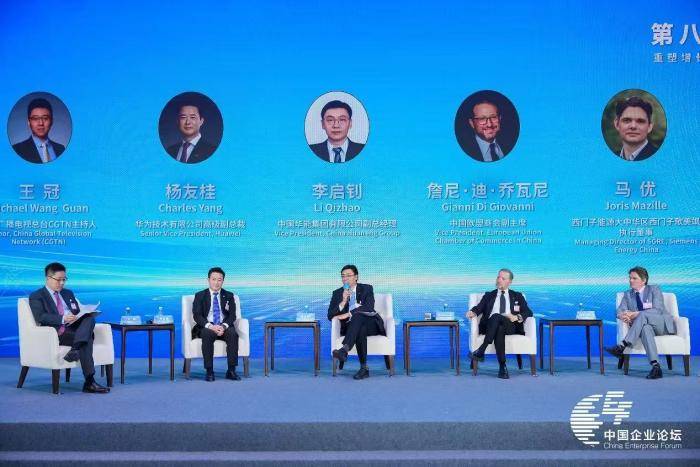
中外企业家共话创新驱动下的全球竞争力
Zhong Guo Jin Rong Xin Xi Wang· 2025-11-04 06:41
Core Insights - The eighth China Enterprise Forum emphasized the importance of innovation in reshaping growth engines and enhancing global competitiveness [1] - Key discussions focused on sustainable development paths driven by innovation and opportunities in global market expansion [1] Group 1: Innovation and Sustainable Development - The State-owned Assets Supervision and Administration Commission (SASAC) highlighted the need for enterprises to leverage innovation to counter external uncertainties and achieve high-quality development [1] - China Huaneng's Vice President stated that integrating ESG principles into corporate development aligns with new development concepts, promoting green transformation and technological innovation [2] - Huawei's Senior Vice President emphasized that continuous R&D investment, constituting 20% of the company's revenue, is crucial for building competitive advantage and societal benefits [3] Group 2: International Cooperation and Energy Transition - Saudi Aramco's Asia Senior Vice President noted that cooperation between Chinese and foreign enterprises is critical for energy security and sustainable development, emphasizing joint innovation [4] - The French Electric Group's China Executive Vice President discussed the importance of complementary advantages in third-party market collaborations to enhance supply chain resilience [4] - The International Trade and Economic Cooperation Research Institute's Deputy Director pointed out that multinational companies need to reassess their relationships with local markets amid changing supply chain dynamics [5]
闻泰科技半导体业务稳健增长,科创半导体ETF(588170)跌幅3.47%
Mei Ri Jing Ji Xin Wen· 2025-11-03 02:54
Group 1 - The Shanghai Stock Exchange's Sci-Tech Innovation Board semiconductor materials and equipment index decreased by 3.27% as of November 3, 2025, with mixed performance among constituent stocks [1] - New Yichang led the gains with a 6.00% increase, while Shen Gong fell by 7.01%, indicating volatility in the semiconductor sector [1] - The Sci-Tech Semiconductor ETF (588170) experienced a decline of 3.47%, with a latest price of 1.36 yuan, and a trading volume of 2.21 billion yuan [1] Group 2 - Galaxy Securities highlighted the emphasis on supply chain security and self-sufficiency, accelerating the validation process for domestic materials [2] - High-end products such as KrF/ArF photoresists and CMP polishing liquids are identified as key areas for breakthroughs, driven by the expansion of HBM and advanced logic chip production capacity [2] - The semiconductor materials ETF (562590) focuses on upstream semiconductor equipment and materials, benefiting from the low domestic replacement rate and high ceiling for domestic substitution [2]
