
品牌价值

Search documents
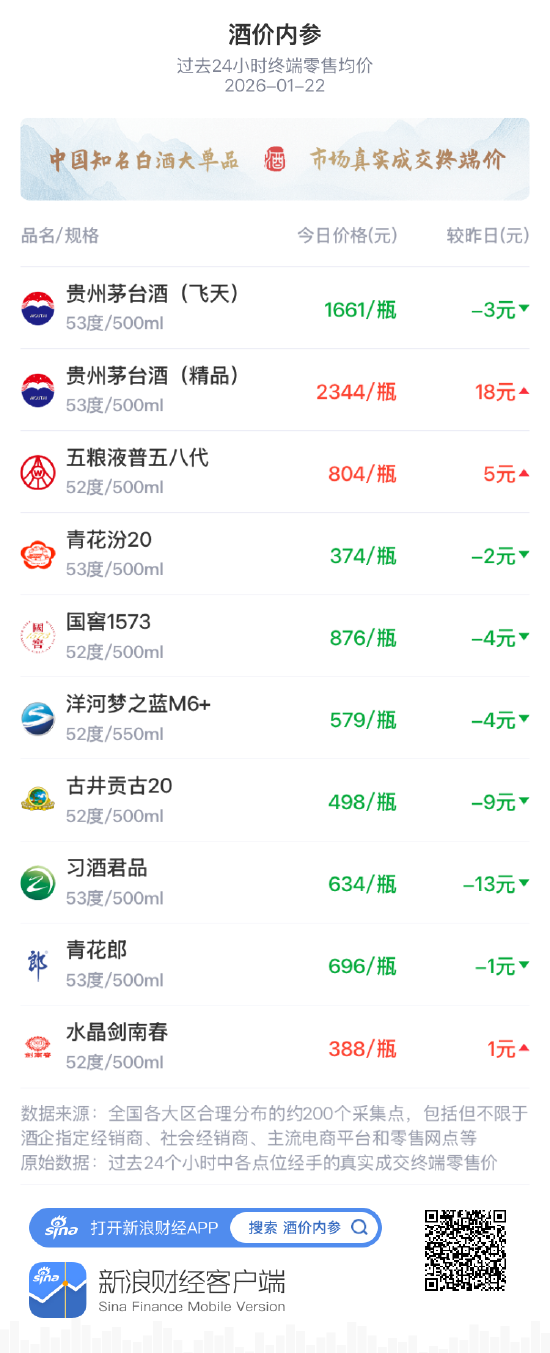
酒价内参1月22日价格发布 市场延续下跌创两月价格新低
Xin Lang Cai Jing· 2026-01-22 01:18
新浪财经"酒价内参"重磅上线 知名白酒真实市场价尽在掌握 新浪财经"酒价内参"过去24小时收集的数据显示,中国白酒市场十大单品的终端零售均价在1月22日迎 来普遍下跌。如果十大单品各取一瓶整体打包售卖,今日总售价为8854元,较昨日下跌12元。市场价格 第五次创下近两个月的新低,高端酒价格中枢持续下移,行业短期调整态势未改。 今日市场普跌特征凸显,十大单品七跌三涨,头部酒品走势分化,仅少数单品显露止跌回暖迹象。下跌 产品中,习酒君品领跌,环比降低13元/瓶;古井贡古紧随其后,环比下跌9元/瓶;国窖1573与洋河梦 之蓝M6+均环比下跌4元/瓶;飞天茅台环比下跌3元/瓶,i茅台平价货源持续投放,终端价格支撑进一步 弱化;青花汾20与青花郎跌幅较小,分别下跌2元/瓶与1元/瓶。上涨产品中,精品茅台领涨,环比大幅 上涨18元/瓶,渠道货源阶段性收紧,叠加部分终端补货需求释放;五粮液普五八代上涨5元/瓶;水晶 剑南春微涨1元/瓶。 "酒价内参"的每日数据源自全国各大区均有合理分布的约200个采集点,包括但不限于酒企的指定经销 商、社会经销商、电商平台和零售网点等,原始取样数据为过去24个小时各点位经手的真实成交终端零 ...

《Brand Finance 2026年全球品牌价值500强》榜单发布:13家中国银行业品牌上榜,工行建行中行农行位列前20
Xin Lang Cai Jing· 2026-01-21 10:48
1月21日金融一线消息,当地时间1月20日,《Brand Finance 2026年全球品牌价值500强榜单报告》在瑞 士达沃斯正式发布。 《Brand Finance 2026年全球品牌价值500强榜单报告》显示,银行业凭借79个品牌,为总价值贡献了 12.5%。其中,13家中国银行品牌以4170亿美元总价值占据行业鳌头,同比增长1.4%。 中国工商银行在榜单中的排名为第12名,凭借908.8亿美元的品牌价值和91.5分的品牌强度指数稳居全球 银行品牌榜首,获得AAA+评级。 上榜的中国银行品牌还有中国建设银行(排名14)、中国银行(排名17)、中国农业银行(排名19)、 招商银行(排名74)、中信银行(排名128)、中国邮政储蓄银行(排名134)、交通银行(排名 167)、上海浦东发展银行(排名272)、兴业银行(排名274)、中国民生银行(排名404)、中国光大 银行(排名461)、恒生银行(排名462)。 | 2025 2026 | | | 2026 2026 | 2026 | 2025 | | --- | --- | --- | --- | --- | --- | | 排名 | 排名 品牌 | | ...




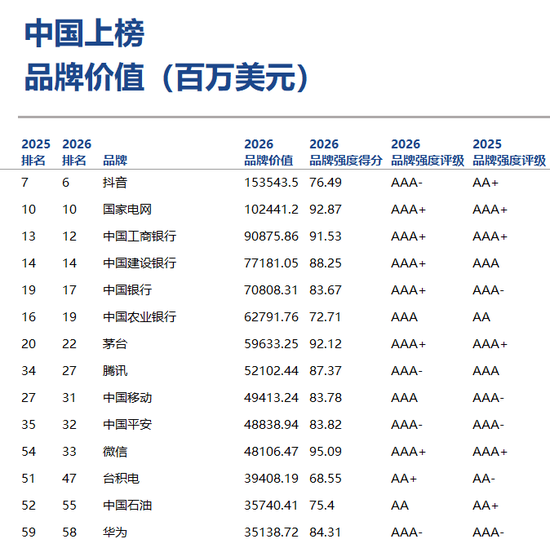
最新!茅台品牌价值达596.3亿美元,位居全球烈酒行业第一
Xin Lang Cai Jing· 2026-01-21 00:18
《Brand Finance 2026年全球品牌价值500强榜单报告》显示,苹果持续领跑榜单,美国共有192个品牌 入选,合计贡献了总品牌价值的53.4%。中国凭借68个品牌位居第二位,占比达15.1%。 今年共有68个中国品牌入选榜单,然而,入榜的品牌总价值较去年增长了9.7%。尽管入榜品牌数比去 年减少了1个,但平均到每个品牌的价值却有所提升。 品牌强度方面,中国上榜品牌的平均品牌强度指数为76.4分(满分100),比全球500强的平均品牌强度 得分75.8高出0.6分。 新浪财经"酒价内参"重磅上线 知名白酒真实市场价尽在掌握 当地时间2026年1月20日,《Brand Finance 2026年全球品牌价值500强榜单报告》在瑞士达沃斯正式发 布。茅台的品牌价值增长2.2%达到596.3亿美元,位居全球烈酒行业第一名。 当地时间2026年1月20日,《Brand Finance 2026年全球品牌价值500强榜单报告》在瑞士达沃斯正式发 布。茅台的品牌价值增长2.2%达到596.3亿美元,位居全球烈酒行业第一名。 《Brand Finance 2026年全球品牌价值500强榜单报告》显示,苹果持续领跑 ...

瑞士达沃斯:《Brand Finance 2026年全球品牌价值500强榜单报告》出炉
Feng Huang Wang Cai Jing· 2026-01-20 23:28
Core Insights - The Brand Finance 2026 Global Brand Value 500 report highlights Apple's continued dominance as the world's most valuable brand, with a brand value of $607.64 billion, reflecting a growth of 5.8% [5][6] - The report indicates that the United States leads with 192 brands contributing 53.4% of the total brand value, followed by China with 68 brands at 15.1% [3][5] - The banking sector remains the highest valued industry globally, contributing 12.5% of total brand value with 79 brands, while media and electronics follow [3][5] Company Highlights - Apple maintains its position as the top brand, with a brand value of $607.64 billion, driven by strong performance in services including advertising and cloud services [5][6] - Microsoft ranks second with a brand value of $565.25 billion, showing a significant growth of 22.6%, bolstering its leadership in AI and cloud services [5][6] - TikTok (Douyin) has seen a remarkable brand value increase of 45.1%, reaching $153.54 billion, making it the highest valued Chinese brand and sixth globally [7][19] - The State Grid of China ranks tenth globally with a brand value of $102.44 billion, leading the utilities sector and achieving a 19.6% growth [8][19] - China Petroleum and China Petrochemical also show positive growth in brand value, with China Petroleum at $35.74 billion and China Petrochemical at $30.42 billion [11][20] Industry Insights - The banking industry is highlighted as the strongest sector for Chinese brands, with a total brand value of $417 billion from 13 banks, marking a 1.4% increase [10] - The utilities sector, led by the State Grid, shows strong performance, with China Southern Power Grid achieving a 33.2% growth in brand value [9][10] - The food and beverage sector is represented by Yili, which ranks third globally in the food industry with a brand value of $14.5 billion, reflecting a 29.2% growth [13][21] - The insurance sector also performs well, with six out of seven Chinese brands on the list showing growth, particularly China People's Insurance with a 12% increase [15][21] - The engineering sector sees China holding nine out of twenty brands, with China National Building Material achieving a 1.3% growth in brand value [15][21]




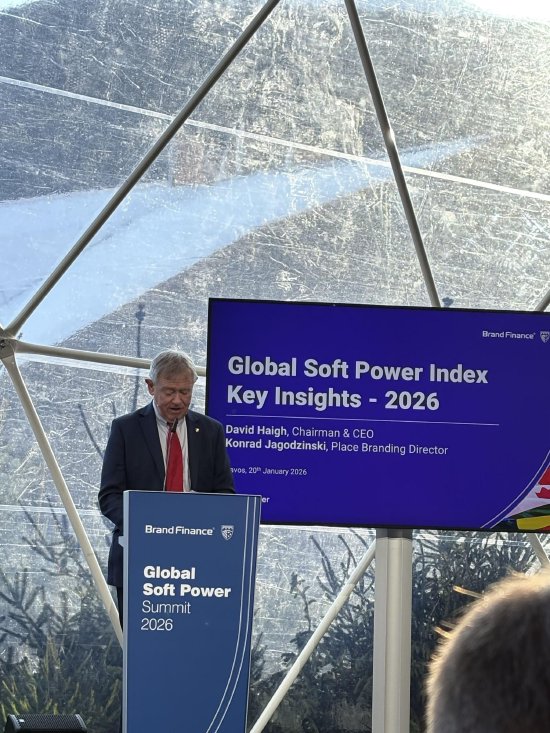
视频|对话品牌金融董事长大卫·海格:中国软实力继续增强 全球品牌价值500强中国占68席
Xin Lang Cai Jing· 2026-01-20 15:12
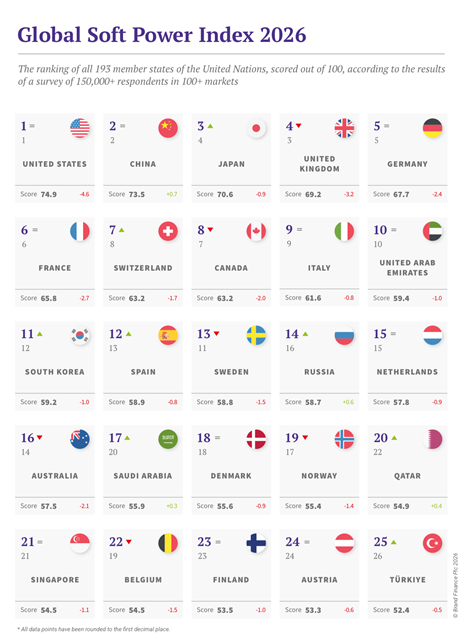
Core Insights - The latest Brand Finance Global Soft Power Index for 2026 indicates that China is the only country among the top ten to have improved its ranking, reflecting a rise in its soft power [1][6] - The gap in soft power between the United States and China has narrowed, with China's total score rapidly approaching that of the U.S., which has seen a significant decline in its score over the past year [4][7] - Brand Finance's 2026 Global Brand Value 500 report reveals that the U.S. has 192 brands contributing 53.4% of the total brand value, while China ranks second with 68 brands, accounting for 15.1% of the total, with TikTok having the highest brand value among Chinese brands [8][10] Brand Performance - Among the 68 Chinese brands listed in the Global Brand Value 500, notable mentions include Bosideng (outerwear), TikTok (social media), Huawei (smartphones), and BYD (electric vehicles), which are recognized for their excellent product quality [6][10] - The report highlights that the U.S. brands continue to dominate the list, but the increasing presence of Chinese brands indicates a shift in global brand dynamics [8][10]
冬季达沃斯发布2026年全球品牌价值500强榜单:品牌总价值双位数跃升,中国品牌表现多维并进
Xin Lang Cai Jing· 2026-01-20 12:21
Group 1 - The Brand Finance 2026 Global Brand Value 500 report shows that Apple continues to lead the rankings, with the United States having 192 brands contributing 53.4% of the total brand value [34][36] - China ranks second with 68 brands, accounting for 15.1% of the total brand value, with TikTok having the highest brand value among them [34][40] - Germany follows with 26 brands contributing 5.6% of the total brand value, while Japan and France rank fourth and fifth, each with 33 brands contributing 4.7% and 4.1% respectively [3][36] Group 2 - The banking industry remains the highest contributing sector with 79 brands, accounting for 12.5% of the total brand value, followed by the media industry with 25 brands at 10.9% and the electronics industry with 17 brands at 8% [4][36] - In 2026, Apple's brand value increased by 5.8% to $607.6 billion, while Microsoft saw a 22.6% growth to $565.2 billion, solidifying its leadership in AI and cloud services [6][38] - TikTok's brand value surged by 45.1% to $153.5 billion, making it the sixth most valuable brand globally, reflecting its strong influence in the short video and social media sectors [8][40] Group 3 - The State Grid of China ranks first in the global utilities sector with a brand value of $102.4 billion, achieving a 19.6% increase [9][41] - China Southern Power Grid experienced a 33.2% growth in brand value, reaching $11.96 billion, becoming the fastest-growing brand in the global utilities sector [11][43] - The banking sector in China shows strong performance with 13 banks collectively valued at $417 billion, a 1.4% increase year-on-year, with the Industrial and Commercial Bank of China leading at $90.9 billion [13][45] Group 4 - The oil and gas sector also performed well, with China National Petroleum and Sinopec both achieving positive growth in brand value [17][49] - Moutai remains the top brand in the global spirits industry with a slight increase of 2.2% to $59.63 billion, while Wuliangye holds the second position with a brand value of $27.3 billion [21][53] - The insurance sector saw significant growth, with China People's Insurance increasing its brand value by 12% to $16.82 billion, moving up five places in the global rankings [25][57]
GYBrand发布2026年全球品牌价值500强榜单!中国78家企业名单一览
Sou Hu Cai Jing· 2026-01-19 04:13
Core Insights - The globalization of Chinese brands is accelerating, with brand value assessment becoming a strategic priority for sustainable development, shifting from an optional to a necessary approach for companies [2] - The GYBrand 2026 World Brand 500 list emphasizes a comprehensive evaluation system based on brand value, financial performance, brand strength, contribution, and sustainability [2] Group 1: Brand Rankings and Distribution - The 2026 GYBrand World Brand 500 includes brands from 33 countries, with a total value exceeding $14 trillion, representing a 7.11% increase from the previous year, and an average brand value of $28.544 billion [3] - The United States leads with 180 companies, while China ranks second with 78 companies, accounting for 15.6% of the total list [3] - Major cities like Beijing, Shanghai, Shenzhen, Guangzhou, and Hangzhou show significant brand concentration, with "Beijing, Shanghai, Shenzhen, Guangzhou, and Hangzhou" collectively contributing 60 companies to the list [3][12] Group 2: Chinese Brand Performance - In 2026, 78 Chinese companies made the GYBrand list, with a total brand value of $22,764 billion, representing 15.9% of the global total, and an average brand value of approximately $292 million [12] - Beijing is the leading city with 38 companies and a total brand value of $12,178 billion, while Shenzhen has 7 companies, all from the private sector [13] - The presence of state-owned enterprises in Beijing highlights its advantages in innovation resources and industrial clusters, reinforcing its leading position in brand value [13] Group 3: Challenges and Opportunities - Chinese brands face a "large but weak" dilemma, needing to transition from scale expansion to value deepening to enhance brand strength [16] - Comparisons with the Fortune Global 500 reveal that while China has a significant number of companies, their average revenue and profit lag behind those of U.S. companies [16] - The ongoing technological revolution and industrial transformation present new opportunities for Chinese brands to enhance their value through innovation, emotional connection, and cultural empowerment [17]

中国玩具解困:不止于“性价比” 押注文化IP与情感价值
Bei Jing Shang Bao· 2026-01-15 05:00
Core Insights - The dominance of LEGO in the toy market highlights the challenges faced by domestic brands in China, particularly in the building block segment, where price competition limits profit margins and investment capabilities [1][9] - Domestic brands are shifting focus towards cultural emotional connections and IP development to differentiate themselves from LEGO and establish a competitive edge [2][3] Market Dynamics - The toy market is experiencing significant growth, driven by adult consumers and the rise of collectible trends, with domestic brands facing intense competition on pricing, design, and branding [2][12] - The price range for domestic building blocks typically falls between 9.9 yuan and 399 yuan, significantly lower than LEGO's pricing, which can be three to five times higher [2][6] Brand Strategy - Domestic brands like Senbao are adopting strategies centered around cultural IP, such as military themes and local cultural narratives, to connect emotionally with consumers and avoid direct price competition [2][3] - The success of military-themed products, such as the Shandong aircraft carrier model, demonstrates the market potential for culturally resonant IP [4][10] Production Challenges - The primary hardware gap between domestic brands and LEGO lies in raw material quality, with domestic brands facing a 20%-30% cost difference in materials, impacting their ability to compete on quality [6][7] - While domestic brands have made advancements in injection molding technology, the precision of molds remains a challenge, with costs significantly lower than LEGO but quality still lagging [7][8] Consumer Behavior - The shift in consumer demographics towards adults has transformed toys into emotional and social commodities, with a growing trend of collecting and personal expression through toys [12][14] - The emergence of unique domestic IPs, such as LABUBU and wakuku, reflects a growing consumer desire for personalized and culturally relevant products [10][12] Future Outlook - The Chinese toy market is entering a golden period, with government support for local IP development and innovative design, indicating a favorable environment for domestic brands to enhance their market presence [15] - The transition from manufacturing advantages to brand value is crucial for domestic brands to establish a strong foothold in both local and international markets [11][15]
是“韩流”更是“暖流” 悦达起亚迎来“又一春”
Yang Zi Wan Bao Wang· 2026-01-13 08:47
Group 1 - The core viewpoint of the article highlights the resurgence of the South Korean wave ("Hallyu") in China, marked by a significant economic delegation visit led by South Korean President Lee Jae-myung, resulting in the signing of 15 cooperation agreements between China and South Korea, including in the field of technological innovation [1] - The economic forum between China and South Korea featured direct dialogues between key automotive leaders, indicating a renewed focus on collaboration in the automotive sector, particularly with Yueda Kia being recognized as a benchmark for Sino-Korean industrial cooperation [1] - Yueda Kia reported a total sales volume of 253,964 vehicles in 2025, reflecting a 2.3% year-on-year growth, achieving positive growth for two consecutive years and maintaining a monthly sales figure exceeding 20,000 units for ten consecutive months [1] Group 2 - Yueda Kia's resilience in the competitive automotive market is attributed to a strategic focus on solidifying manufacturing quality, optimizing channel health, and upgrading service systems, rather than aggressive market strategies [4] - The brand's new slogan "Kia, Driven by Heart" signifies its transformation from a mere automobile manufacturer to a "co-builder of user lives," emphasizing emotional connections with consumers [5] - The brand film "Driven by Heart" conveys warmth and reliability, positioning Kia as a trustworthy partner amidst technological uncertainties, thus enhancing its brand value [6] Group 3 - Yueda Kia's community engagement initiatives, such as collaborating with the Blue Sky Rescue Team and supporting special groups, help build emotional bridges with consumers, reinforcing brand loyalty [9] - The company has successfully established a diverse export lineup, with a cumulative export of 537,000 vehicles over eight years, and in 2025, it exported 122,000 engines, showcasing its global reach [20][21] - The Salt City factory, recognized as a benchmark facility, is undergoing upgrades to align with global standards, enhancing Yueda Kia's strategic position and profitability within the group [23] Group 4 - The upcoming new models, including the new Sportage and EV5 Weekender, reflect Yueda Kia's commitment to meeting diverse consumer needs in both fuel and electric vehicles, with plans for a new large electric SUV by the end of the year [27] - Yueda Kia's dual engine model of "domestic sales + exports" is expected to gain stronger policy and resource support, enhancing its competitive edge in both Chinese manufacturing and global delivery [33] - The recent diplomatic thaw between China and South Korea is seen as a significant opportunity for Yueda Kia, marking a new beginning for the company in the evolving market landscape [35]
潮宏基(002345):预告2025年净利润高增 渠道拓展持续推进
Xin Lang Cai Jing· 2026-01-13 00:33
Core Viewpoint - The company forecasts a significant increase in net profit for 2025, projecting a year-on-year growth of 125% to 175% [1] Group 1: Performance Preview - The company anticipates a net profit attributable to shareholders of 440 to 530 million yuan for 2025, with a corresponding non-recurring net profit of 420 to 510 million yuan, both reflecting a year-on-year growth of 125% to 175% [1] - For Q4 2025, the company expects a net profit of approximately 170 million yuan, marking a substantial turnaround from a loss of 120 million yuan in Q4 2024 [1] Group 2: Key Focus Areas - The jewelry segment is expected to continue its strong growth, with Q3 2025 jewelry business revenue increasing by 54% year-on-year [2] - The company is actively expanding its online and offline channels and accelerating its international layout, with a total of 1,668 jewelry stores expected by the end of 2025, adding 163 stores throughout the year [2] - The company anticipates that the rising gold prices, which increased by 59% in 2025, will enhance consumer interest and preference for gold jewelry [2] Group 3: Brand and Product Strategy - Brands with distinctive features and strong recognition are expected to outperform the industry, with the company focusing on fashionable interpretations of Eastern culture and expanding its young and trendy gold product lines [3] - The company has successfully launched products such as intangible cultural heritage flower silk and IP collaborations, demonstrating its strong product design capabilities [3] Group 4: Profit Forecast and Valuation - The company maintains its EPS forecasts for 2025 and 2026 at 0.53 and 0.66 yuan, respectively, and introduces a 2027 EPS forecast of 0.81 yuan [4] - The current stock price corresponds to 19 and 15 times the P/E ratios for 2026 and 2027, respectively, with a target price of 16.39 yuan, indicating a potential upside of 31% [4]
