政策托底

Search documents
音乐节、美食节轮番登场 科技商品成引流利器
Zheng Quan Shi Bao· 2025-10-08 17:32
Group 1 - The "Double Festival" holiday has ended, showing a continuous increase in national consumer market vitality, with key retail and catering enterprises' sales rising by 3.3% year-on-year during the first four days of the holiday [1] - The integration of culture and tourism has become the strongest engine for consumption, with a clear trend towards policy support, quality upgrades, and experiential consumption [1] - New consumption scenarios, business models, and experiences have emerged, with foot traffic in 78 monitored pedestrian streets and business districts increasing by 4.2% year-on-year during the first three days of the holiday [1] Group 2 - Technology products have become highly sought after during the holiday, with various shopping districts in Hangzhou attracting young visitors through "black technology" experiences, including over 50 types of robots providing diverse interactive performances [2] - The government has played a crucial role in stimulating consumption through policies, with the National Development and Reform Commission issuing 690 billion yuan in special bonds to support the replacement of old consumer goods [2] - As of October 7, over 127 million subsidy applications for vehicle replacements have been received, leading to new car sales exceeding 160 billion yuan, while 823.8 million consumers purchased 11.78 million units of major home appliances, generating over 55.7 billion yuan in sales [2] Group 3 - Various local markets and events have been organized to attract consumers, such as special discounts and live performances, with significant participation noted in places like Zhuzhou and Lushi County [3] - During the National Day cultural and tourism consumption month, over 29,000 cultural and tourism activities will be held, with more than 480 million yuan in consumer subsidies distributed to stimulate spending [3]
9月PMI数据点评:制造业回升,非制造业徘徊
Tebon Securities· 2025-09-30 12:40
Economic Overview - September PMI data indicates weak economic recovery momentum, with the manufacturing sector slightly rebounding but still in contraction at 49.8%, up 0.4 percentage points from the previous month[2] - Non-manufacturing PMI stands at 50.0%, down 0.3 percentage points, reflecting weak service sector demand and increased employment pressure[2] - Overall composite PMI is at 50.6%, a slight increase of 0.1 percentage points, indicating a mixed economic outlook[2] Manufacturing Sector Insights - Manufacturing PMI shows a production index of 51.9%, up 1.1 percentage points, indicating accelerated production expansion[2] - New orders index is at 49.7%, up 0.2 percentage points, but still indicates insufficient demand recovery[2] - Large enterprises report a PMI of 51.0%, while medium and small enterprises are at 48.8% and 48.2%, respectively, highlighting significant structural differentiation[2] Non-Manufacturing Sector Insights - Non-manufacturing business activity index is at 50.1%, with a notable decline in new orders to 46.0%, down 0.6 percentage points, indicating a clear drop in demand[3] - Employment pressure is evident with the employment index at 45.0%, down 0.6 percentage points, suggesting challenges in workforce stability[3] - Business activity expectations remain optimistic at 55.7%, despite a slight decline, indicating potential for future demand recovery[3] Policy and Market Outlook - Short-term economic improvement is expected to rely heavily on policy support, with a new round of policy measures anticipated, including a potential reduction in reserve requirements and interest rates[2] - The National Development and Reform Commission is actively promoting a new 500 billion yuan policy financial tool aimed at supporting project capital[2] - Continuous monitoring of the upcoming October Politburo meeting and the Fourth Plenary Session of the 20th Central Committee is crucial for insights into economic policy direction[2]
帮主郑重9月23日收评:创指翻红却4200股下跌?今儿A股盘面得这么拆!
Sou Hu Cai Jing· 2025-09-23 11:52
Market Overview - The market showed a divergence with the ChiNext index rising by 0.21%, while over 4,200 stocks were declining, indicating a disconnect between index performance and individual stock movements [1][4] - The Shanghai Composite Index fell by 0.18% and the Shenzhen Component Index dropped by 0.29%, highlighting a general trend of individual stock declines despite some sector gains [4] Sector Performance - The semiconductor sector demonstrated strong performance, with stocks like Changchuan Technology hitting the daily limit up of 20%, driven by recent industry recovery and reasonable valuations attracting funds back into the market [3] - Banking stocks, led by Nanjing Bank, also saw gains, with some banks rising over 3%, as investors sought safer investments amid market volatility [3] - The port and shipping sector performed well, with stocks like Nanjing Port and Ningbo Shipping reaching daily limits, likely due to recent improvements in freight data and supportive policies for the logistics industry [3] Underperforming Sectors - The tourism and hotel sectors faced significant declines, with leading companies like Huazhong Hotel and Tibet Tourism hitting the daily limit down, reflecting a correction after previous speculative gains based on travel recovery expectations [3] - The Huawei supply chain also experienced sharp declines, with stocks like Kaipu Cloud dropping over 10%, as profit-taking occurred after substantial prior gains [3] Investment Strategy - The current market environment emphasizes the importance of avoiding impulsive trading decisions, such as chasing high-performing sectors or attempting to bottom-fish in declining sectors without clear support [4] - Investors are advised to focus on stocks with strong earnings support and favorable policies, particularly within resilient sectors like semiconductors and undervalued banking stocks [4] - Maintaining a balanced portfolio and not fully committing to one direction is crucial to manage risks associated with market volatility [4]






帮主郑重:A股过山行情藏玄机!恐高不如看懂节奏
Sou Hu Cai Jing· 2025-09-18 01:31
Market Overview - The A-share market is experiencing significant volatility, with the Shanghai Composite Index fluctuating around 3850 points, showing a slight increase of 0.37% yesterday followed by a minor pullback today, as over 2800 stocks declined [3] - The trading volume has decreased to 2.38 trillion yuan, nearly 400 billion less than the peak at the end of August, indicating a cautious stance from major players ahead of the Federal Reserve's decision [3] Historical Context - A comparison is made to January 2019 when the Shanghai Index fell to 2440 points, with widespread panic about further declines, yet it rebounded over 30% to 3200 points within three months [4] - The current price-to-earnings ratio of the CSI 300 is 13.75, which, while higher than last year, remains significantly lower than historical bubble levels, suggesting that the real risk lies in the quality of stocks rather than their price levels [4] Economic Drivers - The Federal Reserve is expected to lower interest rates by 25 basis points, which would signal the start of a global liquidity easing cycle [5] - Domestic policies are also supportive, with initiatives to boost growth in the power equipment sector and advancements in AI chip testing, indicating a dual drive of liquidity and industrial policy supporting the market [5] Investor Behavior - The primary risk in the current market is not the pullback itself but the emotional reactions of retail investors, particularly younger ones who make up over 60% of new stockholders and tend to hold positions for an average of only three days [5] - Successful long-term investments are likely to be in companies with strong earnings certainty, such as Ningde Times and SMIC, which are benefiting from significant order increases [5] Investment Strategy - Recommendations include maintaining a flexible position of 50-70%, focusing on policy-driven sectors like wind power and energy storage, and avoiding high-flying speculative stocks [6] - Investors are advised to steer clear of two main traps: high-position speculative stocks lacking performance and defensive sectors that are currently under pressure [7] Conclusion - The market is currently in a phase of hesitation, with major players using volatility to wash out weaker hands, while historical patterns suggest that this could be a significant opportunity for patient investors [8]

大摩最新发声:美国投资者对中国市场兴趣创2021年以来新高
Zhong Guo Ji Jin Bao· 2025-09-11 08:08
Core Insights - Morgan Stanley reports that U.S. investor interest in the Chinese stock market has reached its highest level since 2021, with over 90% of investors willing to increase their allocation to China [1][2] Group 1: Reasons for Increased Interest - The first reason is China's leading position in global technology, particularly in humanoid robots, automation, biotechnology, and drug development, which has gained global recognition [2] - The second reason is positive policy signals from the Chinese government, which aims to stabilize the economy and support the capital market, suggesting that the worst may be over [2] - The third reason is the significant improvement in liquidity conditions in the Chinese market, which supports a longer-lasting market rally [3] - The fourth reason is the rising demand for diversified asset allocation among global investors, as U.S. portfolios are highly concentrated in domestic markets, making diversification into Chinese assets a necessary choice [3] Group 2: Investment Preferences and Strategies - U.S. investors are particularly interested in sectors such as artificial intelligence, semiconductors, humanoid robots, automation, and new consumption [3] - Morgan Stanley notes that quantitative and macro funds have mentioned the convenience of participating in the Chinese market through A-share ETFs and index futures, especially when lacking resources for individual stock research [3] - The preferred order of investment for U.S. investors is American Depositary Receipts (ADRs), Hong Kong stocks, and A-shares [3] Group 3: Current Status of Capital Flow - Despite the increased interest, the process of U.S. capital flowing back into the Chinese market has just begun, with only slight increases in allocations to China from certain funds [4] - The report indicates that global and emerging market investors are primarily engaging with the Chinese market, suggesting potential for further increases in allocations [4] Group 4: Areas of Focus for Investors - Investors are advised to monitor inflation data and the real estate market, as it may take 10 to 12 months to digest the excess inventory in China's primary housing market [5] - The direction of policies is crucial, with a focus on stabilizing prices and promoting economic rebalancing, in addition to technology and high-end manufacturing [5] - The availability of hedging tools is essential for macro and quantitative funds to increase their participation in the A-share market [5] - Investors express a desire for greater participation in China's capital market activities, particularly in A-share IPOs, although foreign investors currently cannot participate in IPOs through the stock connect mechanism [6] Group 5: Geopolitical Considerations - Geopolitical factors, particularly U.S.-China relations, remain significant in influencing market volatility, with U.S. policy uncertainties potentially exacerbating market fluctuations [6] - Morgan Stanley assesses that the likelihood of more U.S. administrative orders is low, but any related news causing market declines could present buying opportunities for Chinese assets [6]
大摩最新发声:美国投资者对中国市场兴趣创2021年以来新高
中国基金报· 2025-09-11 08:08
Core Viewpoint - Morgan Stanley reports that American investors' interest in the Chinese stock market has reached its highest level since 2021, with over 90% of investors willing to increase their allocation to the Chinese market [2][4]. Group 1: Reasons for Increased Interest - Four main reasons drive the return of American funds to China: 1. China's leading position in global technology, particularly in humanoid robots, automation, biotechnology, and drug development [4]. 2. Positive policy signals from the Chinese government aimed at stabilizing the economy and supporting the capital market [4]. 3. Improved liquidity conditions in the Chinese market, which supports a longer-lasting market rally [5]. 4. Increased demand for diversified asset allocation among global investors, prompting a shift from a concentrated U.S. portfolio to include Chinese assets [5]. Group 2: Areas of Focus for American Investors - American investors are particularly interested in sectors such as artificial intelligence, semiconductors, humanoid robots, automation, and new consumption [6]. - The preferred methods for participating in the Chinese market include A-share ETFs and index futures, especially for those lacking resources for individual stock research [6]. Group 3: Current Status of Fund Flows - Despite the heightened interest, the process of American funds returning to the Chinese market is just beginning, with only slight increases in allocations observed in certain funds [8]. - The report indicates that global and emerging market investors are primarily engaging with the Chinese market, suggesting potential for further increases in allocations [8]. Group 4: Recommendations for Investors - Morgan Stanley suggests investors pay attention to: 1. Inflation data and the real estate market, noting that it may take 10 to 12 months to digest excess inventory in the primary housing market [9]. 2. Policy direction, emphasizing the need for continued focus on stabilizing prices and promoting economic rebalancing [10]. 3. The availability of hedging tools, which are crucial for macro and quantitative funds to increase their participation in the A-share market [9]. 4. The openness of the capital market, with investors seeking more opportunities to participate in A-share IPOs [10]. 5. Geopolitical factors, particularly U.S.-China relations, which remain a significant influence on market volatility [10].


沪指十年新高!百万亿A股市值背后,场外资金涌动,市场后续怎么走?
Sou Hu Cai Jing· 2025-08-18 12:08
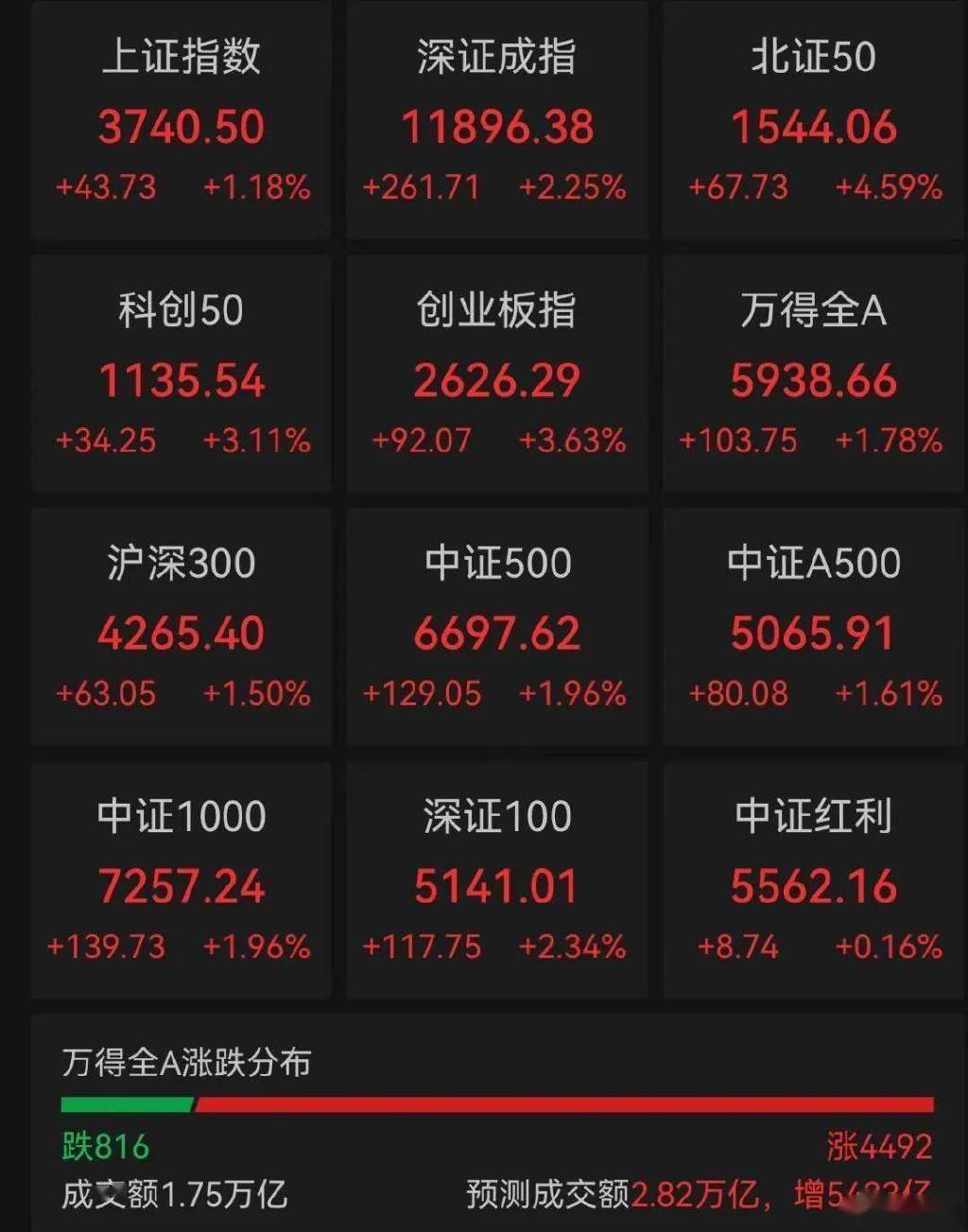
Market Overview - On August 18, the A-share market experienced a significant rally, with the Shanghai Composite Index breaking through the psychological barrier of 3700 points, reaching a nearly ten-year high [1] - The total market capitalization of A-shares surpassed 100 trillion yuan for the first time, marking a new milestone for the market [1] - By midday, the Shanghai Composite Index rose by 1.18%, the Shenzhen Component Index increased by 2.25%, and the ChiNext Index surged by 3.63% [1] Index Performance - Shanghai Composite Index: 3740.50 (+43.73, +1.18%) [2] - Shenzhen Component Index: 11896.38 (+261.71, +2.25%) [2] - ChiNext Index: 2626.29 (+92.07, +3.63%) [2] - Total trading volume reached 1.75 trillion yuan, with nearly 4500 stocks showing gains [1] Market Drivers - The current market rally is primarily driven by "policy support" and "liquidity easing" since September 2024 [3] - Analysts suggest that the market trend remains upward, with expectations for the "14th Five-Year Plan" and a global interest rate cut cycle [3] - The A-share market's circulating market value has increased by over 50% compared to its peak in 2015, indicating a healthy bull market driven by liquidity and improved expectations [3] Sector Insights - Analysts from Shenwan Hongyuan believe that the current environment of moderate monetary policy and support from state-owned enterprises will benefit brokerage firms' businesses [3] - The market is expected to continue its upward trajectory, with small-cap and growth styles gaining an advantage, similar to the market conditions in 2013 [4] - Tianfeng Securities recommends focusing on sectors like AI, consumer goods, and undervalued dividend stocks, while being cautious of potential short-term overheating [6] Future Outlook - The chief economist from China Galaxy Securities outlined three conditions for the Shanghai Composite Index to potentially challenge 4000 points by year-end: further improvement in earnings, optimization of capital structure, and alignment of domestic policies with global economic cycles [4] - Despite the optimistic outlook, some analysts caution about the risk of market corrections due to excessive enthusiasm [4][6] - The demand for high-return assets remains strong amid high growth in household savings and an "asset shortage" backdrop [6]
果然财经|沪指创近十年新高,A股市值首破百万亿,意味着什么
Sou Hu Cai Jing· 2025-08-18 09:37
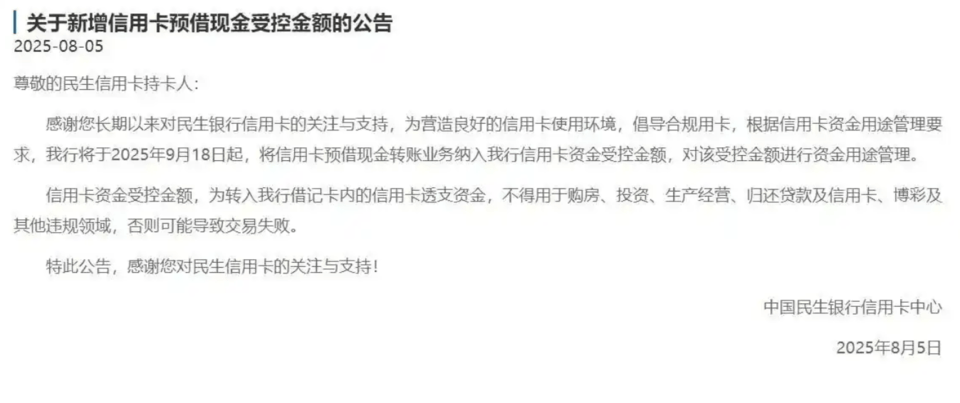
Market Performance - On August 18, the A-share market reached a historic moment with the Shanghai Composite Index rising by 0.85%, hitting a peak of 3741.29 points, surpassing the previous high of 3731.69 points from February 18, 2021, marking the highest level in nearly 10 years since August 2015 [1][2] - The total market capitalization of A-shares exceeded 100 trillion yuan for the first time, attracting significant attention from market participants [1][2] Trading Activity - The trading volume in the Shanghai and Shenzhen markets reached 2.76 trillion yuan, an increase of 519.6 billion yuan compared to the previous trading day, setting a new annual high [2] - The market exhibited a broad-based rally, with the Shenzhen Component Index rising by 1.73% and the ChiNext Index increasing by 2.84%, indicating a strong upward trend across various sectors [2] Sector Highlights - AI hardware-related sectors gained significant attention, with stocks like Feilong Co. and Cambridge Technology hitting the daily limit [2] - The film and television sector also performed well, driven by strong box office results during the summer season, with companies like Jishi Media and Huace Film & TV seeing their stocks hit the daily limit [2] Financial Data Insights - The People's Bank of China reported a record increase in non-bank financial institution deposits, which rose by 2.14 trillion yuan in July, the highest level since records began in 2015, indicating a shift of funds into the capital market [4][5] - In contrast, household deposits decreased by 1.11 trillion yuan, suggesting a "see-saw effect" where funds are moving from savings accounts to investment accounts [4][5] Investment Trends - Analysts suggest that the current market rally is driven by "policy support + liquidity easing," with expectations for continued upward momentum due to upcoming policy plans and a global interest rate cut cycle [3] - However, there is a cautionary note regarding the potential for short-term market corrections as companies prepare to disclose their semi-annual reports [3] Risk Management - In response to the rising market enthusiasm, several banks have issued warnings against the use of credit card funds for stock market investments, emphasizing stricter controls on fund usage [6][8][9] - Analysts have noted that the current influx of funds into the market is primarily from high-net-worth investors, with limited participation from retail investors through public funds [5][10]
A股市值历史首次突破100万亿元大关,上证指数创近10年新高
Sou Hu Cai Jing· 2025-08-18 04:20
Market Performance - A-shares continued to rise significantly on August 18, with the Shanghai Composite Index reaching a nearly 10-year high, up 1.18%, while the Shenzhen Component Index rose by 2.25% and the ChiNext Index increased by 3.63% [2][4] - The total market capitalization of A-shares surpassed 100 trillion yuan for the first time in history, marking a significant milestone [4] - The trading volume in the Shanghai and Shenzhen markets reached 1.72 trillion yuan, an increase of 411.4 billion yuan compared to the previous trading day [2][4] Sector Performance - Strong performance was noted in sectors such as brokerage firms and financial technology, with stocks like Zhinan Zhen and Strong Ray Technology hitting their historical highs [4] - AI hardware stocks, particularly those related to liquid cooling servers, experienced explosive growth, with several stocks reaching their daily limit [4] - The film and television sector also showed active performance, with companies like Huace Film & TV hitting their daily limit [4] Market Sentiment and Outlook - According to Industrial Securities, the current market rally is not primarily driven by improved macroeconomic expectations but rather by policy support and the emergence of new growth drivers, which have boosted market confidence and attracted new capital [6] - Guotai Junan Securities expressed a positive outlook for the Chinese stock market, suggesting that A-share indices may reach new highs, emphasizing the importance of institutional changes in the Chinese market [6]

A股市值突破100万亿元,沪指创近10年新高!专家:向上趋势或延续数月
2 1 Shi Ji Jing Ji Bao Dao· 2025-08-18 03:51
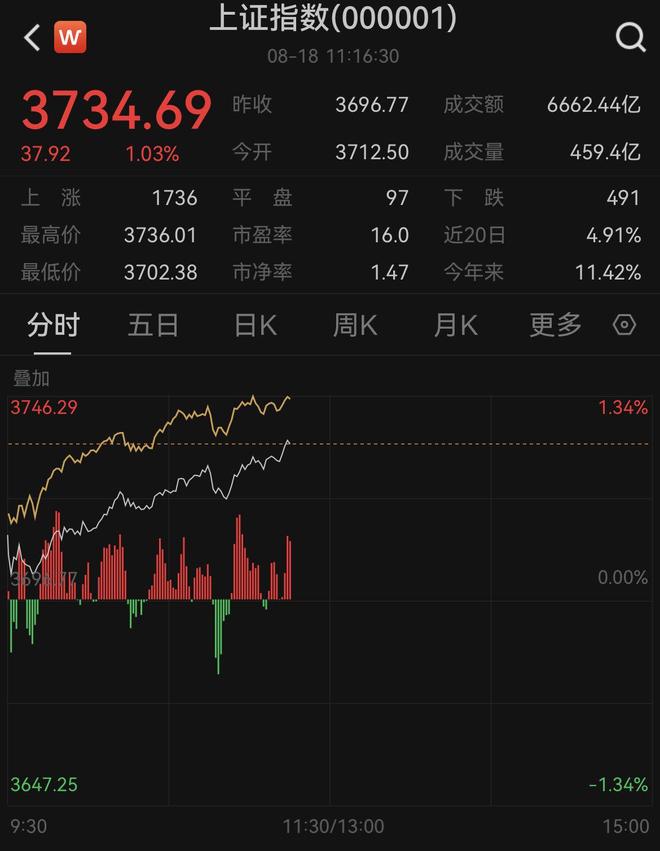
Group 1 - The A-share market continues to show strong performance, with the Shanghai Composite Index breaking through the 3732-point mark, reaching a nearly ten-year high of 3734.69 points, reflecting a 1.03% increase [1] - The total market capitalization of A-share companies has surpassed 100 trillion yuan for the first time in history, marking a significant milestone [1] - The current market rally is driven by China's push for technological innovation, with sectors such as AI, innovative pharmaceuticals, and digital transformation attracting global investors [1] Group 2 - The core driving factors of the current market trend are "policy support and liquidity easing," with expectations for future growth linked to the "15th Five-Year Plan" and a global interest rate cut cycle [2] - The A-share circulating market value has increased by over 50% compared to the peak in 2015, indicating a healthy bull market supported by improved liquidity [2] - Investment strategies suggested include focusing on companies with high earnings certainty, AI-related industries, consumer sector recovery, and undervalued dividend stocks [2]