电动化

Search documents
吉利汽车营收首破3400亿元、销量突破300万辆,全固态电池推出在即
Hua Xia Shi Bao· 2026-03-19 13:17
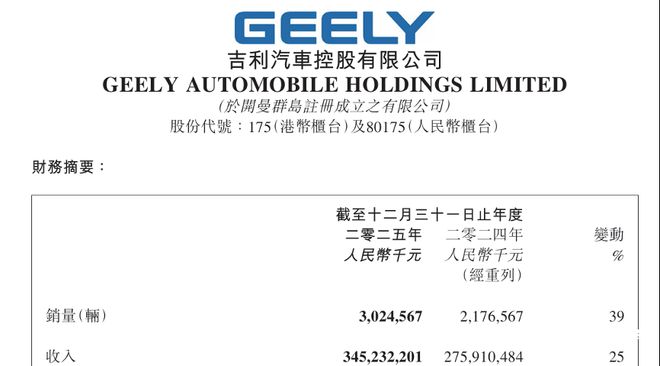
Core Insights - Geely Automobile Holdings Limited reported a record revenue of 345.23 billion yuan for 2025, marking a 25% year-on-year increase, while net profit attributable to shareholders was 16.85 billion yuan, remaining stable year-on-year [3][4] - The company achieved a total sales volume of 3.02 million vehicles, a 39% increase year-on-year, with new energy vehicles (NEVs) accounting for 56% of total sales, reflecting a significant growth of 90% in NEV sales [3][4] Financial Performance - The overall gross profit reached approximately 57.3 billion yuan, a 25% increase compared to the previous year, maintaining stability [5] - Cash reserves at the end of the year stood at 68.2 billion yuan, a 46% increase, providing a solid foundation for future business development [5] Sales and Market Performance - The Galaxy series sold around 1.24 million units, a substantial increase of about 150% year-on-year, contributing significantly to the growth in NEV sales [4] - Geely's export sales reached approximately 420,000 units, a notable increase, with a rising proportion of NEV models, indicating a growing presence in international markets [4][6] Research and Development - R&D expenses for the company reached 17.62 billion yuan, a 28.75% increase, focusing on advanced intelligent driving, automotive-grade chips, and solid-state batteries [7] - The company plans to launch its self-developed solid-state battery at the Beijing Auto Show in April, with expectations for electric vehicle ranges to exceed 1,000 kilometers [7] Strategic Positioning - Geely is adapting to a saturated domestic market by leveraging multi-brand strategies and expanding into overseas markets, entering over 80 countries and regions [6][7] - The company is enhancing its product competitiveness by increasing the self-sufficiency rate of key components, thereby reducing reliance on external supply chains [5][7]



BorgWarner (NYSE:BWA) Conference Transcript
2026-03-18 14:47
Summary of BorgWarner Conference Call - March 18, 2026 Company Overview - **Company**: BorgWarner (NYSE: BWA) - **Industry**: Automotive technology, focusing on clean and efficient technology solutions for combustion, hybrid, and electric vehicles Key Points Market Outlook - Initial guidance for global production is flat to down 3%, with a midpoint of approximately down 1.5% [5][7] - Concerns about consumer demand due to higher vehicle prices and an oil shock, but current demand remains stable [7] Product Mix and Business Strategy - BorgWarner's portfolio includes foundational products, hybrids, and electric vehicles (EVs) [8] - Success is measured by outgrowing industry production in foundational and hybrid markets, with a target of mid-teens growth for e-products [10] - Regionalization is impacting the adoption rates of hybrids and EVs, with China leading in battery electric vehicle (BEV) adoption [12] Performance Metrics - Increased margins by 60 basis points and record free cash flow last year [13] - Year-over-year EPS growth of 14% [13] China Market Insights - China accounts for about 20% of BorgWarner's sales, with 75% of that from local OEMs [16] - Strong relationships with top Chinese OEMs, focusing on speed to market and technology leadership [18][20] - The company has successfully adapted to local market dynamics, achieving faster production timelines compared to Western counterparts [28] Competitive Landscape - BorgWarner is typically ranked 1 or 2 in market share for foundational products, with a path to becoming a top three player in e-products [31][32] - Observations of consolidation in the industry, with larger suppliers winning more business [31] Regulatory Environment - BorgWarner's diverse portfolio allows for adaptability to regulatory changes, focusing on both foundational and e-products as needed [36] - The company has received over 30 awards for its adaptability and success in winning new business [37] Battery Business Challenges - Anticipated revenue decline of about $200 million in the battery business for 2026, impacting growth by 150 basis points [40] - Long-term outlook remains positive due to the ongoing need for energy storage solutions [42] Data Center Market Entry - BorgWarner signed a master supply agreement with TurboCell, targeting $300 million in sales by 2027 [77] - The power generation market is expected to grow in the mid-teens percentage over the next decade [78] Capital Allocation Strategy - Focus on maintaining a healthy balance sheet, with a target of 20% of sales in liquidity [178] - Plans to balance dividends, share repurchases, and potential acquisitions to enhance earnings power [180] Hybrid Vehicle Market - Advanced hybrids present significant opportunities, with content per vehicle estimated at $2,300 compared to $570 for foundational products [165][166] - The company is seeing growth in hybrid applications, particularly in China and Europe [171] Turbocharger Business - Opportunities for growth in turbocharger penetration in North America, with potential for more efficient turbo technologies [119] - Competitive advantages include scale, technology, and customer relationships [129] Additional Insights - The company is exploring power generation, power conversion, and power storage as growth areas outside of automotive [116] - The competitive landscape for new products includes both primary power and backup generation markets, with a focus on flexibility and efficiency [135] This summary encapsulates the key insights and strategic directions discussed during the BorgWarner conference call, highlighting the company's adaptability and growth potential in a changing automotive landscape.

爆亏2.5万亿,都是本田自己作的
36氪· 2026-03-18 13:35
Core Viewpoint - Honda is facing its first annual loss in 69 years, with projected operating losses for the fiscal year 2025 estimated between 270 billion to 570 billion yen (approximately 11.6 billion to 24.7 billion RMB) due to setbacks in its electric vehicle strategy [4][7][10]. Financial Performance - Honda's revised financial forecast for the fiscal year ending March 31, 2026, shows a significant downturn, with expected sales revenue remaining at 2,110 billion yen but operating profit revised to a loss of 570 billion yen, a decrease of 1,120 billion yen from previous estimates [9]. - The operating profit margin is expected to drop from 2.6% to -2.7%, indicating a severe decline in profitability [9]. Reasons for Loss - The primary reason for the substantial losses is Honda's inability to meet the demand for electric vehicles in the U.S., leading to the cancellation of its electric vehicle production and development plans in North America [10][12]. - Honda anticipates a total impairment loss of up to 2.5 trillion yen due to the write-down of tangible and intangible assets related to its electric vehicle investments [12]. Market Performance - Despite the financial struggles, Honda's sales in North America have shown a slight increase of 0.4% year-on-year, maintaining its position as the fourth largest automaker in the U.S. market [18]. - In contrast, Honda's sales in China have significantly declined, with a 24% drop in 2025, marking the fifth consecutive year of sales decline in the region [31]. Strategic Shift - Honda plans to pivot back to hybrid technology as a response to the challenges faced in the electric vehicle market, which is expected to improve its financial situation in the coming years [71][72]. - The company is also facing challenges in adapting to the fast-paced development cycles of competitors in the Chinese market, where it has been criticized for its slower product development timelines [48][59]. Operational Challenges - Honda's operational inefficiencies are highlighted by its lengthy vehicle development cycles, which remain around five years compared to competitors who have reduced theirs to under three years [48][59]. - The company's rigid management structure and decision-making processes have been cited as factors contributing to its inability to respond quickly to market changes [51][57].


福耀玻璃(600660):行稳致远,持续看好公司市占率提升+产品结构升级
Western Securities· 2026-03-18 13:14
Investment Rating - The report maintains a "Buy" rating for Fuyao Glass [5] Core Views - Fuyao Glass achieved a revenue of 45.79 billion yuan in 2025, representing a year-on-year increase of 16.7%, and a net profit attributable to shareholders of 9.31 billion yuan, up 24.2% year-on-year [1][5] - The company’s gross margin and net margin for the year were 37.27% and 20.35%, respectively, showing improvements of 1.04 and 1.23 percentage points year-on-year [2] - The report highlights the acceleration of electrification and intelligence in the automotive industry, leading to an increase in both volume and price for automotive glass products [3] - Fuyao Glass is expected to see revenue growth projections of 52.5 billion yuan in 2026, 60 billion yuan in 2027, and 67.34 billion yuan in 2028, with corresponding net profits of 10.65 billion yuan, 12.28 billion yuan, and 14.08 billion yuan [4][3] Financial Performance Summary - In Q4 2025, Fuyao Glass reported a revenue of 12.5 billion yuan, with a quarter-on-quarter increase of 14.2% and a year-on-year increase of 5.3% [1] - The company’s automotive glass revenue accounted for 93% of total revenue in 2025, indicating a high level of business focus [3] - The average price of automotive glass increased from 164 yuan per square meter in 2018 to 240 yuan per square meter in 2025, reflecting a compound annual growth rate (CAGR) of 5.6% [3] Future Projections - The report forecasts a steady increase in revenue and net profit for Fuyao Glass over the next three years, with expected growth rates of 15%, 14%, and 12% for revenue from 2026 to 2028 [3][4] - The earnings per share (EPS) is projected to rise from 3.57 yuan in 2025 to 5.40 yuan in 2028 [4]

吉利汽车去年营收创新高,净利润增长36%,销量增幅约四成
Nan Fang Du Shi Bao· 2026-03-18 11:08
Financial Performance - In 2025, Geely Automobile reported a record revenue of 345.2 billion yuan, representing a 25% year-on-year increase, while core net profit grew by 36% to 14.41 billion yuan after excluding non-core items [1] - The company plans to increase its dividend by 51.5% to 0.5 HKD per share, totaling 5.39 billion HKD in dividends [1] Sales and Market Strategy - Geely's total sales reached 3.025 million units in 2025, a 39% increase, exceeding the revised annual target of 3 million units [3] - The fuel vehicle segment grew by 3%, while the new energy vehicle sales surged by 90% to over 1.68 million units [3] - The company integrated its brands into three main segments: Zeekr, Lynk & Co, and Geely Galaxy, with Zeekr selling 224,000 units and Lynk & Co selling 350,000 units in 2025 [3] Technological Advancements - Geely launched its "Smart Geely 2025" strategy, marking a significant year for its technological advancements in smart and electric vehicles [3] - The company introduced the industry's first comprehensive AI technology system and plans to release a 2.0 version at CES 2026, featuring a self-reflective WAM world behavior model [3] Autonomous Driving and AI - Geely's G-ASD system has begun L4 RoboTaxi 2.0 operations in Hangzhou and received EU certification, becoming the first high-level autonomous driving system from China to go abroad [4] - The Flyme Auto smart cockpit system has reached 2.26 million units, making it the fastest-growing and most widely adopted smart cockpit system in the industry [4] Green Energy Initiatives - Geely's fifth-generation methanol electric technology has achieved a cost of 0.2 yuan per kilometer and has overcome cold start challenges at -40°C [4] - The new generation of methanol energy vehicles is set to be mass-produced in 2026, with plans to establish over 500 methanol refueling stations across several provinces [4] Global Expansion - Geely aims for a sales target of 3.45 million units in 2026, focusing on product premiumization and optimizing its global marketing structure [5] - In 2025, Geely entered 13 new markets, including major European markets and high-potential regions like Brazil and South Africa, with a significant increase in export sales [7]
招聘 | 国联民生汽车 诚邀加入!【新财富团队 分析师/实习生招聘】
汽车琰究· 2026-03-18 06:20
Core Viewpoint - The article emphasizes the importance of deep research and understanding of the automotive industry, particularly in the context of the ongoing transformation driven by electrification, intelligence, globalization, and premiumization, referred to as the "four transformations" of the automotive sector [9]. Group 1: Research Focus - The company is dedicated to supporting the automotive industry and capital markets through in-depth research on industry trends, business models, and the essence of the automotive sector [9]. - The research team has accumulated significant achievements and maintains deep communication with industry experts and leaders, earning multiple accolades in the field of analysis [9]. Group 2: Recruitment Information - The company is seeking analysts with a passion for automotive research, particularly in the areas of smart and embodied intelligence, to join their team [11]. - Candidates should possess strong analytical skills, independent thinking, and the ability to produce in-depth reports, with a preference for those with backgrounds in electric intelligence or related fields [11]. - Internships are also available for students graduating in 2026, with a focus on smart automotive and embodied intelligence, requiring strong communication skills and the ability to handle high-intensity research work [12].

爆亏2.5万亿,都是本田自己作的
创业邦· 2026-03-17 10:13
Core Viewpoint - Honda is expected to report its first annual loss in 69 years, with projected operating losses for the fiscal year 2025 ranging from 270 billion to 570 billion yen (approximately 11.6 billion to 24.7 billion RMB) due to setbacks in its electric vehicle strategy [5][6][11]. Financial Performance - Honda's revised financial forecast shows a significant turnaround from an expected profit of 550 billion yen to a projected loss of 570 billion yen [6][7]. - For the nine months ending December 31, 2025, Honda's sales revenue decreased by 2.2% to 15,975.6 billion yen, while operating profit plummeted by 48.1% to 591.5 billion yen [15]. Electric Vehicle Strategy - The company has abandoned its electric vehicle production and development plans in North America due to a significant decline in demand, which has led to substantial impairment losses on previously invested assets [8][10]. - Honda's electric vehicle strategy is expected to result in cumulative losses of up to 2.5 trillion yen over the next two years [11]. Market Performance - In North America, Honda's sales increased by 0.4% year-on-year, maintaining its position as the fourth largest automaker despite various challenges [18][19]. - Conversely, in China, Honda's sales dropped by 24% year-on-year, marking the fifth consecutive year of decline [28][32]. Product Development Challenges - Honda's slow response to market demands and lengthy product development cycles (approximately five years) have hindered its competitiveness, especially in the rapidly evolving electric vehicle market [44][50]. - The company's recent product launches, such as the plug-in hybrid version of the Accord, have faced criticism due to design flaws that have negatively impacted sales [34][38]. Future Outlook - Honda plans to shift its focus back to hybrid technology, which is expected to improve its financial situation [60]. - However, the company faces uncertainty regarding future model releases, especially after scrapping numerous new electric vehicle models [62].

机械设备行业快评报告:内销受春节扰动有所承压,出口延续高景气
Wanlian Securities· 2026-03-17 09:52
Investment Rating - The industry investment rating is "Outperform the Market," indicating a projected increase of over 10% relative to the market index in the next six months [12]. Core Insights - In February, domestic sales of excavators in China faced pressure, while exports continued to show high growth. The total sales of excavators reached 17,226 units, a year-on-year decrease of 10.6%, with domestic sales down 42% to 6,755 units, and exports up 37.2% to 10,471 units [3][5]. - For loaders, February sales were 9,540 units, a year-on-year increase of 9.28%, with domestic sales down 14.3% to 3,863 units, and exports up 34.4% to 5,677 units [4][5]. - The decline in domestic sales is attributed to the impact of the Spring Festival and a high base from the previous year, rather than a weakening demand trend. The industry is transitioning to a phase driven by the replacement of existing equipment [5]. - The export market is showing strong performance, with excavator and loader exports growing significantly, indicating that external demand is playing a crucial role in supporting the industry during the off-peak season [5]. - The report suggests that the domestic market is expected to recover due to policies promoting equipment upgrades and local government debt management, while the competitiveness of domestic manufacturers in overseas markets is improving [5]. Summary by Sections Excavator Sales - February sales of excavators totaled 17,226 units, down 10.6% year-on-year, with domestic sales at 6,755 units (down 42%) and exports at 10,471 units (up 37.2%) [3]. - Cumulative sales for January-February reached 35,934 units, a year-on-year increase of 13.1% [3]. Loader Sales - February sales of loaders were 9,540 units, up 9.28% year-on-year, with domestic sales at 3,863 units (down 14.3%) and exports at 5,677 units (up 34.4%) [4]. - Cumulative sales for January-February reached 21,299 units, a year-on-year increase of 27.9% [4]. Market Dynamics - The report highlights that the domestic market is entering a phase driven by the replacement of existing equipment, supported by policies for equipment upgrades [5]. - The strong performance in exports indicates a growing penetration and competitiveness of Chinese brands in the global market [5].
山推股份(000680):公司简评报告:整机销量表现强劲,品牌全球影响力提升
Donghai Securities· 2026-03-16 12:52
Investment Rating - The investment rating for the company is "Buy" (maintained) [1] Core Insights - The company has shown strong performance in machinery sales, with a significant increase in global brand influence [1] - In 2025, the company achieved total revenue of 14,620.17 million yuan, a year-on-year increase of 2.82%, with overseas revenue reaching 8,741 million yuan, up 17.94% [5] - The company aims for a revenue target of 16,100 million yuan in 2026, with overseas revenue projected at 10,500 million yuan [5] - The company has maintained a strong market position, ranking among the top 50 global construction machinery manufacturers [5] Financial Performance Summary - **Revenue Forecasts**: - 2025A: 14,620.17 million yuan - 2026E: 16,227.19 million yuan (10.99% growth) - 2027E: 17,915.22 million yuan (10.40% growth) - 2028E: 19,734.10 million yuan (10.15% growth) [2] - **Net Profit Forecasts**: - 2025A: 1,210.98 million yuan - 2026E: 1,497.56 million yuan (23.67% growth) - 2027E: 1,833.13 million yuan (22.41% growth) - 2028E: 2,202.38 million yuan (20.14% growth) [2] - **Earnings Per Share (EPS)**: - 2025A: 0.81 yuan - 2026E: 1.00 yuan - 2027E: 1.22 yuan - 2028E: 1.47 yuan [2] - **Price-to-Earnings (P/E) Ratios**: - 2025A: 14.22 - 2026E: 11.50 - 2027E: 9.39 - 2028E: 7.82 [2] Market Position and Strategy - The company has a robust product lineup, including over 930 models across six major series, which enhances its competitive advantage [5] - The company is actively expanding its global presence, with 13 overseas subsidiaries and increasing participation in international exhibitions [5] - The overseas revenue accounted for 59.79% of total revenue in 2025, with a gross margin of 28.15% [5]

【月度排名】2026年2月皮卡厂商批发销量排名快报
乘联分会· 2026-03-16 08:41
Group 1: Overall Market Performance - The pickup truck market experienced a slowdown in sales due to the Spring Festival, with February 2026 sales at 41,000 units, a year-on-year decrease of 13.2%. However, sales for January-February 2026 reached 91,000 units, marking a 5.3% increase compared to the same period last year, which is the highest level in the past five years [2]. - In February 2026, pickup truck production was 42,000 units, down 3.1% year-on-year, while production for January-February 2026 totaled 94,000 units, reflecting a 13.7% increase [2]. - Great Wall Motors continues to lead the pickup truck market, with stable performance both domestically and internationally, supported by strong export growth [2]. Group 2: Export Performance - In February 2026, national pickup truck exports reached 23,000 units, a year-on-year increase of 15% but a month-on-month decrease of 14%. For January-February 2026, exports totaled 50,000 units, up 30% year-on-year, maintaining a high export ratio [2]. - The export share of pickup trucks is projected to reach 45% in 2024, 50% in 2025, and 56% in February 2026, indicating a strong growth trajectory for Chinese pickup brands in the export market [2]. Group 3: New Energy Pickup Trucks - In February 2026, new energy pickup truck sales were 5,000 units, down 6% year-on-year and 9% month-on-month. However, sales for January-February 2026 reached 11,000 units, reflecting a 5% year-on-year increase [3]. - The market for new energy pickup trucks is gradually improving, with notable sales from brands such as Zhengzhou Nissan (1,535 units), BYD (1,445 units), and Geely Radar (1,363 units) [3]. Group 4: Manufacturer Sales Rankings - In February 2026, the top pickup truck manufacturers by sales were: Great Wall Motors (12,011 units, down 30.4% year-on-year), SAIC Maxus (4,535 units, down 12.1%), and Zhengzhou Nissan (4,525 units, up 60.6%) [5]. - For January-February 2026, the sales rankings were led by Great Wall Motors (27,361 units, down 7.5%), followed by SAIC Maxus (10,459 units, up 6.0%), and Zhengzhou Nissan (8,578 units, up 92.0%) [6].