资本外流

Search documents
东南亚“火药桶”被点燃?印尼股债双杀,资本逃离泰国
Jin Shi Shu Ju· 2025-09-01 07:01
Group 1: Market Reaction - Indonesia's stock and bond markets are experiencing significant sell-offs due to increasing concerns over political stability, with the benchmark index dropping 3.6%, marking the largest decline in nearly five months [1] - The 10-year government bond yield rose by 7 basis points to 6.4%, the highest level in three weeks, indicating pressure in the bond market [1] - The recent protests, triggered by rising living costs and inequality, have led to a reversal in investor sentiment, impacting foreign capital inflows [1][2] Group 2: Sector Impact - Financial stocks, particularly PT Bank Rakyat Indonesia, PT Bank Central Asia, and PT Bank Mandiri Persero, were the largest contributors to the index decline, each dropping over 4% [2] - Any capital outflow is expected to first impact the financial sector due to its significant index weight and potential liquidity pressures [2] Group 3: Political Context - Protests were fueled by anger over high housing allowances for lawmakers, tax increases, mass layoffs, and inflation, disproportionately affecting low-income Indonesians [2] - The political risk in Indonesia is expected to rise, leading to an increase in equity risk premiums, as noted by investment analysts [1][2] Group 4: Long-term Outlook - Despite current turmoil, analysts believe that the long-term outlook for Indonesia and Thailand remains unchanged due to potential monetary policy easing and attractive valuations in their stock markets [5] - The establishment of the sovereign wealth fund "Danantara," which manages $1 trillion in assets, is a significant development, although concerns remain regarding its impact on the economic situation of low-income populations [5]
特朗普关税影响,印度卢比汇率创新低,沦为年内亚洲表现最差货币
Hua Er Jie Jian Wen· 2025-08-29 09:16
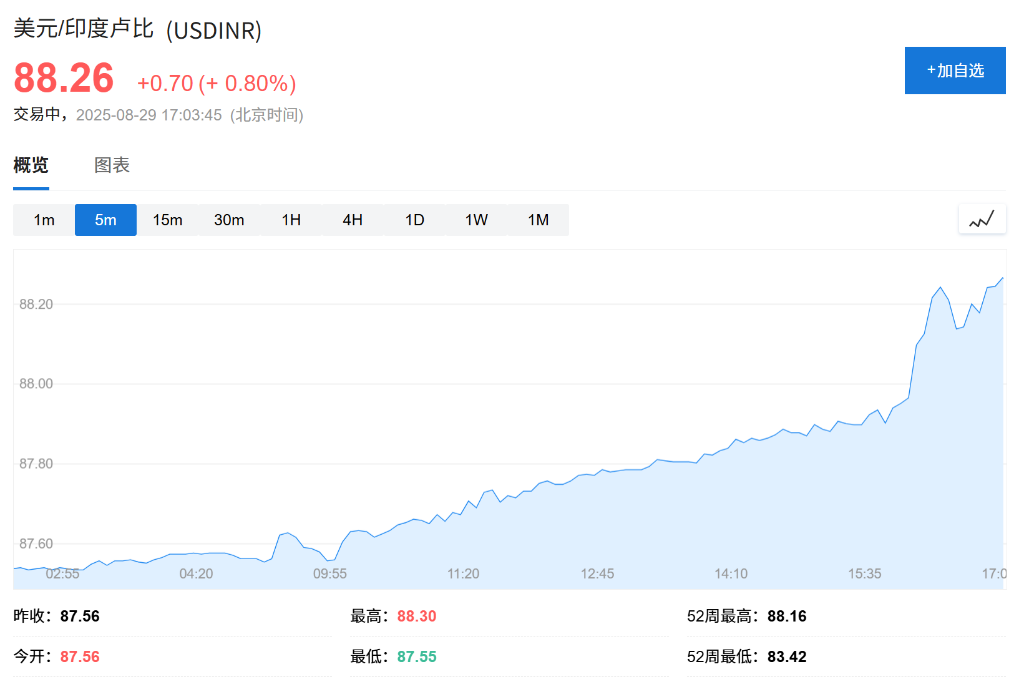
Core Viewpoint - The Indian Rupee has depreciated to a historic low against the US dollar due to concerns over a 50% tariff imposed by the US, which is expected to harm India's economic growth and corporate earnings [1][4]. Currency Performance - The Indian Rupee fell by 0.8% to 88.26 against the US dollar, surpassing the previous record low of 87.9563 set in February [1]. - The depreciation of the Rupee has made it the worst-performing currency in Asia this year, primarily due to ongoing capital outflows [1][4]. Economic Impact - The new US tariffs are projected to reduce India's annual economic growth rate by 0.6 to 0.8 percentage points, with potential GDP impacts of up to 1% if the tariffs remain in place [5]. - Global funds have withdrawn over $13 billion from the Indian stock market this year due to weak corporate earnings [4][5]. Market Performance - The MSCI India Index has underperformed the MSCI Emerging Markets Index for four consecutive months, lagging by over 15 percentage points this year, indicating a trend towards one of the worst annual performances in over two decades [4][5]. Monetary Policy - The Reserve Bank of India (RBI) has cut interest rates three times this year to stimulate the economy, which has weakened the attractiveness of Rupee-denominated assets [5]. - The depreciation of the Rupee has raised concerns about imported inflation, adding further pressure to the economy [5]. Future Outlook - Analysts believe that as long as the US tariff measures are in place, the Rupee will continue to face downward pressure [5]. - The RBI may intervene in the market to stabilize the currency, as indicated by the RBI Governor's comments on maintaining active measures [6].

中国外汇投资研究院:高通胀下英国央行降息冲动与观望压力并存
Xin Hua Cai Jing· 2025-08-13 14:05
Group 1 - The Bank of England lowered the benchmark interest rate from 4.25% to 4%, marking the lowest level in over two years, amidst a divided vote within the Monetary Policy Committee [1][2] - The split decision reflects fundamental differences in economic outlook, highlighting a struggle between prioritizing inflation control and economic growth [2][3] - The current economic indicators show a slowdown in GDP growth, rising unemployment, and weak retail sales, indicating pressure on households, while some sectors like high-end manufacturing and green energy remain resilient [3][4] Group 2 - The decision to lower interest rates comes with risks, as maintaining high rates could exacerbate economic decline and increase unemployment, while premature easing could lead to currency depreciation and imported inflation [2][3] - The divergence in global monetary policy, with the Federal Reserve maintaining a restrictive stance and the European Central Bank signaling slight easing, places the Bank of England in a challenging position regarding capital flows and currency valuation [3][4] - Future policy decisions are expected to be data-dependent and characterized by short-cycle adjustments rather than a straightforward move towards easing, leading to prolonged uncertainty in the market [4]
特朗普要求降关税,日本却主动答应,石破茂为何如此妥协
Sou Hu Cai Jing· 2025-07-26 18:19
Group 1 - The core viewpoint of the article is that Trump's recent trade agreements with Japan and the Philippines signify a shift in regional power dynamics, particularly affecting the political futures of Japanese Prime Minister Kishida and Philippine President Marcos [1][15]. - Japan's automotive industry is significantly impacted by the U.S. reducing tariffs from 25% to 15%, which, while seemingly beneficial, actually diminishes Japan's competitive edge in the long term [3][5]. - Japan is required to invest $550 billion in the U.S. as part of the trade agreement, which could exacerbate its existing economic challenges and lead to capital outflow [6][8]. Group 2 - The trade agreement mandates Japan to open its markets for rice, automobiles, and energy, putting pressure on domestic industries and potentially harming local farmers due to increased competition from U.S. imports [8][10]. - The political landscape in Japan is unstable, with Kishida facing immense pressure following a historic loss in the recent Senate elections, leading to calls for his resignation [12][14]. - The Philippines' trade agreement with the U.S. includes a zero-tariff policy for U.S. goods entering the Philippines, while Philippine goods face a 19% tariff in the U.S., creating an imbalanced trade relationship [17][19]. Group 3 - President Marcos's attempts to seek U.S. support against China have not yielded the desired results, as the U.S. prioritizes its trade relations with China over supporting the Philippines [19][21]. - Marcos's political position is precarious due to rising tensions with the Duterte family and declining public support following electoral setbacks, complicating his ability to govern effectively [23][25].
机构:美日贸易协议对日本股市“喜忧参半”
news flash· 2025-07-23 01:51
Core Viewpoint - The trade agreement between the US and Japan presents mixed implications for the Japanese stock market, with potential benefits for the automotive sector but long-term risks related to capital outflow and currency depreciation [1] Group 1: Impact on Automotive Sector - The automotive sector has already absorbed expectations of a 25% tariff since April, indicating that the market is somewhat prepared for tariff changes [1] - A reduction in tariffs could improve profit expectations and significantly boost stock prices in this sector [1] Group 2: Long-term Economic Concerns - The $550 billion investment commitment may lead to capital outflow, which could weaken the yen and increase government bond yields [1] - Rising fiscal risks are expected to put pressure on the stock market in the long run [1]
巴西前总统博索纳罗:本国金融市场对可能出现的资本外流感到恐慌。
news flash· 2025-07-18 16:10
Group 1 - The core viewpoint of the article highlights that Brazil's financial market is experiencing panic over the potential for capital outflows due to concerns surrounding former President Bolsonaro's influence [1] Group 2 - The article indicates that the financial market's reaction is driven by fears of instability and uncertainty in the political landscape following Bolsonaro's presidency [1] - It suggests that investors are closely monitoring the situation for any signs of increased capital flight, which could have significant implications for the Brazilian economy [1]
机构:债券市场出现轻微\"消化不良\"迹象
news flash· 2025-07-10 06:11
Core Viewpoint - The bond market is showing signs of mild "indigestion," characterized by a steepening yield curve and cheaper government bonds, although it remains stable overall [1] Group 1: Market Conditions - The bond market has begun to exhibit mild "indigestion" signs, indicated by a steepening yield curve [1] - Government bonds have become cheaper, reflecting changes in market dynamics [1] - Despite these changes, the market continues to operate smoothly [1] Group 2: Risk Factors - A potential risk identified is the reduction in savings, leading to increased competition for funds [1] - There is a concern that rising inflation and interest rates could trigger capital outflows, resulting in higher real yields [1] - Such developments could exert pressure on the economy and financial system [1] Group 3: Government Debt Management - National debt management agencies can respond to market conditions by "manipulating" government bond issuance, such as canceling auctions and substituting short-term bonds for long-term ones [1]
盛宝银行:高度依赖石油进口的国家将面临多重阻力
news flash· 2025-06-23 06:40
Core Viewpoint - Countries highly dependent on oil imports, such as India, Thailand, the Philippines, and most European nations, are facing multiple challenges due to rising energy costs, currency depreciation, and capital outflows [1] Economic Impact - Concerns regarding economic growth in these countries may become more pronounced if energy prices remain high [1] - The United States, as a net energy exporter, is relatively less affected by rising oil prices, but it cannot escape broader market fluctuations [1]
摩根士丹利:资本从美国外流,拉美地区股票有望获得660亿美元资金流入,在其当前市值占比大约6%。
news flash· 2025-06-17 15:56
Core Insights - Capital is flowing out of the United States, with Latin American stocks expected to receive an influx of $66 billion, representing approximately 6% of their current market capitalization [1] Group 1 - The outflow of capital from the U.S. indicates a shift in investor sentiment towards emerging markets [1] - Latin America is positioned to attract significant investment, highlighting its potential for growth [1] - The projected $66 billion inflow could enhance the liquidity and valuation of Latin American stocks [1]
特朗普敛财新招:美国准备对美债投资者下手,最高收50%利息税
Sou Hu Cai Jing· 2025-06-05 05:31
Core Viewpoint - The tax reform proposal pushed by the Trump administration, referred to as the "beautiful bill," is facing intense debate in Congress and is seen as a significant shift in the U.S. tax system, with potential global investment implications [1][4]. Group 1: Tax Reform Proposal - The proposal includes a controversial provision, Section 899, which grants the U.S. government unprecedented taxing authority over investments from countries deemed to have "unfair tax practices" [3][4]. - This provision could lead to punitive tax increases on any investment returns from foreign investors, including institutional and individual investors, as well as central banks [3][4]. Group 2: Impact on International Investors - The "long-arm jurisdiction" of the proposed tax regime could significantly affect international financial markets, as it targets investment returns from countries with specific tax classifications [4][10]. - For instance, if Japan holds $1.13 trillion in U.S. Treasury bonds with an average interest rate of 3%, the implementation of Section 899 could result in a tax liability of $151.5 million, effectively halving the returns on these investments [6][10]. Group 3: Fiscal Context - The U.S. government is facing a record fiscal deficit of $1.83 trillion for the 2024 fiscal year, prompting the need for increased revenue through measures like tariffs and the proposed tax reform [8][10]. - The Joint Committee on Taxation estimates that Section 899 could generate $116 billion in tax revenue over the next decade, highlighting the financial motivations behind the proposal [8][10]. Group 4: Broader Implications - The proposed tax changes reflect deeper fiscal anxieties within the U.S., as foreign investors are perceived to benefit from the dollar's dominance without contributing proportionately to U.S. fiscal responsibilities [10][12]. - The potential for a significant restructuring of the international financial system is evident, as investors globally will need to reassess the risk premiums associated with U.S. investments due to the uncertainty surrounding tax liabilities [12].