通胀对冲

Search documents
无视短期波动?大摩看多金价:今年将冲刺4800美元,避险与降息仍是主线
Hua Er Jie Jian Wen· 2026-01-07 08:29
在美联储货币政策转向宽松、全球地缘政治风险加剧以及央行持续购金的多重驱动下,摩根士丹利大幅上调金价预期,预计这一传统避险资产将 在2026年继续刷新历史高点,直至冲刺每盎司4800美元大关。 摩根士丹利在1月5日发布的研究报告中指出,黄金价格正受到宏观经济和政策转变的强力支撑。这些因素包括美联储预期的宽松周期、美联储领 导层的变动,以及各国央行和投资基金持续买入。此前,现货黄金已在2025年创下历史性涨幅,年终收涨64%,创下自1979年以来的最强年度表 现。 但在1月7日,贵金属市场遭遇重挫,现货黄金一度失守4450美元/盎司关口。据华尔街见闻,彭博商品指数(BCOM)即将于1月8日至14日启动年 度权重再平衡,市场正面临被动基金"技术性抛售"带来的流动性冲击压力,黄金面临短期看跌反转风险。 长期方面,地缘政治的不确定性进一步点燃了市场对避险资产的需求。据央视新闻报道,当地时间1月3日中午(北京时间1月4日凌晨),美国总 统特朗普、国防部长赫格塞思在佛罗里达州海湖庄园就美军对委内瑞拉动武、将委内瑞拉总统马杜罗控制并移送出境举行记者会。 随着委内瑞拉局势升级,包括美国军事力量介入及该国领导人被捕的消息传出,不 ...

现货黄金一年50次刷新历史纪录 国际金价为何一路狂飙
Zhong Guo Xin Wen Wang· 2026-01-07 01:12
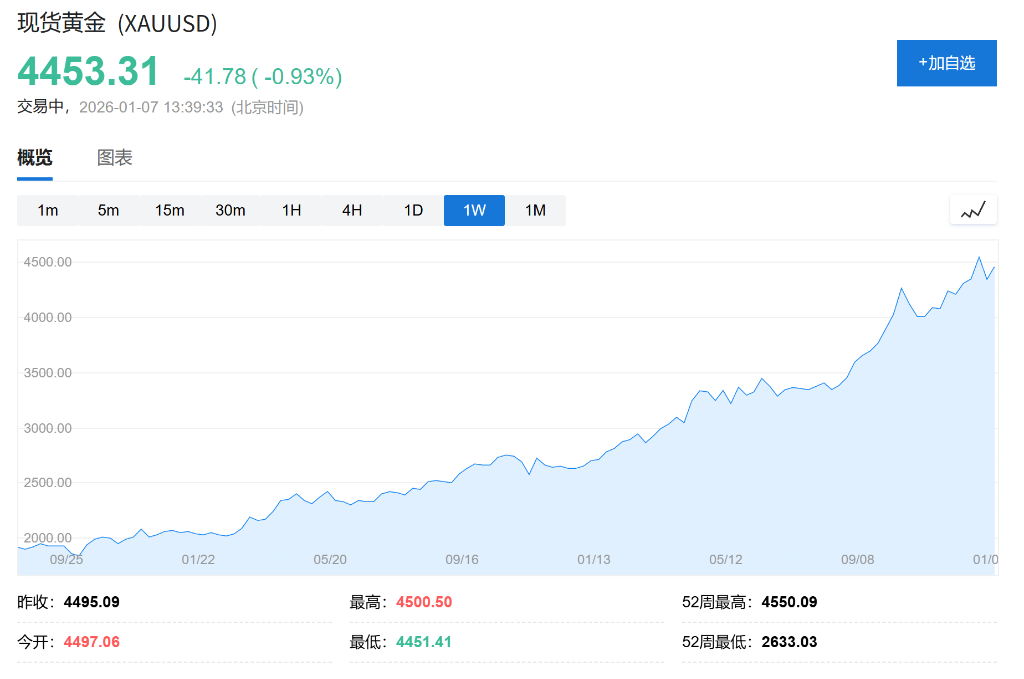
Core Viewpoint - The international gold price has surged significantly in 2025, driven by geopolitical tensions, supply-demand imbalances, and increased demand for safe-haven assets, with prices reaching historical highs by the end of the year [1][2]. Group 1: Price Movement and Historical Context - In 2025, the international gold price rose from $2,600 per ounce at the beginning of the year to $4,500 per ounce by year-end, marking a cumulative increase of over 70% [2][3]. - The gold price performance in 2025 is described as "epic," with 50 instances of new historical records set throughout the year, representing the strongest annual performance since 1979 [2][3]. - The first bull market for gold began when former U.S. President Nixon abandoned the gold standard, leading to a significant increase in gold prices from $35 per ounce in 1971 to a peak of $835 per ounce in 1980 [2][4]. Group 2: Factors Driving Gold Price Surge - The gold price increase in 2025 can be attributed to multiple factors, including geopolitical instability, inflation hedging, and the ongoing "de-dollarization" trend [3][7]. - The first quarter of 2025 saw a surge in gold prices due to tariff fears, with prices rising from $2,900 to $3,500 per ounce [3]. - The geopolitical landscape, including issues in Venezuela, Iran, and the ongoing Russia-Ukraine conflict, has heightened demand for gold as a safe-haven asset [6][7]. Group 3: Central Bank Actions and Market Dynamics - Central banks, particularly in emerging markets like China, India, and Russia, have been increasing their gold reserves, reflecting a shift towards diversifying away from the U.S. dollar [5][7]. - The share of gold in global foreign exchange reserves rose to 20% in 2024, surpassing the euro's 16% share, indicating a growing preference for gold among central banks [5]. - The total amount of gold held by central banks is nearing historical highs, with reserves approaching 3.6 million tons in 2024 [5]. Group 4: Future Outlook - Analysts predict that gold prices may continue to rise, with estimates suggesting prices could reach $5,000 per ounce by 2026 due to ongoing geopolitical tensions and central bank demand [8][10]. - The weakening of the U.S. dollar's dominance is expected to be a slow and complex process, with gold maintaining its status as a key asset amid concerns over the dollar's reliability [9][10]. - The anticipated continuation of low interest rates by the Federal Reserve in 2026 is likely to further support gold prices, as it reduces the opportunity cost of holding gold [10].
国际金价为何一路狂飙?
Ren Min Ri Bao Hai Wai Ban· 2026-01-07 00:14
受地缘政治紧张局势加剧、市场供需紧张及避险需求推动,国际市场黄金期货和现货价格2025年底均创 历史新高。2025年,国际金价累计涨幅超过70%。金价狂飙的背后,以美元为中心的国际货币体系正在 动摇,美元信用正在削弱,此外还有AI产业推进带来的需求。本报邀请中国现代国际关系研究院研究 员陈凤英和中国国际经济交流中心学术委员会副主任陈文玲进行解读。 让人想起"尼克松冲击" 2025年这一轮国际金价上涨可以说走出了"史诗级行情",从年初的2600美元/盎司到年底的4500美元/盎 司,现货黄金全年50次刷新历史纪录 【观察】 在多重因素推动下,国际金价在2025年屡创新高,尤其年底更是频频刷新纪录,全年累计涨幅约七成, 创下自1979年以来最强的年度表现。 国际黄金的首轮牛市始于美国前总统尼克松放弃金本位制并瓦解布雷顿森林货币体系之时。随着尼克松 政府着手扩大美国联邦赤字,通胀率飙升,再叠加两次石油价格冲击的影响,黄金价格从1971年8月的 每盎司35美元一路冲高,于1980年1月触及每盎司835美元的峰值。 "乱世黄金"再次得到验证 "乱世"不一定是战争,也可以是无序。世界正处于百年未有之大变局,也是大乱局,变 ...
张尧浠:黄金本周仍有调整风险、但后市前景待看新高不变
Sou Hu Cai Jing· 2026-01-05 00:57
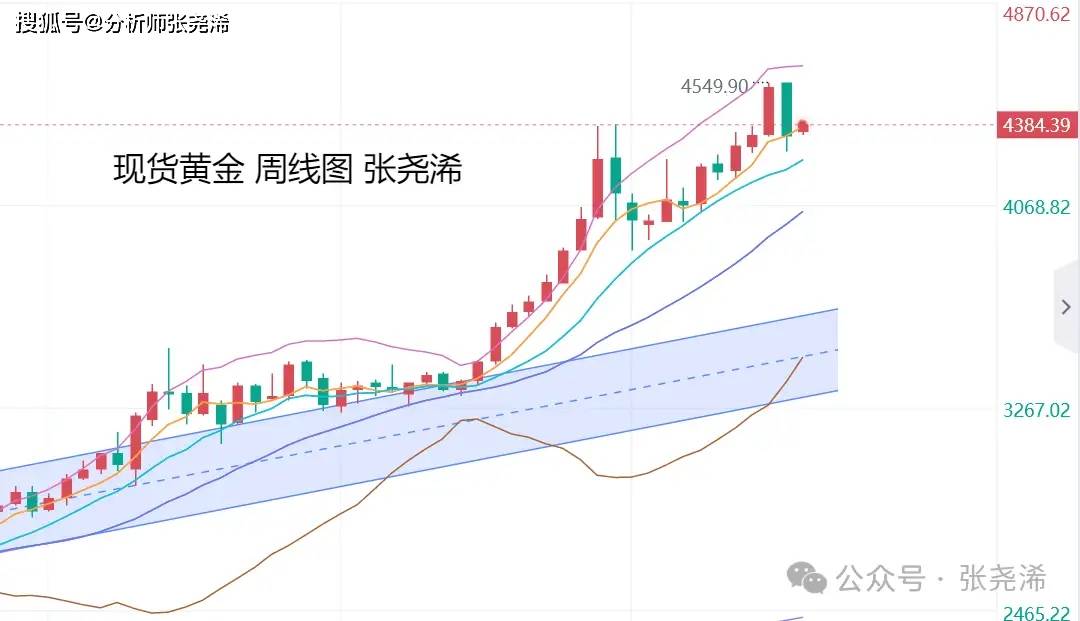
Core Viewpoint - The international gold market experienced a significant decline last week, recovering the previous week's losses and forming a bearish engulfing pattern, indicating potential further downward adjustments. However, the overall upward trend and bullish outlook remain intact, suggesting that any further declines could present buying opportunities [1][3]. Price Movements - Gold prices opened slightly higher at $4,537.12 per ounce, reached a weekly high of $4,548.58, and then fell sharply, recording a daily drop of over $200. The weekly low was $4,274.54, with a final closing price of $4,328.35, reflecting a weekly decline of $203.91 or 4.5% compared to the previous week's close of $4,532.26 [3]. - The market's volatility was influenced by profit-taking after previous surges in precious metals, increased margin requirements for futures contracts, and a drop in initial jobless claims in the U.S. [3][4]. Geopolitical Influences - Recent geopolitical tensions, including U.S. military actions in Venezuela and airstrikes in Yemen, have driven demand for gold as a safe haven. However, these factors are typically short-term boosts, and the overall market adjustment pattern remains to be seen [4][6]. Economic Indicators - The upcoming U.S. non-farm payroll report is highly anticipated, as it will be the first normal monthly data since the end of the government shutdown. Any signs of a slowing job market could accelerate rate cut expectations, which may negatively impact gold prices [6]. - Other economic indicators, such as ISM manufacturing and non-manufacturing PMI, will also be assessed to gauge the health of the U.S. economy and the timing of potential Fed rate cuts [6]. Long-term Outlook - Despite a significant initial increase in gold prices, the overall bullish outlook remains unchanged, supported by factors such as expected Fed rate cuts, geopolitical tensions, and strong central bank demand for gold [6][8]. - Projections for 2026 suggest continued benefits from Fed rate cut expectations, ongoing geopolitical tensions, and strong demand for gold from central banks and ETFs, indicating further bullish market potential [8]. Technical Analysis - On a monthly chart, gold prices have shown a significant pullback, indicating potential for a larger correction towards the $4,000-$3,900 range. However, a strong performance in January could signal a bullish trend towards $5,500-$6,000 [8]. - Weekly and daily charts indicate that while there may be short-term downward pressure, the overall trend remains upward, with key support levels identified at $4,325 and $4,280 [10].
有人一年赚近70万元!2025年贵金属“史诗级爆发”,今年还能上车吗
Huan Qiu Wang· 2026-01-04 06:30
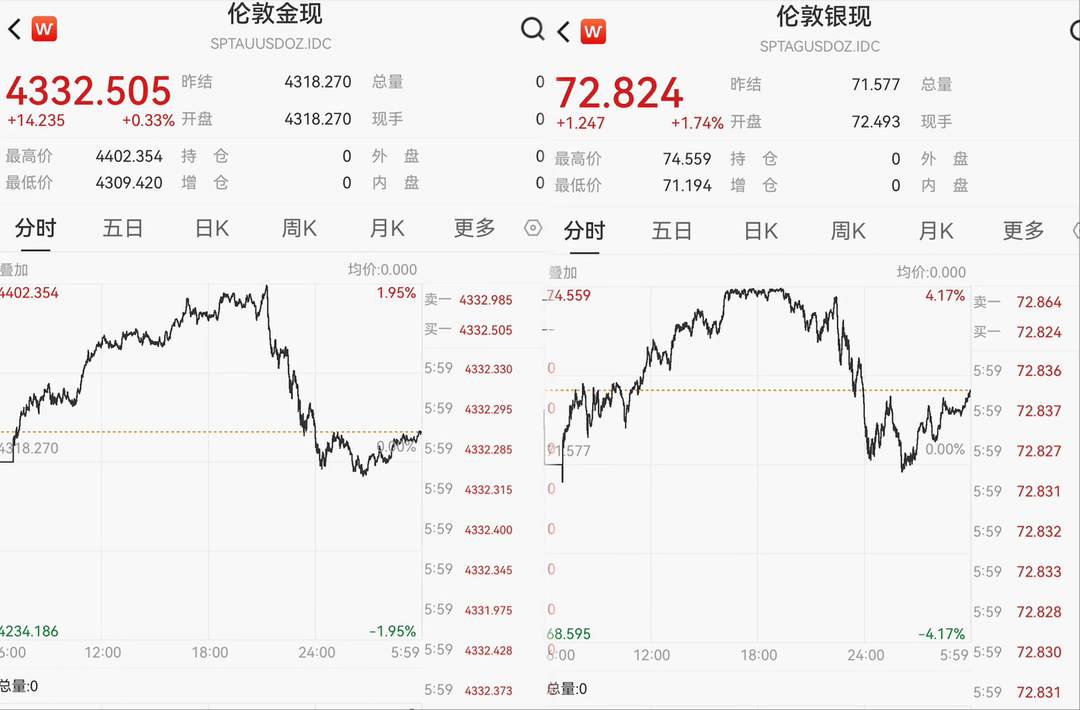
Core Viewpoint - The article highlights the significant rise in precious metal prices, particularly gold and silver, in 2025, marking it as a historic year for these investments, with gold and silver experiencing their largest annual increases since 1979 [2][3]. Precious Metals Performance - On January 2, 2025, precious metals saw a strong start, with gold prices reaching nearly $4,400 per ounce, closing at $4,332.505, a 0.33% increase. Silver also rose significantly, with a peak increase of 4.17%, closing at $72.824, a 1.74% rise [2][3]. - In 2025, gold prices increased by over 64%, while silver prices surged by over 147%. Platinum and palladium also saw substantial gains, with increases of over 126% and approximately 76%, respectively [3][16]. Investment Sentiment - Investors have shown strong interest in gold and silver as safer investment options compared to the stock market, with many reporting significant profits from their investments in these metals [3][16]. - A notable investor reported earnings of nearly $700,000 from gold investments, indicating a robust sentiment towards precious metals [3][16]. Market Analysis - According to industry experts, gold has maintained its status as a safe-haven asset amid global economic uncertainties, driven by factors such as geopolitical tensions and inflationary pressures [8][21]. - Silver's performance is more influenced by industrial demand and global economic recovery, leading to greater price volatility compared to gold [21][22]. Future Outlook - Looking ahead to 2026, experts predict that gold prices may rise to around $5,000 per ounce, with potential for further increases if geopolitical risks escalate or if the Federal Reserve accelerates interest rate cuts [23][24]. - Silver's long-term outlook remains positive due to demand from the technology and green industries, but it is also subject to significant price fluctuations based on economic conditions [24][25].

2025年成贵金属“史诗级一年”,新一年涨势能否延续?
Sou Hu Cai Jing· 2026-01-03 09:27
回顾过去一年的投资,林岳(化名)很庆幸自己重仓了黄金。 从去年初就开始断断续续买进黄金的他,一年下来,购买了包括实物黄金在内的各种黄金投资近50万元。随着黄金价格暴涨,林岳有了十几万的收 益,"庆幸自己坚定看好了黄金的涨势。" 不仅是黄金,2025年堪称贵金属"史诗级一年",国际金银均创1979年以来最大年度涨幅。新年伊始,投资黄金白银是不是好的选择?又有什么需要注意的 方面? 贵金属新年开门红 1月2日,贵金属集体迎来开门红。 Wind数据显示,现货黄金一度涨近2%,突破4400美元/盎司,收盘报4332.505美元/盎司,涨0.33%。现货白银日内涨幅一度扩大至4.17%,触及74美元/盎 司,收盘报72.824美元/盎司,涨1.74%。此外,现货铂金、现货钯金纷纷走高,涨超3%与1.5%。 社交平台截图 中国外汇投资研究院研究总监李钢对潮新闻记者表示,黄金在去年继续表现出较强的避险属性,特别是在全球经济受制于关税恶化预期和地缘政治紧张叠 加的背景下。美国和其他主要经济体的货币政策松中有稳,通胀压力虽已明显降温,但高位顽固性仍存,这推动了投资者对黄金的需求。在2025年末,黄 金价格逐渐稳定在高位,成为市 ...
历史正在重演?复盘黄金两次“史诗级见顶”后,发现主力撤退的三大共同信号
Sou Hu Cai Jing· 2026-01-02 09:25
Core Insights - Despite a general decline in precious metals like gold and silver on the last trading day of 2025, their overall performance for the year was remarkable, with gold achieving its strongest annual gain in 46 years and silver and platinum both more than doubling in value, marking a record year [2][3] Group 1: Gold Performance - Gold surged approximately 65% in 2025, marking its best annual performance since 1979, driven by factors such as Federal Reserve interest rate cuts, ongoing geopolitical tensions, strong central bank purchases, and inflows into ETFs [2][3] - On December 29, 2025, gold prices broke through the $4,500 mark, reaching a historical high of $4,549 before experiencing a rapid decline [3] - The price of gold faced its most severe drop since 2013 on October 21, 2025, after hitting a historical high of $4,380, eventually stabilizing around $3,887 [3] Group 2: Silver and Platinum Performance - Silver's annual increase exceeded 147%, marking its strongest yearly performance ever, significantly outpacing gold [2] - Platinum saw an annual increase of over 122%, also the best on record, while palladium rose more than 75%, achieving its best performance in 15 years [3] Group 3: Market Dynamics and Investor Sentiment - As precious metal prices reached new highs and the new year approached, profit-taking pressure accumulated, leading to increased volatility in the market and a shift in investor sentiment from aggressive buying to caution [4] - The significant fluctuations in precious metal prices serve as a warning for a market typically based on stability and cautious optimism, indicating that accumulated gains could quickly evaporate [4] Group 4: Historical Context and Future Outlook - Historical patterns show that gold has often experienced significant corrections following rapid price increases, suggesting that investors should remain vigilant [5][6] - Analysts maintain a generally bullish outlook for gold and silver in 2026, supported by ongoing geopolitical tensions, inflation concerns, and strong industrial demand [17] - Predictions indicate that gold prices may range between $4,500 and $4,700 per ounce in 2026, with potential to reach $5,000 under certain conditions [18] - Silver is expected to outperform gold in percentage terms in 2026, with prices projected to reach between $85 and $95, driven by strong industrial demand and a tightening supply backdrop [20][21]

Mhmarkets迈汇:贵金属收官 黄金创最大涨幅
Sou Hu Cai Jing· 2026-01-01 15:26
Group 1 - The year 2025 is marked as a historic year for precious metal investors, with gold prices locked in over 60% annual gains due to declining U.S. interest rates, central bank reserve adjustments, and geopolitical risk premiums [1] - Gold reached a historical high of $4,549.71/oz this week, with an annual increase of 64%, making it the strongest year for gold since 1979 [3] - The Federal Reserve's three rate cuts this year have effectively reduced the opportunity cost of holding gold, while expectations for continued rate cuts in 2026 are providing long-term bullish momentum for gold prices [3] Group 2 - Emerging market central banks' gold purchases have become a significant support for gold prices, as many countries are increasing their gold reserves to reduce reliance on a single currency [3] - Silver and platinum have shown remarkable performance this year, with silver prices soaring nearly 150% due to industrial demand from green energy transitions, and platinum rising over 110% due to supply shortages [3] - Despite some profit-taking behavior from investors in the short term, the value of precious metals as a hedge against risk and inflation remains irreplaceable, with continued ETF inflows expected [4]

白银暴涨催生收藏+投资双需求,大批散户跟风抢购
Jin Shi Shu Ju· 2025-12-26 14:55
2025年贵金属上涨浪潮中的身影不仅有黄金——黄金名义价格和通胀调整后价格均创下多项历史新高 ——白银也同步飙升,吸引了大批散户投资者入场,其中既有新晋收藏爱好者,也有受Reddit论坛影响 的投机者,他们通过交易交易所交易基金(ETF)参与白银投资,无需承担实物存储成本。 杰伊·穆勒(Jay Moorer)是一位33岁的亚利桑那州卡车运输经理。受YouTube视频和白银价格飙升的启 发,穆勒大约两个月前开始光顾当地钱币店购买实物白银。他最初购买了3盎司,花费约150美元。此 后,他用闲钱陆续囤积了约60盎司的银饰和银币,并存放在家用保险箱中。 "我知道现在价格正在飙升,但我没有出售的计划。"他说。 白银疯涨及其上涨逻辑 2025年以来,国际现货白银价格已上涨近160%,至每盎司约75美元,10月突破45年历史纪录后涨势进 一步加速。这一涨幅远超黄金——黄金同期上涨70%,至每盎司近4500美元。霍赫希尔德矿业 (HochschildMining)、科尔黛伦矿业(Coeur Mining)等贵金属矿业公司的股价也已翻倍有余。 白银价格上涨部分源于供应受限——全球纯银矿储量大多已枯竭。工业买家需求强劲,尤其是全 ...
资深商品交易员:美国“第二波”通胀隐忧浮现,70年代通胀浪潮或将重演
美股IPO· 2025-12-23 00:51
Core Viewpoint - A former commodity trader warns of a potential "second wave" of inflation reminiscent of the 1970s, driven by fiscal expansion, de-globalization, and ongoing supply constraints, which could impact markets even if it does not reach the extreme highs of 2021 [1][3]. Group 1: Inflation Dynamics - The current inflation environment may not mirror the 1970s exactly, as the U.S. faces a relative oversupply of crude oil, unlike the oil supply shocks of the past [3][4]. - The U.S. budget deficit is projected to reach 6.5% of GDP this year, while Germany is considering a spending plan close to €1 trillion (approximately $1.2 trillion), contributing to inflationary pressures [4]. Group 2: Investment Strategies - Long-term bonds are viewed as the worst-performing asset class in an inflationary environment, while short-duration bonds, such as the 2-year U.S. Treasury yielding around 3.5%, are more attractive [6]. - Stocks are considered a decent safe haven, particularly commodity producers, infrastructure, and industrial sectors, but valuations must be reasonable [7]. - Real estate is highlighted as a crucial asset class, with its price movements closely correlated to official inflation metrics, often compensating for underreported inflation [8]. Group 3: Commodity Focus - Commodities are identified as the best inflation hedge, with a recommendation to diversify beyond just oil and precious metals to include industrial metals (like copper) and agricultural products [9]. - The Bloomberg Commodity Index has an annual roll cost of approximately 2.9%, which investors should consider when holding typical commodity funds [9]. - The current investment portfolio allocation includes 65% in stocks (with 5% hedged through one-year put options), 20% in cash and short-term bonds, and 20% in commodities, with an effective commodity exposure of nearly 35% due to stock holdings related to commodities [9].