降息降准
Search documents
LPR连续5个月不变
2 1 Shi Ji Jing Ji Bao Dao· 2025-10-20 01:26
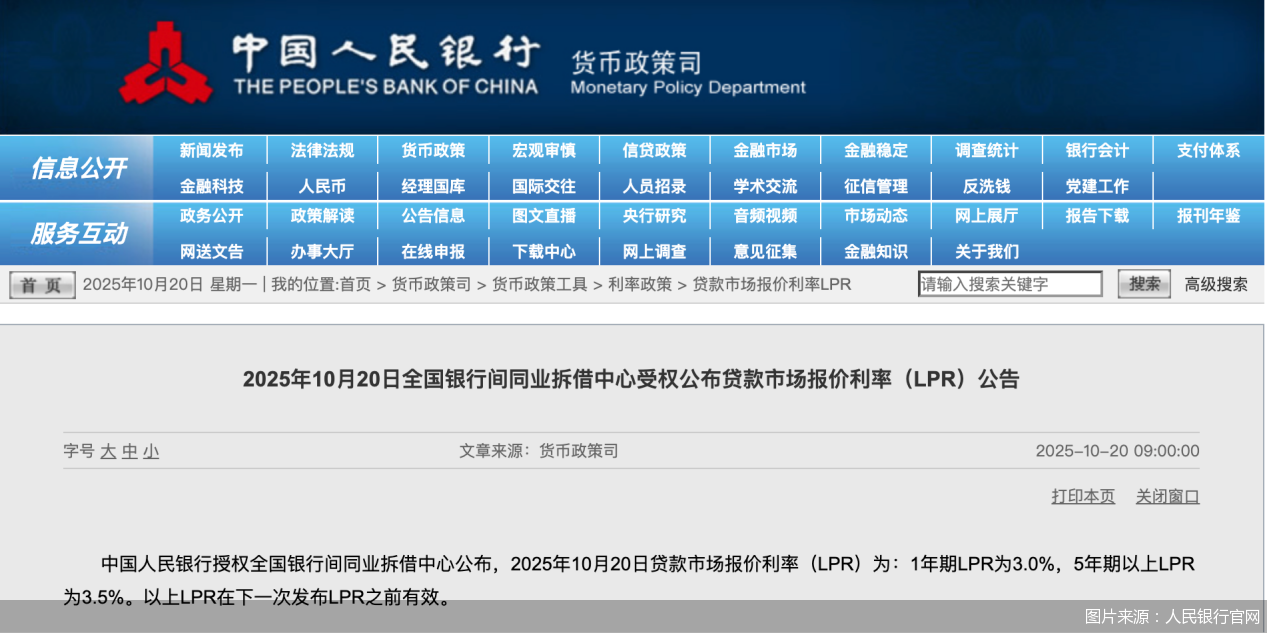
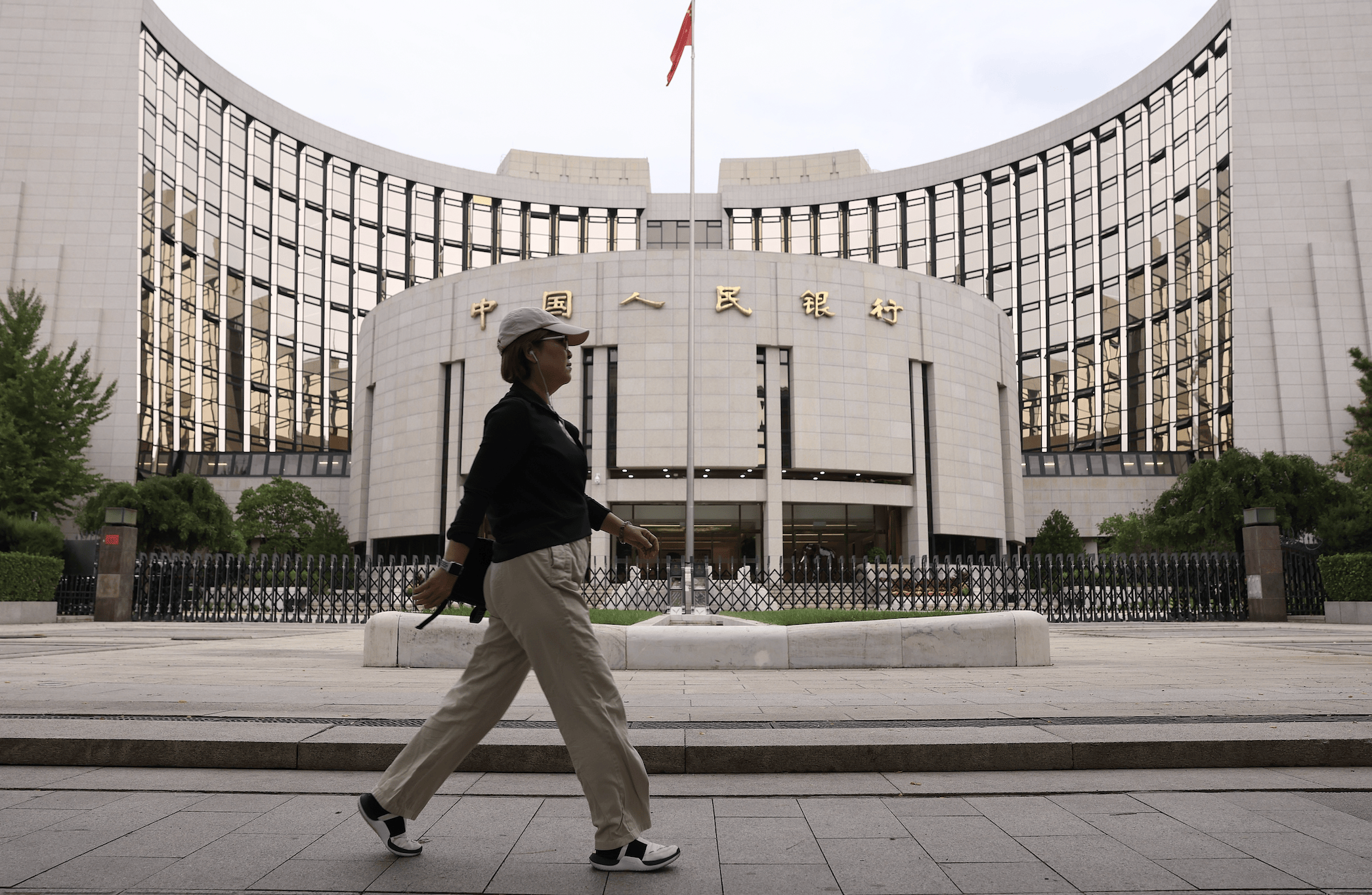
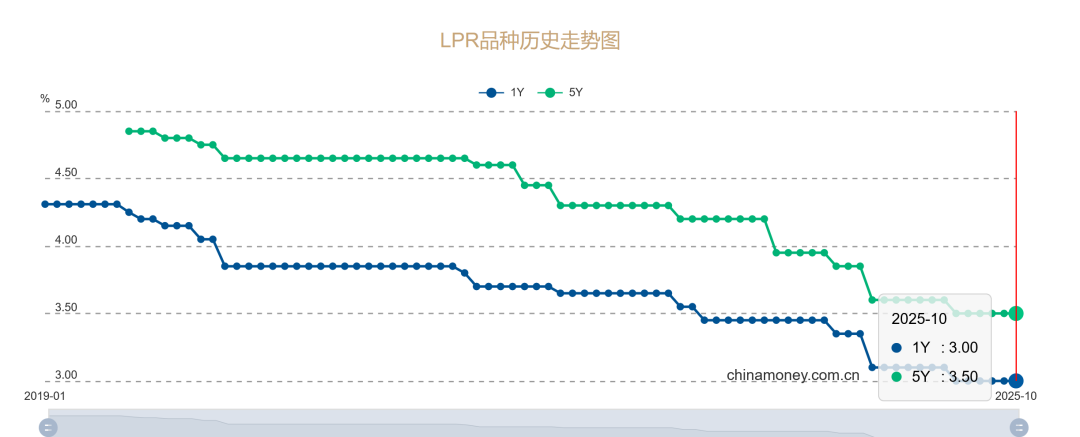
图:央行 10月20日,最新LPR报价出炉,10月LPR报价依然不变,维持了5月以来的利率水平:5年期以上LPR为3.5%,上月为3.5%。1年期LPR为3%,上月为3%。 中信证券固定收益分析师赵诣指出,商业银行息差压力较大,未来逆回购利率引导LPR报价调降,或需存款利率先行走低。此外,三季度以来股市情绪较 好,降息等宽货币工具或有必要关注对市场情绪的合理引导。不排除降息降准等政策工具跟进落地的可能性。(详情) 东方金诚首席宏观分析师王青预计,四季度央行有可能实施新一轮降息降准,并带动两个期限品种的LPR报价跟进下调。另外,预计四季度监管层有可能 通过单独引导5年期以上LPR报价下行等方式,推动居民房贷利率更大幅度下调。 ...
央行宣布,LPR维持不变
Wind万得· 2025-10-20 01:15
Core Viewpoint - The People's Bank of China (PBOC) has maintained the Loan Prime Rate (LPR) unchanged for five consecutive months, indicating a stable macroeconomic environment and a low necessity for further adjustments in the short term [2][4]. Summary by Sections LPR Rate Announcement - As of October 20, the 1-year LPR remains at 3%, and the 5-year LPR is at 3.5%, unchanged from previous rates [2]. Economic Context - The stability in LPR is attributed to a moderately strong macroeconomic performance in the first half of the year, reducing the urgency for rate cuts [4]. - PBOC Governor Pan Gongsheng highlighted that China's economic growth continues to be among the highest globally, and the central bank will maintain a moderately loose monetary policy to support consumption and investment [4]. Future Expectations - Several institutions anticipate that the PBOC may implement new interest rate cuts and reserve requirement ratio reductions in the fourth quarter, which could lead to lower loan rates for businesses and households [4]. - This potential adjustment is seen as a crucial measure to stimulate domestic financing demand and counteract the slowdown in external demand [4]. A-Share Market Reaction - A table summarizing the A-share market performance following previous LPR adjustments indicates varying impacts on the Shanghai Composite Index, with some adjustments leading to positive returns over different time frames [5].

LPR连续5个月不变
21世纪经济报道· 2025-10-20 01:10
Group 1 - The latest LPR (Loan Prime Rate) quotes remain unchanged as of October, with the 5-year LPR at 3.5% and the 1-year LPR at 3% [1][3] - Analysts expect the central bank may implement a new round of interest rate cuts and reserve requirement ratio reductions in Q4, potentially leading to a decrease in LPR quotes [3] - There is an anticipation that regulatory measures may be taken to guide the 5-year LPR downwards, which could result in a more significant reduction in residential mortgage rates [3] Group 2 - Commercial banks are facing significant pressure on interest margins, and a decrease in deposit rates may be necessary to facilitate a reduction in LPR quotes [3] - Positive sentiment in the stock market since Q3 suggests that monetary easing tools like interest rate cuts may need to be monitored for their impact on market sentiment [3] - The possibility of implementing policies such as interest rate cuts and reserve requirement ratio reductions is not ruled out [3]

又见中小银行密集调降存款利率
财联社· 2025-10-19 06:58
东方金诚宏观首席分析师王青预计, 四季度央行有可能实施新一轮降息降准,并带动LPR报价跟进下调。 中信证券研报也认为, 四季度可能有 一次10个基点的降息落地。 据第一财经,在沉寂了一段时间后, 近日,中小银行又进入了新一轮降息潮。 据统计,10月份以来,一批中小银行密集下调或正在准备下调存款利率。 10月13日,上海华瑞银行发布《关于调整人民币存款挂牌利率的公 告》,将3年期整存整取定期存款利率从2.3%调降至2.15%。 今年以来,华瑞银行前后合计8次降息。 与华瑞银行同样在9月底降息的中小银行还有天津金城银行、河南洛阳农商行、洛宁农商行等。展望 后市,业内倾向于认为年内还将再度开启降准降息"窗口"。 ...
前三季度社会融资增量突破30万亿元
Qi Huo Ri Bao Wang· 2025-10-15 19:30
Core Insights - The People's Bank of China reported that in the first three quarters, RMB loans increased by 14.75 trillion yuan, and the total social financing scale increased by 30.09 trillion yuan, which is 4.42 trillion yuan more than the same period last year [1] - The growth in social financing reflects strong financial support for the real economy, with government bonds and on-balance-sheet loans being the main contributors [1][2] - The broad money supply (M2) grew by 8.4% year-on-year, while narrow money (M1) increased by 7.2%, indicating improved liquidity and efficiency in the financial system [3] Group 1: Social Financing and Loans - In September, RMB loans increased by 1.29 trillion yuan, and social financing increased by 35.34 billion yuan, maintaining a robust growth trend [1] - The structure of new loans shows an improvement, with short-term corporate loans increasing by 250 billion yuan, while bill financing decreased by 471.2 billion yuan [2] - The overall loan balance growth rate was 6.6%, which is significantly higher than the nominal GDP growth rate, indicating strong support for the macroeconomic recovery [2] Group 2: Monetary Supply and Policy Outlook - The M1 and M2 growth rates indicate a narrowing gap, reflecting increased activity in corporate operations and a recovery in personal consumption [3] - The central bank is expected to implement a new round of interest rate cuts and reserve requirement ratio reductions by the end of the year to stimulate financing demand [4] - A policy tool worth 500 billion yuan is set to be released in October, which may further support credit expansion and boost infrastructure investment [3]
央行再提“适度宽松”,节后会降息降准吗?
Sou Hu Cai Jing· 2025-09-30 09:20
Core Viewpoint - The People's Bank of China (PBOC) emphasizes the implementation of a moderately accommodative monetary policy, reflecting a shift from aggressive easing to a focus on policy execution and stability in response to current economic conditions [1][3][4]. Monetary Policy Adjustments - The PBOC has lowered the policy interest rate by 10 basis points, leading to a corresponding decrease in the 1-year and 5-year Loan Prime Rate (LPR) by 10 basis points, and has also reduced the deposit rate [1][4]. - The PBOC has cut the relending rate to 1.5% and lowered the reserve requirement ratio by 50 basis points [1]. Economic Context - The latest statements from the PBOC indicate a more cautious approach, removing references to significant economic risks and challenges, and instead focusing on maintaining policy continuity and flexibility [3][4]. - The emphasis on supporting financing for small and micro enterprises and stabilizing foreign trade reflects concerns over potential impacts from U.S. tariff policies [3]. Future Outlook - Analysts suggest that while there may still be room for further interest rate cuts in the fourth quarter, the likelihood of aggressive easing is low given the current economic conditions and the stability of the LPR [4][5]. - The PBOC's current stance is supportive, aiming to create a favorable monetary environment for economic recovery and financial market stability [5][6]. Market Reactions - The market has shown a relatively stable response to the recent U.S. Federal Reserve rate cut, indicating that the PBOC's approach is focused on domestic conditions rather than external influences [1][5]. - There is a consensus among analysts that the priority for the PBOC in the fourth quarter will be economic growth and employment, with potential for further monetary easing if necessary [7].
王青:LPR报价不变符合预期 四季度有可能实施新一轮降息|首席观大势
Di Yi Cai Jing· 2025-09-24 10:51
Core Viewpoint - The People's Bank of China has maintained the Loan Prime Rate (LPR) for both 1-year and 5-year terms at 3.0% and 3.5% respectively, aligning with market expectations [1] Group 1: LPR Rates - The 1-year LPR remains unchanged at 3.0%, consistent with the previous month [1] - The 5-year LPR also stays at 3.5%, unchanged from last month [1] Group 2: Market Analysis - The stability in LPR rates reflects a lack of motivation among banks to lower the LPR amid historically low net interest margins [1] - Recent increases in key mid to long-term market interest rates, such as the AAA-rated 1-year interbank certificates of deposit and 10-year government bond yields, are influenced by market expectations and anti-involution factors [1] Group 3: Future Outlook - Potential impacts from the U.S. high tariff policies on global trade and China's exports may become more pronounced in the fourth quarter [1] - The central bank may consider implementing a new round of interest rate cuts and reserve requirement ratio reductions in the fourth quarter, which could lead to a subsequent decrease in LPR rates [1]
中泰期货晨会纪要-20250923
Zhong Tai Qi Huo· 2025-09-23 14:04
1. Report Industry Investment Rating The document does not provide any industry investment ratings. 2. Core Views of the Report - **Macroeconomic Outlook**: The probability of central bank easing is increasing. The capital market's technology - related content has further improved, and various medium - and long - term funds' holdings of A - share floating market value have increased. There are expectations of interest rate cuts and reserve requirement ratio cuts in the fourth quarter [6][7][10]. - **Stock Market**: A - share technology stocks are favored by funds. The stock market shows signs of a breakthrough after a sharp rise in August, but the sustainability of the upward momentum needs to be observed. It is advisable to consider going long on the stock index futures at low levels and adopt a shock - operation strategy [10]. - **Bond Market**: It is recommended to steepen the short - end and ultra - long - end interest rate curves in the medium - to - long - term for treasury bond futures. A strategy of going long on bonds at low levels can be adopted to bet on the intensification of future monetary policies [11]. - **Black Commodities**: The steel market may experience a "not - so - prosperous peak season." Steel is expected to maintain a shock market, with short - selling of wide - straddle options on steel and short - selling of iron ore at high levels. Double - coking coal prices may continue to rise in the short - term, but the focus should be on the demand of finished products during the "Golden September and Silver October" and the downstream replenishment rhythm before the National Day [14][15][16]. - **Non - ferrous Metals and New Materials**: Aluminum is expected to remain at a relatively high level before the holiday, with a recommendation of high - level observation and appropriate long - buying at low levels. Alumina has an increasing surplus pressure, and short - selling at high levels is recommended [21]. - **Agricultural Products**: For cotton, a strategy of short - selling at high levels is recommended; for sugar, a short - selling strategy is advisable; for eggs, a strategy of short - selling on rebounds is suggested; for apples, a wait - and - see approach is recommended; for corn, selling out - of - the - money call options is proposed; for hogs, a short - selling strategy on the near - term contracts at high levels is recommended [28][30][32][33][34][35]. - **Energy and Chemicals**: For crude oil, short - selling at high levels can be considered; for fuel oil, its price will follow the oil price; for plastics, a weak - shock strategy with a small - amount short - selling allocation is recommended; for rubber, short - term long - buying strategies can be considered; for methanol, a shock strategy is recommended; for caustic soda, the futures are expected to be weak; for asphalt, it will follow the oil price; for the polyester industry chain, a weak - shock trend is expected; for liquefied petroleum gas, a long - term short - selling strategy is maintained [37][38][39][40][41][42][43][45][46]. 3. Summary by Relevant Catalogs 3.1 Macroeconomic Information - The capital market's technology - related content has further improved, with the market value of the A - share technology sector accounting for over 1/4. As of the end of August, various medium - and long - term funds held approximately 21.4 trillion yuan of A - share floating market value, a 32% increase compared to the end of the "13th Five - Year Plan," and foreign investors held 3.4 trillion yuan of A - share market value [6]. - China's 1 - year and 5 - year - plus LPRs have remained unchanged for the fourth consecutive month. There are expectations of interest rate cuts and reserve requirement ratio cuts in the fourth quarter [7]. - The Ministry of Industry and Information Technology and other five departments have issued a work plan for the stable growth of the steel industry, aiming for an average annual growth of about 4% in the added value of the steel industry in the next two years [7]. 3.2 Macroeconomic Finance 3.2.1 Stock Index Futures - A - share technology stocks are favored by funds. The Shanghai Composite Index rose 0.22% to 3828.58 points, with daily trading volume reaching 2.14 trillion yuan. It is advisable to consider going long at low levels and adopt a shock - operation strategy [10]. 3.2.2 Treasury Bond Futures - The bond market was generally strong and volatile on Monday. The central bank conducted a 14 - day reverse repurchase operation, with a net injection of 300 billion yuan. It is recommended to steepen the short - end and ultra - long - end interest rate curves in the medium - to - long - term and go long on bonds at low levels [11]. 3.3 Black Commodities 3.3.1 Steel and Iron Ore - The policy impact on the black market is expected to be neutral, and the market will return to supply - demand fundamentals. The steel market may experience a "not - so - prosperous peak season." Steel is expected to maintain a shock market, with short - selling of wide - straddle options on steel and short - selling of iron ore at high levels [14][15]. 3.3.2 Coking Coal and Coke - Double - coking coal prices may continue to rise in the short - term. The focus should be on the demand of finished products during the "Golden September and Silver October" and the downstream replenishment rhythm before the National Day [16]. 3.4 Non - ferrous Metals and New Materials 3.4.1 Aluminum and Alumina - Aluminum is expected to remain at a relatively high level before the holiday, with a recommendation of high - level observation and appropriate long - buying at low levels. Alumina has an increasing surplus pressure, and short - selling at high levels is recommended [21]. 3.4.2 Zinc - As the macro - impact fades, zinc prices are expected to weaken due to increased supply and weak demand [22]. 3.4.3 Lithium Carbonate - The short - term destocking supports the price, and it is expected to move in a shock manner [23]. 3.4.4 Industrial Silicon - It is recommended to go long on far - month contracts at low levels within the range. The resumption progress of Xinjiang's leading manufacturers is the core supply - demand contradiction [25]. 3.4.5 Polysilicon - It is recommended to operate cautiously with a wide - range shock. The policy progress dominates the price fluctuation [26]. 3.5 Agricultural Products 3.5.1 Cotton - A strategy of short - selling at high levels is recommended due to increasing supply and weak demand [28]. 3.5.2 Sugar - A short - selling strategy is advisable as the domestic and international sugar markets face supply pressure [30]. 3.5.3 Eggs - A strategy of short - selling on rebounds is suggested as the supply pressure is large and the peak season is coming to an end [32]. 3.5.4 Apples - A wait - and - see approach is recommended. Attention should be paid to the weather conditions in the production areas [33]. 3.5.5 Corn - Selling out - of - the - money call options is proposed. The price may decline with the increase in new grain supply, but there is support at the bottom [34]. 3.5.6 Hogs - A short - selling strategy on the near - term contracts at high levels is recommended. The supply - demand pattern is strong supply and weak demand [35]. 3.6 Energy and Chemicals 3.6.1 Crude Oil - It is advisable to short - sell at high levels as the market is likely to shift to a supply - surplus pattern [37]. 3.6.2 Fuel Oil - Its price will follow the oil price, with weak fundamentals for low - sulfur fuel oil and changing demand for high - sulfur fuel oil [38]. 3.6.3 Plastics - A weak - shock strategy with a small - amount short - selling allocation is recommended due to high supply and weak demand [39]. 3.6.4 Rubber - Short - term long - buying strategies can be considered as the price may strengthen gradually [40]. 3.6.5 Methanol - A shock strategy is recommended as the port inventory pressure is large [40]. 3.6.6 Caustic Soda - The futures are expected to be weak as the futures and spot prices deviate [42]. 3.6.7 Asphalt - It will follow the oil price, and the current demand is in the peak season [43]. 3.6.8 Polyester Industry Chain - A weak - shock trend is expected due to weak cost - side drivers and lack of demand [45]. 3.6.9 Liquefied Petroleum Gas - A long - term short - selling strategy is maintained as the supply is abundant and demand is hard to strengthen beyond expectations [46].
股指期货将偏强震荡黄金、白银期货价格再创上市以来新高工业硅、多晶硅、螺纹钢、焦煤、玻璃、纯碱、原油、豆粕、豆油期货将偏弱震荡
Guo Tai Jun An Qi Huo· 2025-09-23 03:35
Report Industry Investment Rating No relevant content provided. Core View of the Report Through macro - fundamental analysis and technical analysis, the report predicts the trend of various futures on September 23, 2025. Index futures are expected to oscillate strongly, while industrial silicon, polysilicon, rebar, coking coal, glass, soda ash, crude oil, soybean meal, and soybean oil futures are expected to oscillate weakly. Gold and silver futures are likely to reach new highs [2][3]. Summary by Directory 1. Futures Market Outlook - **Index Futures**: On September 23, 2025, index futures are expected to oscillate strongly. For example, IF2512 has resistance levels at 4518 and 4545 points and support levels at 4455 and 4444 points [2][18]. - **Treasury Bond Futures**: The ten - year Treasury bond futures contract T2512 and the thirty - year Treasury bond futures contract TL2512 are likely to oscillate widely on September 23, 2025 [2]. - **Precious Metal Futures**: Gold and silver futures are expected to oscillate strongly and reach new highs. For instance, the gold futures contract AU2512 will attack resistance levels at 855.0 and 860.0 yuan/gram, and the silver futures contract AG2512 will attack resistance levels at 10400 and 10500 yuan/kg [2][3]. - **Base Metal Futures**: Copper futures are expected to oscillate and consolidate, while aluminum and alumina futures are likely to oscillate weakly on September 23, 2025 [3]. - **Industrial and Agricultural Futures**: Industrial silicon, polysilicon, rebar, coking coal, glass, soda ash, crude oil, soybean meal, and soybean oil futures are expected to oscillate weakly on September 23, 2025 [3][4][6]. 2. Macro Information and Trading Tips - **International Relations**: Trump said he would meet with Chinese leaders during the APEC Economic Leaders' Meeting. China's Ministry of Foreign Affairs responded that the two sides are communicating [7]. - **Economic Data**: China's 1 - year LPR in September was reported at 3%, and the 5 - year and above variety was reported at 3.5%, both remaining unchanged for the fourth consecutive month. Some analysts believe that the central bank may implement a new round of interest rate cuts and reserve requirement ratio cuts in the fourth quarter [7]. - **Financial Market**: As of the end of June, China's banking industry's total assets were nearly 470 trillion yuan, ranking first in the world; the stock and bond market sizes ranked second in the world; and the foreign exchange reserve size ranked first in the world for 20 consecutive years [8]. 3. Commodity Futures - Related Information - **Precious Metals**: On September 22, international precious metal futures generally rose. COMEX gold futures rose 2.03% to 3781.20 US dollars/ounce, and COMEX silver futures rose 3.17% to 44.32 US dollars/ounce [11]. - **Crude Oil**: On September 22, international oil prices oscillated narrowly. The main contract of US crude oil fell 0.10% to 62.34 US dollars/barrel, and the main contract of Brent crude oil fell 0.05% to 66.01 US dollars/barrel [11]. - **Base Metals**: On September 22, London base metals showed mixed results. LME zinc rose 0.38%, LME lead rose 0.15%, LME copper rose 0.13%, while LME tin fell 0.44%, LME nickel fell 0.46%, and LME aluminum fell 0.62% [11]. - **Exchange Rates**: On September 22, the on - shore RMB against the US dollar closed at 7.1148 at 16:30, down 23 basis points from the previous trading day, and closed at 7.1138 at night. The central parity rate of the RMB against the US dollar was reported at 7.1106, up 22 basis points from the previous trading day [12]. 4. Futures Market Analysis and Outlook - **Index Futures**: On September 22, index futures generally showed a small - scale upward trend. For example, the main contract IF2512 of CSI 300 index futures rose 0.30% (0.44% based on the closing price) [12]. - **Treasury Bond Futures**: On September 22, Treasury bond futures closed up across the board. The 30 - year main contract rose 0.22%, the 10 - year main contract rose 0.20%, the 5 - year main contract rose 0.13%, and the 2 - year main contract rose 0.04% [36]. - **Precious Metal Futures**: Gold and silver futures continued to rise and reached new highs. For example, the gold futures contract AU2512 reached a new high of 851.98 yuan/gram during the night trading on September 23 [45]. - **Base Metal Futures**: Copper futures showed a small - scale upward trend, while aluminum and alumina futures showed a downward trend on September 22 [59][63]. - **Industrial and Agricultural Futures**: Industrial silicon, polysilicon, rebar, coking coal, glass, soda ash, crude oil, soybean meal, and soybean oil futures showed different degrees of decline on September 22 [70][71][80].
LPR连续4月“按兵不动” 央行表态货币政策立场是支持性的
Sou Hu Cai Jing· 2025-09-22 23:18
Core Viewpoint - The LPR rates for September remain unchanged, with the 1-year LPR at 3.0% and the 5-year LPR at 3.5%, consistent since May, indicating a stable monetary policy environment in China [1][3][5] Summary by Relevant Sections LPR Rates and Market Expectations - The LPR rates have been stable for five consecutive months, reflecting a lack of change in the 7-day reverse repurchase rate, which has remained at 1.40% since May [3][4] - Analysts suggest that the unchanged LPR rates align with market expectations, as banks lack the incentive to lower LPR quotes due to rising market interest rates and historical low net interest margins [3][5] Monetary Policy Context - The People's Bank of China (PBOC) emphasizes a supportive monetary policy stance, aiming for a balance between domestic needs and external factors, particularly in light of the recent Federal Reserve rate cut [2][7] - The PBOC's approach is to maintain liquidity and support economic recovery while monitoring macroeconomic data for potential adjustments [7][8] Future Outlook - Analysts predict a possibility of new rounds of interest rate cuts and reserve requirement ratio reductions in the fourth quarter, driven by the need to stimulate domestic demand and stabilize the real estate market [5][6] - The PBOC may consider further lowering the LPR to alleviate high mortgage rates and boost housing demand, which is seen as crucial for reversing negative market expectations [6][8]