GDP增长

Search documents
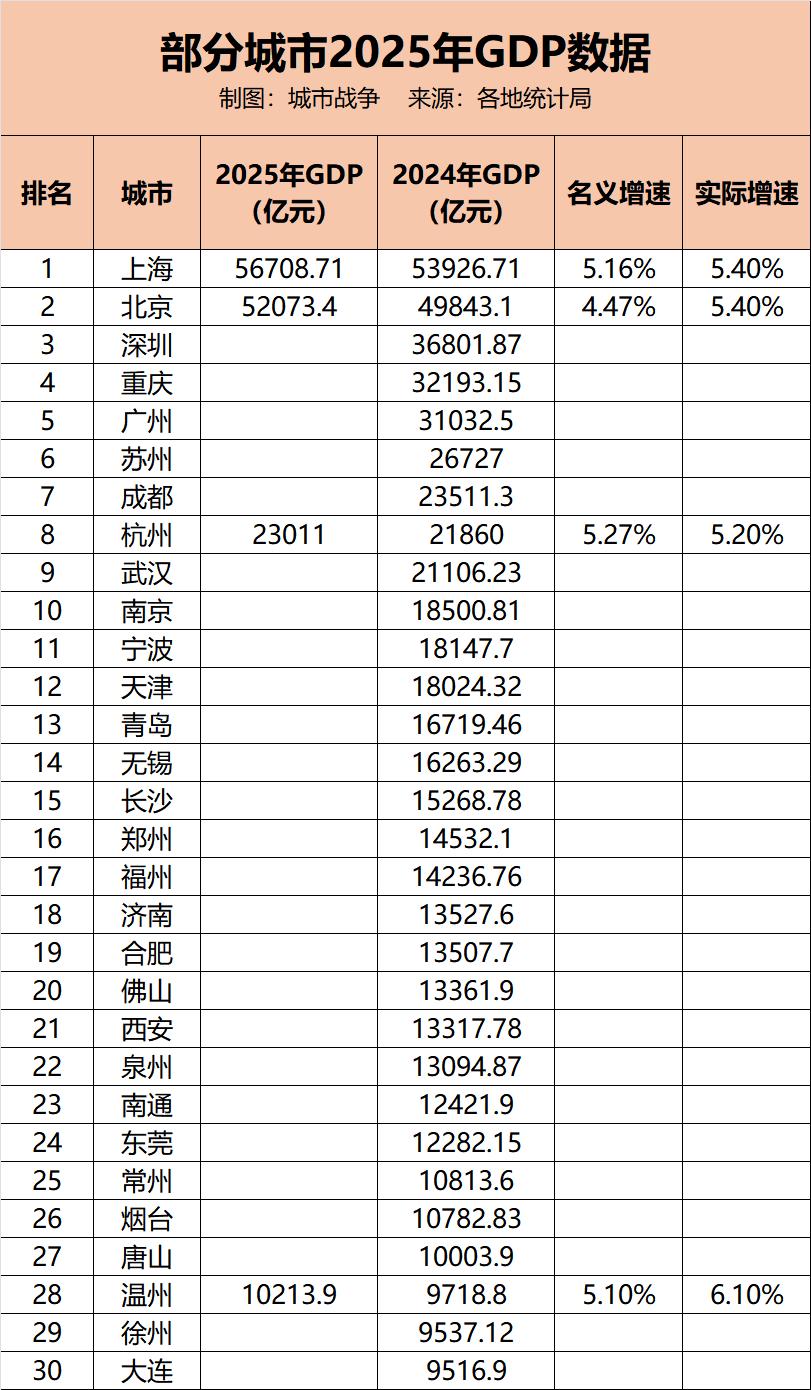
泉州2025年GDP公布!
Xin Lang Cai Jing· 2026-02-04 12:19
Economic Overview - In 2025, the GDP of Quanzhou reached 13778.34 billion yuan, growing by 5.3% year-on-year, with a three-industry structure of 2.0:50.5:47.5 [1][16][17] Agricultural Sector - The total output value of agriculture, forestry, animal husbandry, and fishery was 494.94 billion yuan, an increase of 3.6% from the previous year [2][18] - Agricultural output value rose to 210.48 billion yuan, up 5.5%, with grain production at 52.91 million tons, increasing by 2.5% [2][18] - The fishery sector saw a production value of 178.36 billion yuan, growing by 4.7%, with significant increases in abalone (23.2%) and shrimp (18.8%) production [4][20] Industrial Sector - The industrial added value for large-scale enterprises increased by 7.0%, with key industries showing strong growth, such as paper and printing (13.4%) and machinery (11.0%) [5][21] - Private industrial enterprises saw an added value growth of 7.8%, outpacing the average growth rate [5][21] - High-tech industries also experienced growth, with electronic information increasing by 6.7% and resource recycling by 18.7% [5][21] Tertiary Sector - The added value of the tertiary industry grew by 4.7%, accounting for 47.5% of GDP, a historical high [6][22] - The wholesale and retail sector contributed significantly, with a growth of 6.1%, boosting the tertiary sector's growth by 2.2 percentage points [6][22] - Tourism thrived, with total visitors reaching 112.28 million, an increase of 11.1%, and total tourism spending rising by 11.3% [7][22] Consumer Market - The total retail sales of consumer goods reached 6416.07 billion yuan, growing by 4.1% [8][24] - Online retail sales surged by 17.8%, with significant growth in essential goods and cultural products [8][24] Investment and Construction - Fixed asset investment grew by 1.1%, with a notable increase in government infrastructure investment by 10.2% [9][25] - Private investment also rose by 5.6%, contributing positively to overall investment growth [10][26] Foreign Trade - The total foreign trade volume decreased by 12.9% to 2363.79 billion yuan, with exports down by 16.9% [11][27] - The export of mechanical and electrical products reached 307.09 billion yuan, accounting for 18.6% of total exports [11][27] Fiscal and Financial Overview - The total public budget revenue was 991.60 billion yuan, increasing by 1.7%, with a focus on social welfare spending [13][28] - Financial institutions reported a growth in loans by 6.4%, with significant increases in sectors like leasing and business services [13][28] Income and Prices - The per capita disposable income reached 54858 yuan, growing by 5.1%, with rural income growth outpacing urban [14][29] - Consumer prices rose by 1.0%, with most categories experiencing price increases [15][30]
2025年乌兹别克斯坦GDP增长7.7%
Shang Wu Bu Wang Zhan· 2026-01-30 15:02
Economic Growth - Uzbekistan's GDP is projected to grow by 7.7% in 2025, an increase of 1 percentage point from 6.7% in 2024, marking the highest growth rate since 2021 [1] Inflation and Income - The inflation rate is expected to decrease from 9.8% to 7.3%, while the growth rate of real household income is anticipated to decline from 11.7% to 9.2% [1] Population and Employment - The resident population of Uzbekistan is projected to increase by nearly 700,000, surpassing 38.23 million [1] Industrial and Sector Performance - Industrial output growth is expected to slightly rise from 6.5% to 6.8%, with the construction sector showing significant performance, growing by 14.2% [1] - Agriculture, forestry, and fishing are projected to grow by 4.4%, while retail services are expected to increase by 14.7% [1] Trade and Transportation - Foreign trade volume is expected to grow by 20.7%, with exports increasing by 24% and imports by 18.5% [1] - Freight turnover is projected to grow by 1.9%, while passenger turnover is expected to increase by 5.8% [1] - Retail sales are anticipated to grow by 11.2% [1]
法国去年第四季度初步GDP环比增长0.2%
Mei Ri Jing Ji Xin Wen· 2026-01-30 06:52
每经AI快讯,1月30日消息,法国去年第四季度初步GDP环比增长0.2%。 (文章来源:每日经济新闻) ...
菲律宾去年第四季度GDP同比增长3%,预估增长3.7%
Mei Ri Jing Ji Xin Wen· 2026-01-29 02:14
每经AI快讯,1月29日消息,菲律宾去年第四季度GDP同比增长3%,预估增长3.7%。 ...
机构:最新FOMC声明可能传达美联储将重新关注通胀的信号
Jin Rong Jie· 2026-01-28 19:55
美联储如预期保持利率不变,并表示其3月的决策将取决于即将公布的数据。道明 证券 财富管理分析师 Sid Vaidya表示,该声明承认了GDP强劲增长和稳定的失业率,这引发了美联储将对仍然高企通胀给予 多大重视的问题。近期一系列降息支持了就业。因此,Sid Vaidya怀疑,最新的声明可能是美联储将重 新关注通胀的信号。 ...
美国冬季风暴恐削去一季度GDP 1.5%,经济或陷短暂停滞
Jin Shi Shu Ju· 2026-01-27 11:37
SHMET 网讯:冬季风暴" Fern"虽已基本结束,但其对美国造成的破坏影响将长期持续。 为评估此次强烈冬季风暴的经济影响,美国银行首席经济学家阿迪亚·巴韦(Aditya Bhave)回顾了2021年2月袭击美国的 冬季风暴"维奥拉"(Viola)。这两场风暴均导致美国约一半地区发布冬季天气预警。2021年2月消费者支出环比下降 0.9%,而1月曾增长1.3%。然而,这种波动可能并非完全由"维奥拉"造成:2021年1月的支出也受到2020年12月《综合拨款 法案》通过以及有利的季节性调整的提振。 巴韦在其分析中使用了美国银行最新的汇总信用卡和借记卡数据来聚焦"维奥拉"的影响。在截至2021年2月19日的一周 内,总卡类支出同比下降3.7%,而此前数周的趋势约为同比增长6%。 | | 1/17 | 1/16 | 1/15 | 1/14 | 1/13 | 1/12 | 1/11 | 1/10 | | --- | --- | --- | --- | --- | --- | --- | --- | --- | | Total card spending | 3.3% | 4.4% | 4.4% | 4.0% | 4 ...


由于政治僵局,泰经济增长速度预计将会放缓
Shang Wu Bu Wang Zhan· 2026-01-26 16:09
(原标题:由于政治僵局,泰经济增长速度预计将会放缓) 据曼谷邮报1月23日报道,CIMB泰国银行预计,由于国内政治局势的动荡 以及外部环境的不确定性,泰国今年第一季度的GDP增长速度将会比上季度有 所放缓。 该银行预测,由于出口下滑的影响,泰国今年的GDP增长率将为1.6%。这 一情况是在2025年出口表现强劲之后的结果——当时预计出口量将增长12%, 从而使GDP增加2.1%。 此外,Amonthep先生表示,货币政策委员会的宽松货币政策已于12月结 束——当时央行将政策利率下调了25个基点,降至1.25%。预计2026年,货币 政策委员会会全年保持政策利率不变。 CIMBT认为,由于中央银行对黄金交易的监管措施,泰铢会呈现疲软走势。国 内政治上的不确定性以及泰国主权信用评级的下调也可能对泰铢造成压力。 CIMBT预计泰国第二季度的经济增长率为1.2%;新政府在6月成立后所实 施的各项经济刺激措施对经济增长起到了一定的推动作用。泰国定于2月8日举 行大选。 根据这种情景预测,GDP增长速度将在今年下半年有所好转,第三和第四 季度的增长率分别将达到2.5%和2.4%。 Amonthep先生表示,旅游业预计仍将 ...
华联期货周报:2025年GDP增长5%,新旧产业分化凸显-20260126
Hua Lian Qi Huo· 2026-01-26 03:31
1. Report Industry Investment Rating - Not provided in the given content 2. Core Viewpoints of the Report - In 2025, China's GDP reached 1,401,879 billion yuan, a year - on - year increase of 5.0% at constant prices, achieving the annual growth target. The quarterly growth rate showed a "high at first and stable later" trend. The tertiary industry was prominent, with the added value of the second and first industries also growing [9]. - The decline in China's real estate development investment intensified in 2025, with the investment in residential properties also facing increasing pressure. The sales side was under greater pressure, and the average price of commercial housing had obvious downward pressure [9]. - In December 2025, the added value of industrial enterprises above the designated size in China increased steadily, with new kinetic energy characteristics in industrial growth and obvious differentiation in traditional industries. Exports showed resilience, and residents' income increased steadily [11]. - In December 2025, China's imports and exports reached a record - high monthly scale. Exports to ASEAN and the EU increased, while exports to the US decreased [97]. - In December 2025, China's manufacturing PMI returned to the expansion range, and the non - manufacturing business activity index also rebounded, but there were significant industry differences [252][260]. 3. Summary of Each Section 3.1 National Economic Accounting - In 2025, China's GDP reached 1,401,879 billion yuan, a 5.0% year - on - year increase at constant prices. The quarterly growth rates from the first to the fourth quarter were 5.4%, 5.2%, 4.8%, and 4.5% respectively. The tertiary industry added value was 808,879 billion yuan, growing 5.4%. The second - industry added value was 499,653 billion yuan, growing 4.5%. The first - industry added value was 93,347 billion yuan, growing 3.9% [9]. 3.2 Industry - In December 2025, the added value of industrial enterprises above the designated size increased by 5.2% year - on - year and 0.49% month - on - month, with an annual growth of 5.9%. Manufacturing was the main growth driver, and new kinetic energy in industrial growth was prominent, while traditional high - energy - consuming sectors were weak. Exports showed resilience [11]. 3.3 Price Index - In December 2025, China's CPI increased by 0.8% year - on - year, and remained flat for the whole year. Food prices increased by 1.1%, and non - food prices increased by 0.8%. PPI decreased by 1.9% year - on - year in December 2025, with a 2.6% decline for the whole year [64][72]. 3.4 Real Estate - In 2025, China's real estate development investment was 827.88 billion yuan, a 17.2% year - on - year decrease. Residential investment decreased by 16.3%. The construction area, new construction area, and sales volume of commercial housing all declined [9][125][129][133]. 3.5 Foreign Trade and Investment - In December 2025, China's total imports and exports were 601.42 billion US dollars, a 6.24% year - on - year increase. Exports were 357.78 billion US dollars, a 6.6% increase, and imports were 243.64 billion US dollars, a 5.7% increase. The trade surplus was 114.14 billion US dollars [97]. 3.6 Fixed - Asset Investment - In 2025, China's fixed - asset investment (excluding rural households) was 4,851.86 billion yuan, a 3.8% year - on - year decrease. Private fixed - asset investment decreased by 6.4%. Investment in the first, second, and third industries showed different trends [117]. 3.7 Domestic Trade - The report shows the trends of service retail sales, catering revenue, and commodity retail, and the year - on - year changes in the retail sales of enterprises above the designated size in various industries [161][163][168]. 3.8 Transportation - The report presents the year - on - year changes in the transportation volume of four types of goods and passengers, and the traffic flow of subways in nine major cities and traffic fixed - asset investment [171][176][179]. 3.9 Banking and Currency - The report analyzes the new social financing scale, social financing scale stock, new RMB loans, and currency liquidity. In December, the M1 - M2 "scissors gap" expanded, reflecting weakening capital activation and weak corporate business and trading willingness [186][197][203]. 3.10 Fiscal and Employment - The report shows the central and local general budget public revenues and expenditures, and the situation of urban new employment and surveyed unemployment rate [235][240][241][245]. 3.11 Business Surveys - In December 2025, China's manufacturing PMI was 50.1%, returning to the expansion range. The non - manufacturing business activity index was 50.2%, also rebounding, but with significant industry differences [252][260]. 3.12 US Macroeconomy - The report provides data on the quarterly changes in the US real GDP annualized quarterly rate, employment, retail sales, and the Fed's asset structure and federal funds rate [267][271][277][279].
邦达亚洲:多重利好因素支撑 黄金突破4900关口
Xin Lang Cai Jing· 2026-01-23 07:39
Economic Data Summary - The U.S. Bureau of Economic Analysis reported that the annualized quarter-on-quarter real GDP for Q3 was 4.4%, slightly above market expectations and the previous revision of 4.3%, marking the fastest growth in two years [1][6] - Consumer spending in the last quarter increased by 3.5% on an annualized basis, with service spending achieving the fastest growth in three years and goods spending also accelerating compared to the previous quarter [1][6] - The final value of the core Personal Consumption Expenditures (PCE) price index for Q3 was 2.9%, in line with expectations, indicating no significant increase in inflationary pressures [1][6] - Following a contraction of 0.6% in Q1, the real GDP rebounded strongly in Q2, growing by 3.8% [1][6] - The data for the first three quarters suggests an annualized growth rate of 2.5% for the U.S. economy through the first three quarters of 2025, driven by consumer spending, exports, government spending, and investment, with a decline in imports contributing positively to GDP [1][6] Japan's Monetary Policy - The Bank of Japan maintained its policy interest rate at 0.75%, aligning with market expectations, while raising its medium- to long-term inflation forecasts, indicating a more optimistic assessment of price pressures [2][7] - The central bank kept its core CPI forecast for FY2025 unchanged at 2.7% but raised projections for the next two fiscal years, with the FY2026 core CPI forecast increased from 1.8% to 1.9% and FY2027 remaining at 2.0% [2][7] - The core-core CPI forecast, which better reflects underlying price trends, was also revised upward, with FY2025 forecast raised from 2.8% to 3.0%, FY2026 from 2.0% to 2.2%, and FY2027 from 2.0% to 2.1% [2][7] Gold Market - Gold prices surged significantly, reaching a historical high around 4960, supported by a weaker U.S. dollar, ongoing trade tensions, and geopolitical risks that heightened safe-haven demand [3][8] - Expectations of two interest rate cuts by the Federal Reserve this year also provided support for gold prices [3][8] Australian Dollar Performance - The Australian dollar rose sharply, breaking the 0.6800 mark and reaching a 15-month high around 0.6850, bolstered by a weaker U.S. dollar and strong economic data from Australia [4][9] - Increased expectations for interest rate hikes in Australia further supported the currency [4][9] USD/JPY Exchange Rate - The USD/JPY pair experienced slight gains, trading around 158.60, supported by ongoing political uncertainties in Japan and positive economic data from the U.S. [5][10] - A decrease in market risk aversion also contributed to the support for the exchange rate [5][10]
多省市GDP出炉!中国万亿城市又扩容了
3 6 Ke· 2026-01-23 02:25
Economic Expansion of Cities - Beijing officially joins the "5 trillion club" with a GDP of 52,073.4 billion yuan in 2025, growing by 5.4% year-on-year [2] - Shanghai's GDP is projected to reach 56,708.71 billion yuan in 2025, with a nominal growth rate of 5.16%, aiming for 60 trillion yuan by 2026 [2] - The number of trillion-yuan cities in China increases from 27 to 28, with Wenzhou entering the ranks at 10,213.9 billion yuan and a growth rate of 6.1% [2][3] Economic Growth of Provinces - Shandong province is expected to exceed 10 trillion yuan in GDP by 2025, becoming the third province in China to achieve this milestone [5] - Zhejiang province's GDP is projected to reach 94,545 billion yuan, with a year-on-year growth of 5.5%, driven by private and digital economies [6] - Sichuan and Henan provinces maintain strong economic positions with GDPs of 67,665.34 billion yuan and 66,632.79 billion yuan, respectively, both growing over 5.5% [6] Future Economic Outlook - The expansion of trillion-yuan cities and the emergence of new economic powerhouses reflect a significant upgrade in China's economic landscape [8] - The upcoming years are expected to see further growth in both trillion and three trillion yuan cities, indicating a transition towards high-quality development in the Chinese economy [8]