
国产替代

Search documents
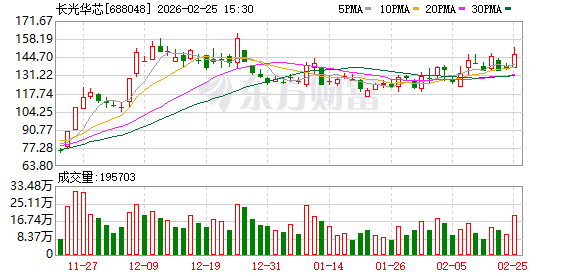
长光华芯:公司高度重视100G EML芯片的国产替代机遇
Zheng Quan Ri Bao· 2026-02-25 11:41
Core Viewpoint - The company emphasizes the opportunity for domestic substitution of 100G EML chips and plans to ramp up production capacity by 2026 to meet the urgent demand in both domestic and international markets [2] Group 1 - The company is committed to addressing the supply gap in high-end optical chip solutions [2] - The company will provide stable and reliable domestic high-end optical chip solutions for customers [2] - Investors are encouraged to monitor the company's public disclosures for specific timelines regarding production ramp-up [2]


收购落空股价腰斩,开普云股份回购或难挡冲击
Di Yi Cai Jing· 2026-02-25 11:17
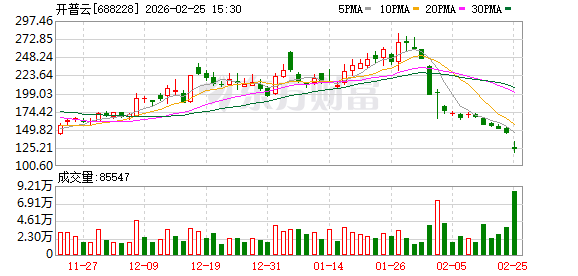
Core Viewpoint - The company announced the termination of its acquisition plan for Nanning Taike Semiconductor, leading to a significant drop in its stock price, reflecting market concerns over its growth prospects and valuation collapse [2][6]. Group 1: Acquisition Details - The acquisition was intended to combine the company's expertise in AI and information technology with Nanning Taike's storage technology capabilities, aiming to enhance AI-optimized storage solutions [2]. - The acquisition plan involved a cash payment and share issuance to acquire 100% of Nanning Taike's shares from Shenzhen Jintai Ke Semiconductor [2][3]. - Following the announcement of the acquisition's termination, the company's stock price fell sharply, with a maximum intraday drop of over 18% on February 25, ultimately closing down 14.78% [2][3]. Group 2: Financial Performance and Market Reaction - The company's stock price had previously surged by 325.24% from 65.8 yuan to a historical high of 279.81 yuan, driven by optimistic expectations surrounding the acquisition [3]. - After the acquisition was called off, the stock price experienced a significant decline, with a cumulative drop of 55.96% from its peak [3][6]. - The company's revenue for 2024 is projected to be 617 million yuan, a decrease of 10.98% year-on-year, with a net profit of approximately 20.59 million yuan, down 49.98% [7]. Group 3: Business Outlook and Challenges - The company's core business has shown weak profitability, with multiple AI applications struggling to establish viable business models, which undermines its current high valuation [6][7]. - The termination of the acquisition means the company loses the potential additional profits and valuation premium that would have come from integrating Nanning Taike's storage business [6]. - The company is expected to face continued losses in 2025, with projected net losses ranging from 8 million to 12 million yuan, reflecting a significant decline compared to previous years [7].

商道创投网·会员动态|神州普惠·完成B轮融资
Sou Hu Cai Jing· 2026-02-25 11:13
Core Insights - Beijing Shenzhou Puhui Technology Co., Ltd. has completed a B-round financing led by the Beijing Advanced Manufacturing and Intelligent Equipment Industry Investment Fund, indicating strong investor confidence in the company’s technology and market position [2][4] Company Overview - Founded in 2003 and headquartered in Beijing, Shenzhou Puhui is recognized as a "little giant" enterprise in the deep-sea technology sector, supported by the Ministry of Industry and Information Technology [2] - The company has over 20 years of experience in fiber optic sensing and underwater detection technology, establishing a complete industrial chain from core components to specialized equipment and overall solutions [2] - Its product range includes fiber optic hydrophone towed arrays, underwater observation networks, marine resource exploration equipment, 3D imaging sonar, distributed fiber optic demodulators, and special sensing cables, with several technologies leading domestically [2] Financing Purpose - The financing will focus on three strategic directions: accelerating the domestic replacement of high-end marine instrument equipment, integrating sonar products with unmanned marine platforms, and expanding into civil market sectors such as oil and gas exploration, underwater security, water monitoring, and bridge inspection [3] Investment Rationale - The investment in Shenzhou Puhui is based on its significant technological barriers, industry position, and strategic value, with a strong emphasis on its long-standing expertise in fiber optic sensing and underwater detection [4] - The company has established a complete R&D and manufacturing system and has industrial bases in cities like Wuhan, Harbin, and Hainan, showcasing its strong engineering delivery capabilities [4] - With the implementation of the marine power strategy, the demand for underwater sensing equipment is rapidly extending from research to civil applications, positioning the company to seize this historic opportunity [4] Industry Perspective - The financing reflects the recognition of state-owned capital for "hard technology" enterprises in the deep-sea technology sector, with various government departments actively supporting the development of specialized and innovative enterprises [5] - The investment aligns with the responsibilities of fund managers to create long-term value for investors by supporting companies with deep technological foundations and clear paths to industrialization [5] - The deep-sea technology sector is at a critical juncture of transitioning from research to industrial application, emphasizing the need for entrepreneurs to balance technological leadership with engineering capabilities and commercialization [5]

景嘉微:公司积极拓展与各方伙伴的协同机会,共同探索共赢发展路径
Zheng Quan Ri Bao· 2026-02-25 11:09
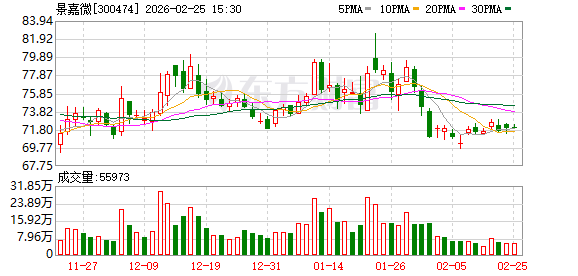
Group 1 - The company, Jingjia Micro, is actively expanding collaborative opportunities with various partners to explore win-win development paths [2] - The company is committed to advancing the construction of domestic GPUs [2] - Jingjia Micro will fulfill its information disclosure obligations according to relevant regulatory requirements [2]

ETF投资手册之二:半导体 ETF 投资指南
HUAXI Securities· 2026-02-25 09:21
- Semiconductor ETFs are categorized into three types: material equipment indices, design manufacturing indices, and full industry chain indices, based on their constituent stocks' distribution across the semiconductor industry chain[37][39][40] - Material equipment indices focus on upstream industries, with constituent stocks having over 95% market capitalization in semiconductor materials and equipment sectors[40][43] - Design manufacturing indices target midstream industries, with constituent stocks having over 95% market capitalization in IC design, manufacturing, and packaging sectors[40][43] - Full industry chain indices cover both upstream and midstream sectors, with a balanced distribution across materials, equipment, design, manufacturing, and packaging industries[40][43][47] - Material equipment indices exhibit higher elasticity during "self-reliance" logic phases, driven by external sanctions and supply chain security concerns[75][76][79] - Design manufacturing indices are more sensitive to terminal demand expansion, showing higher elasticity during industry upturns and demand-driven growth phases[70][71][73] - Full industry chain indices provide balanced exposure, with annualized returns ranging from 20.20% to 29.90% and Sharpe ratios between 0.75 and 0.98 during observed periods[82][84][85] - Specific indices like "科创芯片设计" and "集成电路" differ in sample space and valuation, with the former focusing on high-growth chip design firms and exhibiting higher elasticity[87][89][92] - ETF selection should consider factors like scale, management fees, tracking error, and liquidity; for example, "科创芯片 ETF基金" offers lower fees and sufficient scale for systematic semiconductor exposure[94][95][97]
神工股份2025年营收增长46%净利破亿 “AI+国产替代”双轮驱动迎丰收
Ju Chao Zi Xun· 2026-02-25 08:37
Core Insights - The company reported a total revenue of 443 million yuan for the year 2025, marking a year-on-year increase of 46.26%, with net profit attributable to shareholders reaching 101 million yuan [1] - Multiple financial indicators, including operating profit, total profit, net profit excluding non-recurring items, and basic earnings per share, all saw increases exceeding 30% compared to the previous year, indicating a comprehensive and high-quality recovery rather than a singular growth dimension [4] Group 1: Market Drivers - The company's growth is driven by a "global market recovery" and "domestic substitution," creating a strong resonance [4] - The overseas market is significantly boosted by the demand for artificial intelligence, leading to increased operational rates and capital expenditures in high-end logic and storage chip manufacturing [4] - As a core material supplier in the upstream of chip manufacturing, the company's large-diameter silicon materials business benefits from the AI-driven global expansion, resulting in steady revenue growth [4] Group 2: Domestic Market Dynamics - The acceleration of domestic substitution is evident, with local storage chip manufacturers closely following global advanced levels in both technology and capacity, increasing the demand for localized key consumables [4] - The company's silicon component business is well-positioned in this sector, experiencing rapid order growth, which serves as a second engine for revenue increase [4] Group 3: Internal Efficiency Improvements - The company has optimized production organization and improved process efficiency, significantly increasing capacity utilization and production scale during the market recovery [4] - The enhancement in production volume has gradually released scale effects, effectively diluting unit fixed costs [4] - Continuous efforts in cost reduction, efficiency enhancement, and refined internal control have further solidified and improved profitability, ensuring the quality of growth [5]


华大智造战略“换道”:5000万美元剥离美国子公司CGI,轻资产模式深耕北美市场
2 1 Shi Ji Jing Ji Bao Dao· 2026-02-25 08:33
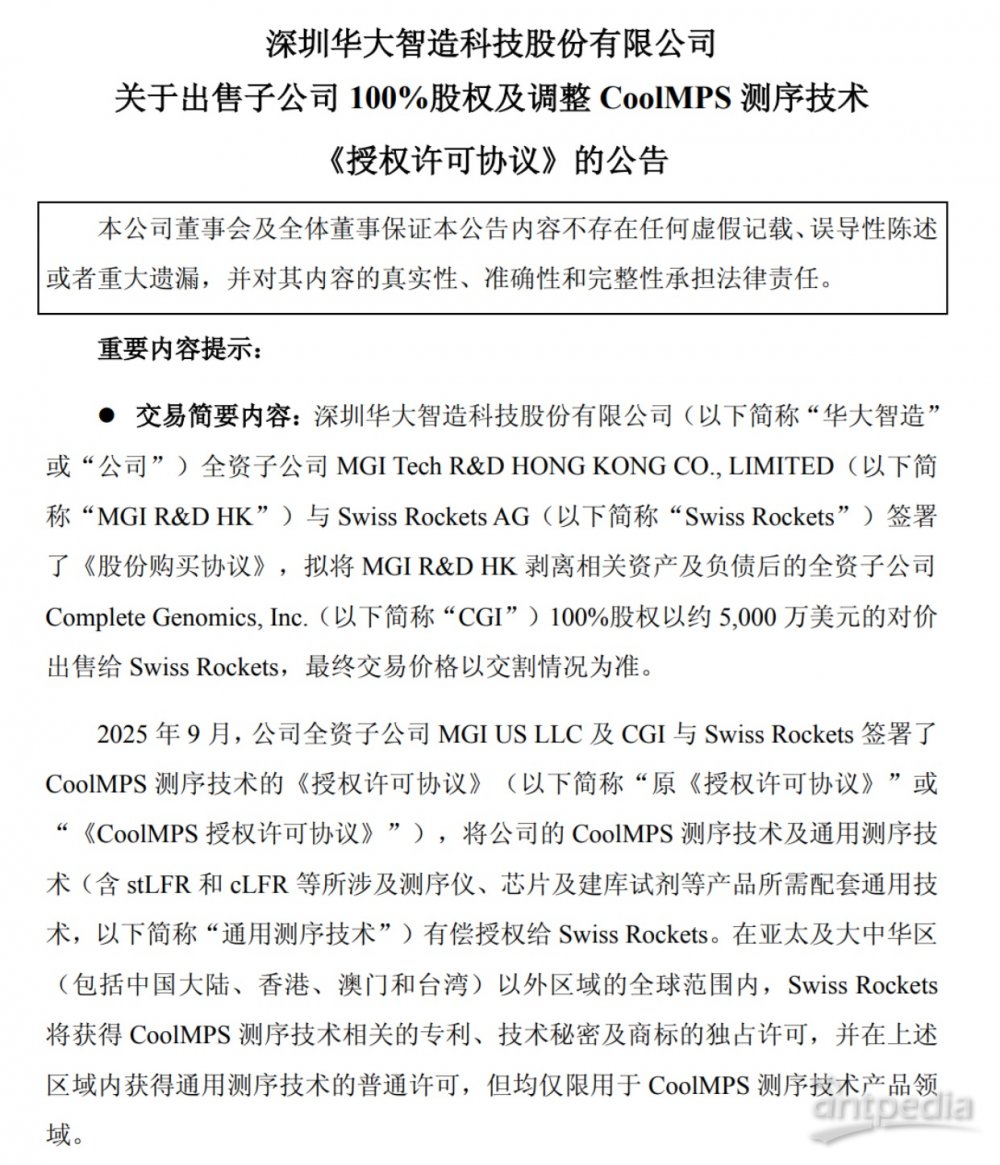
Core Viewpoint - BGI Genomics is undergoing a significant adjustment in its globalization strategy, marked by the sale of its U.S. subsidiary Complete Genomics (CGI) for $50 million to Swiss Rockets, alongside a core technology licensing agreement for its optical sequencing technology StandardMPS in North America [1][4]. Group 1: Strategic Shift - The divestiture of CGI is seen as a strategic "change of course" rather than a mere asset disposal, allowing BGI to alleviate ongoing losses and optimize its asset structure while retaining future strategic development space in North America [1][4]. - The transaction combines equity divestiture with core technology licensing, providing immediate cash flow and reducing operational uncertainties by transforming volatile business operations into structured, guaranteed licensing income [4][5]. Group 2: Financial Implications - BGI anticipates that the $50 million from the sale will significantly improve cash flow and reduce operational losses, with projections indicating a narrowing of net losses for 2025 compared to 2024 [1][5]. - The company expects to receive at least $120 million in licensing fees from Swiss Rockets, including an upfront payment of $20 million and potential milestone payments and sales shares [4][5]. Group 3: Market Context - The North American gene sequencing market is projected to reach approximately $6.87 billion in 2023, with a compound annual growth rate (CAGR) of 15.2% expected from 2024 to 2030, dominated by major players Illumina and Thermo Fisher Scientific [6]. - BGI's decision to shift focus from direct market entry to technology licensing is a response to the high compliance costs and competitive pressures in the North American market [6][8]. Group 4: Future Outlook - The transaction is part of a broader trend in the global gene sequencing industry, which is expected to exceed $25 billion by 2025 and $50 billion by 2030, with significant growth in the Chinese market [8]. - BGI's strategy aligns with national policies promoting the domestic production of high-throughput gene sequencing technologies, aiming to enhance its market position while mitigating risks associated with international operations [8][9].

MLCC涨价潮叠加稀土管制 国产替代趁势而起
Ju Chao Zi Xun· 2026-02-25 08:27
Core Viewpoint - The MLCC (Multi-Layer Ceramic Capacitor) market is experiencing a significant shift, driven by a surge in AI demand and supply chain restructuring, particularly due to restrictions on Japanese suppliers like TDK, which opens opportunities for Chinese manufacturers [2][6][12]. Group 1: Market Dynamics - The passive component sector, particularly MLCC, has seen a price increase of nearly 20% due to rising demand from AI applications, with major players like Murata considering price hikes [2][3]. - AI servers require significantly more MLCCs compared to traditional servers, with demand for AI servers reaching approximately 20,000 MLCCs per unit, compared to 2,200 for general servers [3]. - The high-end MLCC market is characterized by a supply shortage, with major manufacturers operating at over 80% capacity, and Murata's production levels reaching 90-95% [4][5]. Group 2: Supply Chain Changes - TDK's inclusion on a watch list by the Chinese Ministry of Commerce indicates stricter controls on rare earth materials, potentially disrupting its production capabilities and creating a supply gap in the high-end MLCC market [2][6]. - The restrictions on TDK could lead to a "shortage crisis" in the automotive and industrial supply chains, especially as demand for high-end MLCCs continues to rise [6]. Group 3: Opportunities for Chinese Manufacturers - Chinese MLCC manufacturers are positioned to fill the market gap left by TDK, leveraging their access to local resources and established supply chains [8][9]. - Companies like Fenghua Advanced Technology and Sanhui Group have made significant technological advancements, enabling them to produce high-end MLCCs that meet international standards [9][10]. - The market for MLCCs is projected to grow significantly, with estimates suggesting a global market size of 140.8 billion yuan by 2028, with Chinese market share exceeding 50% [12]. Group 4: Competitive Landscape - The competitive landscape is shifting, with Chinese firms transitioning from being alternative suppliers to primary providers, driven by the need for supply chain stability among clients [11][12]. - Major Chinese manufacturers are expanding their production capacities and entering global supply chains, with Fenghua Advanced Technology and Micro Capacitor Technology achieving significant market penetration [12][13]. - The technological advancements and increased production capabilities of Chinese firms are expected to enhance their market share in the high-end MLCC sector, challenging the dominance of Japanese manufacturers [9][13].



半导体设备ETF(159516)收涨超4.5%,行业周期上行与国产替代共振
Mei Ri Jing Ji Xin Wen· 2026-02-25 08:26
半导体设备ETF(159516)跟踪的是半导体材料设备指数(931743),该指数聚焦于半导体产业链中的 材料与设备领域,选取涉及半导体材料研发、生产及半导体设备制造的相关上市公司证券作为指数样 本,以反映半导体行业上游相关上市公司证券的整体表现。其成分证券具有高技术壁垒和成长性特征, 是捕捉该领域发展机遇的重要指标。 (文章来源:每日经济新闻) 2月25日,半导体设备ETF(159516)收涨超4.5%,行业周期上行与国产替代共振 消息面上,2月24日,台积电与ASML相继发布财报,台积电2025年第四季度盈利超预期并给出积极的 2026年资本开支指引,ASML单季度新增设备订单创历史新高。 平安证券指出,半导体设备材料板块方面,半导体库存去化趋势向好,终端基本面逐步回暖,周期上行 与国产替代形成共振。 ...


20cm速递|科创芯片ETF国泰(589100)收涨1%,半导体周期上行与国产替代共振
Mei Ri Jing Ji Xin Wen· 2026-02-25 08:25
Core Viewpoint - The semiconductor sector is experiencing an upward cycle driven by domestic substitution and increasing investments in AI hardware, with expectations for accelerated development in advanced semiconductor processes [1] Group 1: Semiconductor Market Trends - The semiconductor capital expenditure outlook is improving due to rising prices in computing, storage, and display panels [1] - The production capacity for third-generation electronic materials may become increasingly tight as Rubin Ultra gradually ramps up [1] Group 2: ETF Performance - The Guotai Science and Technology Chip ETF (589100) rose by 1% on February 25, tracking the semiconductor index (000685) which includes companies across the entire semiconductor industry chain [1] - The index has a daily price fluctuation limit of 20% and reflects the overall performance of listed companies in the semiconductor sector on the Sci-Tech Innovation Board [1]