
半导体

Search documents
兴森科技跌2.02%,成交额7.52亿元,主力资金净流出7817.39万元
Xin Lang Cai Jing· 2026-01-20 02:47
Group 1 - The core viewpoint of the news is that Xingsen Technology's stock has shown significant growth this year, with a 12.09% increase since the beginning of the year and a notable 23.59% increase over the past 20 days [2] - As of January 20, Xingsen Technology's stock price was 23.73 yuan per share, with a market capitalization of 403.33 billion yuan and a trading volume of 7.52 billion yuan [1] - The company's main business segments include PCB (Printed Circuit Board) at 71.45%, IC packaging substrate at 21.09%, and semiconductor testing board at 3.17% [2] Group 2 - For the fiscal year 2025 (January to September), Xingsen Technology reported a revenue of 5.373 billion yuan, representing a year-on-year growth of 23.48%, and a net profit attributable to shareholders of 131 million yuan, which is a remarkable increase of 516.08% [2] - The company has distributed a total of 1.129 billion yuan in dividends since its A-share listing, with 270 million yuan distributed over the past three years [3] - As of September 30, 2025, the top ten circulating shareholders include Hong Kong Central Clearing Limited and Southern CSI 500 ETF, with notable changes in their holdings [3]

中原证券晨会聚焦-20260120
Zhongyuan Securities· 2026-01-20 00:40
Key Insights - The report highlights that China's GDP for 2025 is projected to reach 1401879 billion yuan, reflecting a growth of 5.0% compared to the previous year, indicating a successful completion of the "14th Five-Year Plan" [5][8] - The semiconductor industry showed strong performance in December 2025, with a 5.11% increase in the domestic semiconductor sector, outperforming the broader market [19] - The electric power and utilities sector maintained a "stronger than market" investment rating, with a focus on stable, high-dividend companies in the sector [36][38] Domestic Market Performance - The Shanghai Composite Index closed at 4114.00, with a slight increase of 0.29%, while the Shenzhen Component Index rose by 0.09% to 14294.05 [3] - The average P/E ratios for the Shanghai Composite and ChiNext indices are 16.80 and 53.52, respectively, indicating a favorable environment for medium to long-term investments [9][10] Industry Analysis - The aerospace and electric grid sectors led the A-share market with slight gains, while the internet services and software development sectors faced challenges [6][9] - The battery and semiconductor sectors are highlighted as key areas for investment, with significant growth potential driven by technological advancements and market demand [11][12] Economic Indicators - The report notes a trend of increased capital inflow into the equity market, with a notable rise in margin trading balances, suggesting a positive outlook for market continuation [10][11] - The CPI showed a slight increase in December 2025, indicating marginal improvements in domestic demand [10][11] Sector-Specific Insights - The new energy vehicle sector saw sales of 171.0 million units in December 2025, a year-on-year increase of 7.14%, supported by favorable policies [15] - The chemical industry experienced a slowdown in price declines, with specific focus on agricultural chemicals and polyester filament [17] - The gaming industry is projected to continue its steady growth, with animation films leading box office revenues [27][30]

海默科技董事长杜勤杰:双轮驱动锁定转型发展新航线
Zhong Guo Zheng Quan Bao· 2026-01-19 23:16
Core Viewpoint - Haimer Technology is undergoing a strategic transformation rooted in two main pillars: its traditional business serves as a stable foundation, while investments in semiconductors and artificial intelligence provide a roadmap for future growth [2] Group 1: Strategic Transformation - The company has initiated a series of asset divestitures, including the transfer of 99.33% of Xi'an Sitan Instrument for 370 million yuan and a 20% stake in Haimer Underwater Production Technology for a total of 100 million yuan, aiming to raise over 450 million yuan [3] - The divestiture of non-core assets is intended to focus resources on more competitive and promising main businesses, thereby reserving capital for nurturing a second growth curve [3] Group 2: Investment in Emerging Technologies - Haimer Technology plans to invest 200 million yuan in the Chongqing Zhongxin Xicheng Liangshan Venture Capital Fund, which targets a total scale of 1.05 billion yuan, focusing on advanced packaging and the semiconductor and AI industry chain [4] - This investment is viewed as a critical step in laying the groundwork for future business development rather than merely a financial investment [4] Group 3: Talent and Organizational Restructuring - The company has introduced a stock incentive plan for 107 key employees, granting up to 41.065 million shares, which represents 8.05% of the total share capital [5] - A dual-layer assessment system has been established to ensure alignment between company performance and individual contributions, with a focus on achieving profitability by 2026 [5] Group 4: Financial Stability and Future Outlook - Currently, Haimer Technology is in a transitional phase where traditional business provides stable cash flow, accounting for over 55% of revenue, primarily from long-term contracts in the Middle East [6] - The company aims to maintain its competitive advantage in high-end oil and gas equipment while making substantial progress in the semiconductor and AI sectors [6]


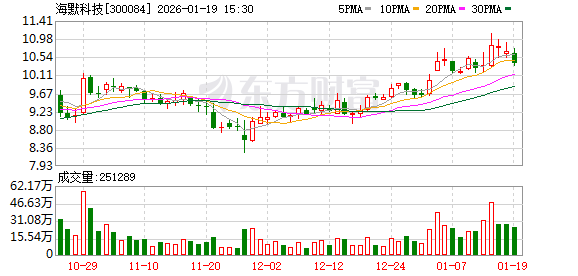
海默科技董事长杜勤杰: 双轮驱动锁定转型发展新航线
Zhong Guo Zheng Quan Bao· 2026-01-19 21:53
Core Viewpoint - Haimer Technology is undergoing a strategic transformation that combines its traditional business with investments in semiconductor and artificial intelligence sectors, aiming for a dual-driven growth model [1] Group 1: Strategic Transformation - The company has initiated a series of asset disposals, including the transfer of 99.33% of Xi'an Sitan Instrument for 370 million yuan and 20% of Haimer Underwater Production Technology for a total of 100 million yuan, to enhance its financial strength [2] - The expected cash inflow from these transactions is over 450 million yuan, which will significantly bolster the company's cash reserves to approximately 1 billion yuan, facilitating its strategic transition and new business development [2] - The focus of the asset divestiture is to concentrate resources on core businesses with greater competitive potential and to prepare for a second growth curve [2] Group 2: Investment in Emerging Technologies - Haimer Technology plans to invest 200 million yuan in the Chongqing Zhongxin Xicheng Liangshan Venture Capital Fund, which targets a total scale of 1.05 billion yuan, focusing on advanced packaging and the semiconductor and AI industry chain [3] - This investment is seen as a critical step in positioning the company for future growth, moving beyond mere financial investment to strategic involvement in high-tech sectors [3] - The fund has an 8-year lifespan with a 4-year investment period, offering an 8% annualized return after returning principal to partners, which helps manage investment risks while enabling potential industrial synergies [3] Group 3: Talent and Organizational Restructuring - To ensure cohesive execution of the transformation, the company has introduced a stock incentive plan for 107 individuals, granting up to 41.065 million shares, representing 8.05% of total equity [4] - The incentive plan includes a dual-layer assessment system that requires meeting both company-wide performance targets and individual performance metrics for unlocking rights [4] - Organizational adjustments have been made to strengthen strategic investment management by consolidating various departments, enhancing the company's ability to evaluate and engage in emerging industries [4][5] Group 4: Financial Stability and Future Outlook - Currently, Haimer Technology is in a transitional phase where traditional business provides stable cash flow while new industry investments pave the way for future growth [6] - The company’s main revenue from multiphase metering products and related services exceeds 55%, primarily from long-term contracts in the Middle East, providing a buffer for the transformation [6] - The chairman emphasizes a commitment to practical execution and a rejection of path dependency, aiming to solidify the company's competitive advantage in high-end oil and gas equipment while achieving substantial breakthroughs in semiconductor and AI sectors [6]
双轮驱动锁定转型发展新航线
Zhong Guo Zheng Quan Bao· 2026-01-19 21:11
Core Viewpoint - Haimer Technology is undergoing a strategic transformation that combines its traditional business with investments in semiconductor and artificial intelligence sectors, aiming for a dual-driven growth model [1][5]. Group 1: Strategic Transformation - The company is focusing on asset divestiture to enhance its financial strength, with plans to raise over 4.5 billion yuan through the sale of non-core assets [2]. - The board approved the transfer of 99.33% of Xi'an Sitan Instrument shares for 370 million yuan and 20% of Haimer Underwater Production Technology for 100 million yuan [1][2]. - The goal of these divestitures is to concentrate resources on more competitive and promising core businesses, thereby preparing for a second growth curve [2]. Group 2: Investment in Emerging Technologies - Haimer Technology plans to invest 200 million yuan in the Chongqing Zhongxin Xicheng Two Mountains Venture Capital Fund, which targets semiconductor and AI industries [2][3]. - The fund has a target size of 1.05 billion yuan and aims to invest in advanced packaging and related sectors [2]. - This investment is seen as a critical step in positioning the company for future growth and tapping into high-potential markets [3]. Group 3: Talent and Organizational Restructuring - The company has introduced a stock incentive plan for 107 key employees, granting up to 41.065 million shares, which represents 8.05% of the total share capital [3][4]. - A dual-layer assessment system will be implemented to ensure alignment between company performance and individual contributions [3]. - Organizational adjustments have been made to strengthen strategic investment management capabilities, combining various departments to enhance focus on emerging industries [4]. Group 4: Financial Stability and Future Outlook - The company’s traditional business still accounts for over 55% of its revenue, primarily from long-term contracts in the Middle East, providing a stable cash flow during the transition [4]. - The management emphasizes a commitment to maintaining a competitive edge in the oil and gas sector while pursuing breakthroughs in semiconductor and AI fields [5]. - The company expresses confidence in its strategic direction and readiness to adapt to new growth opportunities while ensuring a solid foundation [5].
液冷--不只有出海链
傅里叶的猫· 2026-01-19 15:39
Core Insights - The article discusses the growth potential of the liquid cooling market, particularly in China, driven by increasing domestic demand and regulatory support for energy-efficient data centers [1][5]. Group 1: Market Overview - China's "Special Plan for Green and Low-Carbon Development of Data Centers" mandates that by the end of 2025, the overall rack rate of data centers should not be less than 60%, with a PUE (Power Usage Effectiveness) of less than 1.5 [1]. - The article highlights that liquid cooling technology is becoming increasingly important, with PUE values for different cooling methods showing significant efficiency advantages: air cooling (1.4-1.6+), cold plate liquid cooling (1.1-1.2), and immersion liquid cooling (<1.09) [2]. Group 2: Cost and Delivery Models - The initial investment costs for air cooling are low, while cold plate liquid cooling has medium costs, and immersion cooling has high initial costs. However, operational costs are lower for immersion cooling compared to the other methods [2]. - The delivery models for liquid cooling systems can be categorized into decoupled and integrated delivery, with decoupled delivery allowing for more flexibility and competition in procurement, while integrated delivery offers clearer responsibility but may limit options [3][4]. Group 3: Industry Dynamics - The market for liquid cooling components is concentrated, with the top three suppliers holding an average market share of 60-70%. The top two suppliers have a combined market share exceeding 85%, indicating a strong oligopoly [5]. - Major manufacturers are projected to have significant procurement amounts for cold plates, with estimates of over 10 billion RMB for one major player and close to 15 billion RMB for another, highlighting the financial scale of the industry [5].

ETF周报2026年1月第1期:宽基ETF净流出超2000亿-20260119
East Money Securities· 2026-01-19 13:07
Group 1: Overall ETF Fund Flow Situation - The overall net outflow of the stock ETFs (excluding cross-border) from January 12 to 16, 2026, reached 1412.8 billion, a change of -1436.2 billion compared to the previous week, with a significant outflow of 1545.6 billion occurring on January 15 and 16 alone [12][15] - Money market ETFs have seen continuous net outflows in recent weeks, while A-share industry and thematic ETFs recorded a net inflow of nearly 700 billion in a single week, indicating that individual investors are actively entering the market [15][17] - Hong Kong stock ETFs experienced a net inflow of over 10 billion, continuing the inflow trend, while cross-border industry and thematic ETFs had a net inflow of 104.2 billion, slightly decreasing by 31.6 billion from the previous week [17][21] Group 2: Wide-based/Style/Industry/Sub-sector ETF Fund Flow Analysis - The total net outflow of wide-based ETFs reached 2126.2 billion, with those linked to the CSI 300 index seeing a net outflow of over 1000 billion, while the CSI 500, CSI A500, and other wide-based ETFs also experienced varying degrees of outflow [21][22] - In terms of Smart Beta and major industries, there was a notable inflow in dividend ETFs, particularly in the latter half of the week, while technology and cyclical sectors remain the hottest directions [21][24] - From January 12 to 16, the inflow in the non-ferrous metals sector showed strong sustainability, with software, artificial intelligence, media, and military industries also seeing significant net inflows, although some divergence was observed in the latter half of the week [24][26] Group 3: Representative ETF Fund Flow Overview - The top five ETFs with the highest net inflows from January 12 to 16 were: - Harvest CSI Software Service ETF (75.4 billion) - Southern CSI Shenwan Non-ferrous Metals ETF (63.7 billion) - GF CSI Media ETF (62.7 billion) - Yongying National Satellite ETF (58.0 billion) - Huaxia CSI Electric Grid Equipment Thematic ETF (38.9 billion) - The ETFs with the highest net outflows during the same period included: - Huatai-PB CSI 300 ETF (-475.2 billion) - Huaxia CSI 300 ETF (-269.7 billion) - E Fund Shanghai Stock Sci-Tech 50 ETF (-249.1 billion) - E Fund ChiNext ETF (-239.0 billion) - Huaxia Shanghai Stock 50 ETF (-191.1 billion) [30]
百元股数量创新高!这一板块扎堆
Xin Lang Cai Jing· 2026-01-19 11:47
Core Insights - The A-share market has reached a historic milestone with the number of stocks closing above 100 yuan reaching 222, driven primarily by the technology sector [1][6] - The surge in hundred-yuan stocks is attributed to market structure optimization, with funds concentrating on high-quality assets, particularly in AI, semiconductors, and high-end manufacturing [1][3] Group 1: Market Trends - The technology sector, especially companies in AI computing and semiconductors, has become the new focus of the A-share market, indicating a shift in core market drivers [2][7] - The top ten hundred-yuan stocks predominantly consist of technology companies, with only Kweichow Moutai being an exception, highlighting a concentration of "new tech" firms [2][7] Group 2: Company Performance - Companies like Cambricon Technologies, a leader in AI chips, reported a staggering revenue of 4.607 billion yuan for the first three quarters of 2025, marking a year-on-year increase of 2386.38% [3][8] - Source Code Technology, a leader in optical chips, achieved a revenue of 383 million yuan in the same period, reflecting a year-on-year growth of 115.09% [3][8] Group 3: Future Outlook - Experts predict that the expansion of hundred-yuan stocks is a sign of market maturity, with companies possessing core competitiveness likely to continue receiving valuation premiums [4][9] - The ongoing trend of long-term capital inflow and the continuation of technological industry trends suggest that the hundred-yuan stock group may continue to grow, although structural differentiation is expected to become more pronounced [3][4][9]


AI硬件板块震荡调整,半导体设备ETF易方达(159558)、云计算ETF易方达(516510)等产品受关注
Sou Hu Cai Jing· 2026-01-19 11:37
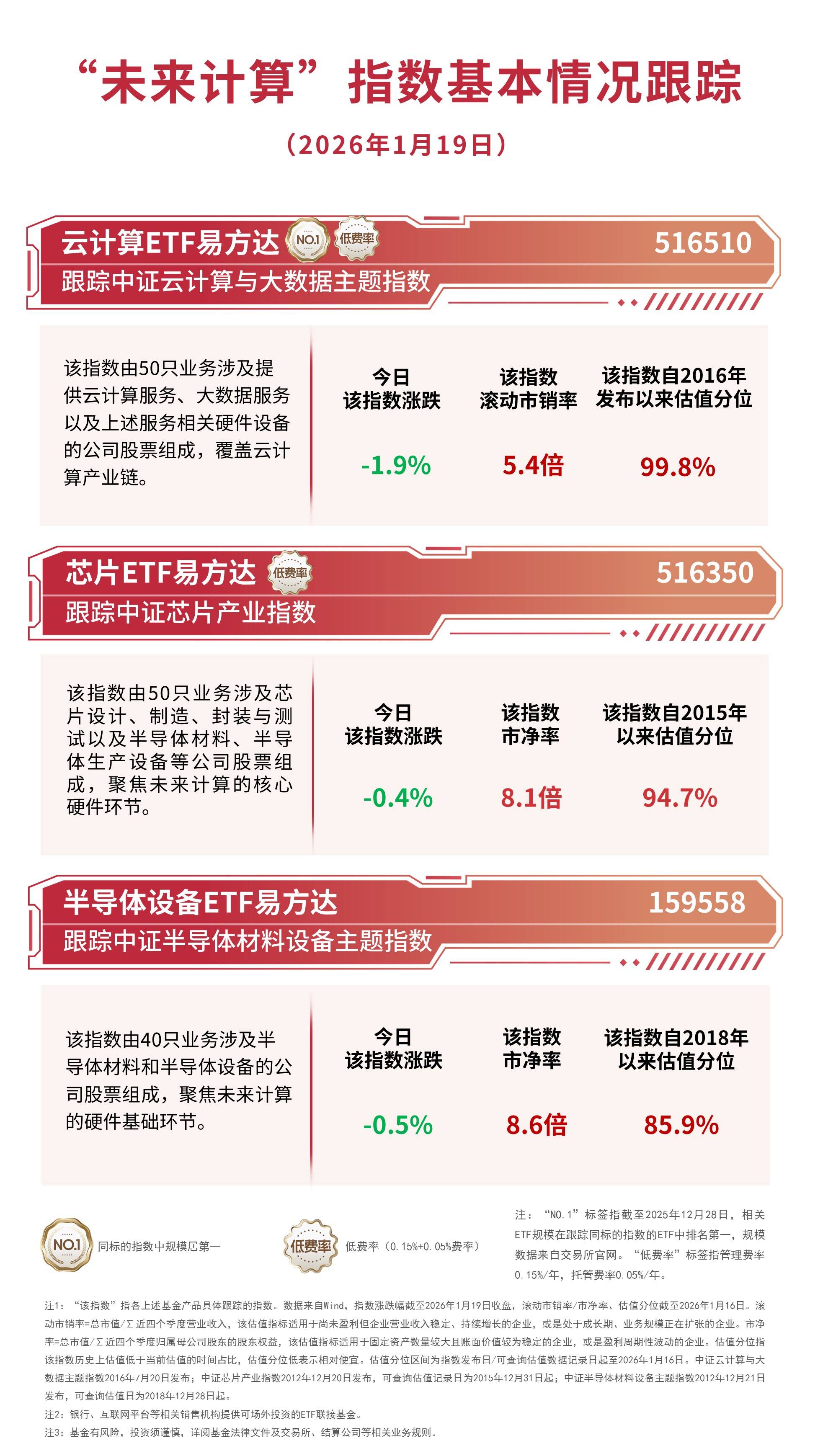
Group 1 - The AI hardware sector experienced fluctuations today, with the CSI Cloud Computing and Big Data Theme Index declining by 1.9%, the CSI Semiconductor Materials and Equipment Theme Index down by 0.5%, and the CSI Chip Industry Index falling by 0.4% [1] - Despite the market adjustments, there was a significant capital inflow into semiconductor equipment ETFs, with the E Fund Semiconductor Equipment ETF (159558) seeing a net subscription of over 170 million units throughout the day [1] - According to Dongwu Securities, domestic semiconductor equipment is entering a historic development opportunity, with a strong expansion cycle expected to begin in 2026, and the overall order growth rate for the semiconductor equipment industry is projected to exceed 30% [1] Group 2 - The semiconductor equipment ETF by E Fund tracks the CSI Semiconductor Materials and Equipment Theme Index, which consists of 40 companies involved in semiconductor materials and equipment, focusing on the hardware foundation for future computing [5] - The CSI Semiconductor Materials and Equipment Theme Index is composed of stocks from companies engaged in semiconductor design, manufacturing, packaging, testing, and semiconductor materials and production equipment [3]
金宏气体电子级二氯二氢硅产品顺利试生产 正全力推进在半导体客户端的测试认证
Zheng Quan Shi Bao Wang· 2026-01-19 10:17
Core Viewpoint - Jin Hong Gas (688106) reported a revenue of 2.031 billion yuan for the first three quarters of 2025, marking a 9.33% increase year-on-year, while net profit decreased by 44.9% to 116 million yuan [1] Group 1: Company Overview - Jin Hong Gas was established in 1999 and went public on the Sci-Tech Innovation Board in 2020, specializing in the research, production, sales, and integrated solutions of gases [1] - The company aims to be a leader in the gas industry by providing innovative and sustainable gas solutions [1] Group 2: Financial Performance - For the first three quarters of 2025, the company's operating cash flow amounted to 290 million yuan [1] - The sales revenue from specialty gases accounted for 33.07% of total revenue, with high-purity hydrogen, helium, nitrous oxide, mixed gases, and ultra-pure ammonia being significant contributors [1] Group 3: Product Development - The core product of the company's convertible bond fundraising project is electronic-grade dichlorodihydrosilane, which has entered trial production, with an expected annual capacity of 200 tons upon full production [1] - Jin Hong Gas is actively promoting the testing and certification of this product for semiconductor clients [1] Group 4: Market Strategy - Future growth in the specialty gas business is expected to come from three main areas: increased demand from the semiconductor sector, expansion of high-quality new customers, and the launch of new specialty gas products [2] - The company plans to enhance its market share in bulk retail while identifying quality acquisition targets for horizontal expansion [2] - In the on-site gas production business, the company will focus on new project opportunities and existing stock replacement [2]
