
去美元化

Search documents
期货市场交易指引2026年02月13日-20260213
Chang Jiang Qi Huo· 2026-02-13 01:47
1. Report Industry Investment Ratings - **Macro Finance**: Bullish on stock indices in the medium to long term, suggesting buying on dips; expecting treasury bonds to trade in a range [1][5] - **Black Building Materials**: Short - term trading for coking coal; range trading for rebar; buying on dips for glass [1][7] - **Non - ferrous Metals**: Reducing trading positions for general traders before the holiday for copper, increasing hedging coverage; strengthening observation for aluminum; observing for nickel; range trading for tin, gold, and silver; expecting lithium carbonate to trade in a range [1][9] - **Energy and Chemicals**: Range trading for PVC, styrene, rubber, urea, and methanol; temporarily observing for caustic soda and soda ash; expecting polyolefins to trade weakly [1][15] - **Cotton Textile Industry Chain**: Expecting cotton and cotton yarn to adjust in a range; expecting apples and jujubes to trade in a range [1][25] - **Agriculture and Animal Husbandry**: Partially taking profits on short positions in hogs before the year, adopting a rolling short strategy on rebounds; reducing positions in eggs before the holiday, avoiding short - chasing; being cautious about chasing highs in corn, suggesting hedging on rebounds for grain - holding entities; observing the performance of the M2605 contract at 2700 for soybean meal, shorting on highs [1][27] - **Oils and Fats**: High - level oscillation, suggesting buying on dips, paying attention to position risks before the holiday [3][32] 2. Core Views - The report provides investment suggestions for various futures products based on their fundamentals, market trends, and macro - economic factors. It takes into account factors such as supply and demand, inventory, cost, and policy to analyze the price trends of different futures and gives corresponding trading strategies [1][5][9] 3. Summary by Directory Macro Finance - **Stock Indices**: In the medium to long term, they are bullish, and investors can buy on dips. Before the holiday, they may trade in a range, and it is advisable to hold positions lightly and focus on defense [1][5] - **Treasury Bonds**: They are expected to trade in a range. Although the overall price level shows a mild recovery, the bond market's reaction to price data is limited. After the holiday, there are uncertainties regarding important meetings and bond supply [5] Black Building Materials - **Coking Coal**: Short - term trading is recommended as the coal market shows short - term fluctuations, but the sustainability of the price increase is limited [1][7] - **Rebar**: It is expected to trade in a range. The futures price is undervalued, but the demand has declined, and the inventory is accumulating. It is advisable to trade lightly before the holiday [7] - **Glass**: Buying on dips is recommended. Although there are supply and demand constraints, the futures price has fallen to a relatively low level, and there may be variables before the contract expires [7][8] Non - ferrous Metals - **Copper**: It is expected to trade in a range. The recent sharp decline is mainly due to macro - level panic. Although the supply is tight, the demand is weakening, and the inventory is increasing. General traders are advised to reduce positions, while hedgers are advised to increase hedging coverage [9] - **Aluminum**: It is expected to trade at a high level. The supply is increasing, but the demand is weakening. It is advisable to strengthen observation and reduce positions before the holiday [10] - **Nickel**: It is expected to trade in a range. Although the nickel ore supply is strong, the fundamentals are weak. It is recommended to observe [12] - **Tin**: It is expected to trade in a range. The supply of tin ore is tight, and the downstream demand is stable. It is recommended to trade in a range and pay attention to supply and demand changes [13][14] - **Silver and Gold**: They are expected to trade in a range. The market is affected by factors such as the nomination of the Fed chairman and economic data. The medium - term price center is rising, and short - term adjustment is expected. It is recommended to trade in a range [14][15] - **Lithium Carbonate**: It is expected to trade in a range. The supply is increasing, and the demand is in the off - season. It is necessary to pay attention to the impact of mine - end disturbances [15] Energy and Chemicals - **PVC**: It is expected to trade in a wide range at a low level. The supply is high, the demand is weak, but the valuation is low. It is necessary to pay attention to policies and cost factors [15][17] - **Caustic Soda**: It is expected to trade at a low level. The demand is weak, and the supply pressure is high. It is recommended to observe [17] - **Styrene**: It is expected to trade in a range. The inventory is expected to decrease, but the valuation is high. It is necessary to be cautious about chasing highs [19] - **Rubber**: It is expected to trade in a range. The supply is in the off - season, and the demand is weak before the holiday. It is necessary to pay attention to inventory and downstream consumption [19][20] - **Urea**: It is expected to trade in a range. The supply is increasing, the demand is stable, and the inventory is at a low level. It is recommended to trade in the range of 1730 - 1830 [20] - **Methanol**: It is expected to trade in a range. The supply is decreasing, the demand is weak, and the price is affected by geopolitical and port factors [21] - **Polyolefins**: They are expected to trade weakly. The supply is high, the demand is weak, and the inventory is accumulating. It is recommended to short on highs [22][24] - **Soda Ash**: It is recommended to observe. The supply is in surplus, but the cost support is strong, and the downward space may be limited [24] Cotton Textile Industry Chain - **Cotton and Cotton Yarn**: They are expected to adjust in a range. Although the long - term outlook is optimistic, the short - term is under pressure from the internal - external price difference [25] - **Apples**: They are expected to trade in a range. The market is stable during the Spring Festival stocking period, and the trading volume of different grades of fruits varies [25] - **Jujubes**: They are expected to trade in a range. The acquisition price in the production area is based on quality [27] Agriculture and Animal Husbandry - **Hogs**: They are expected to build a bottom in a range. Before the year, partial profit - taking on short positions is recommended, and a rolling short strategy on rebounds can be adopted. In the long - term, the supply is expected to increase in the first half of the year, and the price may be under pressure [27] - **Eggs**: They are expected to rebound from a low level. Before the holiday, the position should be reduced, and short - chasing should be avoided. It is advisable to hedge on rebounds for the 05 and 06 contracts [29] - **Corn**: The price increase is limited. In the short - term, it is necessary to be cautious about chasing highs, and grain - holding entities can hedge on rebounds. In the long - term, the supply - demand pattern is relatively loose [30][31] - **Soybean Meal**: It is expected to trade in a range at a low level. The M2605 contract should pay attention to the support at 2700, and short positions can be established on highs [31] Oils and Fats - They are expected to oscillate at a high level. The fundamentals of the three major oils are mixed, with soybean oil expected to be relatively strong, and palm oil and rapeseed oil relatively weak. It is recommended to buy on dips and pay attention to position risks before the holiday [32][37]
申银万国期货:昨夜贵金属下跌,白银跌幅较大
Jin Rong Jie· 2026-02-13 01:44
Core Viewpoint - Precious metals have declined, with silver experiencing a significant drop due to a decrease in market risk appetite and liquidity shocks impacting prices [1] Economic Data - The U.S. added 130,000 non-farm jobs in January, significantly exceeding the expected 70,000 [1] - The unemployment rate stands at 4.3%, lower than the anticipated 4.4% [1] - Following the data release, expectations for interest rate cuts have cooled, although the overall U.S. job market is trending towards a slowdown [1] Federal Reserve Outlook - The U.S. economy is expected to require interest rate cuts for support, particularly after the new Federal Reserve Chair takes office mid-year [1] Long-term Factors - Long-term supportive factors for gold, such as de-dollarization, geopolitical risks, and central bank gold purchases, remain intact [1] - The People's Bank of China has increased its gold holdings for the 15th consecutive month [1] Market Expectations - After sufficient market adjustments and accumulation of new positive factors, gold is anticipated to return to a steady upward trend [1] - Due to the higher volatility of silver compared to gold and the current low gold-silver ratio, investors are advised to adopt a wait-and-see approach [1]
IEA需求预警施压油市:申万期货早间评论-20260213
申银万国期货研究· 2026-02-13 00:54
Group 1: Oil Market Insights - The International Energy Agency (IEA) has revised down its forecast for global oil demand growth in 2026, now predicting a surplus of 3.73 million barrels per day, slightly higher than the previous month's estimate of 3.69 million barrels per day [1] - The surplus is primarily driven by increased supply from OPEC+ and non-OPEC countries, despite a slowdown in global oil demand growth [1][3] - The IEA has adjusted its forecast for global oil supply growth in 2026 from 2.5 million barrels per day to 2.4 million barrels per day, indicating that supply growth is outpacing demand growth [3] Group 2: Precious Metals Market - Precious metals, particularly silver, have seen significant declines, attributed to a drop in U.S. tech stocks and a decrease in market risk appetite [2][18] - The U.S. added 130,000 non-farm jobs in January, exceeding expectations, which has tempered interest rate cut expectations, although the overall employment market is cooling [2][18] - Despite short-term volatility, long-term factors such as de-dollarization, geopolitical risks, and central bank gold purchases remain supportive for gold prices, with expectations for a return to a steady upward trend [2][18] Group 3: Stock Market Overview - U.S. stock indices have declined, with a market turnover of 2.16 trillion yuan, and a reduction in financing balance by 15.917 billion yuan to 26.27824 trillion yuan [4][11] - February is expected to maintain a phase of positive momentum, supported by seasonal recovery in consumption and the release of policy dividends from the "14th Five-Year Plan" [4][11] - However, potential volatility in overseas capital markets during the upcoming holiday period, particularly due to geopolitical risks, should be monitored [4][11] Group 4: Agricultural Products - Brazil's cotton exports for the 2025/26 season are projected to reach 14.5 million bales, an increase of 1.5 million bales year-on-year, marking a record high for the third consecutive year [1] - The growth in cotton exports is primarily driven by demand from China, Bangladesh, Turkey, and India, with an expected year-on-year increase of 6% [1] Group 5: Commodity Price Movements - The COMEX reported a significant drop in registered silver inventory by 3.256882 million ounces, with total inventory falling below 100 million ounces to 98.138005 million ounces [1] - The physical outflow of qualified delivery silver exceeded 4.7 million ounces in a single day, indicating a net outflow from the trading system [1]


黄金“疯狂”行情背后推手:避险情绪共振、美元走弱、全球央行“入手”
Nan Fang Du Shi Bao· 2026-02-12 23:13
Core Viewpoint - The article discusses the significant factors driving the long-term bullish trend in the gold market over the past decade, highlighting geopolitical risks, changes in dollar credibility, collective central bank purchases, and shifts in asset allocation logic as the main drivers of gold's price surge. Group 1: Geopolitical and Economic Factors - The demand for gold as a safe-haven asset has surged due to increasing geopolitical and economic uncertainties, with events like Brexit, trade wars, and the Russia-Ukraine conflict contributing to gold price spikes [10][12][13] - The global macroeconomic risks and rising inflation expectations have acted as accelerators for gold prices, with significant price movements observed during key geopolitical events [13] Group 2: Dollar Weakness - The weakening of the US dollar has positively impacted gold prices, as a decline in dollar credibility makes gold more attractive to investors holding other currencies [14] - The total US national debt has ballooned from $18 trillion in 2015 to over $38 trillion, undermining confidence in the dollar and contributing to gold's price increase [14][15] Group 3: Central Bank Purchases - Central banks have significantly increased their gold reserves, with gold accounting for 20% of global central bank reserve assets by 2024, surpassing US Treasury bonds for the first time in 30 years by 2025 [16][17] - The annual gold purchases by central banks have exceeded 1,000 tons since 2022, indicating a strong and accelerating demand for gold as a reserve asset [17][18] Group 4: Changing Asset Allocation Logic - There has been a fundamental shift in global asset allocation, with gold emerging as a strategic investment asset rather than merely a decorative item, particularly in the Chinese market [19][20] - The younger demographic is increasingly investing in gold, with a notable rise in gold jewelry ownership among consumers aged 18 to 24, reflecting a shift towards more frequent and smaller-scale investments [20]

特朗普打出“王炸”,或将中国踢出美元体系,赖清德却高兴不起来
Sou Hu Cai Jing· 2026-02-12 22:35
Group 1 - The core objective of the recently passed Taiwan Protection Act by the U.S. House of Representatives is to exclude China from the SWIFT global financial system, aiming to cut off China's access to the global dollar settlement system [1][3] - Over 90% of cross-border trade is settled in U.S. dollars through SWIFT, and the U.S. believes that severing this connection will pressure China on the Taiwan issue [3] - China's foreign exchange reserves remain stable at over $3.4 trillion, and the use of the CIPS cross-border payment system has increased, with a 43% year-on-year growth in transaction volume in 2024, making it a reliable alternative to SWIFT [3][12] Group 2 - Financial sanctions have historically been a double-edged sword, as seen in the cases of Russia and Iran, where such measures led to accelerated de-dollarization globally [5][7] - The U.S. has previously removed countries from SWIFT, but these actions have not resulted in complete isolation; instead, they have prompted countries to seek alternative trade methods [7] - The U.S. financial decoupling from China could lead to significant repercussions for American businesses, as many rely on the Chinese market and supply chains [15] Group 3 - Taiwan's economy is highly dependent on exports to mainland China, and any disruption in financial channels could severely impact Taiwanese businesses [10] - The U.S. has a history of abandoning allies, which raises concerns for Taiwan regarding the reliability of American support [10] - China's long-term strategy includes reducing reliance on U.S. debt and increasing gold reserves, indicating preparedness against U.S. financial coercion [12][15] Group 4 - The global share of the Chinese yuan in foreign exchange transactions has risen to 8.6%, reflecting a growing willingness among countries to settle in yuan [13] - China's complete industrial system and large consumer market position it to withstand external financial pressures, suggesting that U.S. attempts to isolate China may backfire [13][17] - The narrative of U.S. financial dominance is challenged by China's resilience and industrial strength, indicating a shift in the global financial landscape [15][17]
中方持续9个月抛售美债后,美财长对我们说辞变了:绝不能脱钩,真相就藏在黄金和芯片里
Sou Hu Cai Jing· 2026-02-12 18:48
有意思的是,面对这个情况,美国财政部长贝森特最近公开讲话的调子却变了,他强调美国不希望和中国脱钩,甚至说中美关系处在"相当舒适的位置"。一 边是我们持续减持他们国家的"借条",另一边是他们高层放软话,这背后到底发生了什么?今天我们就来拆解一下这盘金融与战略交织的大棋。 最近金融圈有个大动静,中国还在持续抛售美国国债,而且手笔不小。到去年11月,咱们手里的美债已经降到6826亿美元,差不多是2008年金融危机时的水 平了。算下来,我们从2013年的顶峰时期,已经抛掉了将近一半。 过去,我们积累了大量的美元资产,主要是美国国债,这就像把很多鸡蛋放在了一个篮子里。现在,国际环境变了,把一部分鸡蛋挪到黄金、其他货币资产 以及全球实物投资里,是任何一个大型经济体都会做的风险分散操作。 更直接的背景是国际政治经济环境的不确定性在增加。过去几年,美国频繁使用金融制裁工具,比如在俄乌冲突后,冻结甚至讨论没收俄罗斯的美元资产。 这个举动给全世界所有持有大量美元资产的国家都敲响了警钟。大家心里都会打鼓:今天可以对俄罗斯这么做,明天如果关系紧张,会不会轮到我?这种潜 在的风险,促使中国必须提前做好准备,降低对单一美元资产的过度依赖 ...
2月10日金价:今日金价1130克,没意外的话,明后两天或迎更大级别行情
Sou Hu Cai Jing· 2026-02-12 11:07
Core Viewpoint - The domestic gold market has shown relative stability after experiencing significant fluctuations in international gold prices, with prices remaining above the critical psychological level of $5000 per ounce [1][5]. Domestic Gold Prices - The Shanghai Gold Exchange's gold T D price is reported at 1128.94 yuan per gram, a slight increase of 0.61% from the previous trading day [3]. - The basic gold price for AU9999 is 1117.37 yuan per gram, showing a minor decrease of 0.04% [3]. - Investment gold bars are priced between 1136 yuan and 1148 yuan per gram, with specific bank offerings such as China Construction Bank's Longding gold bar at 1144.25 yuan per gram and Bank of China at 1148.36 yuan per gram [3]. - Brand gold jewelry prices remain high, with brands like Chow Tai Fook and Chow Sang Sang priced at 1560 yuan per gram, which includes brand premiums and craftsmanship costs, approximately 400 yuan higher than the basic gold price [3]. International Gold Market - The spot gold price is at $5032.87 per ounce, slightly down by 0.50%, but still above the $5000 mark [5]. - International gold prices experienced extreme volatility, with a significant drop on January 30, followed by a sharp increase on February 3, marking the largest single-day increase since 2009 [5]. - The Shanghai Gold Exchange's gold T D price fell to a low of 1081 yuan per gram on February 5, a decrease of 4.29% from the previous day [5]. Factors Supporting Gold Prices - Global central bank gold purchases are a major driving force, with a reported net purchase of 230 tons in Q4 2025, a 6% increase quarter-on-quarter [6]. - China's gold reserves reached 2304.5 tons by the end of October 2025, reflecting a continuous increase over 12 months [6]. - The Federal Reserve's interest rate cuts have reduced the opportunity cost of holding gold, enhancing its appeal as a non-yielding asset [6]. - Geopolitical risks continue to inject uncertainty into the market, reinforcing gold's status as a traditional safe-haven asset [6]. - The supply-demand dynamics show a tightening market, with global gold production around 3600 tons per year from 2016 to 2024, while demand has surged to over 4500 tons annually from 2022 to 2024, creating a persistent supply gap [6]. Consumer Behavior in the Gold Market - The domestic physical gold market is characterized by simultaneous "consumption heat" and "recovery heat," driven by festive consumption and preservation needs as the Spring Festival approaches [8]. - There is a notable increase in foot traffic in brand gold stores, with some popular styles experiencing supply shortages [8]. - The gold recovery market is also bustling, with consumers opting to cash in at high prices, leading to increased business for recovery shops [8]. - Young consumers are changing their perception of gold, viewing it as both a store of value and a fashionable accessory [8]. - Sales personnel report a surge in customers concerned about potential price increases after the holiday, prompting pre-holiday purchases [8]. Market Dynamics - On February 10, the gold T D opened at 1119.5 yuan per gram, with a peak of 1130.8 yuan and a low of 1114.5 yuan, indicating a strengthening bullish sentiment [10]. - The silver market has shown even more volatility, with a reported drop of 9.71% as of February 5, highlighting the broader market fluctuations [10].
重仓超长期特别国债!偏债混合类理财产品入围收益榜前十
2 1 Shi Ji Jing Ji Bao Dao· 2026-02-12 09:06
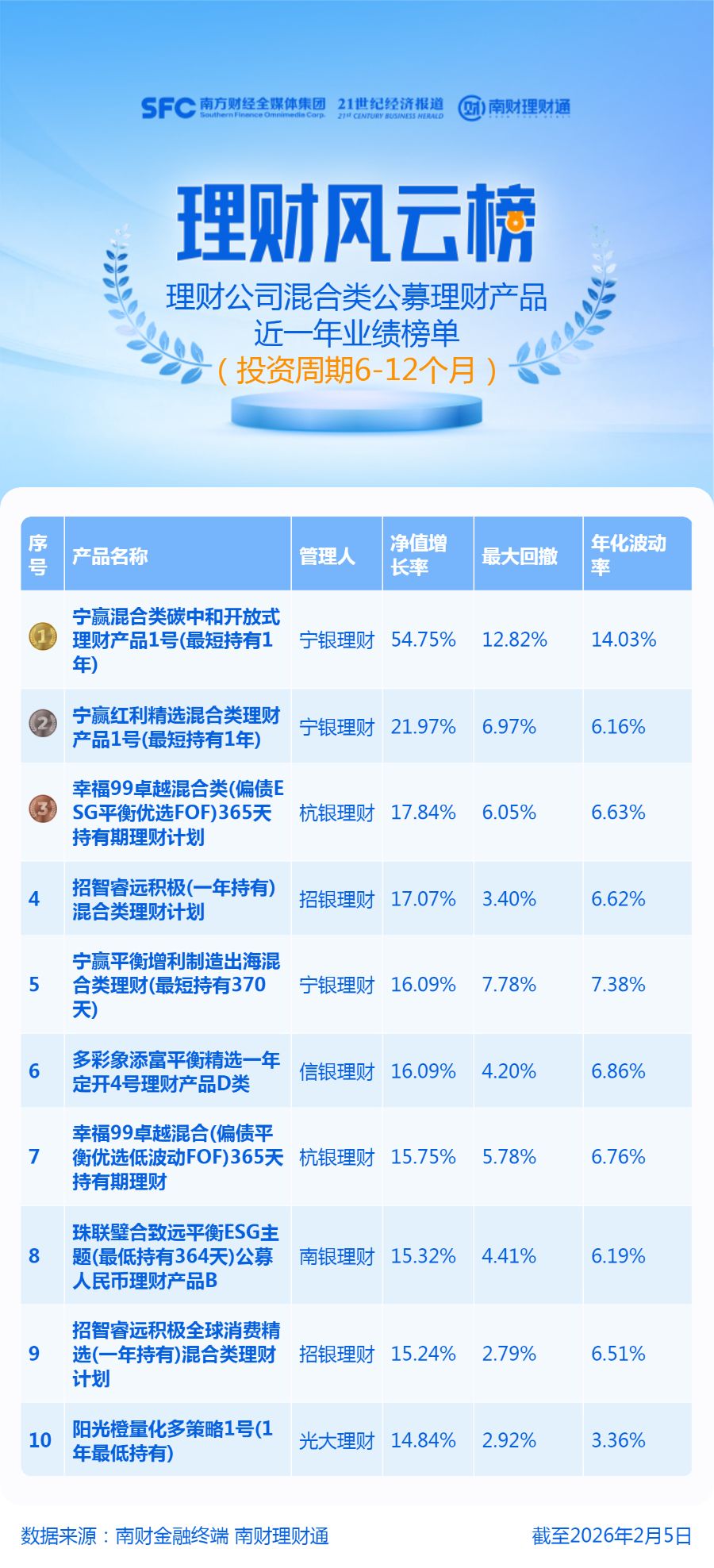
Core Viewpoint - The report highlights the performance of mixed public financial products over the past year, indicating a competitive landscape with several products achieving significant net value growth, particularly in the context of supportive policies for technology industries and global supply chain restructuring [5][6]. Market Performance - In Q4 2025, sectors such as new energy, semiconductors, and AI outperformed in the equity market due to supportive policies for the technology industry and global supply chain restructuring [5]. - Bond yields experienced a general upward trend influenced by marginal improvements in economic data and expectations of policy interest rate adjustments [5]. - Gold prices showed volatility and an upward trend supported by the acceleration of "de-dollarization" and geopolitical risks [5]. Overall Performance of Mixed Public Financial Products - As of February 5, 2026, there were a total of 214 mixed public financial products with investment periods of 6-12 months [6]. - Among these, 11 products achieved a net value growth rate exceeding 15%, with approximately 30% of products showing growth rates between 5% and 10%, and nearly 60% falling within the 1% to 5% range [6]. - Notable institutions include Ningyin Wealth Management with three products listed, while Zhaoyin Wealth Management and Hangyin Wealth Management each had two products featured [6]. Product Asset Allocation Overview - Ningyin Wealth Management's top three products maintained high equity investment ratios, with the leading product experiencing a maximum drawdown of 12.82% over the past year [7]. - Hangyin Wealth Management's two products had equity investments not exceeding 20%, focusing on government bonds and index funds [7]. - The "Happiness 99 Excellent Mixed (Debt-Weighted ESG Balanced Preferred FOF) 365-Day Holding Period Financial Plan" heavily invested in long-term government bonds, with 30-year and 50-year bonds making up 21.66% and 20.03% of the portfolio, respectively [7]. - Zhaoyin Wealth Management's products included over 20% allocation to QDII overseas investments, with a focus on bank perpetual bonds and TLAC non-capital bonds [7][8]. - Xinyin Wealth Management's "Colorful Elephant Tianfu Balanced Selected One-Year Open-End Financial Product D" had a bond holding ratio of 61.74%, with a diversified investment approach [8]. - Nanyin Wealth Management's "Pearl Link and Combine Excellent ESG Theme (Minimum Holding 364 Days) Public RMB Financial Product B" had a fixed income asset ratio of 59.20% [8]. - Everbright Wealth Management's "Sunshine Orange Quantitative Multi-Strategy No. 1 (Minimum Holding of 1 Year)" had a fixed income investment ratio of 33.44% [8].
2300吨黄金运抵回国,丢失定价权,美财长开甩锅中国,美元已经没救了
Sou Hu Cai Jing· 2026-02-12 08:21
Core Viewpoint - The global financial system, previously dominated by the US dollar, is undergoing significant transformation, as evidenced by the volatility in the gold market [1] Group 1: Gold Market Dynamics - In January 2026, gold prices experienced extreme fluctuations due to a widespread loss of confidence in the US dollar, exacerbated by significant fiscal policy disagreements between US political parties [3] - US Treasury Secretary Scott Bessent attributed the collapse of speculative bubbles to actions by Chinese traders, specifically tightening margin requirements, which highlights the declining control of the US over the gold market [3][4] - The US federal debt approached $40 trillion in 2026, with rising interest payments creating a heavy fiscal burden, prompting investors to seek more reliable assets [4] Group 2: De-dollarization Trends - The trend of de-dollarization accelerated in 2024, with countries like India and Turkey significantly increasing their gold purchases, moving physical gold back to their home countries, which impacts the New York Federal Reserve's gold reserves [6] - The People's Bank of China resumed its gold accumulation plan in November 2024, increasing reserves by tens of thousands of ounces monthly, surpassing 2,300 tons by January 2026, enhancing the security and availability of its reserves [6][10] - China's trade surplus exceeded $1 trillion in 2025, with part of the funds used to purchase gold at lower prices, improving cost efficiency compared to previous high-price buying strategies [6] Group 3: Currency and Payment Systems - The share of the Chinese yuan in cross-border payments rose to 6% in 2025, correlating with the growth in gold reserves and facilitating the expansion of multilateral clearing systems [8] - The rise of digital currencies and local currency settlement tools supports the de-dollarization movement, with Middle Eastern oil-exporting countries beginning to explore contracts settled in yuan in early 2026 [8] - Despite US inflation being kept below 3% in 2025, price pressures remain, leading central banks to seek alternative anchors, reflecting the fragility of the dollar system [8] Group 4: Historical Context and Future Outlook - The historical context of the US dollar decoupling from gold in the early 1970s mirrors the current upheaval in the gold market, indicating a shift in market resilience from the West to the East [11] - Bessent's blame on Chinese traders underscores anxiety within the US financial sector, as gold price fluctuations are no longer solely influenced by the Federal Reserve [11] - The shift towards physical gold trading in Shanghai over virtual contracts in London is shortening settlement cycles and reducing exchange rate volatility, enhancing China's position against dollar fluctuations [10]

贵金属数据日报-20260212
Guo Mao Qi Huo· 2026-02-12 07:08
1. Report Industry Investment Rating - Not provided in the given content 2. Core Viewpoints of the Report - In the short - term, precious metal prices are expected to continue to fluctuate within a stable range, and investors are advised to pay attention to US CPI data. During the long Spring Festival holiday, investors are recommended to hold light positions to avoid risks from overseas market fluctuations. [6] - In the long - term, the underlying logic of the precious metal bull market remains solid. With the probability of the Fed cutting interest rates this year, continuous global geopolitical uncertainties, and the US's huge debt promoting the de - dollarization wave, the allocation demand of global central banks, institutions, and residents is expected to continue. The price center of precious metals still has room to rise, and long - term strategies suggest buying on dips. [6] 3. Summary by Relevant Catalogs 3.1 Price Tracking - **2.11 vs 2.10 Price Changes**: On February 11, compared with February 10, London gold spot rose 0.8% to $5064.52 per ounce, London silver spot rose 2.7% to $83.45 per ounce, COMEX gold rose 0.9% to $5088.90 per ounce, COMEX silver rose 2.9% to $83.23 per ounce, AU2602 rose 0.8% to 1133.00 yuan per gram, AG2602 rose 4.0% to 20505.00 yuan per kilogram, AU (T + D) rose 0.8% to 1126.49 yuan per gram, and AG (T + D) rose 4.0% to 19949.00 yuan per kilogram. [5] - **2.11 vs 2.10 Spread/Ratio Changes**: The gold TD - SHFE active spread rose 9.2% to - 6.51 yuan per gram, the silver TD - SHFE active spread rose 4.9% to - 556 yuan per kilogram, the gold internal - external spread (TD - London) rose 8.9% to - 4.16 yuan per gram, the silver internal - external spread (TD - London) fell 16.2% to - 977 yuan per kilogram, the SHFE gold - silver ratio fell 3.1% to 55.25, the COMEX gold - silver ratio fell 2.0% to 61.15, the AU2604 - 2602 spread fell 5.1% to 2.60 yuan per gram, and the AG2604 - 2602 spread fell 23.4% to - 439 yuan per kilogram. [5] 3.2 Position Data - **2.10 vs 2.9 Position Changes**: On February 10, compared with February 9, the gold ETF - SPDR decreased 0.03% to 1079.32 tons, the silver ETF - SLV increased 0.16% to 16216.45052 tons, the non - commercial long positions of COMEX gold decreased 14.91% to 214508 contracts, the non - commercial short positions increased 4.71% to 48904 contracts, the non - commercial net long positions decreased 19.37% to 165604 contracts, the non - commercial long positions of COMEX silver decreased 10.56% to 38883 contracts, the non - commercial short positions decreased 34.22% to 13006 contracts, and the non - commercial net long positions increased 9.17% to 25877 contracts. [5] 3.3 Inventory Data - **2.11 vs 2.10 Inventory Changes**: On February 11, compared with February 10, the SHFE gold inventory remained unchanged at 105072.00 kilograms, the SHFE silver inventory increased 5.79% to 342102.00 kilograms, the COMEX gold inventory decreased 0.18% to 35229811 troy ounces, and the COMEX silver inventory decreased 1.07% to 386273025 troy ounces. [5] 3.4 Interest Rates/Exchange Rates/Stock Market - **2.11 vs 2.10 Interest Rates/Exchange Rates/Stock Market Changes**: On February 11, compared with February 10, the US dollar/Chinese yuan central parity rate fell 0.03% to 6.94, the US dollar index rose 0.01% to 96.87, the 2 - year US Treasury yield fell 0.86% to 3.45%, the 10 - year US Treasury yield fell 1.42% to 4.16%, the VIX rose 2.48% to 17.79, the S&P 500 fell 0.33% to 6941.81, and NYWEX crude oil fell 0.34% to 64.20. [5] 3.5 Market Review - On February 11, the main contract of Shanghai gold futures closed up 0.56% to 1130.4 yuan per gram, and the main contract of Shanghai silver futures closed up 1.88% to 20944 yuan per kilogram. [5] 3.6 Influencing Factor Analysis - The uncertainty of the Middle East geopolitical situation has increased, and safe - haven demand and continued gold purchases by global central banks have pushed up precious metal prices. However, the unexpectedly strong US January non - farm payrolls report has shifted the market's expectation of the Fed's first interest rate cut from June to July, strengthening the US dollar index and pressuring precious metal prices. [6] - For silver, the relatively high London spot silver lease rate, the decline in New York inventory, and the low - level inventory of the Shanghai Futures Exchange limit the downward space of silver prices. But due to the inflow of imported silver into the market and weak pre - holiday market demand, the domestic silver price is continuously at a discount to the overseas price, and the monthly spread of silver futures has also narrowed. [6]