
戴维斯双击

Search documents
大盘股反弹,深证100为何总能 “拔得头筹” 成最强?
Xin Lang Cai Jing· 2025-07-31 08:39
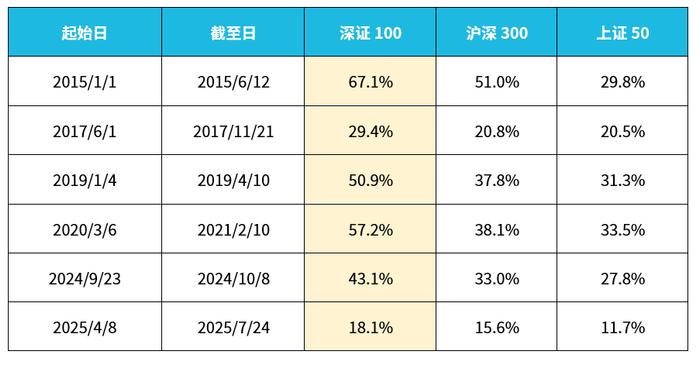
Group 1 - The core viewpoint of the article highlights that the Shenzhen 100 index often leads the market rebound, significantly outperforming other broad-based indices during upward trends over the past decade [1][2] - Historical performance data shows that the Shenzhen 100 index had the highest rebound rates compared to the CSI 300 and SSE 50 during various market uptrends, with a peak rebound of 67.1% from January 1, 2015, to June 12, 2015 [1] - The index is characterized by a strong growth factor exposure, with its constituent stocks primarily in high-growth sectors such as new energy and semiconductors, indicating a preference for high-growth potential assets [2][4] Group 2 - The Shenzhen 100 index is classified as a "large-cap growth" index, with a significant positive exposure to the size factor, reflecting a heavy allocation to leading enterprises [1][4] - The index's constituents exhibit high revenue growth rates and net profit growth rates, which are consistently above market averages, further emphasizing its growth-oriented nature [2][4] - The Morningstar style box is used to classify the index's investment style, positioning it as the strongest in growth among large-cap indices [4] Group 3 - The article discusses the profitability and growth expectations of the Shenzhen 100 index, noting that its high return on equity (ROE) provides a buffer during market adjustments, making its valuation more stable [9][11] - The index's rebound potential is supported by its constituent stocks, which are leaders in their respective industries, ensuring stable revenue and profit even during market corrections [14] - The top ten constituents of the Shenzhen 100 index include major companies like CATL and BYD, which are positioned in sectors with long-term growth prospects [15]

港美股看台丨年内港股表现领先全球,还能涨吗?
Zheng Quan Shi Bao· 2025-07-30 12:45
Group 1 - The Hong Kong stock market has shown strong performance in 2025, with the Hang Seng Index rising over 25% year-to-date, outperforming major global markets such as the US, Japan, and Europe [1][2] - The recent volatility in the Hong Kong market, including a 1.36% drop on July 30, marks the largest single-day decline in over a month, raising questions about future opportunities [1][6] - Positive factors driving the Hong Kong market's strength include stable economic performance with GDP growth exceeding 5%, improved US-China relations, and positive developments in certain domestic industries [2][3] Group 2 - Structural factors contributing to the Hong Kong market's performance include valuation advantages and strong profit growth, attracting global capital [3] - The "China asset safe haven" effect has become significant, with international capital reallocating towards Hong Kong amid easing external pressures [3] - Southbound capital has played a crucial role in the Hong Kong market, with net purchases reaching 853.7 billion HKD year-to-date, surpassing the total for the entire previous year [4] Group 3 - The trading activity of Southbound capital has increased, with total transaction volume exceeding 15 trillion HKD in 2025, indicating heightened interest from international investors [4] - Korean financial institutions have shown a strong interest in the Hong Kong market, with their trading volume in the first five months of the year exceeding 1.5 trillion HKD, a significant increase compared to the previous year [5] - Despite recent fluctuations, the Hong Kong market is still considered to have room for growth, as current levels remain significantly below historical highs [6]
年内港股表现领先全球,还能涨吗
Zheng Quan Shi Bao· 2025-07-30 11:40
还有上涨空间吗? 港股市场在年内表现领先全球后,近几个交易日波动开始加大。其中7月30日,恒生指数收盘下跌 1.36%,创出近一个多月来最大单日跌幅。 在波动加大后,港股市场后续还有机会吗? 年内港股表现领先全球 在2024年触底回升后,2025年以来港股市场再接再厉,总体强劲上行,并领先于全球主要股市。 2025年以来,港股市场恒生指数年内累计上涨超过25%,明显超过同期美、日、欧等主要市场股市表 现。数据显示,当地时间年初至7月29日,美股市场道琼斯工业指数累计上涨4.91%,纳斯达克综合指 数累计上涨9.26%,标准普尔500指数累计上涨8.32%。此外,日本股市中,日经225指数2025年以来累 计上涨1.91%。 另外,港股市场主要指数年内表现也优于同期A股市场主要指数表现。数据显示,2025年以来,上证指 数累计涨幅为7.88%。 不过,在经历连续上涨后,港股市场近几个交易日上行遇阻,波动也明显加大。其中7月30日 ,恒生指 数下跌1.36%,创出近一个多月来最大单日跌幅。 对于推动年内港股市场持续走强,并优于其他主要股市的主要因素,保银投资总裁、首席经济学家张智 威在接受证券时报记者采访时认为, ...
港美股看台丨年内港股表现领先全球,还能涨吗?
证券时报· 2025-07-30 11:38
Core Viewpoint - The Hong Kong stock market has shown strong performance in 2025, leading global markets, but has recently experienced increased volatility and a significant drop on July 30, 2025 [1][6]. Market Performance - The Hang Seng Index has risen over 25% in 2025, outperforming major global markets such as the US and Japan, where the Dow Jones, Nasdaq, and S&P 500 have increased by 4.91%, 9.26%, and 8.32% respectively [4]. - The Shanghai Composite Index has only seen a cumulative increase of 7.88% during the same period, indicating that Hong Kong's performance is superior to that of A-shares [5]. Factors Driving Market Strength - Three main factors have contributed to the strong performance of the Hong Kong stock market: stable economic growth with a GDP growth rate exceeding 5%, improved US-China relations, and positive developments in certain domestic industries such as innovative pharmaceuticals [8]. - The "Davis Double Play" effect, characterized by low valuations and strong profit growth, has attracted capital to the Hong Kong market, making it a preferred choice for global investors seeking to avoid risks associated with high-valued markets [9]. - The influx of southbound capital has significantly influenced the pricing power in the Hong Kong market, with southbound trading accounting for a larger share of total trading volume in 2025 compared to 2024 [9][10]. Capital Inflows - As of July 30, 2025, southbound trading has seen a net inflow of 853.7 billion HKD, surpassing the total net inflow for the entire year of 2024 [11]. - The total trading volume of southbound capital has exceeded 15 trillion HKD in 2025, indicating heightened trading activity compared to 11.23 trillion HKD in 2024 [12]. Future Outlook - Despite recent volatility, the Hong Kong market is still considered to have room for growth, as current levels remain significantly below historical highs [14]. - Analysts suggest that ongoing positive factors may continue to support the market, with expectations of favorable news emerging in the near future [15]. - The strong performance of the Hong Kong market is closely linked to foreign capital inflows and the significant role of southbound capital, with sectors like AI and innovative pharmaceuticals gaining consensus among investors [16].

港股医械携手AI板块飙升:政策与资金共舞,戴维斯双击效应显现
2 1 Shi Ji Jing Ji Bao Dao· 2025-07-30 09:57
Core Viewpoint - The medical device and consumables sectors, along with AI healthcare, are experiencing significant growth driven by favorable policies and market dynamics. Group 1: Medical Device and Consumables Sector - The Hong Kong medical ETF (159366) saw a rise of over 4.5% on July 30, with a trading volume nearing 600 million, benefiting from the active market for innovative drugs and devices [1] - The medical device ETF (159883) recorded a net inflow of 2.03 billion, ranking first among comparable funds, with a total of 7.14 billion in net inflows over nine consecutive days [1] - Policy expectations are positive, with high-value consumables expected to benefit from improved procurement policies, leading to a reduction in valuation pressure and a more stable long-term performance outlook for leading companies [1][3] Group 2: Policy Support and Market Dynamics - Continuous policy support for the medical consumables sector is shifting the focus from price wars to value wars, with the National Medical Insurance Bureau facilitating the pricing of innovative medical consumables [3] - The optimization of the 11th batch of national drug procurement rules aims to address the issue of price undercutting, allowing companies to maintain profit margins and focus on innovation [3][4] - The simplification of the approval process for innovative consumables is expected to accelerate their market entry, enhancing the support for clinically valuable new products [4] Group 3: AI Healthcare Sector - The AI healthcare sector is gaining momentum, with the 2025 World Artificial Intelligence Conference showcasing practical applications that address clinical challenges and promote scalable solutions [5] - The release of the "2025 Artificial Intelligence + Health Shanghai Practice" outlines a development path for AI healthcare, focusing on data flow issues and the integration of AI with biomedicine [5] - The Hong Kong medical ETF (159366) has become a key investment vehicle for AI healthcare, reflecting a 7.36% increase over the past week, driven by the sector's growth potential [6] Group 4: Investment Trends and Market Sentiment - The release of policy benefits has positioned medical consumables and AI healthcare as core investment areas, with significant capital inflow observed in these sectors [6] - The recovery of domestic medical equipment procurement is expected to boost upstream consumable demand, while AI healthcare companies in Hong Kong are attracting foreign investment due to their technological advantages [6][7] - The collaboration between the recovery of the CXO sector and AI healthcare is amplifying growth potential, as domestic CXO companies leverage cost advantages to secure more AI-driven drug development contracts [7]
指数从正常估值到高估,会涨多少呢?
银行螺丝钉· 2025-07-30 04:01
Core Viewpoint - The A-share market has experienced a rare six-week consecutive rise, with the Shanghai Composite Index consistently surpassing 3600 points, indicating a recovery from undervaluation to normal valuation, with potential for further increases [1]. Group 1: Factors Influencing Index Growth - The potential increase in index value depends on two main factors: the difference in valuation at the time of buying and selling, and the growth in earnings during the holding period [5]. - The formula for index points is defined as: Index Points = Valuation * Earnings [4]. - Historical data shows that from May 2018 to March 2021, the CSI All Share Index rose over 80%, with valuation improvement contributing approximately 40-50% of this gain [7][8]. Group 2: Valuation and Earnings Growth - The increase in index value from normal to high valuation is generally estimated to be between 20-40%, depending on the volatility of the index [12]. - While valuation improvement is relatively predictable, the growth in earnings is more challenging to forecast and is influenced by economic cycles [14][15]. - Different bull markets exhibit varying degrees of index growth due to fluctuations in earnings, as seen in the bull markets of 2007, 2009, and 2015 [16]. Group 3: Investment Strategy - The optimal investment scenario is characterized by a "Davis Double Play," where low valuations during a downturn are followed by both valuation and earnings growth as the market recovers [17][20]. - In Q1 2025, listed companies showed a year-on-year earnings growth of 4.46%, indicating signs of recovery, particularly in sectors like technology and pharmaceuticals [21]. - The implementation of favorable policies in the previous year is expected to gradually reflect in the earnings growth of listed companies [26].

ST盛屯(SH.600711):上半年营收同比增长20.94%,产能持续扩张
Cai Fu Zai Xian· 2025-07-30 03:27
Core Viewpoint - 盛屯矿业 demonstrated strong stability in its half-year report for 2025, with a revenue of 13.804 billion yuan, a year-on-year increase of 20.94%, and a net profit of 1.053 billion yuan, reflecting the company's focus on strategic metal resources like copper, nickel, and cobalt [1] Group 1: Financial Performance - In the first half of 2025, the company achieved a total profit of 1.352 billion yuan, a year-on-year increase of 0.47%, and basic earnings per share of 0.34 yuan [1] - The energy metals business generated revenue of 9.187 billion yuan, with copper production at 102,600 metric tons and nickel production at 24,500 metric tons, reflecting a year-on-year growth of 9.87% [2] - The basic metals business recorded sales revenue of 3.849 billion yuan, with gold production reaching 110.23 kg [4] Group 2: Strategic Initiatives - The company is enhancing resource security through deepening resource layout, strengthening project management, and fostering strategic partnerships [1] - A joint venture with Xiamen Xatong New Energy Materials Co., Ltd. aims to build a production line for 40,000 tons of new energy battery precursors in Guizhou Province [3] - The company is actively expanding its production capacity, with ongoing projects to increase copper production capacity to 120,000 metric tons per year [2] Group 3: Cost Management and Operational Efficiency - The company is focused on cost control and operational efficiency, achieving a period expense ratio of 5.90%, a decrease of 0.33 percentage points year-on-year [5] - Continuous optimization of the operational system and detailed management practices have led to significant improvements in operational efficiency [6] - The company is positioned to benefit from a favorable industry outlook, with expectations of profit and valuation growth [6]

港股创新药50ETF(513780)盘中涨超2%!港股创新药继续猛攻,板块有望迎来“戴维斯双击”!
Jin Rong Jie· 2025-07-30 02:58
Group 1 - The core viewpoint of the articles highlights the strong performance and growth potential of the Hong Kong innovative drug sector, particularly the Hong Kong Innovative Drug 50 ETF, which has seen a year-to-date increase of 105% [1][2] - The Hong Kong Innovative Drug 50 ETF has attracted significant capital inflow, with a net inflow of 340 million yuan over the last five trading days and over 600 million yuan in the past three months, indicating accelerated investment interest [1] - The CRO and CDMO sectors are expected to experience a recovery in demand due to multiple factors, including the anticipated easing of overseas interest rates in Q4 2024 and the introduction of significant policies in 2025, which could lead to a "Davis Double Play" scenario of simultaneous profit and valuation increases [1] Group 2 - The mid-year reporting season is expected to show performance in the innovative drug sector similar to Q1, with a positive outlook for sub-sectors such as innovative drugs and the innovative drug supply chain, which are showing signs of recovery [2] - The top ten constituents of the China Securities Hong Kong Stock Connect Innovative Drug Index account for 70.03% of the index, including high-quality A-share companies like Innovent Biologics and CSPC Pharmaceutical Group, indicating a strong focus on innovative drug research and development [2] - The domestic innovative drug sector is at a new historical starting point, with companies enhancing their competitiveness and expanding overseas, supported by rapid revenue growth and favorable policies [2]
保险框架:“慢牛市”下的戴维斯双击
2025-07-30 02:32
Summary of Conference Call on the Insurance Industry Industry Overview - The insurance industry is currently experiencing a "slow bull market" driven primarily by investment yield improvements, with a low proportion of new business relative to existing liabilities. The key to future profitability lies in the widening gap between investment yields and liability costs [1][2]. Core Insights and Arguments - **Investment Yield and Liability Costs**: The pricing rate for ordinary life insurance is set to decrease by 50 basis points (BP), which will improve existing liability costs, although the extent of this improvement remains to be seen. The dynamic adjustment mechanism and cost control measures are expected to continue enhancing the cost of existing liabilities [1][2]. - **Regulatory Adjustments**: Regulatory changes and market stabilization measures have increased the capacity and willingness of insurance funds to allocate to equity assets. It is anticipated that 30% of new premiums will be allocated to equity assets, which will help boost investment yields [1][2]. - **Market Valuation**: The market currently undervalues the existing business of insurance companies, failing to fully account for the potential impacts of increased equity allocation and reduced cost structures. This presents an opportunity for valuation recovery within the industry [1][3]. - **Davis Double Opportunity**: The current insurance industry presents a Davis Double opportunity based on three factors: investment yield, liability costs, and leverage effects. Historical data indicates that investment yield improvements have significantly influenced valuations during previous upturns [2]. Stock Selection Criteria - **High Leverage Life Insurance Stocks**: Focus on companies that are significantly impacted by expected improvements in interest spreads, such as New China Life, China Life, and China Pacific Insurance [4]. - **Stable Dividend Stocks**: Consider companies with stable operations and dividend outlooks, such as Ping An Insurance, China Re, and China Taiping [4]. Future Profitability and Valuation - **Valuation Recovery Potential**: The insurance industry's valuation should be assessed from both net asset and existing business perspectives. The current low market valuation of existing business does not consider the potential for equity allocation and cost reductions. In an ideal scenario, industry valuations could recover to one times net asset value, with further upside potential [3]. - **Profitability Model Breakdown**: The profitability model can be dissected into investment yield, liability cost rate, and leverage. All three factors currently show growth potential, supporting the case for industry valuation recovery [6]. Additional Considerations - **Leverage and Investment Yield**: The potential for increased leverage and investment yield, combined with declining liability costs, suggests that future interest spreads have room for improvement. This is supported by the current market and regulatory environment [5][6].
药明康德交出“史上最强”半年报,CRO行业正在迎来三大复苏信号
Jin Rong Jie· 2025-07-30 01:02
2)创新药出海带动研发链需求。2025年Q1中国创新药License-out交易33笔,总金额超362亿美元(同比 +258%),恒瑞医药、翰森制药等与默沙东、诺和诺德达成重磅合作(单笔首付达2亿美元),本土创 新药国际化加速,直接拉动CRO临床前及生产服务需求。 药明康德近日公告,上半年净利润85.61亿元,同比增长101.92%,计划每10股派发现金红利3.5元(含 税)。公司预计2025年整体收入从人民币415-430亿元上调至人民币425-435亿元。 光大证券指出,药明康德作为CRO行业龙头,交出"史上最强"半年报,显示出行业需求的强劲。其收入 上调预期,表明业务拓展顺利,对CRO行业有积极示范效应。 从行业来看,CRO行业正在迎来三大复苏信号: 1)全球外包渗透率提升。全球药企研发成本攀升推动外包需求,2025年上半年,国内CRO企业普遍呈 现订单高增、产能扩张的态势;药明康德上调收入指引,验证行业需求确定性。 本文源自:金融界 3)政策与资本双支撑。国内医保局推动创新药审评审批提速,欧美暂缓《生物安全法案》至2032年, 地缘政治风险短期缓和,利好创新药行业。 展望后市,CRO、CDMO板块自2 ...
