
美联储政策

Search documents
张尧浠:基本面风向有待明确、金价短期仍具调整走低风险
Sou Hu Cai Jing· 2025-11-04 01:15
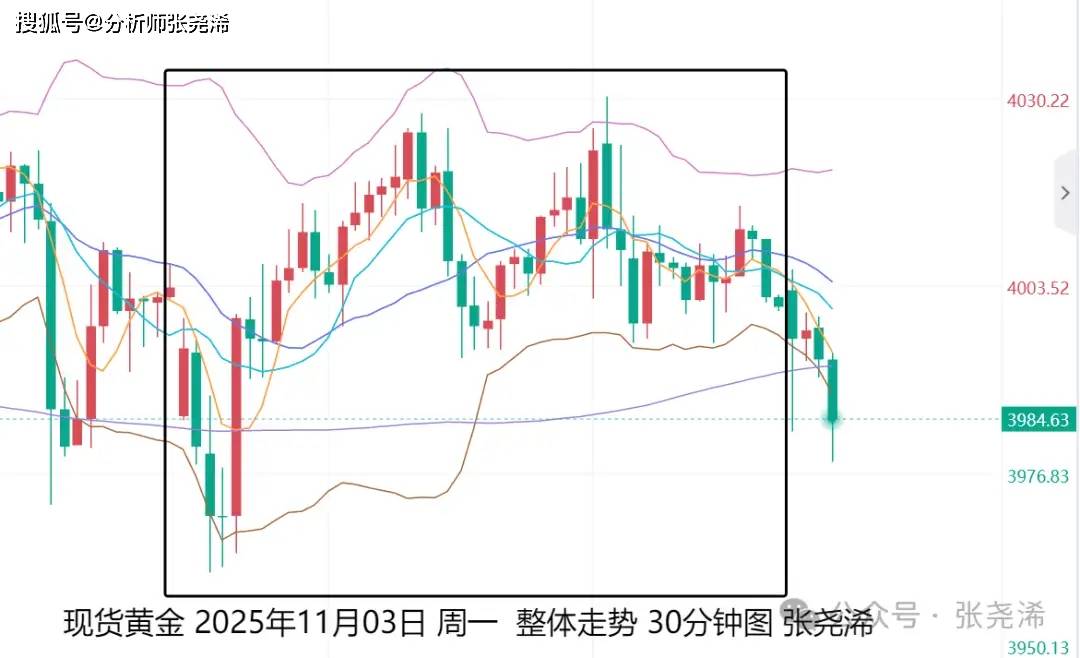
Core Viewpoint - The international gold price is currently experiencing a phase of adjustment and potential decline, with a need for clearer fundamental signals to determine future trends [1][5]. Market Performance - On November 3, gold opened at $3990.81 per ounce, reached a low of $3962.57, and fluctuated between $3995 and $4030, closing at $4001.34, marking a slight decline of $2.25 or 0.056% from the previous close [1]. - The price has retraced over 11% from its historical high on October 20 but has since reduced the monthly decline to around 8%, reflecting a typical "high-level breathing" phase [5]. Influencing Factors - Increased speculative selling pressure due to rising gold tax costs and political negotiations in the U.S. contributed to the initial decline in gold prices [3]. - The market is currently awaiting key economic data releases, including the ADP employment report and ISM PMI, which are expected to influence gold prices depending on whether they meet or fall short of market expectations [3]. Technical Analysis - Monthly charts indicate a potential downward trend, with expectations of a drop to $3800 or even $3700 unless the price can close above $4100 [5]. - Weekly analysis shows that gold has encountered resistance at previous trend lines, and the current support level is near the 10-week moving average, with a potential rebound if it breaks above the 5-week moving average [7]. Short-term Outlook - The short-term outlook for gold remains focused on range trading, with expectations of continued volatility until the resolution of the U.S. government shutdown and the release of non-farm payroll data [3][5]. - Key support levels to watch are $3970 and $3940, while resistance levels are at $4015 and $4030 [9].

贵金属日报-20251103
Guo Tou Qi Huo· 2025-11-03 14:59
| Millio | ■控期货 | 责金属日报 | | --- | --- | --- | | | 操作评级 | 2025年11月03日 | | 黄金 | ☆☆☆ | 刘冬博 高级分析师 | | 白银 | ☆☆☆ | F3062795 Z0015311 | | | | 吴江 高级分析师 | | | | F3085524 Z0016394 | | | | 010-58747784 | | | | gtaxinstitute@essence.com.cn | 今日贵金属延续震荡。上周美联储如期降息25个基点,宣布12月1日起结束缩表,但鲍威尔表态偏鹰,周内 多位官员讲话反对12月降息,体现美联储内部对政策前景分歧严重,市场预计12月降息概率下降至50%附 近。中美贸易谈判顺利结束,双方互降关税在海事物流、关税暂停期、芬太尼等问题上达成基本共识、贸易 紧张局势有所缓和。两国领导人在釜山会晤,同意加强双方在经贸、能源等领域合作,促进人文交流,两国 元首同意保持经常性交往。宏观情绪风险偏好积极,短期贵金属维持调整构筑高位震荡平台,耐心等待企稳 且波动率下降后的参与机会。关注美国政府停摆问题解决进展,非农等重要经济数据大 ...
美联储理事米兰:我认为美联储的政策过于紧缩
Hua Er Jie Jian Wen· 2025-11-03 12:18
市场有风险,投资需谨慎。本文不构成个人投资建议,也未考虑到个别用户特殊的投资目标、财务状况或需要。用户应考虑本文中的任何 意见、观点或结论是否符合其特定状况。据此投资,责任自负。 美联储理事米兰:我认为美联储的政策过于紧缩。 风险提示及免责条款 ...
综合晨报-20251103
Guo Tou Qi Huo· 2025-11-03 09:06
1. Report Industry Investment Ratings No relevant content provided. 2. Core Views of the Report - The medium - term trend of the crude oil market is bearish, while short - term attention should be paid to the intensity of Ukraine's attacks on Russian energy facilities and the geopolitical risks in Venezuela [2]. - For precious metals, the short - term market sentiment is fluctuating, and it is advisable to wait for opportunities after the volatility decreases [3]. - In the copper market, the volume - price potential of Shanghai copper remains, and long - positions should be held based on 86,000 [4]. - The aluminum market is driven by positive macro - sentiment, and Shanghai aluminum will continue to run strongly in the upward channel since May [5]. - Alumina is in a pattern of oversupply, and it will mainly operate weakly with limited rebound space [6]. - Cast aluminum alloy will continue to follow the aluminum price and is unlikely to have an independent market [7]. - For zinc, a cross - market reverse arbitrage strategy has a good profit - loss ratio, and Shanghai zinc is expected to fluctuate between 22,000 and 23,000 yuan/ton in the fourth quarter [8]. - The lead market is a combination of long and short factors, and it is expected to fluctuate between 17,000 and 17,500 yuan/ton [9]. - Nickel prices are running weakly with a downward - moving center of gravity [10]. - For tin, it is advisable to short - sell on rallies, and the right - side trading should refer to the 20 - day moving average [11]. - Lithium carbonate is expected to oscillate strongly in the short term [12]. - The short - term trend of polysilicon depends on the fermentation of policy news, and it is recommended to take a light - position and follow - the - trend strategy [13]. - The price center of industrial silicon is expected to oscillate upwards, but the amplitude is limited [14]. - Steel prices will mainly oscillate in the short term, and attention should be paid to the marginal changes in demand and the promotion of domestic demand stimulus policies [15]. - Iron ore is expected to oscillate at a high level [16]. - The coke price may be more likely to rise than to fall [17]. - The coking coal price is also more likely to rise than to fall [18]. - For manganese silicon and silicon iron, attention should be paid to the impact of the Sino - US leaders' negotiations [19][20]. - The container shipping index (European line) market is in a game between "weak reality" and "strong expectation", and this week is an important observation period for spot freight rates [21]. - For fuel oil, it is recommended to pay continuous attention to the low - level layout opportunities of the high - sulfur and low - sulfur price spread [22]. - The asphalt market has weak "peak - season" demand, and the medium - and long - term de - stocking is expected to slow down [23]. - The fundamentals of liquefied petroleum gas are expected to improve marginally, and it is relatively strong compared to crude oil cracking [24]. - The urea market will maintain low - level operation in the short term [25]. - Methanol is expected to continue to be weak in the short term but may gradually stop falling and stabilize [26]. - For pure benzene, a calendar - spread reverse arbitrage strategy is recommended [27]. - Styrene prices may continue to run weakly [28]. - Polypropylene, plastic, and propylene prices are still under pressure [29]. - PVC may fluctuate with the overall macro - sentiment, and caustic soda prices are expected to run at a low level [30]. - For PX and PTA, a reverse arbitrage strategy should be continued, and attention should be paid to the impact of energy geopolitical risks [31]. - Ethylene glycol is expected to continue to accumulate inventory, and its price will follow the external market [32]. - Short - fiber may accumulate inventory in mid - to - late November, and bottle - chip prices are under pressure [33]. - Glass prices have limited downward space, and it is advisable to hold short - term out - of - the - money put options [34]. - For natural rubber, it is advisable to wait and see and pay attention to cross - variety arbitrage opportunities [35]. - For soda ash, a short - selling strategy on rallies should be adopted in the long term [36]. - For soybeans and soybean meal, attention should be paid to the policy adjustment of soybean imports from the US after the Sino - US trade relaxation [37]. - For soybean oil and palm oil, attention should be paid to the supply of palm oil and the guidance of Sino - US soybean trade [38]. - For rapeseed and rapeseed oil, rapeseed meal prices may be boosted by oilseed futures prices, while rapeseed oil may continue its weak trend [39]. - For soybean No.1, attention should be paid to the performance of imported soybean trade and the policy guidance of domestic soybeans [40]. - Corn prices in Dalian may continue to run weakly at the bottom [41]. - Pig prices are likely to form a second bottom in the first half of next year [42]. - For eggs, it is advisable to wait for short - selling opportunities at high levels in the fourth quarter [43]. - Zhengzhou cotton may fluctuate in the short term, and it is advisable to wait and see [44]. - For sugar, attention should be paid to the subsequent weather and sugarcane growth [45]. - Apple prices are expected to remain high in the early sales stage, and attention should be paid to the subsequent warehousing situation [46]. - For timber, low inventory strongly supports the price, and it is advisable to wait and see [47]. - For pulp, it is advisable to wait and see or conduct short - term operations [48]. - In the stock index market, the market style should focus on the technology - growth sector, and the layout should be based on the direction of technological innovation and industrial upgrading [49]. - The yield curve steepening of treasury bonds is expected to come to an end [50]. 3. Summary by Relevant Catalogs Energy and Chemicals - **Crude Oil**: Last week, international oil prices declined slightly, with Brent's December contract down 0.94%. The eight voluntary - production - cut countries decided to increase production by 137,000 barrels per day in December but will suspend production increases in the first quarter of next year [2]. - **Precious Metals**: On Friday, precious metals fluctuated. The Fed's internal disagreement on policy prospects, Sino - US trade relaxation, and the US government shutdown are affecting market sentiment [3]. - **Copper**: On Friday, domestic and foreign copper prices recovered some losses. The volume - price potential of Shanghai copper remains [4]. - **Aluminum**: On Friday, Shanghai aluminum continued to fluctuate strongly. Macro - sentiment is positive, but the fundamentals of the aluminum market have limited resonance [5]. - **Alumina**: Alumina production capacity is at a historical high, and the oversupply pattern is difficult to change [6]. - **Cast Aluminum Alloy**: The spot price of Baotai ADC12 is 20,800 yuan. It will follow the aluminum price [7]. - **Zinc**: The LME plans to limit near - month positions. The upside resistance of zinc at the 3,050 - dollar mark is large [8]. - **Lead**: The supply pressure of lead is increasing, but the cost support is still strong [9]. - **Nickel and Stainless Steel**: Nickel prices are running weakly, with the center of gravity moving downwards [10]. - **Tin**: Last week, domestic and foreign tin prices fluctuated. It is advisable to short - sell on rallies [11]. - **Lithium Carbonate**: Lithium carbonate prices are under pressure at high levels. The futures price is rising, and the market is actively trading [12]. - **Polysilicon**: The polysilicon futures price has risen significantly, driven by the planned capacity storage of leading enterprises [13]. - **Industrial Silicon**: The weekly production in Xinjiang has increased slightly, while that in Yunnan has declined due to the dry season [14]. - **Steel (Thread & Hot - Rolled Coil)**: Steel prices fell on Friday night. The demand for thread and hot - rolled coil is improving, but the negative feedback pressure in the industrial chain remains [15]. - **Iron Ore**: The iron ore futures price rebounded last week. The supply is high, and the demand support is weakening [16]. - **Coke**: The coke price rose and then fell during the day. There is an expectation of a third price increase [17]. - **Coking Coal**: The coking coal price rose and then fell during the day. The overall inventory has increased slightly [18]. - **Manganese Silicon and Silicon Iron**: The demand for both is supported by high iron - water production. Attention should be paid to the Sino - US leaders' negotiations [19][20]. - **Container Shipping Index (European Line)**: The market is in a game between "weak reality" and "strong expectation". This week is an important observation period for spot freight rates [21]. - **Fuel Oil & Low - Sulfur Fuel Oil**: The absolute price of fuel oil follows the cost. The high - sulfur market has a multi - factor intertwined pattern, and the low - sulfur market is weak [22]. - **Asphalt**: The demand in the north is decreasing, and the commercial inventory is de - stocking faster [23]. - **Liquefied Petroleum Gas**: The weekly commodity volume has decreased slightly, and the arrival volume has increased significantly [24]. - **Urea**: Urea prices are fluctuating narrowly. The market sentiment is boosted by industry meetings [25]. - **Methanol**: The methanol futures price has fallen significantly. The port inventory pressure is large [26]. - **Pure Benzene**: Last week, the price of pure benzene declined. Attention should be paid to the inventory accumulation rhythm [27]. - **Styrene**: Styrene prices may continue to run weakly due to weak cost support and inventory concerns [28]. - **Polypropylene, Plastic, and Propylene**: The supply of propylene has increased slightly. The prices of polypropylene and plastic are under pressure [29]. - **PVC & Caustic Soda**: PVC may fluctuate with the macro - sentiment, and caustic soda prices are expected to run at a low level [30]. - **PX & PTA**: The supply of PX and PTA is increasing. A reverse arbitrage strategy should be continued [31]. - **Ethylene Glycol**: The price of ethylene glycol follows the external market, and it is expected to continue to accumulate inventory [32]. - **Short - Fiber & Bottle - Chip**: Short - fiber may accumulate inventory in mid - to - late November, and bottle - chip prices are under pressure [33]. - **Glass**: Glass prices have limited downward space. Attention should be paid to the continuation of the improvement in Shahe's spot market [34]. - **Natural Rubber, Synthetic Rubber**: Demand is slowly recovering, and it is advisable to pay attention to cross - variety arbitrage opportunities [35]. - **Soda Ash**: The soda ash futures price is falling. A short - selling strategy on rallies should be adopted in the long term [36]. Agricultural Products - **Soybeans and Soybean Meal**: The price of Dalian soybean meal contract 2601 continued to be strong on Friday night. Attention should be paid to the policy adjustment of soybean imports from the US [37]. - **Soybean Oil and Palm Oil**: Soybean oil and palm oil prices are affected by the supply of palm oil and Sino - US soybean trade [38]. - **Rapeseed and Rapeseed Oil**: Rapeseed meal prices may be boosted, while rapeseed oil may continue its weak trend [39]. - **Soybean No.1**: The price of soybean No.1 is slightly rising. Attention should be paid to the trade of imported soybeans and domestic policies [40]. - **Corn**: Dalian corn futures prices declined slightly on Friday night. The supply is abundant, and the demand is weak [41]. - **Pig**: Pig prices are likely to form a second bottom in the first half of next year [42]. - **Egg**: Egg prices are fluctuating. It is advisable to wait for short - selling opportunities at high levels in the fourth quarter [43]. - **Cotton**: US cotton prices are rising, and Zhengzhou cotton may fluctuate in the short term [44]. - **Sugar**: International sugar supply is sufficient. Attention should be paid to the weather and sugarcane growth in Guangxi [45]. - **Apple**: Apple prices are expected to remain high in the early sales stage [46]. - **Timber**: Timber prices are supported by low inventory [47]. - **Pulp**: Pulp prices are fluctuating narrowly. The port inventory is high, and the demand is general [48]. Financial Products - **Stock Index**: A - shares showed structural differentiation. The market style should focus on the technology - growth sector [49]. - **Treasury Bonds**: Treasury bond futures are fluctuating strongly. The yield curve steepening is expected to end [50].
黄金、白银期货品种周报-20251103
Chang Cheng Qi Huo· 2025-11-03 05:22
1. Report Industry Investment Rating - No relevant information provided 2. Core Viewpoints of the Report - For gold futures, the overall trend of Shanghai gold futures is in an upward channel and may be at the end of the trend. It's recommended to wait and see. For silver futures, the overall trend of Shanghai silver futures is in a strong upward stage and is currently at the end of the trend. It's also recommended to wait and see [7][30] 3. Summary by Directory Gold Futures 3.1.1 Mid - term Market Analysis - Mid - term trend: The overall trend of Shanghai gold futures is in an upward channel and is currently at the end of the trend - Trend judgment logic: Last week, the gold price showed a "first decline then rise" trend. It was affected by factors such as the cooling of risk - aversion sentiment, profit - taking, and the rumor of the Philippine central bank's selling in the early stage, and then stabilized and rebounded supported by the Fed's interest - rate cut, technical support, and the continuous gold purchase of the Chinese central bank. In the long - term, the gold - buying trend of global central banks and the risk - aversion demand under the background of de - dollarization are the core drivers, but in the short - term, the uncertainty of the Fed's policy path and market sentiment fluctuations need to be concerned - Mid - term strategy: It is recommended to wait and see [7][8] 3.1.2 Variety Trading Strategy - Last week's strategy review: The gold contract 2512 was expected to fluctuate at a high level, with the upper resistance at 960 - 965 and the lower support at 920 - 925. It was recommended to wait and see - This week's strategy suggestion: The Shanghai gold main contract 2512 may fluctuate between 904 - 920 yuan/gram in the short term, with the upper pressure level at 930 - 940 yuan/gram and the lower support level at 900 - 904 yuan/gram. It is recommended to wait and see [10][11] 3.1.3 Relevant Data Situation - The report presents multiple data charts including the price trends of Shanghai gold and COMEX gold, SPDR gold ETF holdings, COMEX gold inventory, US 10 - year Treasury yield, US dollar index, US dollar against offshore RMB, gold - silver ratio, Shanghai gold basis, and gold internal - external price difference [18][20][22] Silver Futures 3.2.1 Mid - term Market Analysis - Mid - term trend: The overall trend of Shanghai silver futures is in a strong upward stage and is currently at the end of the trend - Trend judgment logic: Last week, the silver price showed a "decline and then stabilization" trend. It was affected by factors such as the cooling of risk - aversion sentiment, the improvement of London market liquidity, and profit - taking in the early stage, and then gradually recovered supported by the Fed's interest - rate cut, continuous reduction of COMEX inventory, and the effectiveness of technical support. The closing price at the end of the week returned to 11,400 yuan/ton (the same as the beginning of the week). In the long - term, the Fed's policy path, the recovery of industrial demand, and the change of global inventory structure need to be concerned - Mid - term strategy: It is recommended to wait and see [30][31] 3.2.2 Variety Trading Strategy - Last week's strategy review: The silver main contract 2512 was expected to fluctuate at a high level, with the upper resistance at 11,785 - 12,085 and the lower support at 10,915 - 11,285. It was recommended to wait and see - This week's strategy suggestion: The silver main contract 2512 may fluctuate between 11,000 - 12,000 yuan/ton in the short term, with the upper resistance level at 11,800 - 12,000 yuan/ton and the lower support level at 11,000 - 11,200 yuan/ton. It is recommended to wait and see [34][35] 3.2.3 Relevant Data Situation - The report presents multiple data charts including the price trends of Shanghai silver and COMEX silver, SLV silver ETF holdings, COMEX silver inventory, Shanghai silver basis, and silver internal - external price difference [45][47][49]
金价暴跌后能抄底吗?普通人别瞎折腾,避免“理财”陷阱!
Sou Hu Cai Jing· 2025-11-01 08:59
Core Viewpoint - The recent fluctuations in gold prices are influenced by various factors, including monetary policy, geopolitical tensions, and central bank activities, indicating both short-term volatility and long-term stability in gold as an investment asset [1][3][9]. Group 1: Monetary Policy Impact - Gold prices are highly sensitive to U.S. Federal Reserve's interest rate decisions, with expectations of rate hikes leading to price declines and anticipated rate cuts causing price increases [4][9]. - The market is currently speculating on potential rate cuts in 2025, which adds to the volatility of gold prices as expectations shift [4]. Group 2: Geopolitical and Economic Factors - Ongoing geopolitical conflicts, such as the Israel-Palestine and Russia-Ukraine situations, drive investors towards gold as a safe haven asset during times of uncertainty [7]. - Persistent inflation concerns further enhance gold's appeal, as it is viewed as a hedge against currency devaluation [7]. Group 3: Central Bank Activities - In the first three quarters of 2024, global central banks purchased over 800 tons of gold, with countries like China and India significantly increasing their reserves [9]. - This strategic accumulation by central banks is aimed at securing assets rather than seeking short-term profits, providing a strong support for gold prices [9]. Group 4: Investment Strategies - Investors are advised against speculative strategies such as waiting for gold prices to drop to unrealistic levels, as historical trends show that significant declines are unlikely [11]. - A recommended approach is to adopt a dollar-cost averaging strategy, investing in gold gradually rather than attempting to time the market [11][13]. - Gold should be viewed as a stabilizing asset in an investment portfolio, with a suggested allocation not exceeding 10% of total assets [13].
【UNforex本周总结】美元稳固主导市场,黄金承压整理,贸易与政策博弈升温
Sou Hu Cai Jing· 2025-11-01 08:09
Group 1 - The US dollar remains strong, supported by the Federal Reserve's hawkish stance and high US Treasury yields, with the dollar index approaching 99.70 [1] - The euro is under pressure due to economic weakness and easing expectations, leading to a continuous decline against the dollar [1] - The Japanese yen has fallen below 154.50 against the dollar, reaching a new low for the year, raising speculation about potential official intervention [1] Group 2 - Gold prices are struggling to maintain momentum, hovering above the $4000 mark, with a brief breakout followed by a retreat due to reduced appeal of non-yielding assets [1] - The Federal Reserve's policy signals are a focal point, with officials maintaining a hawkish tone and emphasizing the need for patience in addressing inflation [1] - The probability of a rate cut in December has decreased from 90% to below 70%, impacting the strength of the dollar and putting pressure on non-US currencies and precious metals [1] Group 3 - US-China trade relations continue to be a significant factor in market volatility, with short-term uncertainties likely to suppress market sentiment, while potential improvements could boost global economic recovery in the long term [2] - The European Central Bank has kept interest rates unchanged, with President Lagarde indicating that euro appreciation may reduce inflationary pressures, suggesting a cautious policy outlook [2] - The Japanese government emphasizes the importance of exchange rate stability, with expectations of potential measures to prevent excessive depreciation of the yen [2] Group 4 - Global stock markets have generally risen, particularly in the US, with the S&P 500 and Dow Jones indices recording weekly gains, driven by strong performance in technology stocks [2] - Despite the hawkish Fed and a strong dollar potentially limiting gains, risk appetite in the market has improved [2] - Upcoming economic indicators, such as the ISM manufacturing PMI and ADP employment data, are anticipated to provide further insights into economic direction [2] Group 5 - The overall market dynamics this week are shaped by a strong dollar, adjustments in Fed policy expectations, gold price fluctuations, and trade tensions [3] - The dollar maintains its dominant position, while gold shows weak rebound potential, with European and Japanese policy signals becoming new focal points for observation [3] - Investors are advised to closely monitor Fed communications, economic data, and US-China negotiation progress, as these factors will continue to influence short-term market sentiment and direction [3]
【UNforex财经事件】黄金价格维持关键支撑 美联储鹰派言论限制上涨空间
Sou Hu Cai Jing· 2025-11-01 03:46
黄金市场在4000美元附近保持稳定,尽管美联储的鹰派言论和美元走强限制了黄金的上涨空间,但中长 期的支撑因素依然存在。投资者应关注未来几周美联储政策变化和贸易谈判进展,这些因素将深刻影响 黄金价格。短期内黄金可能维持震荡整理,投资者应保持谨慎,等待更多明确的市场信号。 美联储官员的鹰派言论加大了市场的不确定性。克利夫兰联储主席哈马克明确反对降息,而亚特兰大联 储主席博斯蒂克则支持继续降息,认为经济仍处于紧缩状态。政策意见分歧增加了市场对美联储未来政 策路径的猜测,也导致黄金价格波动。同时,美联储的鹰派立场使得美元和美国国债收益率得到支撑, 从而进一步限制了黄金的上涨空间。然而,央行购金和地缘政治风险仍为黄金提供了长期支撑,市场的 中期前景依然看好。 黄金价格在4000美元附近稳定,尽管经历了几次回调,依旧保持在关键支撑位。美元指数持续上升,接 近99.70,强势美元和高企的美国国债收益率对黄金价格构成压力。中美贸易局势稍有缓和,避险需求 减弱,进一步消减了黄金的吸引力。随着美联储在近期的会议中淡化降息预期,市场对降息的期待逐步 减弱,也使得黄金的上涨动力受到限制。美联储主席鲍威尔表示,未来几个月的货币政策将更 ...
【UNforex财经事件】美联储鹰派预期升温 美元站稳高位 黄金震荡整理
Sou Hu Cai Jing· 2025-10-31 10:33
Group 1 - Recent US economic data remains robust, leading to a decrease in market expectations for interest rate cuts by the Federal Reserve, with the probability of a December rate cut dropping from 90% to below 70% [1] - The strong performance of the US dollar is supported by high interest rates and signs of economic expansion, with the dollar index maintaining above 99.50 [1] - The European Central Bank decided to keep its main interest rates unchanged, aligning with market expectations, while the Eurozone inflation has decreased to 2.1%, indicating weak growth momentum [1] Group 2 - The strong US dollar is hindering the rebound of gold prices, which saw a temporary increase of over 2% but remains under pressure due to the Fed's tight policy and declining rate cut expectations [2] - Gold is experiencing limited upward movement due to reduced safe-haven demand and the strengthening dollar, resulting in a short-term inability to break through resistance levels [2] - Market focus is expected to shift back to central bank policy signals as key inflation and employment data are released in the coming weeks, highlighting the need for vigilance regarding monetary policy and global economic changes [2]
Is It All Over For the Bull Run? Rates Cuts Sink Crypto Markets – Here’s Why Crypto is Down
Yahoo Finance· 2025-10-30 21:56
Core Insights - The crypto market experienced a significant downturn following the Federal Reserve's rate cut, with Bitcoin and Ether prices declining sharply after the announcement [1][3][4] Group 1: Market Reaction to Federal Reserve's Actions - The Federal Reserve cut rates by 25 basis points, lowering the target range to 3.75%-4.00%, but the cautious tone from Chair Jerome Powell dampened expectations for further cuts [4][6] - Following the Fed's announcement, Bitcoin's price fell towards the $107,000–$109,000 range, while Ether eased to approximately $3,700–$3,900 [1][2] Group 2: Impact on Crypto Market Value - The crypto market lost over $80 billion in total value, with altcoins like XRP and SOL experiencing the most significant declines [5] - Heavy liquidations were observed in both spot and derivatives markets, particularly around the $109,000 area, indicating a rapid unwinding of positions by investors [5] Group 3: Future Outlook and Price Predictions - Analysts noted that Bitcoin's price is currently trading near $108,000 after a pullback, with key resistance identified in the $111,900-$112,000 range, which is crucial for any potential new all-time highs [6][7]