
量化紧缩

Search documents
三大股指期货齐涨 美国政府“关门”或使非农无法按时公布
Zhi Tong Cai Jing· 2025-10-03 12:29
Market Overview - US stock index futures are all up, with Dow futures rising by 0.24%, S&P 500 futures up by 0.18%, and Nasdaq 100 futures also increasing by 0.18% [1] - European indices show mixed results, with Germany's DAX down by 0.24%, UK's FTSE 100 up by 0.52%, and France's CAC40 down by 0.08% [2] - WTI crude oil prices increased by 0.35% to $60.69 per barrel, while Brent crude rose by 0.37% to $64.35 per barrel [3] Economic Data and Events - The non-farm payroll report scheduled for release is likely to be postponed due to the government shutdown, affecting the publication of economic data [4] - The US banking system's reserves have dropped for eight consecutive weeks, falling below $3 trillion for the first time, raising concerns about the Federal Reserve's balance sheet reduction [5] - Federal Reserve's Williams emphasized the need for central banks to prepare for unexpected changes and maintain stable inflation expectations [6] Company News - Hedge funds are adjusting strategies ahead of Japan's ruling party election, betting on yen appreciation and reducing risk assets [7] - Bank of America reported a record inflow of $9.3 billion into tech stocks, driven by the AI investment boom, despite the government shutdown [8] - Chevron's refinery in California experienced a fire, impacting over 16% of the state's refining capacity [10] - Applied Materials anticipates a $600 million revenue loss due to expanded export restrictions on its products to China [10] - Tesla has begun selling its Cybertruck in Qatar, expanding its international presence amid slowing demand in core markets [11] - Boeing's 777X commercial flight plan has been delayed until early 2027, potentially leading to a non-cash accounting charge of $2.5 billion to $4 billion [12]



美股前瞻 | 三大股指期货齐涨 美国政府“关门”或使非农无法按时公布
智通财经网· 2025-10-03 12:27
Market Overview - US stock index futures are all up, with Dow futures rising by 0.24%, S&P 500 futures up by 0.18%, and Nasdaq 100 futures also increasing by 0.18% [1] - European indices show mixed results, with Germany's DAX down by 0.24%, UK's FTSE 100 up by 0.52%, and France's CAC40 down by 0.08% [2] - WTI crude oil prices increased by 0.35% to $60.69 per barrel, while Brent crude rose by 0.37% to $64.35 per barrel [3] Economic Data and Events - The US non-farm payroll report scheduled for release is likely to be delayed due to the government shutdown, affecting the publication of economic data [4] - The US banking system's reserves have dropped for eight consecutive weeks, falling below $3 trillion for the first time, raising concerns about the Federal Reserve's balance sheet reduction [5] - Federal Reserve's Williams emphasized the need for central banks to prepare for unexpected changes and maintain stable inflation expectations [6] Company News - Hedge funds are adjusting strategies ahead of Japan's ruling party election, betting on yen appreciation and reducing risk assets [7] - Bank of America reported a record inflow of $9.3 billion into tech stocks, driven by the AI investment boom, despite the government shutdown [8] - Goldman Sachs predicts that the US economy will accelerate by 2026, but expects a market pullback in the next 1-2 years due to various factors [9] - Chevron's refinery in California experienced a fire, impacting over 16% of the state's refining capacity [10] - Applied Materials anticipates a $600 million revenue loss due to expanded export restrictions to China [10] - Tesla has begun selling its Cybertruck in Qatar, expanding its international presence amid slowing demand in core markets [11] - Boeing's 777X commercial flight plan has been delayed until early 2027, potentially leading to a non-cash accounting charge of $2.5 billion to $4 billion [12]

美银行体系准备金八连降跌破3万亿美元 美联储缩表或接近拐点
智通财经网· 2025-10-02 23:39
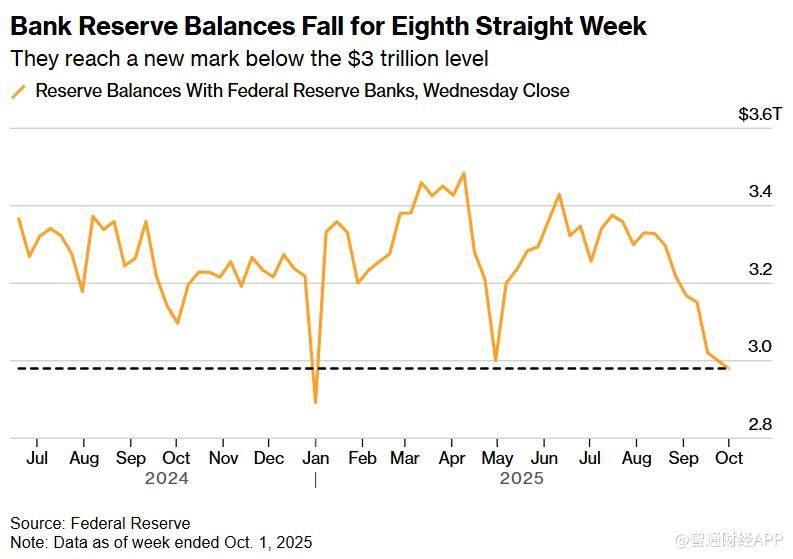
Core Points - The U.S. banking system's reserves have declined for eight consecutive weeks, falling below $3 trillion for the first time, raising concerns about the Federal Reserve's potential early end to balance sheet reduction [1] - As of the week ending October 1, bank reserves decreased by $20.1 billion to $2.98 trillion, marking the lowest level since January of this year [1] Group 1 - The decline in reserves is closely linked to the U.S. Treasury's increased debt issuance, which has accelerated since the debt ceiling was raised in July, absorbing market liquidity [4] - This situation directly impacts the liabilities on the Federal Reserve's balance sheet, including the overnight reverse repurchase (RRP) tool and commercial bank reserves [4] - As RRP gradually depletes, commercial bank reserves at the Federal Reserve have become the primary source of liquidity outflow, with foreign banks experiencing a more significant decline in cash assets compared to domestic banks [4] Group 2 - The changes occur while the Federal Reserve continues its quantitative tightening (QT) policy, which involves reducing its holdings of Treasury and MBS to tighten financial system liquidity [4] - Earlier this year, the Federal Reserve slowed the pace of balance sheet reduction to avoid market disruptions, despite Chairman Powell stating that bank reserves remain "ample" [4] - Recent signs in the funding market suggest that the Federal Reserve may be approaching a critical point regarding reserve levels [4] Group 3 - There is inconsistency within the Federal Reserve regarding the definition of "ample" reserves, with Vice Chair Bowman emphasizing the need to shrink the balance sheet as much as possible to bring reserves closer to "scarce" levels [4] - Governor Waller estimated that the minimum reserve level is approximately $2.7 trillion [4]
供应下降缓解市场紧张情绪 全球长期债券重回投资者视野
Zhi Tong Cai Jing· 2025-09-26 06:58
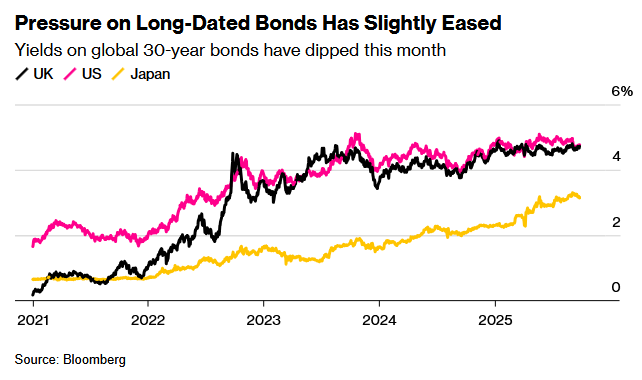
Group 1 - The global long-term bond market is experiencing a rebound as investors seek buying opportunities after a sell-off, with U.S. and Japanese 30-year bond yields dropping approximately 20 basis points since early September, and UK yields falling over 10 basis points [1] - The recent decline in long-term bond yields is partly driven by reduced supply, as some countries shift their issuance focus to cheaper short-term bonds, with Japan proposing to cut long-term bond issuance and the UK central bank reducing long-term bond sales in its quantitative tightening plan [1][2] - There is a growing optimism in the long-term bond market, highlighting the significant role of supply concerns in recent sell-offs, despite ongoing worries about rising fiscal deficits [2] Group 2 - Strong economic growth globally is alleviating concerns about fiscal deficits and prompting investors to reconsider long-term interest rate trends, with recommendations for Australian investors to adopt positions that benefit from a flattening yield curve [3] - The Bloomberg Global Aggregate Index indicates that bets on long-term bonds are starting to pay off, with 10-year and longer bonds returning 0.7% this month, outperforming shorter-term bonds [6] - Recent auctions show strong demand for long-term bonds, with Japan's 40-year bonds seeing enthusiastic buying and the strongest demand for 20-year bonds since 2020 [6]
9月海外月度观察:美联储降息如期兑现,货币政策延续分化-20250924
Huachuang Securities· 2025-09-24 15:25
1. Report Industry Investment Rating There is no information provided in the content about the report's industry investment rating. 2. Core Viewpoints of the Report In September 2025, multiple employment data in the US indicated a cooling labor market, and the cost - pressure transmission of tariff adjustments was still slow. The economic recovery momentum in the Eurozone, Japan, etc., increased. In terms of monetary policy, the Fed's restart of interest rate cuts was fulfilled as expected, which was defined as a "risk - management - style" cut by Powell and was somewhat hawkish. The European and British central banks remained on hold, waiting for the tariff impact to become clearer. In October, attention should be paid to the fundamental performance of major countries, and the intensification of capital market volatility risks should be vigilant [7]. 3. Summary by Relevant Catalogs 3.1 Overseas Economy: Divergent Monetary Policy Trends and Overall Controllable Inflation Pressure 3.1.1 Global Economy: Resilient Economy and Manufacturing PMI Back in Expansion Zone The global economy remained resilient, and the manufacturing PMI returned to the expansion zone. In August, the J.P. Morgan Global Manufacturing PMI index was 50.9%, up 1.2 percentage points from 49.7% in July. Only the Eurozone's manufacturing PMI was above the 50 boom - bust line among major overseas countries. The global services PMI index decreased by 0.1 percentage points to 53.4% in August, maintaining high - level prosperity. In trade, the Baltic Dry Index fluctuated upward, and South Korea's exports in the first 20 days of September increased by 13.5% year - on - year. The Fed cut interest rates as expected, the European and British central banks remained on hold, and the Bank of Japan sent hawkish signals. The US Treasury Secretary considered "all stabilization options" to support Argentina [8]. 3.1.2 Developed Economies: Resilient Economies in Major Countries and Potentially Controllable Inflation Pressure - **US: Slowing Fundamental Growth Momentum and Cooling Labor Market** - Economic growth showed a divergence in prosperity. Manufacturing continued to contract, while the service industry expanded faster. In August, the US ISM manufacturing PMI rose to 48.7%, and the non - manufacturing PMI rose to 52.0%. - Newly added employment was far below expectations, and the unemployment rate reached a new high. In August, the non - farm payrolls increased by 22,000, and the unemployment rate rose to 4.3%. - The inflation level was relatively moderate, and the pressure on commodity prices from tariffs was limited. In August, the US CPI increased by 2.9% year - on - year. - Retail sales remained resilient, and the sustainability of consumption momentum needed attention. In August, US retail sales increased by 0.62% month - on - month. - The real estate market was restricted by high mortgage rates and rising housing prices [21][22][23]. - **Eurozone: Strengthening Recovery Momentum, Divergent Prosperity in the UK and Japan, and Unstable Manufacturing Recovery Foundation** - The Eurozone's recovery momentum increased. In August, the composite PMI rose to 51.0%, and the manufacturing PMI rose to 50.7%. - The UK's manufacturing continued to contract, while business activities in the service industry accelerated expansion. In August, the UK's manufacturing PMI fell to 47.0%, and the service industry PMI rose to 54.2%. - Japan's economic prosperity was divergent. In August, the composite PMI rose to 52.0%, and the manufacturing PMI rose to 49.7%. - In terms of inflation, the Eurozone's inflation remained stable month - on - month, the UK faced greater pressure, and Japan's inflation remained high [35][37][39]. 3.2 Monetary Policy: US Restarts Rate Cuts, Europe and UK are Cautious, and Japan Sends More Hawkish Signals 3.2.1 Fed: "Risk - Management - Style" Rate Cut Implemented, Focus on Downward Employment Risks On September 18, the Fed cut interest rates for the first time this year, lowering the federal funds rate target range by 25BP to 4.0% - 4.25%. The policy balance shifted from focusing on inflation rebound to employment stall risks. The dot - plot predicted two more rate cuts in October and December. Whether to cut rates again in October depends on the performance of September's non - farm data, and the Fed's independence and the composition of the new council members have increased the uncertainty of future rate - cut prospects [54]. 3.2.2 ECB: ECB Continues to Hold Rates Steady, Inflation Risks are Roughly Balanced On September 11, the ECB held rates steady, maintaining the main refinancing rate at 2.15%. It believed that manufacturing and services were growing, and previous rate cuts would further boost consumption and investment. It raised inflation expectations for 2025 and 2026 and lowered those for 2027. In the future, it may continue to make data - dependent and meeting - by - meeting decisions [58]. 3.2.3 BoJ: Increased Probability of Interest Rate Hike, Planned Reduction of ETF and Other Assets On September 19, the BoJ kept the benchmark interest rate at 0.5% and decided to gradually sell ETF and J - REITs in the market. Two officials voted against and supported a 25 - basis - point rate hike. If economic and price forecasts are realized, the BoJ may continue to raise interest rates, increasing the possibility of restarting rate hikes this year [61]. 3.2.4 BoE: BoE Maintains Interest Rates, Slows Down Quantitative Tightening, and Reduces Expectations of Rate Cuts This Year On September 18, the Monetary Policy Committee voted to keep the policy rate at 4% and announced a reduction in the scale of central bank balance - sheet contraction from October. Concerns about inflation rebound made the market cautious about further rate cuts by the BoE this year [64]. 3.3 Financial Markets: US Treasury Yields First Declined and Then Rose, the US Dollar Index Weakened, and International Oil Prices Fluctuated 3.3.1 US Bond Market: Cooling Labor Market and Fed Rate Cut Implementation Led to Fluctuations in US Treasury Yields In September, the US bond market focused on the weakening labor market and the Fed's rate cut. In the first and middle of the month, the yield dropped from 4.28% to around 4%. In the late month, it rebounded to around 4.15%. Overall, the 2 - year US Treasury yield rose 2BP to 3.61%, and the 10 - year yield fell 8BP to 4.15% [67][68]. 3.3.2 Exchange - Rate Market: Weakening US Dollar Index, Fluctuating Japanese Yen, and Strengthening Euro and Pound - The US dollar index was overall weak. In early September, the downward risks in the labor market increased rate - cut expectations and pressured the US dollar. In the middle and late months, the Fed's rate cut was less dovish than expected, and the US dollar index rebounded. - The Japanese yen fluctuated in a narrow range between 146 - 148 due to the US dollar index and domestic political uncertainties. - The euro and pound strengthened overall. In the first and middle of the month, the Eurozone's economic indicators were positive, and the pound was supported by the UK's fiscal policy and the BoE's stance [69][70]. 3.3.3 International Crude Oil: Geopolitical Frictions and Oil - Demand Outlook Caused Volatility in Crude Oil Prices In September, international oil prices fluctuated around $63 per barrel. In early September, concerns about OPEC + production increases and US economic recession led to a price drop. Then, geopolitical tensions and reduced concerns about supply surpluses pushed prices up. In the middle and late months, the Fed's statement on employment risks and EU sanctions on Russia caused prices to fall again [74].
财政疑虑挥之不去 英国30年期金边债需求创2022年以来最低
智通财经网· 2025-09-23 11:20
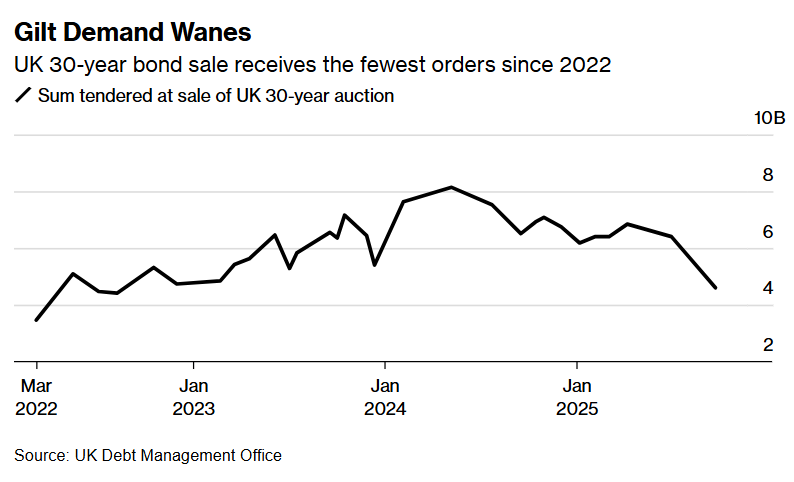
Core Insights - The demand for 30-year UK government bonds has unexpectedly dropped to its lowest level since 2022, highlighting a significant decline in market appetite for long-term gilt amid rising government budget deficits [1][4] - UK Chancellor Rachel Reeves is attempting to persuade the market to accept her fiscal spending plan, but concerns remain regarding the government's recent £18 billion overshoot in borrowing [1][4] Group 1: Demand and Auction Results - The UK Debt Management Office (DMO) auctioned £1.5 billion of long-term gilts maturing in 2056, receiving bids worth £4.6 billion (approximately $6.2 billion), indicating a threefold oversubscription, yet the auction size is the smallest in three years [1][4] - The "tail" measure, which reflects the difference between the weighted average and the lowest accepted bid, widened to 1.4 basis points, up from 0.8 basis points in July, indicating weakened demand [4] Group 2: Market Reactions and Future Outlook - Following the auction, the yield on 30-year UK government bonds fell by 4 basis points to 5.51%, after previously declining by more than 5 basis points before the auction [4] - Despite increased volatility in the secondary market, overall performance in recent auctions for various maturities of gilts has been robust, with demand for a recent 10-year gilt auction nearing record levels [4][5] Group 3: Policy Adjustments - The upcoming gilt issuance is the last long-term gilt auction of the year, with the Bank of England announcing a reduction in the proportion of certain long-term gilts sold under its quantitative tightening (QT) plan to 20% to help mitigate market volatility [5]
全球央行议息周落幕,货币政策保持分化|国际
清华金融评论· 2025-09-23 10:25
Core Viewpoint - The article discusses the recent monetary policy decisions made by major central banks, highlighting the divergence in their approaches, which may lead to increased volatility in global financial markets and a new phase in economic dynamics [2]. Group 1: Federal Reserve - The Federal Reserve announced a 25 basis point rate cut, lowering the federal funds rate target range to 4.00% to 4.25%, marking its first rate cut in nine months [4]. - The Fed's decision reflects a cautious balance between employment and inflation goals, with indications of a cooling labor market and rising inflation levels [4]. - The updated dot plot suggests an additional 50 basis points cut by the end of the year, followed by 25 basis points cuts in each of the next two years [4]. Group 2: Bank of Canada - The Bank of Canada also cut its overnight rate by 25 basis points to 2.5%, its first reduction in six months, following a cumulative decrease of 225 basis points since June 2024 [6]. - The decision was driven by a weakening economy, with a 1.5% decline in GDP and ongoing job market challenges, while inflation risks have diminished [6]. - The Bank will closely monitor export conditions and the overall economic impact of these trends [6]. Group 3: Bank of England - The Bank of England decided to maintain its benchmark interest rate at 4%, pausing its previous rate cuts [8]. - The UK labor market is showing signs of slowdown, with inflation remaining high at 3.8% in August, expected to rise to around 4% in September [8]. - The Bank plans to reduce its holdings of UK government bonds by £70 billion over the next 12 months as part of its monetary policy adjustments [8]. Group 4: Bank of Japan - The Bank of Japan kept its benchmark rate unchanged at 0.5%, while indicating potential future rate increases depending on economic and inflation forecasts [10]. - Japan's economy is gradually recovering, but short-term growth may be pressured by global economic slowdowns [10]. - Current inflation rates are between 2.5% and 2.9%, with expectations for gradual increases supported by improving economic conditions [10]. Group 5: Market Reactions - The decisions from the Federal Reserve, Bank of Canada, Bank of England, and Bank of Japan align with market expectations, indicating that the market has already priced in the anticipated rate cuts and policy stances [10].

美国经济不需要激进降息?大摩:美联储或给市场泼冷水
Jin Shi Shu Ju· 2025-09-22 12:36
Core Viewpoint - The U.S. stock market indices reached new historical highs, driven by market adaptation to White House policy uncertainties and ongoing optimism surrounding artificial intelligence (AI) [2] Group 1: Market Performance - The S&P 500 index has risen 33.75% since its low in April, with a year-to-date increase of 13.3% [2] - The Federal Reserve initiated a new round of interest rate cuts, which is providing support to the market [3] Group 2: Economic Outlook - Morgan Stanley's strategy team, led by Mike Wilson, warns that if the Fed's rate cuts do not meet investor expectations, it could lead to market volatility [3] - Wilson believes the U.S. economy may not require aggressive rate cuts, suggesting that the current economic transition is moving towards an early recovery phase [4] - There are signs of pent-up demand in sectors that have experienced weak growth over the past few years, including real estate, short-cycle industries, consumer goods, transportation, and commodities [4] Group 3: Federal Reserve Policy - The Fed's current "easing shift" differs from conventional paths in past economic cycles, as the labor market has not deteriorated to a level necessitating significant rate cuts, and inflation remains above the 2% target [4] - There is a contradiction between the Fed's policy response and the market's demand for rapid rate cuts, posing short-term risks to the stock market [4] Group 4: Liquidity Concerns - The market faces risks if the Fed recognizes the economic shift from "rolling recession to recovery" and determines that large-scale rate cuts are unnecessary, which could disappoint the market [5] - Liquidity is gradually tightening as the Fed continues quantitative tightening while the U.S. Treasury issues a large volume of bonds [5] - Signs of liquidity pressure may first appear in the spread between the Secured Overnight Financing Rate (SOFR) and the federal funds rate, with the Bank of America Merrill Lynch MOVE index currently at 72.5, close to a four-year low [5]
英国央行量化紧缩侧重中短债 规避长端风险
Jin Tou Wang· 2025-09-22 05:07
Group 1 - The core viewpoint of the article highlights the Bank of England's upcoming 12-month quantitative tightening (QT) plan starting in October, which will prioritize the sale of short- and medium-term UK government bonds [1] - Edward Allenby from Oxford Economics indicates that the Bank of England is focusing on short- and medium-term bonds due to more significant pressure signals in these markets compared to long-term bonds [1] - This strategy aims to effectively manage liquidity contraction while minimizing potential impacts on long-term interest rates and financial market stability, reflecting a cautious approach to normalizing monetary policy [1] Group 2 - The GBP/USD exchange rate is currently at 1.3461, down 0.05% from the previous close of 1.3468, following a pullback from an 11-week high of 1.3726 [1] - The 21-day simple moving average (SMA) is at 1.3524, and the 14-day relative strength index (RSI) remains above the 50 midline, suggesting that buyers may still expect this pullback to be short-term [1] - For a meaningful rebound, GBP/USD needs to close above the supply zone of 1.3600-1.3620 on the daily candlestick chart [1]
贵金属日评-20250922
Jian Xin Qi Huo· 2025-09-22 01:59
行业 贵金属日评 日期 2025 年 9 月 22 日 宏观金融团队 研究员:何卓乔(宏观贵金属) 021-60635739 hezhuoqiao@ccb.ccbfutures.com 期货从业资格号:F3008762 研究员:黄雯昕(国债集运) 021-60635739 huangwenxin@ccb.ccbfutures.com 期货从业资格号:F3051589 研究员:聂嘉怡(股指) 021-60635735 niejiayi@ccb.ccbfutures.com 期货从业资格号:F03124070 请阅读正文后的声明 每日报告 一、贵金属行情及展望 日内行情: 虽然美元指数因美联储预计 2026 年之后大幅放缓降息步伐以及英国央行放 缓缩表步伐、日本央行按兵不动等信息而连续三个交易日回升,但市场乐观评估 特朗普政府压力下的美联储降息进程,伦敦黄金在 3630 美元/盎司附近企稳小幅 反弹。4 月下旬至 8 月份金价横盘震荡消化高估值压力,但美联储降息东风助推 金价于 9 月初突破阻力而开启新一轮上涨趋势,本轮涨势或延续至 2026 年春夏之 交,建议投资者继续持多头思路参与贵金属交易,空头套保者可适当 ...