价值投资

Search documents
鹏华基金前基金经理王宗合因病逝世,曾创千亿级基金发行纪录
Nan Fang Du Shi Bao· 2025-12-30 12:00
Core Insights - Wang Zonghe, former deputy general manager of Penghua Fund and renowned fund manager, passed away on December 29 due to illness, with a memorial service scheduled for December 31 [2] - He managed over 50 billion yuan in assets and set a record for public fund subscription, leading to widespread mourning and remembrance in the industry [2] Group 1: Career Highlights - Wang Zonghe held a master's degree in finance from Renmin University of China and began his career in industry research at China Merchants Fund before joining Penghua Fund in May 2009 [2] - He progressed from researcher to assistant fund manager, officially becoming a fund manager in December 2010, and was promoted to deputy general manager in January 2021 [2] - His longest-managed fund has been held for over 12 years, making him one of the few fund managers to maintain a consistent research system in the industry [2] Group 2: Investment Achievements - Wang Zonghe's peak career period reflects the "star-making era" of public funds, where he accurately captured the white liquor industry's trends, leading to outstanding performance in products like Penghua Consumer Preferred and Penghua Pension Industry, both winning Golden Bull Fund Awards [3] - In July 2020, his Penghua Craftsmanship Selected Mixed Fund attracted 137.1 billion yuan in subscription on its first day, setting a record in public fund history [3] - By the end of Q3 2020, the total scale of funds under his management surged to 55.426 billion yuan, an increase of over 40 billion yuan from the previous quarter, contributing to a doubling of Penghua Fund's mixed fund scale to over 140 billion yuan [3] Group 3: Investment Philosophy - Wang Zonghe's investment philosophy centered on value investing, focusing on leading companies in key industries, famously stating "Thirteen years of wind and rain, walking alongside Moutai" [3] - He adhered to the investment standards of Warren Buffett and Charlie Munger, prioritizing companies with high barriers to entry, sustainable ROE, and compounding effects, while avoiding high-valuation growth stocks [3] - The returns of his managed funds, Penghua Consumer Preferred and Penghua Pension Industry, reached 244.70% and 211.40% respectively, with annualized returns exceeding 10% [3]


认知即财富:2026年,为什么我建议你重读混沌这份“上市公司创始人”课表?
混沌学园· 2025-12-30 11:48
Core Insights - The essence of value investing is understanding the cognitive boundaries of founders and their decision-making processes during critical moments, rather than relying solely on financial reports or stock charts [2][3] - The upcoming year 2026 is expected to present challenges, but the underlying logic of business remains constant, emphasizing the importance of founder insights in navigating uncertainty [3][12] Group 1: Investment Philosophy - Warren Buffett emphasizes that buying stocks is essentially buying a part of the company, advocating for a long-term investment mindset [2] - Charlie Munger criticizes superficial analysis, suggesting that true understanding comes from engaging with the founders and their philosophies [2] - The article highlights the importance of learning from successful founders who have survived market pressures, as their insights are invaluable [10] Group 2: Educational Framework for 2026 - A curriculum is proposed for 2026, featuring sessions led by prominent company founders, focusing on their strategic insights and experiences [4][5][7][9] - The courses aim to provide a deeper understanding of business fundamentals, emphasizing real-world applications over theoretical knowledge [10] - The design logic of the curriculum is based on verified cognition, practical logic, and the opportunity to adopt the perspectives of successful leaders [10] Group 3: Market Trends and Company Strategies - The article discusses the significance of understanding the decision-making logic of founders during critical times, which contributes to a company's competitive advantage [3] - It mentions various companies and their strategic transformations, such as Anta's strategic pivot and Bosideng's brand rejuvenation, as examples of resilience and adaptability [3] - The focus on hard technology and manufacturing reflects the evolving landscape of the A-share and Sci-Tech Innovation Board markets [4]

为何你总在“高买低卖”?揭秘投资行为背后的人性心理偏差
Sou Hu Cai Jing· 2025-12-30 11:23
Market Overview - The A-share market shows a significant characteristic of "strong technology, stable cycles," with overall performance being differentiated [1] - The Shanghai Composite Index closed at 3965.12 points, remaining flat compared to the previous trading day, while the Shenzhen market was more active, with the Shenzhen Component Index rising by 0.49% and the ChiNext Index increasing by 0.63% [1] - The STAR 50 Index performed notably well, with a rise of 1.01% and increased trading volume, indicating a clear preference for the technology innovation sector [1] - The overall market turnover remained active at 21,426 billion, reflecting differing risk preferences among investors [1] Sector Performance - The oil and petrochemical sector led the market with a strong performance, rising by 2.63%, followed by cyclical and manufacturing sectors such as automobiles, non-ferrous metals, and machinery, all of which saw gains exceeding 1.3% [1] - In contrast, sectors like retail and real estate experienced noticeable adjustments [1] Investor Behavior - The market phenomenon reflects common psychological behaviors among investors, often leading to the "buy high, sell low" cycle due to panic selling during short-term downturns and chasing prices during bullish trends [2] - This behavior is rooted in cognitive biases rather than information asymmetry, creating opportunities for rational investors to achieve long-term excess returns [2] Psychological Traps - The concept of "short-term myopia" is highlighted, where investors overreact to short-term performance and news while neglecting the long-term cash flow generation ability of companies [3] - Another related trap is "linear extrapolation," where trends are assumed to continue indefinitely, leading to extreme market sentiments during bull and bear markets [3] Value Investment Philosophy - Value investment provides a framework to help investors recognize and resist inherent psychological tendencies, focusing on long-term business models and economic value [4] - Investors are encouraged to maintain a "margin of safety" by purchasing stocks significantly below their estimated intrinsic value to account for future uncertainties and potential errors in judgment [4][5] Long-term Investment Perspective - The ultimate goal of investing is not just financial analysis but also a long-term journey of self-discipline against human weaknesses [5] - Long-term returns will reward those who can overcome instinctual impulses and maintain vigilance during market extremes [6] - Ordinary investors can cultivate this "foresight" through systematic decision-making processes, maintaining clear buy/sell disciplines, and regularly reviewing investment decisions to identify cognitive biases [6]
文化建设铸就行业灵魂 浦银安盛探索公募基金特色文化建设之路
Jin Rong Jie· 2025-12-30 10:10
Core Viewpoint - The public fund industry is embarking on a new journey of high-quality development, emphasizing the importance of industry culture and responsibility in achieving this goal [1][9]. Group 1: Industry Culture and Development - The public fund industry is guided by the "Five Musts and Five Must Nots" of Chinese financial culture to foster a positive industry ecosystem [1]. - The company is actively exploring a cultural construction model that reflects its banking background, focusing on areas such as party building, compliance, talent development, and corporate social responsibility [1]. Group 2: Party Building and Governance - The company prioritizes party building as a key element of its development strategy, aligning with the spirit of the 20th National Congress and promoting high-quality development [2]. - Various educational activities are conducted to deepen understanding of red history and enhance party discipline among employees [2][3]. Group 3: Compliance and Risk Management - Compliance is viewed as a fundamental principle for the company's sustainable development, with a focus on establishing a robust compliance and risk control system [4]. - The company has implemented a three-tier internal control system and developed various regulations to ensure compliance and risk management are integral to its culture [4]. Group 4: Digitalization and Risk Management - The company is enhancing its risk management capabilities through digitalization, developing an information platform for effective risk identification and analysis [5]. - The "Puyin Ansheng Smart Space" project, recognized with the 2024 Financial Technology Development Award, exemplifies the company's innovative approach to risk management [5]. Group 5: Talent Development - The company adheres to a "long-termism" approach in talent development, establishing a professional talent selection and training system to enhance employee capabilities [7]. - In 2025, the company plans to conduct nearly 100 training sessions, covering various topics to improve employee skills and align with regulatory requirements [7]. Group 6: Corporate Social Responsibility - The company is committed to social responsibility, focusing on investor education and community support initiatives [8]. - Notable projects include the "Zero Carbon Home" initiative and various educational and agricultural support programs aimed at benefiting local communities [8]. Group 7: Future Directions - The company aims to continue innovating in cultural construction and contribute to the high-quality development of the industry and the Shanghai International Financial Center [9].
一定要大量读书,投资理财入门的5本经典好书,强烈推荐
Sou Hu Cai Jing· 2025-12-30 09:09
Group 1 - The core idea of the articles emphasizes the importance of understanding investment principles and human behavior to achieve long-term success in investing [3][4][6] - The concept of "Mr. Market" is highlighted, illustrating that investors should not be swayed by short-term market fluctuations but should focus on the intrinsic value of quality companies [6][10] - The significance of maintaining a rational and patient approach in investing is reiterated, as many investors tend to forget these principles during critical moments [4][6] Group 2 - "The Intelligent Investor" by Benjamin Graham distinguishes between investment and speculation, stressing the need for a rational approach based on thorough analysis of a company's intrinsic value [15][16][17] - The book emphasizes the psychological factors that can lead to poor decision-making, such as greed and fear, which are common pitfalls for investors [17] - The importance of understanding the long-term potential of investments rather than chasing short-term gains is a key takeaway [15][17] Group 3 - "Principles" by Ray Dalio focuses on the importance of facing reality and understanding causal relationships in decision-making, which is applicable not only in investing but also in personal growth [19][20][21] - The book encourages the development of a decision-making system that minimizes subjective biases and promotes learning from mistakes [21][22] - Dalio's perspective on failure as a necessary component of progress is a crucial insight for investors [22][23] Group 4 - "Value Investing" by Bruce C. Greenwald provides a comprehensive overview of the evolution of value investing and introduces a dynamic framework for modern market conditions [25][26] - The book clarifies that true value comes from a company's economic structure rather than merely buying cheap stocks, emphasizing the importance of competitive advantages and industry structure [26][27] - The concept of "margin of safety" is discussed in depth, highlighting the need for investors to account for uncertainties in their valuations [28][29]
TSYY: Not The Best Tesla Income Fund
Seeking Alpha· 2025-12-30 09:06
Core Viewpoint - The article discusses the journey of an individual transitioning from a potential career in politics to a focus on value investing, emphasizing the importance of risk management and long-term wealth growth [1] Group 1: Career Transition - The individual initially pursued a career in politics but faced challenges that led to a shift towards finance and investment [1] - After a stint in a sales role at a law firm, where the individual excelled and managed a team, the experience contributed to a deeper understanding of company sales strategies [1] - The individual worked as an investment advisory representative with Fidelity, focusing on 401K planning, but found the company's approach misaligned with their value investing philosophy [1] Group 2: Investment Philosophy - The individual emphasizes a value investing approach, prioritizing an owner's mindset and a long-term investment horizon [1] - The experience gained from reading annual reports and books on public companies has been instrumental in assessing company prospects [1] - The individual expresses excitement when products have strong market demand, indicating a preference for investments that demonstrate inherent value [1] Group 3: Current Endeavors - The individual began writing for Seeking Alpha in November 2023 to share investment opportunities discovered through personal research and experience [1] - The articles serve as a platform for the individual to document and share the investment journey with readers, fostering a community of like-minded investors [1]


10余家资管机构谈“三投资”:将理念转化为市场各方一致行动
Di Yi Cai Jing· 2025-12-30 06:21
近日,由中共上海市委金融委员会办公室(下称"上海市委金融办")、上海证券交易所(下称"上交 所")指导,上海资产管理协会(下称"协会")主办的2025资产管理行业践行资本市场"理性投资、价值 投资、长期投资"(下称"三投资")理念优秀实践机构座谈会在上交所举行。 上海市委金融办副主任曹艳文;上交所党委委员、副总经理苑多然;协会会长,中保投资有限责任公司 党委书记、董事长贾飙;协会秘书长韩康等出席座谈会。 贾飙表示,这是上海资产管理协会连续两年主办的"资产管理行业践行'三投资'理念优秀实践活动"。协 会先后组织举办"三投资"座谈会、专业技术沙龙、专题培训班,并与上交所、第一财经共同主办《秒懂 金融·资管行业践行"三投资"理念优秀实践系列访谈》节目。通过一系列活动,推动资管与文化融合发 展,持续提升资产管理业价值观和行为规范等"软实力"。 他同时表示,协会制定了未来五年建设发展规划要点,明确提出"促进建设一流资产管理机构""推进资 管业金融文化建设",其中一项重点工作就是持续深化"三投资"品牌活动影响力。资管机构要从品牌建 设、文化建设、发展战略三方面深化对"三投资"理念的理解和实践,为自身创造价值。 "践行'三 ...
巴菲特正式交棒!“安全边际大师”塞斯·卡拉曼长文致敬:为何他史上最佳,独一无二……
聪明投资者· 2025-12-30 03:57
Core Viewpoint - Warren Buffett will retire as CEO of Berkshire Hathaway on January 1, 2026, after 60 years in the role, handing over to Greg Abel, who will take on the role of chairman behind the scenes. Buffett's legacy includes a company valued at over $1 trillion, with post-tax profitability nearing $50 billion and cash reserves exceeding $350 billion [4][5]. Group 1 - The transition of CEO has generated significant buzz in the business and investment communities since Buffett's unexpected announcement of retirement at the shareholder meeting in May [5]. - Buffett's cautious approach in recent years has slowed down the company's performance, with Berkshire's large cash holdings negatively impacting its results [6][7]. - As of December 29, 2025, Berkshire Hathaway's Class A shares increased by 10.44%, lagging behind the S&P 500's 17.41% gain, and the company has underperformed the index over the past 3, 10, and 15 years [7]. Group 2 - Over 80% of Berkshire's revenue comes from the U.S., and the company has diversified its business, resembling a mutual fund in the stock market [8]. - Greg Abel, who has been with Berkshire for many years and has experience in managing its energy and non-insurance businesses, is seen as an unknown factor in the eyes of the public [9]. - Analysts note that while Abel has strong operational and financial management skills, he lacks the investment management experience and reputation that Buffett built over 60 years [10]. Group 3 - Buffett's investment strategy is characterized by a focus on value investing, viewing stocks as ownership in businesses and planning for long-term holds [30]. - His investment process involves thorough due diligence, recognizing quality companies, and waiting for exceptional opportunities to invest [30]. - Buffett's unique approach includes increasing his holdings when stock prices drop, contrasting with the typical investor behavior of selling during downturns [31]. Group 4 - Buffett's success is attributed to five core traits: alertness and decisiveness in judgment, simplicity in analysis, the ability to distinguish between great and mediocre investments, long-term focus, and flexibility in improving investment strategies [34][36]. - He has navigated various market conditions, maintaining exceptional performance despite increasing competition and market complexities [36]. - Buffett emphasizes the importance of investing in quality companies and holding them for the long term, which has proven to be a successful strategy [36][40]. Group 5 - Buffett's philanthropic efforts include a significant donation of $31 billion to the Gates Foundation, which doubled its annual funding capacity, and he co-founded the "Giving Pledge" to encourage billionaires to donate a majority of their wealth [62][63]. - His approach to investing and philanthropy reflects a commitment to traditional American values and a belief in the long-term potential of the U.S. economy [20][60]. - Buffett's legacy is not only in his financial achievements but also in his life philosophy, which emphasizes doing the right thing for businesses and shareholders [66].
2025,商业世界的十大关键词
3 6 Ke· 2025-12-30 03:25
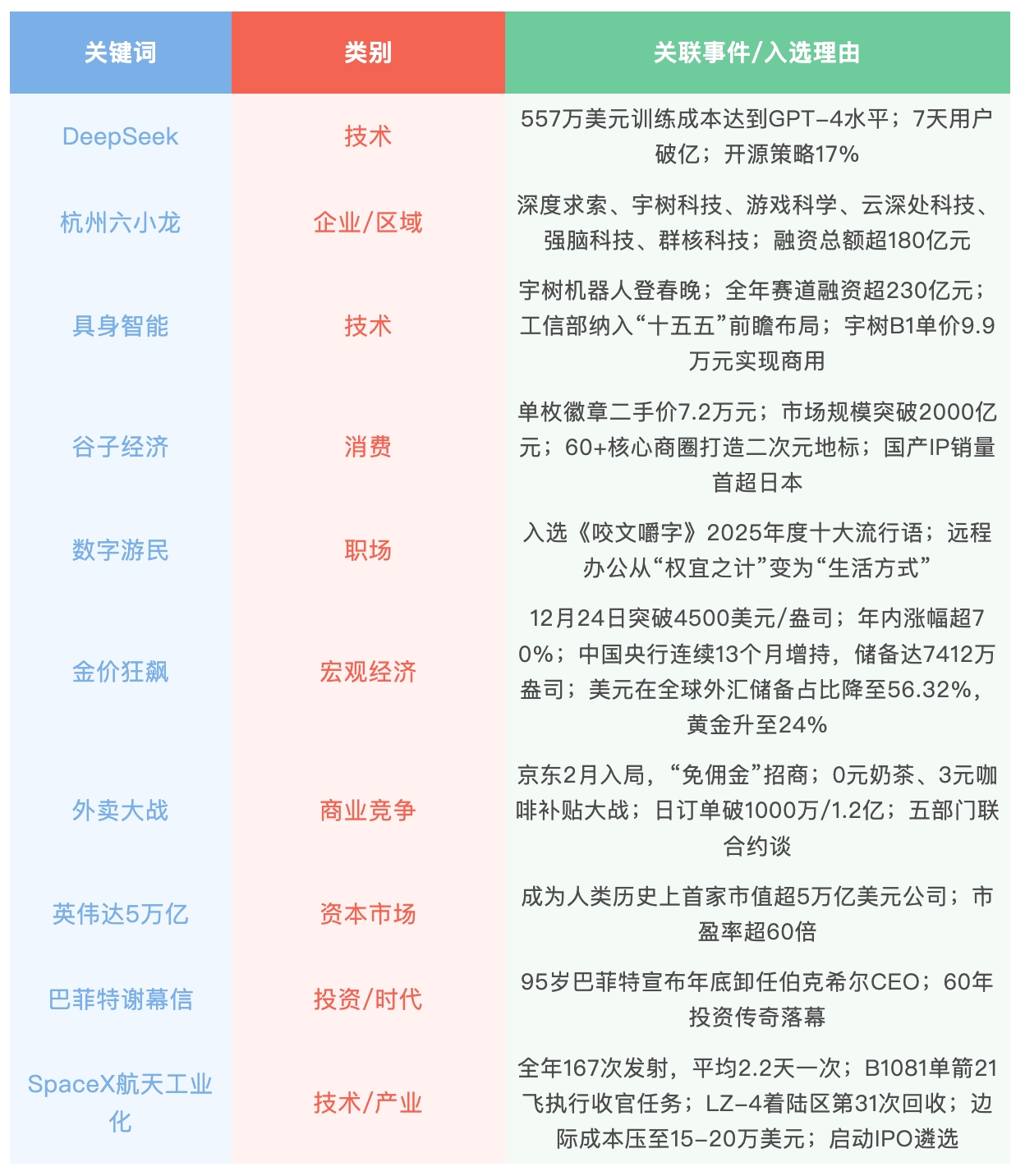
Group 1 - Nvidia's stock price plummeted 17% in a single day, resulting in a market value loss of nearly $600 billion, marking the largest single-day market loss in U.S. stock market history [1] - The emergence of DeepSeek, a Chinese company, has caused significant concern on Wall Street, as it achieved results comparable to OpenAI's GPT-4 with a training cost of only $5.57 million, compared to OpenAI's $100 million [2][9] - The media has referred to this event as an "Sputnik moment" in the AI field, indicating a significant shift in technological capabilities [3] Group 2 - DeepSeek's success challenges the notion that more computational power is necessary for better AI models, suggesting that smarter algorithms can achieve similar results with less resource investment [9] - The "Six Little Dragons" from Hangzhou, including DeepSeek and other tech companies, have collectively raised over 18 billion yuan, indicating a shift towards technology-driven growth in the region [12][13] - The concept of "embodied intelligence" is gaining traction, with significant investments in humanoid robots and AI that can interact with the physical world, marking a new frontier in AI development [16] Group 3 - The "Guzi economy," referring to the market for anime and gaming merchandise, has grown to a market size of 200 billion yuan, with over 667,000 related enterprises in China [19] - The rise of "digital nomads," who work remotely and travel, is reshaping workplace dynamics and challenging traditional office structures [20] - Gold prices surged by 70% in 2025, reaching over $4,500 per ounce, driven by a decline in the dollar's global reserve status and increased central bank purchases [23] Group 4 - The competition in the food delivery market intensified with JD's entry, leading to significant consumer benefits through aggressive pricing strategies [26] - Nvidia's market capitalization surpassed $5 trillion, making it the first company in history to reach this milestone, reflecting its dominance in the AI hardware market [28][29] - Warren Buffett announced his retirement as CEO of Berkshire Hathaway, raising questions about the future of value investing in the rapidly evolving tech landscape [32] Group 5 - SpaceX achieved a record 167 rocket launches in 2025, demonstrating the industrialization of space travel and significantly reducing launch costs [35] - The developments in AI, technology, and consumer behavior in 2025 indicate a transformative year, with implications for various industries and investment strategies [36]

北京房价加速下跌啊
集思录· 2025-12-29 14:22
Core Viewpoint - The article discusses the significant decline in real estate prices in major cities like Beijing, highlighting a shift in buyer psychology and investment logic in the real estate market [1][5][10]. Group 1: Real Estate Price Trends - In Beijing's Haidian district, the transaction price for a specific property type dropped to 750,000, down from 968,000 six months prior, indicating a substantial decline [1]. - The article notes that while previously, real estate was seen as a guaranteed investment, the current market reflects a shift where prices are not expected to rebound quickly, and the investment logic has changed from growth to value [10][9]. Group 2: Buyer Sentiment and Behavior - There is a noticeable shift in buyer sentiment, with many individuals now opting for full cash purchases rather than relying on loans due to job instability and economic uncertainty [5][6]. - The article mentions that the perception of real estate as a secure investment has diminished, leading to a decrease in interest in purchasing properties, especially in first and second-tier cities [4][3]. Group 3: Economic and Policy Context - The article outlines a broader economic context where the government is shifting its focus away from real estate investment, indicating a change in national strategy towards infrastructure and new industries [13][14]. - It highlights that the funding for real estate development has decreased significantly, with projections showing a decline in investment from 15.4 trillion in the 14th Five-Year Plan to an estimated 8-10 trillion in the 15th Five-Year Plan [16].