扩内需

Search documents
A股策略周报:关注政策协同与价格改善信号-20250803
Ping An Securities· 2025-08-03 14:21
Group 1: Market Overview - A-shares experienced a slight decline of 0.9% in the Shanghai Composite Index, while the Wande Micro Index rose by 1.5%[5] - The S&P 500 index in the US fell by 2.4% due to unexpected cooling in non-farm payroll data[6] - The manufacturing PMI in China decreased to 49.3%, reflecting a 0.4 percentage point drop from the previous month[10] Group 2: Economic Indicators - The major raw material purchase price index increased by 3.1 percentage points to 51.5%, indicating rising costs[7] - The ex-factory price index rose by 2.1 percentage points to 48.3%, suggesting price improvements in manufacturing[7] - The unemployment rate in the US slightly increased to 4.2%, with non-farm employment growth revised down to 33,000 jobs[6] Group 3: Policy and Future Outlook - The Politburo meeting on July 30 emphasized the need for more proactive fiscal policies and moderately loose monetary policies[7] - The introduction of a child-rearing subsidy of 3,800 yuan per child per year aims to stimulate domestic demand[7] - The probability of a 25 basis point rate cut by the Federal Reserve in September has risen to 80% following recent economic data[6] Group 4: Investment Recommendations - Suggested investment focus includes technology growth sectors, benefiting from both domestic and external demand[8] - Emphasis on sectors likely to improve due to "anti-involution" policies, such as renewable energy and traditional cyclical industries[8] - Caution advised regarding macroeconomic recovery not meeting expectations and potential tightening of monetary policy[8]
31省份消费版图
2 1 Shi Ji Jing Ji Bao Dao· 2025-08-02 04:30
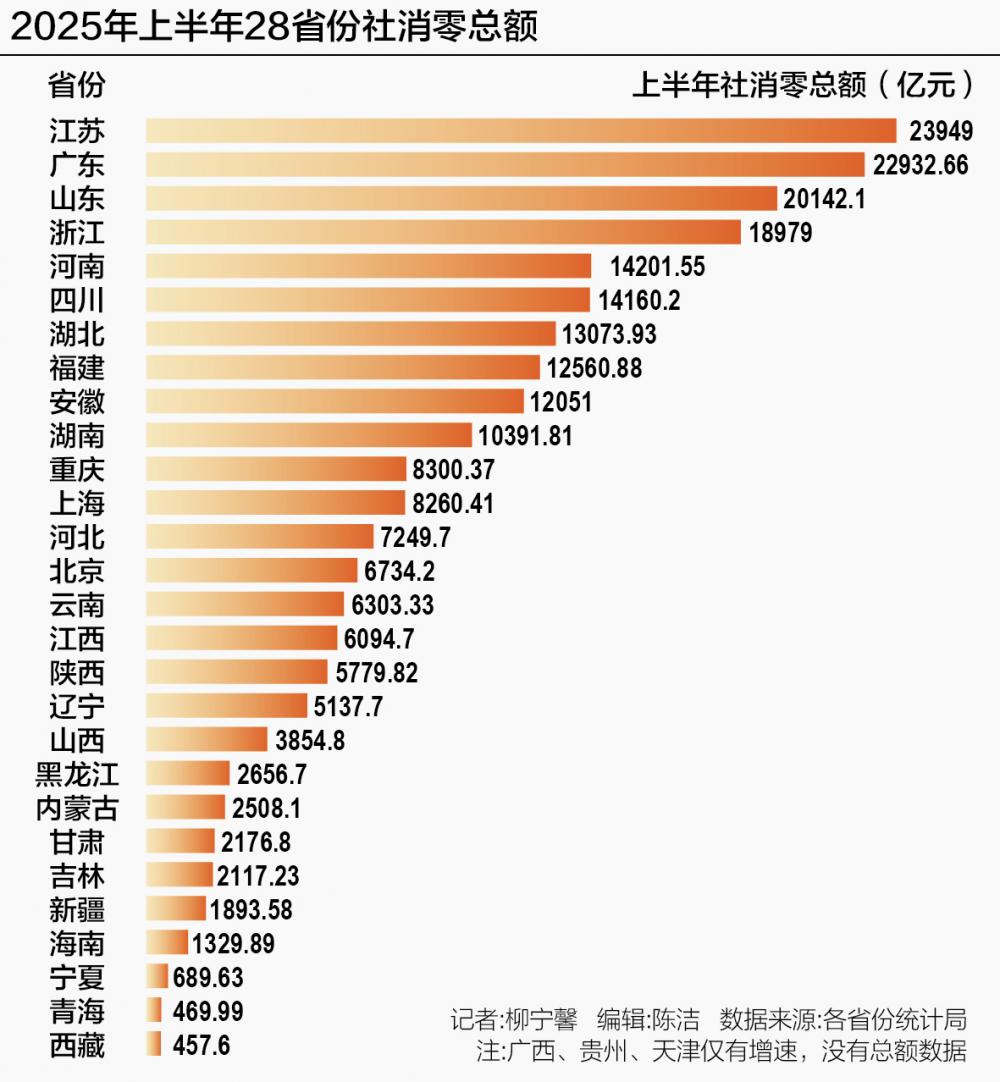
Core Insights - Domestic demand contributed 68.8% to China's GDP growth in the first half of the year, highlighting its role as the main driver of growth [1] - The consumption reports from 31 provinces indicate the initial effectiveness of strategies aimed at expanding domestic demand [1] Consumption Growth - The top ten provinces by total retail sales of consumer goods (社消零) in the first half of the year are Jiangsu, Guangdong, Shandong, Zhejiang, Henan, Sichuan, Hubei, Fujian, Anhui, and Hunan, with Jiangsu, Guangdong, and Shandong exceeding 2 trillion yuan [1][5] - 19 provinces outperformed the national retail sales growth rate of 5%, with 11 provinces achieving growth rates of at least 6%, led by Hainan at 11.2% [1][5] - Hainan's total retail sales reached 1329.89 billion yuan, growing 11.2% year-on-year, with significant growth in automobile sales, particularly in new energy vehicles [5][6] Regional Performance - Jiangsu, Guangdong, and Shandong are the top three provinces in retail sales, with Jiangsu leading at 23949 billion yuan, followed by Guangdong at 22932.66 billion yuan and Shandong at 20142.1 billion yuan [5][6] - The rankings of the top ten consumption provinces have shifted, with Fujian surpassing Anhui to become the eighth largest [6] Consumption Drivers - The main drivers of consumption growth include trade-in policies and the rise of online shopping, with structural factors such as effective domestic demand policies and rapid growth in e-commerce playing significant roles [9][10] - In Fujian, the implementation of trade-in policies and online consumption led to a total retail sales figure of 12560.88 billion yuan, with a growth rate of 6% [10] Future Outlook - The second half of the year is expected to focus on emerging consumption and service consumption, with many provinces planning to enhance trade-in policies and promote service consumption activities [2][11] - The government plans to increase fiscal support for trade-in subsidies to 300 billion yuan, potentially driving an additional 2 trillion yuan in consumption [11] Service Consumption Trends - New consumption hotspots are emerging, particularly in technology and high-quality exhibitions, which are expected to drive service consumption [12][13] - Various provinces are implementing specific actions to enhance service consumption, including cultural tourism and sports events [13][14]

扩内需反内卷推进统一大市场 发改委部署下半年经济工作
Zheng Quan Shi Bao· 2025-08-01 17:19
Economic Performance - In the first half of the year, China's economy showed steady progress and performed better than expected despite complex internal and external environments, with multiple key indicators reflecting positive outcomes [1] - The total investment for the "two heavy" construction projects has been fully allocated at 800 billion, and the central budget investment of 735 billion has been largely disbursed [1] Policy Measures - The National Development and Reform Commission (NDRC) will continue to utilize its policy toolbox to stabilize employment and expand domestic demand, aiming for a reasonable recovery in prices, stable employment, and optimized economic growth [2] - The NDRC plans to implement measures to promote service consumption, emerging economies, and digital consumption to further unleash consumption potential [2] Market Dynamics - The NDRC is addressing issues of "involution," disorderly competition, and market disarray in various industries, which will be a focus for governance in the second half of the year [2] - The NDRC is revising the pricing law as part of efforts to combat "involution" and ensure sustainable development across multiple industries [3] Trade and Market Integration - From January to April, inter-provincial trade sales accounted for 40.4% of total sales revenue, an increase of 0.6 percentage points year-on-year, indicating a trend of reduced market transaction costs and improved factor mobility [3] - The NDRC is developing an action plan to advance the construction of a unified national market, focusing on the unification of systems related to property rights, market access, fair competition, social credit, and quality standards [3] Energy Sector Developments - The NDRC is working on the construction of a unified national electricity market, which is crucial for ensuring energy security, low-carbon transition, and economic growth [4] - The electricity market barriers are gradually being eliminated, with cross-grid trading mechanisms being established, which aids in precise price discovery and effective supply-demand regulation [4] Innovation and Technology - The NDRC plans to implement the "Artificial Intelligence +" initiative to promote large-scale commercial applications of AI, optimize the innovation ecosystem, and enhance policy support in areas such as computing power, algorithms, data, and talent [5]
消费品以旧换新再加码,第四批690亿元资金将于10月下达
Zhong Guo Jing Ji Wang· 2025-08-01 06:47
Core Viewpoint - The Chinese government is actively promoting consumption recovery through various measures, including the issuance of special bonds and targeted policies to enhance consumer confidence and spending [1][2][3] Group 1: Economic Data and Trends - In the first half of the year, the total retail sales of consumer goods increased by 5%, with a growth rate improvement of 0.4 percentage points compared to the first quarter and 1.3 percentage points compared to the same period last year [1] - The contribution rate of final consumption to economic growth reached 52% in the first half of the year, with the second quarter showing a slight increase to 52.3% [1] - The sales generated from the "trade-in" program exceeded 1.7 trillion yuan, indicating a significant boost in consumer spending [2] Group 2: Policy Initiatives and Actions - The National Development and Reform Commission (NDRC) is implementing a series of special actions to stimulate consumption, focusing on improving people's livelihoods and expanding consumer demand [1][2] - Various departments are rolling out major policies and hosting diverse promotional activities to boost consumption, including sports and cultural events [2] - The NDRC plans to enhance consumer capacity, cultivate new growth points in service consumption, and optimize supply to encourage spending [3] Group 3: Future Plans and Measures - The NDRC aims to implement more robust measures to support consumption, including promoting stable employment and income growth [3] - There is a focus on developing new service consumption areas, such as cultural tourism and healthcare services, while reducing consumption restrictions [3] - The NDRC will ensure the effective use of special bond funds for trade-in programs and strengthen product quality and price regulation to prevent fraudulent practices [3]
国家发展改革委:不断完善稳就业扩内需政策工具箱
Zheng Quan Ri Bao Wang· 2025-08-01 03:26
本报记者 杜雨萌 8月1日,国家发展改革委举行新闻发布会,解读当前经济形势和经济工作。针对7月31日国务院常务会议审议通过的《关 于深入实施"人工智能+"行动的意见》,国家发展改革委政策研究室主任、新闻发言人蒋毅称,下一步,国家发展改革委将会 同有关方面,注重让市场有方向、有信心,注重务实管用,深入实施"人工智能+"行动。 具体来说,一方面,大力推进人工智能规模化商业化应用,充分发挥我国产业体系完备、市场规模大、应用场景丰富等优 势,推动人工智能在经济社会发展各领域加快普及、深度融合,形成以创新带应用、以应用促创新的良性循环。另一方面,着 力优化人工智能创新生态,加大政策支持力度,夯实算力、算法、数据、开源、人才、安全等方面基础,加快形成动态敏捷、 多元协同的人工智能治理格局,更好支撑技术落地和产业发展壮大。 另据蒋毅介绍,今年第三批690亿元支持消费品以旧换新的超长期特别国债资金已下达完毕,将于10月份按计划下达第四 批690亿元资金,届时将完成全年3000亿元的下达计划。 蒋毅表示,下一步,国家发展改革委将会同财政部、商务部等部门,督促地方落实资金配套责任、细化资金使用计划,确 保资金有序均衡用到年底。同 ...
国家发改委:常态化开展政策预研储备,将根据实际需要及时推出
Sou Hu Cai Jing· 2025-08-01 02:48
Core Insights - The National Development and Reform Commission (NDRC) highlighted the strong resilience of the economy in the first half of the year, with domestic demand contributing 68.8% to GDP growth, indicating its role as a key driver of growth [1][1][1] - The NDRC plans to implement measures to stabilize employment and the economy, ensuring policy continuity, stability, and flexibility to convert external pressures into internal momentum [1][1][1] - The NDRC will enhance economic monitoring and forecasting, regularly conduct policy research, and improve the toolbox for stabilizing employment and expanding domestic demand [1][1][1] Economic Performance - The economy demonstrated strong resilience in the first half of the year, with significant contributions from domestic demand and robust performance in foreign trade [1][1][1] - The equipment manufacturing sector continues to play a stabilizing role in the economy, while the modern service industry is accelerating its development [1][1][1] Future Outlook - The NDRC aims to maintain a stable employment situation and market expectations, striving for a reasonable recovery in price levels and optimizing economic growth [1][1][1] - There will be a focus on coordinating policies and work for the current and next year to ensure effective implementation of economic stabilization measures [1][1][1]
X @外汇交易员
外汇交易员· 2025-08-01 02:28
Policy Focus - The government will strengthen economic monitoring, forecasting, and early warning systems [1] - The government will normalize policy research and reserve measures [1] - The government aims to improve the policy toolbox for stabilizing employment and expanding domestic demand [1] - Policies will be adjusted based on actual needs, coordinating efforts between the current and next year [1] Economic Goals - The government prioritizes stabilizing employment, businesses, and market expectations [1] - The government seeks to achieve a reasonable recovery in price levels [1] - The government aims for overall stability in social employment and optimized economic growth [1]
债市将震荡偏弱运行 且波动幅度放大
Qi Huo Ri Bao· 2025-07-31 23:40
上周债市经历显著调整,本周则呈现双向宽幅波动特征。10年期国债活跃券收益率本周在1.712%至 1.750%震荡,30年期国债活跃券收益率在1.918%至1.965%震荡,日内波动幅度较6月有所加大。 关注点二是深化改革重要性提升,将现代化产业体系建设相关表述放在深化改革框架之下。新增"反内 卷"相关表述,但注重"无序竞争""产能治理""地方招商",弱化"低价"问题。 会议强调政策连续性稳定性 关注点三是对资本市场的表述从此前的"稳定和活跃"改为"增强国内资本市场的吸引力和包容性",有助 于风险偏好和市场活跃度继续稳步提升。 7月中共中央政治局会议强调"保持政策连续性稳定性,增强灵活性预见性""宏观政策要持续发力、适时 加力""要落实落细更加积极的财政政策和适度宽松的货币政策,充分释放政策效应"。在二季度GDP表 现维持韧性、6月经济基本面运行平稳且结构分化的背景下,会议定调下半年宏观政策取向保持积极, 延续一致性导向。 关注点四是扩内需继续放在首位,但取消"两新"表述。稳外贸措辞增加,保民生、促就业仍是重点,安 全工作部署进一步强化。整体表述基本延续去年年底中央经济工作会议精神。 关注点一是充分肯定了今年上 ...
宏观策略、大类资产配置与大宗投资机会7月刊:内部行情交流会策略分享
Guo Tou Qi Huo· 2025-07-31 12:21
Report Industry Investment Rating No relevant content provided. Core Viewpoints of the Report - In the past two months, geopolitical risks did not cause spill - over effects, and the main line was to maintain stable geopolitical conflicts. Bilateral trade negotiations and tariff issues were under market attention, and China - US economic and trade conflicts maintained a stable stance. Domestic policies showed changes, with the "anti - involution" policy framework moving from expectation to implementation and the fiscal policy showing stronger signals of marginal efforts [3]. - The global risk preference has been repaired, and risk assets generally rose. The US dollar remained weakly volatile, and the market structure changed. The sectors corresponding to "anti - involution" and "expanding domestic demand" in the commodity market were strong, and the pricing expectations for re - inflation and profit repair increased [8][9]. - In the next 1 - 2 months, continue to track geopolitical disturbances and the implementation of US multilateral tariffs and China - US tariff suspension. Domestic policies should be tracked for their hedging effects on the decline in external demand. For financial products, the macro - liquidity is expected to remain stable and positive, and for commodities, the impact of "anti - involution" policies on the market is increasing [11][12][14]. Summary by Directory 1. Market Review and Outlook - **Macro Operation Characteristics**: Geopolitical conflicts remained stable, trade negotiations were under market attention, and domestic policies changed. The "anti - involution" policy was expected to be implemented, and the fiscal policy showed marginal efforts [3]. - **Characteristics of Major Asset Operations**: Since mid - June, global risk preference has been repaired, risk assets generally rose, the US dollar remained weakly volatile, and the market structure changed. The sectors related to "anti - involution" and "expanding domestic demand" in the commodity market were strong [8][9]. - **Future Outlook**: Track geopolitical disturbances, the implementation of US multilateral tariffs and China - US tariff suspension, and the hedging effects of domestic policies on external demand [11][12]. 2. Financial Products - **Stock Index**: In July, the A - share market performed well, with the growth style stronger than the value style. The implementation of the long - term assessment mechanism for insurance funds and "anti - involution" policies supported the market. In August, if there is incremental capital inflow, the performance of equity assets is worth looking forward to, and attention should be paid to sector rotation [23]. - **Treasury Bonds**: Since July, the bond market has been weak, and the yield curve has shown a "bear steepening" feature. In August, the yield of the 10 - year treasury bond may continue to fluctuate within a range, and a curve steepening strategy is recommended [24][25]. 3. Commodities - **Energy**: Oil prices are likely to be under pressure and fluctuate. The coal market may have a tail - end upward period, and the PG/ crude oil ratio is expected to be suppressed. The natural gas market may be weak during the replenishment season [18][27][29]. - **Chemicals**: Propylene futures lack unilateral opportunities in the short term. Styrene is expected to continue its weak consolidation pattern. A strategy of going long on glass and short on soda ash is recommended [31][33][34]. - **Non - ferrous Metals and Precious Metals**: Polysilicon may remain oscillating strongly in the short term, and lithium can be considered for long - position replenishment after a correction. Alumina may face a callback risk, and copper prices may face resistance at integer levels [37][39]. - **Black Metals**: Steel prices are expected to rise with fluctuations, and it is not recommended to chase the rise of iron ore at high prices. Coking coal may be strong in the short term but face valuation pressure in the medium term. Ferroalloys are expected to rise first and then fall with a rising bottom [41][42][43]. - **Agricultural Products**: For oils, it is recommended to go long on soybean and palm oils at low prices. Cotton is expected to oscillate at a high level [46][48].
二季度政治局会议传递积极信号
水皮More· 2025-07-31 10:37
Core Viewpoint - The article emphasizes the continuation of a stable yet progressive macroeconomic policy, focusing on maintaining policy stability while enhancing flexibility and timely adjustments to stimulate economic recovery [1][3]. Fiscal Policy - The fiscal policy aims for detailed implementation, emphasizing structural optimization, with a focus on enhancing social welfare and targeted spending for specific groups [4]. - The government plans to accelerate the issuance of long-term special bonds, with net financing reaching 7.66 trillion yuan in the first half of 2025 [4]. Monetary Policy - A moderately loose monetary policy is anticipated, with potential interest rate cuts to lower overall financing costs for society [5]. - The central bank has already implemented a 10 basis point interest rate cut and a 50 basis point reserve requirement ratio reduction, with further easing expected [5]. Industry Policy - The industry policy focuses on fostering technological innovation and promoting healthy competition, with an emphasis on emerging industries and strategic sectors [6][8]. - Key areas for support include quantum computing, artificial intelligence, and biotechnology, with a push for collaboration between research institutions and enterprises [6]. Real Estate Policy - The real estate policy highlights the importance of high-quality urban renewal and managing local government debt risks, with a focus on stabilizing the housing market [9]. - Recent data shows a decline in property sales, with June's sales area and revenue down by 5.5% and 10.8% year-on-year, respectively [9]. Domestic Demand Expansion - The strategy for expanding domestic demand involves enhancing both consumption scenarios and consumer capacity, with potential policies to optimize social security contributions and tax structures [11][12]. - Recent retail sales data indicates a 4.8% year-on-year growth, but a decline in consumer confidence remains a concern [11]. Employment and Social Welfare - The employment policy prioritizes job creation for key demographics, including recent graduates and migrant workers, while ensuring social safety nets are in place [13]. - The approach combines development with safety nets to stabilize society and rebuild consumer confidence [13]. Capital Market - The capital market is encouraged to enhance its attractiveness and inclusivity, with recent positive performance in A-shares and Hong Kong stocks [14]. - The government has introduced various supportive measures to stabilize and invigorate the capital market, including optimizing monetary policy tools [14]. High-Level Opening Up - The policy aims to maintain a stable foundation for foreign trade and investment, with measures to support foreign trade enterprises and promote integrated development of domestic and foreign trade [15]. - The focus is on enhancing the resilience of enterprises and the support capabilities of open platforms in a complex external environment [15].