
服务消费

Search documents
大消费迎“催化剂”!这些方向被看好
Zhong Guo Zheng Quan Bao· 2025-12-10 14:28
Core Viewpoint - Recent policies aimed at boosting consumption and domestic demand are expected to positively impact the consumer sector, with a focus on direct subsidies and consumption loan interest subsidies as short-term measures to stimulate spending [1] Group 1: Policy Initiatives - A series of policies have been released to enhance domestic demand and consumption, with expectations for increased fiscal spending and a focus on service consumption [2] - The Ministry of Industry and Information Technology and other departments have outlined a plan to create three trillion-level consumption sectors and ten hundred-billion-level consumption hotspots by 2027 [2] - The "old-for-new" policy is anticipated to continue, directing more resources towards service consumption and improving the overall consumption environment [3] Group 2: Investment Opportunities - The consumer industry is showing signs of bottoming out, with fundamental recovery acting as a catalyst for stock prices, particularly in sectors like chain restaurants, new tea drinks, and sports companies [1][4] - Service consumption is expected to enter a rapid growth phase, driven by personalized interactions and unique experiences, offering significant investment potential compared to traditional goods consumption [4] - Companies focusing on dividend distribution and share buybacks are improving the industry landscape, with a "dividend+" strategy recommended for stable short-term investments [4] Group 3: Strategic Focus Areas - Two main lines for investment in the consumer sector are suggested: one focusing on high replicability through efficient supply chains, and the other on high experience creation capabilities that offer unique consumer experiences [5] - Specific sectors to watch include chain restaurants, sports companies, entertainment operators with valuable IP, and platform companies with strong ecosystem capabilities [5]
连跨3个万亿元台阶,江苏地区生产总值今年有望突破14万亿元
Yang Zi Wan Bao Wang· 2025-12-10 13:42
Economic Growth - Jiangsu's GDP has increased from 10.5 trillion yuan in 2020 to 13.7 trillion yuan in 2024, with expectations to surpass 14 trillion yuan this year, marking the crossing of the fourth trillion yuan milestone during the "14th Five-Year Plan" [1][3] - All 13 cities in Jiangsu have entered the national top 100, reflecting significant economic progress [3] Consumer Market - The retail sales of consumer goods in Jiangsu remain among the highest in the country, with a projected consumption boost of over 351 billion yuan from the "old-for-new" consumption initiative in 2024-2025 [3] - The integration of events and consumption has led to the emergence of new business models, stimulating consumer potential [3] Manufacturing and Innovation - Jiangsu's regional innovation capability has risen to second in the nation, with over 70% growth in high-tech enterprises and significant contributions to patent creation and technological platforms [4] - The province leads the nation in advanced manufacturing clusters and strategic emerging industries, including power batteries, integrated circuits, and biomedicine [4] Environmental Initiatives - Jiangsu is actively promoting carbon neutrality and has launched a provincial carbon footprint public service platform to track emissions across various stages of production [5] - The province has achieved significant environmental quality improvements, with PM2.5 levels meeting national standards for four consecutive years [5] Employment and Social Welfare - Jiangsu has maintained urban employment growth above 10% nationally, with a reduction in the urban-rural income gap to 2.04:1 [6] - The province has established a comprehensive elderly care service system and achieved high rates of basic health insurance coverage [6] Consumer Engagement and Events - The province has issued approximately 2.54 billion yuan in consumption vouchers and digital currency red packets, with over 500,000 businesses participating in the "Su New Consumption + Su Super League" initiative [7] - Various promotional activities, including food festivals and local delicacies, have attracted significant public engagement, enhancing the integration of commerce, culture, and sports [7]

每日报告精选-20251210
GUOTAI HAITONG SECURITIES· 2025-12-10 13:14
Market Overview - Overall asset performance shows commodities outperforming equities, with the Korean stock market leading gains[4] - MSCI global index increased by 0.6%, but growth momentum has significantly slowed compared to previous weeks[5] - The yield curve for Chinese bonds is steepening, indicating a "bear steepening" trend, while U.S. bonds are experiencing a "bull steepening" trend[6] Commodity and Currency Trends - 10 out of 13 major commodities recorded price increases, with COMEX silver rising by 101.9% year-to-date[7] - The U.S. dollar index fell by 0.5%, with the euro and pound appreciating by 0.4% and 0.8% respectively; the dollar has depreciated by 8.8% since the beginning of the year[7] Consumer and Industrial Insights - Service consumption has improved year-on-year, with Shanghai Disneyland's visitor index up by 75% compared to last year[10] - Real estate transactions in major cities have seen significant declines, with new home sales down by 32.5% year-on-year[30] Financial Sector Developments - As of November 2025, the total net asset value of public funds reached 36 trillion yuan, with equity funds increasing by 1.55%[24] - The performance evaluation of the investment banking sector is shifting towards enhancing investor experience[23] Company-Specific Highlights - Traffic Bank's net profit growth is projected at 2.3% for 2025, with a target price adjustment to 8.58 yuan based on a 0.72x PB valuation[34] - Didi's EBITA is expected to be 46.0 billion yuan in 2025, with a target market value of 234.7 billion yuan[39]
国泰海通|策略:AI产业延续高景气,服务消费同比偏强
国泰海通证券研究· 2025-12-10 11:52
Group 1: Core Insights - The article highlights a mixed economic outlook, with the AI industry continuing to thrive while the real estate and durable goods sectors show signs of decline [1] - Service consumption has seen a significant year-on-year increase, driven by improved travel demand during the autumn holiday period [1][2] - Industrial metal prices have surged due to rising expectations of overseas interest rate cuts, while the real estate market experiences a notable drop in transaction volumes [1][2] Group 2: Service Consumption - Service consumption indicators show a year-on-year improvement, with Shanghai Disneyland's crowd index decreasing by 17.7% month-on-month but increasing by 75.0% year-on-year, indicating a recovery in tourism demand [2] - Movie box office revenues have increased by 227.7% year-on-year despite a month-on-month decline of 34.1%, suggesting a strong recovery in consumer spending on entertainment [2] Group 3: Real Estate and Durable Goods - The real estate market in 30 major cities has seen a year-on-year decline in transaction volume of 34.8%, with first, second, and third-tier cities experiencing declines of 32.6%, 33.0%, and 42.7% respectively [2] - The sales of passenger vehicles have also decreased, with a year-on-year drop of 8.1% in November 2025, indicating growing inventory pressure among dealers [2] Group 4: Technology and Manufacturing - The price of DRAM storage remains high, with DDR4 and DDR5 prices at $46.5 and $26.3 respectively, reflecting a month-on-month increase of 9.4% for DDR4 [3] - Manufacturing activity has improved, with increased operating rates in sectors such as automotive and chemicals, alongside a slight improvement in hiring intentions [3] Group 5: Logistics and Transportation - Long-distance travel demand remains stable, with a slight month-on-month increase in the Baidu migration index, while air passenger demand has shown year-on-year improvement despite a recent decline [4] - The dry bulk shipping price index has increased significantly due to rising demand from overseas iron ore production, although overall export activity has decreased [4]

国内高频 | 服务消费相关指标走强(申万宏观·赵伟团队)
申万宏源宏观· 2025-12-10 11:51
Core Viewpoint - The article discusses the current state of industrial production, construction, and demand trends in China, highlighting weak performance in various sectors while noting some marginal improvements in construction and consumer behavior. Industrial Production - The operating rate of blast furnaces continues to decline, with a decrease of 1.1% week-on-week to 81.1%, and a year-on-year drop of 0.8 percentage points [2] - Steel apparent consumption fell by 2.68% week-on-week and decreased by 2.4 percentage points year-on-year to 1.2% [2] - Steel social inventory continues to decline, down 2.9% week-on-week [2] Construction Industry - Cement production and demand show marginal improvement, with the national grinding operating rate increasing by 0.5% week-on-week to 38.9% [23] - Cement shipment rates decreased by 0.8% week-on-week to 44.4%, with a year-on-year decline of 2.1% [23] - Cement inventory ratio continues to decline, down 1.9% week-on-week [23] Chemical and Automotive Sectors - The operating rate in the petrochemical chain is at a historical low, with soda ash operating rate down 6.3% week-on-week to 80.7% [12] - The automotive sector shows weak performance, with semi-steel tire operating rates up 1.7% week-on-week to 70.9%, but down 8.1% year-on-year [12] Demand Trends - National commodity housing transactions have decreased, with a 24% week-on-week drop in average daily transaction area across 30 major cities [46] - The migration scale index remains stable, with a year-on-year increase of 0.5 percentage points to 19.8% [58] - Movie attendance and box office revenue have surged, with attendance up 322% year-on-year and revenue up 313.9% [64] Price Trends - Agricultural product prices are generally rising, with vegetable prices up 2.1% week-on-week, while pork prices fell by 0.7% [88] - The South China industrial product price index increased by 1% week-on-week, with energy prices up 0.3% and metal prices up 1.7% [100]
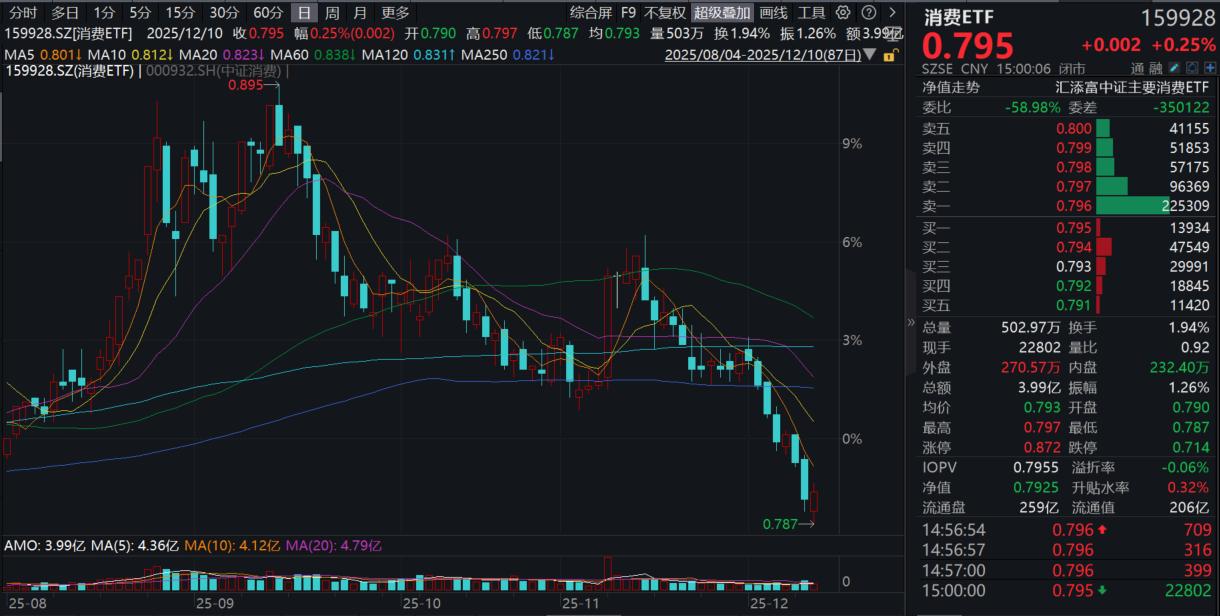
11月CPI同比上涨0.7%,某地产龙头冲击涨停!消费ETF(159928)、港股通消费50ETF(159268)双双收红!茅台回归指导价,段永平仍看多
Xin Lang Cai Jing· 2025-12-10 09:06
Group 1: Market Performance - On December 10, A-shares rebounded with slight gains in the consumer sector, as the Consumer ETF (159928) rose by 0.25% with a total trading volume of 399 million yuan [1] - The Consumer ETF (159928) saw a net inflow of over 170 million yuan in the past 10 days, and as of December 9, its latest scale exceeded 20.5 billion yuan, leading its peers significantly [1] Group 2: Economic Indicators - The National Bureau of Statistics reported that consumer spending continues to recover, with the Consumer Price Index (CPI) slightly decreasing by 0.1% month-on-month and increasing by 0.7% year-on-year. The core CPI, excluding food and energy prices, rose by 1.2% year-on-year [3] Group 3: Real Estate and Alcohol Industry - Real estate stocks showed unusual upward movement in the afternoon, with a leading real estate company nearing a trading limit, influenced by recent mortgage-related news [6] - In the alcohol sector, the price of 25-year Flying Moutai bottles dropped to 1,500 yuan, a decrease of 15 yuan from the previous day. The wholesale reference price for the original box remained unchanged at 1,520 yuan [6] Group 4: Valuation and Investment Opportunities - The valuation of the Consumer ETF (159928) remains attractive, with a TTM price-to-earnings ratio of 19.32, which is at the 2.84% percentile over the past decade, indicating it is cheaper than 97% of the historical time [8] - The white liquor sector is facing price pressure, with high inventory and weak demand challenges. However, the current adjustment in stock prices has reflected pessimistic expectations, suggesting long-term investment value [10] Group 5: Consumer Trends - There is a growing emphasis on expanding service consumption, which is expected to accelerate as China's GDP per capita exceeds 13,000 USD. This shift indicates significant growth potential in sectors like culture, leisure, and health [11] - Recent data shows positive trends in consumer spending, with notable increases in luxury goods sales and hotel industry performance, indicating a recovery in consumer sentiment [12]






万联证券:把握服务消费领域的投资机会 重点关注连锁餐饮及体育
智通财经网· 2025-12-10 03:31
Core Viewpoint - The report from Wanlian Securities indicates that domestic service consumption in China has rebounded to 46% of total household consumption in 2024, nearing a structural critical point of 50%, suggesting a rapid growth phase for the industry, which is expected to be a key driver for domestic demand and consumption [1] Group 1: Investment Opportunities - Investment opportunities in the service consumption sector can be focused on two key dimensions: 1) High replicability, emphasizing business models that can achieve rapid replication through standardized processes and strong supply chains; 2) High experience creation capability, targeting services that provide unique experiences, emotional resonance, or cultural identity [2] Group 2: Overview of Service Consumption - Modern service consumption is transitioning from "functional satisfaction" to "experience co-creation" and "emotional healing," where consumers pay for personalized, memorable experiences that create deep and lasting memories. Compared to traditional goods consumption, service consumption shows significant growth elasticity, stable profitability, and superior operational efficiency [3][4] Group 3: Development Trends - Service consumption in China is approaching a structural critical point for accelerated penetration in consumption share. The demand side is increasingly segmented, focusing on the "young and elderly" demographics. The supply side is characterized by a diversified service platform ecosystem that incubates supply and influences decision-making [4] Group 4: Classification of Service Consumption - The classification framework for service consumption is based on two dimensions: 1) Experience creation capability, which relates to psychological satisfaction and emotional resonance; 2) Replicability, which assesses the standardization of service processes and the potential for cross-regional and cross-demographic expansion. Three main tracks are identified: 1) Scale efficiency type (low experience + high replicability); 2) Artisan economy type (high experience + low replicability); 3) Brand premium type (high experience + high replicability) [5] Group 5: Recommendations - Recommendations include: 1) Chain restaurants/tea drinks, focusing on leading brands with supply chain advantages; 2) Sports, leveraging the economic impact of events and related services; 3) Performing arts, targeting operators with scarce IP value; 4) Service platforms, which are crucial for supply-demand matching and brand incubation [6]
中央政治局会议“划重点”:建设强大国内市场,加紧培育壮大新动能|中央经济工作会议前瞻
Hua Xia Shi Bao· 2025-12-10 01:55
本报(chinatimes.net.cn)记者张智 北京报道 "下半年以来,消费增长势头回落、投资需求陷入收缩区间,导致中国经济下行压力显著加大,呈现 出'前高后低'的走势。这意味着,扩大内需迫在眉睫。"中国人民大学国家发展与战略研究院副院长刘 晓光表示。 本次会议提出,要持续"扩大内需、优化供给,做优增量、盘活存量","扩大内需"依然被排在了各项工 作的第一位,新增表述"优化供给"。同时提出,"要坚持内需主导,建设强大国内市场","持续扩大内 需""坚持内需主导"。 事实上,过去三年以来,中央政治局会议对"扩大国内需求"的期待与日俱增。 在国务院发展研究中心原副主任刘世锦看来,当前,需求不足已经成了中国经济增长的主要痛点。 政策抓手上,此次会议首次提出"坚持内需主导",也首次提出"优化供给",意在增强国内大循环的内生 动力和可靠性。 "扩大内需不只是需求侧的改革,还需要新的消费产品和新的消费场景供给,推动新质生产力的发展成 果在市场中变现,对扩大消费形成引领性的作用。"远东资信研究院副院长张林对《华夏时报》记者表 示。 精准发力内需痛点 扩大内需再次被放到重要位置上! 12月8日,中共中央政治局召开会议分析 ...

服务消费专题系列一:消费结构变迁,体验塑造价值
Wanlian Securities· 2025-12-09 07:56
Investment Rating - The industry maintains a "Strong Buy" rating, indicating a positive outlook for investment opportunities in the service consumption sector [4]. Core Insights - In 2024, domestic service consumption's share in resident consumption has recovered to 46%, nearing the structural critical point of 50%, and is expected to enter a rapid growth phase, becoming a key engine for driving domestic demand and boosting consumption [2][28]. - Compared to goods consumption, service consumption offers higher growth elasticity and user stickiness due to its personalized interaction and unique experiences, presenting vast investment opportunities [2][57]. - Investment opportunities in the service consumption sector can be strategically focused on two key dimensions: one is along the high replicability line, emphasizing scale expansion and supply chain efficiency; the other is along the high experience shaping capability line, focusing on services that provide unique experiences, emotional resonance, or cultural identity [2][57]. Summary by Sections Service Consumption Overview - Service consumption is defined as the total expenditure on various non-physical services paid by residents to meet their life needs, covering twelve major categories including health services, entertainment, and education [10]. - The essence of modern service consumption is shifting from "functional satisfaction" to "experience co-creation" and "emotional healing," emphasizing the creation of multi-dimensional experiences that form lasting memories [10][14]. Development of Service Consumption - The share of service consumption is expected to accelerate, with a structural critical point approaching, as seen in international examples where service consumption's share increases significantly after surpassing 50% [24][25]. - The growth potential of service consumption is high, with per capita service consumption growth consistently outpacing overall consumption growth, indicating a slower marginal utility decline compared to goods consumption [29]. Classification of Service Consumption - A classification framework for service consumption is proposed based on two dimensions: experience shaping capability and replicability. This framework helps identify investment value across different business models [44]. - Three main tracks of service consumption are identified: 1. Scale efficiency type (low experience shaping capability + high replicability) represented by chain restaurants and tea shops [48]. 2. Artisan economy type (high experience shaping capability + low replicability) exemplified by concert events [51]. 3. Brand premium type (high experience shaping capability + high replicability) typified by sports events [54]. Investment Recommendations - The report suggests focusing on key tracks such as chain restaurants/tea shops, sports companies, performing arts operators, and platform enterprises that can effectively connect supply and demand [57].
中银国际:服务消费迎利好 重视社服行业景气回升
智通财经网· 2025-12-09 07:51
Group 1: Tourism Industry - The overall performance of the tourism industry is stable but shows signs of divergence, with growth expected to continue slowing down [1][2] - Domestic travel is experiencing stable growth in visitor numbers, but consumer spending power remains insufficient; cross-border travel is benefiting from visa-free policies and improved capacity [2] - The upcoming long holiday during the Spring Festival in 2026 and the gradual implementation of spring and autumn holidays are expected to boost travel enthusiasm [2] Group 2: Hotel Industry - The hotel industry continues to face pressure, with supply-side expansion leading to increased market competition [3] - Demand remains unfulfilled, and corporate cost control measures are in place, resulting in an average market sentiment [3] - Profit growth for hotel companies is primarily driven by cost reduction and quality improvement, with a recovery in industry sentiment needed for further profit release [3] Group 3: Restaurant Industry - The restaurant market is experiencing a slowdown in growth due to various factors affecting consumer spending [4] - Competition is shifting from price wars to more rational approaches, with average spending per customer stabilizing [4] - Companies need to focus on improving their operational efficiency to navigate the current market conditions [4] Group 4: Duty-Free Industry - The duty-free sector is showing marginal improvements in industry sentiment, with sales growth turning positive in September 2025 [5] - The upcoming closure of Hainan Island is expected to enhance the advantages of duty-free operators, benefiting from free trade port policies [5] - The expansion of visa-free policies and the recovery of international flight capacity are driving growth in international customer traffic [5] Group 5: Human Resources Industry - The human resources industry is maintaining growth, driven by flexible employment and outsourcing [6] - Despite a lack of confidence in the recruitment market, key companies are performing well in outsourcing and flexible employment sectors [6] - Future revenue growth will depend on the operational efficiency of companies [6] Group 6: Exhibition Industry - The exhibition sector is experiencing performance divergence, with domestic exhibitions benefiting from an improving business environment [7] - Companies should focus on stable growth in internal business and actively engage in emerging industries [7] - International exhibitions face challenges due to geopolitical instability, requiring careful monitoring [7]