
通胀预期

Search documents
【comex黄金库存】11月10日COMEX黄金库较上一交易持平
Jin Tou Wang· 2025-11-11 08:45
Group 1 - COMEX gold inventory recorded at 1173.52 tons on November 10, unchanged from the previous trading day [1][2] - COMEX gold price closed at $4118.50 per ounce on November 10, up 2.64%, with an intraday high of $4123.90 and a low of $4004.20 [1][2] Group 2 - Divergence in Federal Reserve officials' statements is becoming more pronounced, with San Francisco Fed President Daly supporting a dovish stance while St. Louis Fed President calls for caution, indicating ongoing policy uncertainty affecting market dynamics [2] - Latest data shows the U.S. consumer confidence index dropped to 50.3, a two-year low, while inflation expectations remain high at 4.7%, reinforcing market expectations for the Fed to maintain an accommodative policy [2]
国债期货周报:缺乏增量利好,期债上行暂缓-20251110
Yin He Qi Huo· 2025-11-10 08:13
1. Report Industry Investment Rating No relevant content provided. 2. Core Viewpoints of the Report - The bond market may be desensitized to weak foreign trade data, while strong inflation data may boost inflation expectations and suppress bond market performance. In the short - term, the bond market may operate weakly and stably due to lack of incremental positive factors [5]. - It is expected that the bond market will be weak first and then stable next week [5]. - For strategies, in the short - term, a defensive approach with a wait - and - see attitude is recommended for unilateral trading. For arbitrage, try to go long on the current - next quarter inter - period spread and hold short positions on the 30Y - 7Y term spread [5]. 3. Summary by Relevant Catalogs 3.1 First Part: Weekly Core Points Analysis and Strategy Recommendation 3.1.1 Macroeconomic Data Analysis - **Foreign Trade**: In October, China's export amount decreased by 1.1% year - on - year and import amount increased by 1.0% year - on - year, both falling short of expectations. The negative export growth was related to a high base last year and trade disputes in October [9]. - **Inflation**: In October, CPI increased by 0.2% year - on - year and month - on - month. Core CPI increased by 1.2% year - on - year and 0.2% month - on - month, better than expected. PPI decreased by 2.1% year - on - year and increased by 0.1% month - on - month, also better than expected [20][25]. - **Market Liquidity**: This week, the central bank net withdrew 15722 billion yuan of short - term liquidity, but the market funds were balanced and loose. Next week, government bond issuance will increase, with a net payment scale of about 3691.83 billion yuan, but the impact on funds is expected to be controllable [31][36]. 3.1.2 Futures Market Analysis - **Valuation**: The next - quarter contracts are generally over - valued compared to the current - quarter contracts, and the T contract IRR is also high compared to market funds. The IRR of TL, T, TF, TS current - quarter contracts are 1.4099%, 1.8770%, 1.6519%, 1.6209% respectively; the next - quarter contracts are 1.6357%, 1.8782%, 1.6831%, 1.7064% respectively [38][42]. - **Position Transfer**: As of Friday, the position transfer progress of TS, TF, T, TL contracts were 17.0%, 18.3%, 18.4%, 27.8% respectively. It is expected to accelerate next week, and may drive the inter - period spread to widen [47]. 3.2 Second Part: Relevant Data Tracking - **Trading Volume and Open Interest**: Data on the trading volume and open interest of TS, TF, T, TL contracts are provided [52]. - **Contract Spreads**: Data on the spreads between TS, TF, T, TL contracts are provided [55]. - **Yield and Spread**: Data on the yield of treasury bond cash bonds and the term spread of treasury bond yields are provided, as well as data on the US 10 - year treasury bond yield and the Sino - US 10 - year treasury bond spread [57][59]. - **Exchange Rate**: Data on the US dollar index and the offshore US dollar - RMB exchange rate are provided [61].
国泰海通证券:数据“真空”或加剧联储降息预期波动
Ge Long Hui· 2025-11-10 01:17
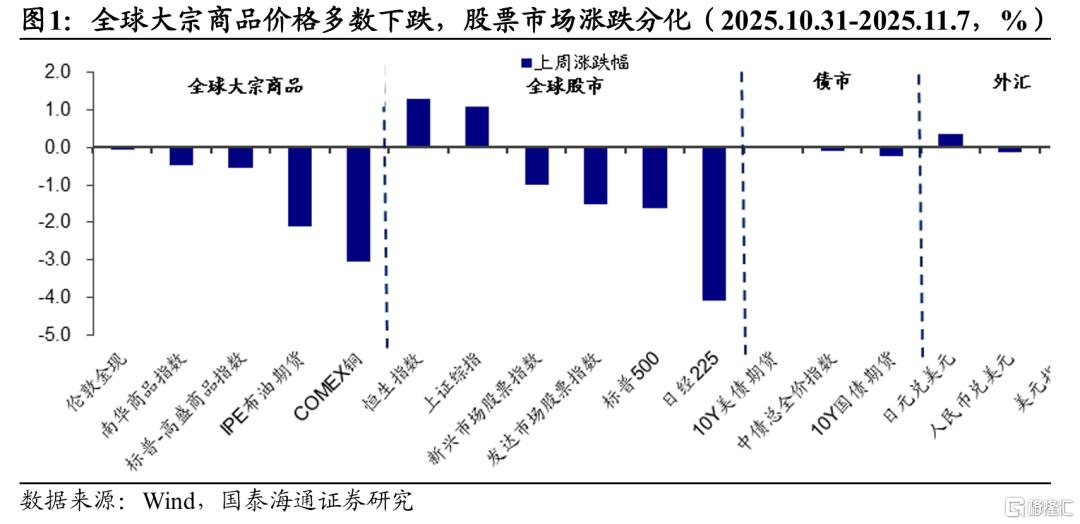
Economic Overview - The US economy is experiencing marginal decline, with short-term and long-term inflation expectations diverging. The ISM manufacturing PMI for October 2025 fell to 48.70%, down from 49.10%, remaining below the threshold of 50, indicating contraction [5][4]. - The University of Michigan consumer confidence index for November 2025 decreased to 50.3, down from 53.6, reflecting declining consumer sentiment [5][4]. - The US refinery utilization rate for the week ending October 31, 2025, dropped to 86.0%, down from 86.6% the previous week [8]. - The US crude steel production for the week ending November 1, 2025, showed a slight year-on-year decline, with a production rate of 9.2%, compared to 9.9% the previous week [8]. Market Performance - Global asset prices showed mixed performance, with commodity prices mostly declining. The Hang Seng Index rose by 1.29%, and the Shanghai Composite Index increased by 1.08%. In contrast, the emerging market stock index fell by 0.99%, and the developed market stock index decreased by 1.51%. The S&P 500 dropped by 1.63%, and the Nikkei 225 fell by 4.07% [1][4]. - Commodity prices generally declined, with London gold down by 0.06%, the S&P-Goldman commodity index down by 0.54%, and IPE Brent crude futures down by 2.11% [1][4]. - In the bond market, the domestic 10Y government bond futures price fell by 0.22%, and the overall index of China’s bonds decreased by 0.10% [1][4]. Policy Implications - The "data vacuum" due to the US government shutdown has intensified market volatility regarding Federal Reserve rate cut expectations. The release of the September CPI data was delayed from October 15 to October 24, and the October CPI report, originally scheduled for November 13, may also be delayed [2][20]. - Current market expectations indicate a 66.9% probability of a 25 basis point rate cut by the Federal Reserve in December, with a 33.1% chance of maintaining the current rate [20]. - The European Central Bank (ECB) has maintained stable monetary policy, with key deposit rates held at 2%. The ECB is cautious about ongoing global trade tensions and geopolitical risks, which may impact future economic forecasts [21].


胜率大降!若特朗普“对等关税”被推翻,市场会如何反应?
华尔街见闻· 2025-11-09 12:25
Core Viewpoint - A legal challenge against the Trump administration's key tariff powers is leading the market to anticipate a significant, albeit possibly temporary, reversal of trade barriers [1][5]. Group 1: Legal Challenge and Market Reaction - The market's expectation of the Trump administration winning the IEEPA tariff case has significantly decreased, with the probability dropping from approximately 40% to 27% following preliminary comments from judges during the hearing [4][5]. - The market sentiment is shifting towards the likelihood that the Supreme Court will overturn the IEEPA-based tariff policy, which is a key variable affecting current market emotions [5][6]. Group 2: Alternative Legal Avenues - Despite setbacks in court, the Trump administration still has other legal avenues to impose tariffs, as indicated by Treasury Secretary Bessent's optimism and readiness to utilize alternative legal authorizations [6]. - Potential alternative measures include Section 122, allowing a broad 15% tariff within 150 days, Section 338, permitting tariffs up to 50% on countries discriminating against U.S. businesses, and the concept of "licensing fees" for tariffs, although the latter faced skepticism during the hearing [7][8][9]. Group 3: Short-term Winners and Losers - If the IEEPA tariffs are overturned, the effective tariff rate in the U.S. is expected to drop from an estimated 12.5% to around 9% [11]. - The biggest beneficiaries in the short term are likely to be economies heavily reliant on trade with the U.S. and most affected by the IEEPA tariffs, particularly Vietnam and Mexico [11][15]. - Other countries, such as India, may also see significant tariff reductions, while the EU and the UK are expected to benefit the least [15]. Group 4: Market Performance and Trading Strategies - On the day of the hearing, the market showed a favorable response, with the Mexican peso and Brazilian real appreciating, aligning with the analysis of potential winners [13]. - The Russell 2000 small-cap index outperformed the S&P 500, reflecting a positive market sentiment towards tariffs [16]. - One-year inflation swap rates fell by over 5 basis points, indicating that investors quickly adjusted their expectations regarding inflation pressures from tariffed goods [16].


若特朗普“对等关税”被推翻,市场会如何反应?
Hua Er Jie Jian Wen· 2025-11-09 03:14
Core Viewpoint - A legal challenge against the Trump administration's key tariff powers is leading to market expectations of a significant, albeit possibly temporary, reversal of trade barriers [1][2]. Group 1: Legal Challenge and Market Reaction - The market's expectation of the Trump administration winning the IEEPA tariff case has significantly decreased, with the probability dropping from approximately 40% to 27% following initial court comments perceived as unfavorable [2]. - The outcome of this legal challenge is a key variable influencing current market sentiment [2]. Group 2: Potential Market Impact - If the court ultimately overturns the tariffs imposed under IEEPA, it could trigger a trading surge, leading to a decrease in inflation expectations, an increase in stock prices (especially small-cap stocks), and a strengthening of certain emerging market currencies like the Mexican peso and Brazilian real [1][4]. - The effective tariff rate in the U.S. is projected to drop from 12.5% to around 9% if IEEPA tariffs are overturned, which would benefit countries heavily reliant on trade with the U.S. [4][6]. Group 3: Beneficiaries and Losers - The primary beneficiaries of a potential IEEPA overturn would be countries with high trade dependency on the U.S., such as Vietnam and Mexico, while the EU and the UK would benefit the least [6]. - Other countries like India, which has not reached a trade agreement with the U.S., could see significant tariff reductions [6]. Group 4: Trading Strategies - Market performance on the day of the hearing indicated a favorable sentiment towards small-cap stocks, with the Russell 2000 index outperforming the S&P 500 [8]. - The foreign exchange market saw the Mexican peso and Brazilian real rise, aligning with the analysis of potential winners [8].
国债衍生品周报-20251109
Dong Ya Qi Huo· 2025-11-09 01:23
Report Summary 1. Report Industry Investment Rating - Not provided in the given content 2. Core View of the Report - There are both positive and negative factors affecting the treasury bond market. Positive factors include high geopolitical risks driving up market risk - aversion and the central bank's restart of treasury bond trading operations. Negative factors are the accelerated bond supply, reduced positions, and rising inflation expectations. The short - term technical support is effective, and investors can focus on rebound opportunities while controlling risks and monitoring policy trends [2] 3. Summary by Related Catalogs Factors Affecting the Market - **Positive Factors**: High geopolitical risks increase market risk - aversion, driving up demand for treasury bond futures. The central bank's restart of treasury bond trading operations signals monetary policy support and boosts market confidence [2] - **Negative Factors**: The accelerated bond supply and significant reduction in positions suppress futures prices. Rising inflation expectations and climbing yields of overseas treasury bonds indirectly affect market sentiment [2] Market Indicators - **Yield**: The report presents the historical data of 2Y, 5Y, 7Y, 10Y, and 30Y treasury bond yields from 2024/04 to 2025/08 [3] - **Funding Rate**: It shows the historical data of deposit - type institutional pledged repurchase weighted average rates (1 - day and 7 - day) and 7 - day reverse repurchase rates from 2023/12 to 2025/06 [3] - **Term Spread**: Data on the 7Y - 2Y and 30Y - 7Y treasury bond term spreads from 2024/04 to 2025/08 are provided [4][5] - **Open Interest**: Historical open interest data of 2 - year, 5 - year, 10 - year, and 30 - year treasury bond futures from 2015/12 to 2023/12 are presented [8] - **Trading Volume**: Historical trading volume data of 2 - year, 5 - year, 10 - year, and 30 - year treasury bond futures from 2024/04 to 2025/08 are shown [9] Basis and Spread - **Basis**: Data on the basis of 2 - year, 5 - year, 10 - year, and 30 - year treasury bond futures' current - quarter contracts are provided, with different time ranges for each [10][11][12][16] - **Inter - delivery Spread**: Data on the inter - delivery spreads (current - quarter minus next - quarter) of 2 - year, 5 - year, 10 - year, and 30 - year treasury bond futures are presented, with different time ranges for each [14][15][17][18] - **Inter - variety Spread**: Data on the TS*4 - T and T*3 - TL inter - variety spreads are provided, with different time ranges for each [19][20]
昨夜 美股突变
Shang Hai Zheng Quan Bao· 2025-11-08 01:29
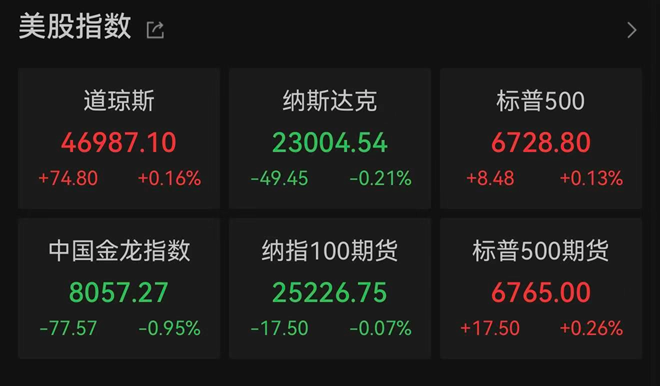
Group 1: Consumer Confidence and Economic Outlook - The University of Michigan's consumer confidence index for November dropped to 50.3, the lowest level in over three years, down from 53.6 in October [6][7] - Concerns over government shutdown and high prices have led to increased pessimism regarding personal financial situations among consumers [6][7] - The current economic conditions index fell by 6.3 points to a record low of 52.3, indicating growing worries about the impact of the government shutdown [7] Group 2: Stock Market Performance - U.S. stock markets experienced a "V-shaped" recovery after initial declines, with the Dow Jones Industrial Average rising by 74.80 points (0.16%) to 46,987.10, while the Nasdaq Composite fell by 49.46 points (0.21%) to 23,004.54 [4] - Major technology stocks mostly declined, with the index of the seven largest U.S. tech companies dropping by 0.56%, and Tesla falling nearly 4% [4] - All three major U.S. stock indices closed lower for the week, with the Dow down 1.21%, Nasdaq down 3.04%, and S&P 500 down 1.63% [4] Group 3: Impact of Government Shutdown - The ongoing government shutdown has led to significant disruptions, including the cancellation of approximately 1,000 flights and delays for over 3,500 flights across the U.S. [9] - The shutdown has also affected the release of key economic data, including the non-farm payroll report, which has been absent for two consecutive months [7][9] - Concerns about the economic impact of the shutdown have prompted investors to seek safe-haven assets, with gold potentially benefiting from this trend [7] Group 4: Corporate Investments - Meta announced plans to invest $600 billion in the U.S. by 2028 for building AI data centers and recruiting talent, while also collaborating with utility companies for necessary resources [4]
【环球财经】美国消费者信心指数11月继续下滑
Xin Hua She· 2025-11-08 01:20
Core Insights - The preliminary consumer confidence index for November in the U.S. dropped to 50.3, down from 53.6 in October and significantly lower than 71.8 in November of the previous year, indicating ongoing consumer concerns about employment and inflation [1][1][1] Economic Indicators - The current economic conditions index for November fell to 52.3, compared to 58.6 in October and 63.9 in November last year [1][1][1] - The consumer expectations index decreased to 49.0, down from 50.3 in October and 76.9 in the same month last year [1][1][1] Inflation Expectations - The one-year inflation expectation slightly increased from 4.6% in October to 4.7% in November [1][1][1] Consumer Sentiment Analysis - The decline in the consumer confidence index by approximately 6% is attributed to a 17% decrease in current personal financial conditions and an 11% drop in expectations for future business prospects [1][1][1] - Concerns regarding the ongoing federal government "shutdown," which has lasted over a month, are contributing to consumer anxiety about potential negative impacts on the economy [1][1][1]
隔夜美股 | 三大指数涨跌不一 热门中概股普跌 加密货币大反弹
智通财经网· 2025-11-07 23:26
Market Overview - The three major U.S. stock indices experienced mixed results, with the Dow Jones down 1.21%, Nasdaq down 3.04%, and S&P 500 down 1.63% for the week [1] - As of the latest close, the Dow rose by 74.80 points to 46987.10, Nasdaq fell by 49.46 points to 23004.54, and S&P 500 increased by 8.48 points to 6728.80 [1] - European indices also faced declines, with Germany's DAX30 down 0.80%, UK's FTSE 100 down 0.57%, and France's CAC40 down 0.18% [1] Oil Market - WTI crude oil futures for December delivery increased by 0.54% to settle at $59.75 per barrel, while Brent futures for January rose by 0.39% to $63.63 per barrel [2] - OPEC+ has decided to pause production increases in Q1 of next year as a preventive measure against current oversupply in the market [2] - The estimated idle capacity within OPEC+ has significantly decreased to approximately 4 to 4.3 million barrels per day [2] Currency and Precious Metals - The U.S. Dollar Index fell by 0.47% to 99.735, with the euro and pound both appreciating against the dollar [3] - Gold prices rose by 0.6% to $4000.99 per ounce, driven by a weaker dollar and increased demand for safe-haven assets due to government shutdown uncertainties [3] Macro News - Senate Democrats proposed a plan to extend ACA subsidies for one year to end the government shutdown, which has been met with resistance from Senate Republicans [4] - Economic forecasts indicate a looming fiscal crisis for the U.S. by 2045-2050, with potential catastrophic consequences for government debt management [5] - Consumer confidence has dropped to a three-year low, with the Michigan Consumer Sentiment Index falling from 53.6 to 50.3 [6] Cryptocurrency - Bitcoin rose over 2.3% to $103,664.2, while Ethereum increased nearly 4% to $3,443.89 [2] Individual Company News - Strategy increased the fundraising scale of its perpetual preferred stock STRE from €350 million to €620 million (approximately $715.1 million) [8] - Trump Media Technology Group reported a Q3 gain of $15.3 million from Bitcoin-related securities options [8] Analyst Ratings - JPMorgan lowered the target price for ConocoPhillips (COP) from $115 to $112 [9] - Citigroup raised the target price for Eli Lilly (LLY) from $1,190 to $1,250 [9] - Stifel reduced the target price for Microchip Technology (MCHP) from $82 to $75 [9]
美国11月消费者信心指数降至50.3 创三年来最低值
Zhong Guo Xin Wen Wang· 2025-11-07 23:15
Group 1: Consumer Confidence Index - The U.S. consumer confidence index for November dropped to 50.3, marking a 6.2% decrease from October's 53.6 and a 29.9% decline year-over-year, reaching its lowest level since June 2022 and the second lowest since 1978 [1] - The current conditions confidence index fell to 52.3, down 10.8% month-over-month and 18.2% year-over-year, representing the lowest level since 1951 [1] - The future expectations confidence index decreased to 49, a 2.6% drop from the previous month and a 36.3% decline compared to the same period last year [1] Group 2: Inflation Expectations - Consumers' inflation expectations for the next year rose to 4.7%, an increase of 0.1 percentage points from October [1] - The expectation for inflation over the next five years decreased to 3.6%, down 0.3 percentage points from October [1] Group 3: Government Shutdown Impact - The ongoing federal government shutdown, now in its 38th day, is the longest in U.S. history and is raising concerns among consumers about its potential negative impact on the economy [2] - The Congressional Budget Office estimated that the prolonged shutdown could reduce the annualized GDP growth rate by 1 to 2 percentage points in Q4, leading to an economic loss of $7 billion to $14 billion that may not be recoverable [2]