
量化紧缩

Search documents
本周,美国、英国、日本迎来大日子
Sou Hu Cai Jing· 2025-09-15 00:32
Core Viewpoint - The focus of the global financial market this week is on the anticipated interest rate cuts by major central banks, particularly the Federal Reserve, following Trump's return to the presidency [1] Group 1: Central Bank Decisions - The Federal Reserve is expected to cut rates by 25 basis points, influenced by a softening labor market and pressure from the White House [2] - The Bank of Canada is also expected to lower rates to 2.5% amid weak employment and economic contraction [3] - Other developed economies, such as the Bank of England and the Bank of Japan, are likely to maintain their current rates, with the latter still on a tightening path [2][3] Group 2: Economic Indicators - U.S. retail sales are projected to grow by 0.3% month-on-month, indicating consumer resilience despite concerns over labor market weakness and rising prices [3] - In Canada, inflation is expected to slightly rise to 2% in August, while core inflation remains around 3% [3] - Key economic data from Japan, including trade balance and CPI, will be closely monitored for inflation trends [4] Group 3: Regional Developments - In Europe, the UK is expected to maintain its inflation rate at 3.8%, with the Bank of England likely to keep the base rate at 4% [5] - The European Central Bank will hold a two-day meeting, with important economic data from Germany and the Eurozone set to be released [6] - In Latin America, Brazil's GDP indicators suggest an economic slowdown, while the central bank is expected to maintain high interest rates [9]
银行超级周来袭!36小时决定万亿资金流向,投资者如何应对?
Sou Hu Cai Jing· 2025-09-14 23:37
Core Insights - A rare "Central Bank Super Week" is set to unfold, with major central banks including the Federal Reserve, Bank of Canada, Bank of England, and Bank of Japan announcing interest rate decisions within 36 hours, impacting nearly 40% of the global economy [1][2][4] Group 1: Central Bank Actions - The Federal Reserve is widely expected to announce a 25 basis point rate cut, marking its first reduction since Trump's second term, influenced by a softening labor market and political pressure from the White House [5][6] - The Bank of England is likely to maintain its benchmark rate at 4%, with a focus on its quantitative tightening plans amid recent market volatility [8] - The Bank of Canada is anticipated to follow the Fed's lead with a rate cut to 2.5% due to disappointing employment data and a contraction in Q2 [8] - The Bank of Japan is expected to keep rates unchanged, with market attention on potential future rate hikes, as over half of experts predict a possible increase in December [8] Group 2: Emerging Market Central Banks - Most emerging market central banks are expected to adopt a cautious stance, maintaining current rates due to heightened geopolitical risks and domestic instability [10] - Brazil's central bank is likely to keep borrowing costs at a 19-year high of 15%, while Indonesia's decision is complicated by political turmoil [10] Group 3: Market Reactions and Predictions - The anticipated Fed rate cut has led to a surge in gold prices, with COMEX gold futures reaching $3649.40 per ounce, driven by expectations of a looser monetary policy [13] - UBS forecasts that gold prices could rise to $3900 per ounce by mid-next year, supported by favorable market conditions and increased ETF inflows [13] - The European Central Bank has maintained its rates but has not provided guidance on future policy actions, indicating a balanced risk outlook for economic growth [15] Group 4: Global Economic Implications - The divergent monetary policies reflect significant differences in economic conditions across countries, with the U.S. facing labor market challenges that justify a rate cut [17] - The outcomes of this "Central Bank Super Week" are expected to have profound implications for global capital flows and could redefine the financial landscape heading into 2026 [17]

“央行超级周”来了--这36小时交易员要“连轴转”了
华尔街见闻· 2025-09-14 11:44
全球金融市场即将迎来一个"央行超级周", 一场密集的利率决策风暴将在约36小时内席卷全球。 从美联储到日本央行,多家主要央行将相继公布利率决议,其政策走向将为全球经济的最后季度定下基调,并直接影响着全球半数交易最活跃的货币。 备受瞩目的焦点是美联储, 市场普遍预期其将宣布自特朗普第二任期以来的首次降息。 在美联储做出决定前, 周二公布的美国零售销售数据将是最后的重要参考。 经济学家预测8月零售额增长0.3%。在劳动力市场不稳和物价上涨的背景下,消费 者的持续消费能力存有疑问。 此外,周四的失业救济申请数据将揭示上周的就业数据跳升是暂时现象还是市场持续恶化的前兆。 长期以来,白宫一直敦促降低借贷成本,而美联储主席鲍威尔则对关税驱动的通胀保持警惕。 然而,近期劳动力市场的疲软迹象,为降息亮起了绿灯,多数经 济学家预计降息幅度为25个基点。 紧随其后,加拿大央行也预计将采取降息行动。而英格兰银行在8月出现罕见的三方意见分歧后,此次可能维持利率不变。周期的尾声将由日本央行画上句 号,该行虽有紧缩倾向,但预计短期内不会采取行动。 这些决策将对占全球经济总量五分之二的经济体产生影响,包括七国集团(G7)中的四个国家。 对 ...

美联储重启降息在即 美股能否延续强势上攻
Di Yi Cai Jing· 2025-09-14 03:50
Group 1 - The core sentiment in the market is optimistic, driven by Oracle's strong performance and the potential for a new wave of AI development, leading tech stocks to push the S&P 500 and Nasdaq towards historical highs [1] - Investors are closely monitoring the upcoming Federal Reserve monetary policy meeting, with expectations of interest rate cuts to address a slowing job market [1][2] - There was a significant outflow from U.S. equity funds, exceeding $10.4 billion last week, indicating that investors are opting to lock in profits amid uncertainty [6] Group 2 - Recent data shows inflation and employment pressures, with the overall CPI rising 0.4% month-over-month in August, the largest single-month increase since January [2] - The core CPI, excluding food and energy, increased by 0.3% month-over-month and 3.1% year-over-year, aligning with market expectations [2] - The job market appears to be weakening, as initial jobless claims rose by 27,000 to 263,000, surpassing expectations [2][3] Group 3 - Market expectations indicate a 74% probability of the Federal Reserve cutting rates by 75 basis points by December, reflecting concerns over the labor market rather than inflation [3][4] - Analysts suggest that tariffs have increased some prices but do not foresee sustained inflation acceleration due to rising wages and inflation expectations [4] - The upcoming Federal Reserve meeting is anticipated to signal a shift towards monetary easing, with a likely 25 basis point cut [4] Group 4 - The stock market indices showed strong performance last week, with the Nasdaq rising 2% and the S&P 500 increasing by 1.6%, marking two consecutive weeks of gains [5] - Oracle's robust earnings outlook has positively impacted AI-related sectors, providing support for the major indices [5][6] - Despite the strong market performance, there are warnings that the Federal Reserve's actions could dampen investor enthusiasm, leading to potential profit-taking [6][7] Group 5 - The market sentiment is currently dominated by the principle of not opposing the Federal Reserve, with technical traders following a trend-based approach [7] - The upcoming Federal Reserve interest rate decision may trigger profit-taking opportunities, especially if a dovish stance is announced [7] - Overall market outlook remains cautiously bullish, with potential support for interest-sensitive sectors following a rate cut [7]
美联储重启降息在即,美股能否延续强势上攻
Di Yi Cai Jing· 2025-09-14 03:37
Group 1 - The core sentiment in the market is optimistic, driven by Oracle's strong performance and the potential for a new round of AI development, leading tech stocks to push the S&P and Nasdaq towards historical highs [2] - Investors are closely monitoring the upcoming Federal Reserve monetary policy meeting, with expectations of interest rate cuts due to a slowing job market [2][3] - Recent data indicates inflationary pressures, with the overall CPI rising 0.4% month-on-month in August, the largest single-month increase since January [3][4] Group 2 - The job market shows signs of weakness, with a downward adjustment of 911,000 jobs in non-farm employment data, and initial jobless claims rising to 263,000, exceeding expectations [3][4] - Market expectations for the Federal Reserve to restart rate cuts are increasing, with a 74% probability of a cumulative 75 basis points cut by December [4][5] - The stock market experienced significant inflows, with over $10.4 billion exiting U.S. equity funds last week, indicating a trend of investors locking in profits [6][7] Group 3 - Oracle's strong earnings outlook, with a 359% year-on-year increase in remaining performance obligations (RPO) to $455 billion, signals robust demand in the AI sector [7] - The upcoming "Triple Witching Day" may lead to increased volatility in the market due to the expiration of stock index futures and options [6][8] - Overall market sentiment remains cautiously bullish, with potential support for interest rate-sensitive sectors if the Federal Reserve adopts a dovish stance [8]


“央行超级周”来了--这36小时交易员要“连轴转”了
Hua Er Jie Jian Wen· 2025-09-14 02:58
全球金融市场即将迎来一个"央行超级周",一场密集的利率决策风暴将在约36小时内席卷全球。从美联 储到日本央行,多家主要央行将相继公布利率决议,其政策走向将为全球经济的最后季度定下基调,并 直接影响着全球半数交易最活跃的货币。 备受瞩目的焦点是美联储,市场普遍预期其将宣布自特朗普第二任期以来的首次降息。长期以来,白宫 一直敦促降低借贷成本,而美联储主席鲍威尔则对关税驱动的通胀保持警惕。然而,近期劳动力市场的 疲软迹象,为降息亮起了绿灯,多数经济学家预计降息幅度为25个基点。 紧随其后,加拿大央行也预计将采取降息行动。而英格兰银行在8月出现罕见的三方意见分歧后,此次 可能维持利率不变。周期的尾声将由日本央行画上句号,该行虽有紧缩倾向,但预计短期内不会采取行 动。 这些决策将对占全球经济总量五分之二的经济体产生影响,包括七国集团(G7)中的四个国家。对于 投资者和交易员而言,这无疑将是一段需要高度关注的紧张时期,市场波动性可能显著加剧。 焦点:美联储降息与白宫的博弈 本周最核心的事件无疑是美国联邦公开市场委员会(FOMC)的利率决议。市场经济学家普遍预测,美 联储将宣布降息25个基点。 这一决定是在复杂的背景下做出 ...
纳指续创历史新高,甲骨文两日跌超11%
Di Yi Cai Jing Zi Xun· 2025-09-13 00:17
Market Overview - The U.S. stock market showed mixed results, with the Nasdaq closing at a record high, supported by Microsoft, while investors focused on the upcoming Federal Reserve policy meeting, where a rate cut is widely expected due to a slowing job market [2] - The Dow Jones Industrial Average fell by 273.78 points, or 0.59%, to 45,834.22 points, while the Nasdaq rose by 0.44% to 22,141.10 points, and the S&P 500 dipped by 0.05% to 6,584.29 points [2] - The Dow gained 0.95% for the week, the Nasdaq increased by 2.03%, and the S&P 500 rose by 1.59%, marking the best weekly performance for the S&P 500 since early August [2] Individual Stocks - Tesla surged by 7.4%, while Microsoft rose by 1.8%, Apple by 1.7%, and Meta by 0.6%. Nvidia and Google saw minor increases, while Amazon fell by 0.8% and Oracle dropped by 5.1% [2][6] - Microsoft avoided potential high antitrust fines from the EU by offering a discounted Office product without Teams components and reached a non-binding agreement with OpenAI [5] - Warner Bros Discovery's stock increased by nearly 17% amid reports of a potential acquisition offer from Paramount Skydance [6] Economic Indicators - The University of Michigan's consumer confidence index fell to 55.4 in September, the lowest since May, down from 58.2 in August, indicating rising concerns about the economy [4] - The 10-year U.S. Treasury yield rose by 3.3 basis points to 4.06%, while the 2-year yield increased by 1.2 basis points to 3.56% [3] Inflation and Federal Reserve Expectations - Recent inflation reports have reinforced expectations for a Federal Reserve rate cut, with traders fully pricing in a 25 basis point cut next week [5] - The CME FedWatch Tool indicates a 7.5% probability for a 50 basis point cut, with expectations for a total of 75 basis points in cuts this year and an additional 50-75 basis points in the next 12 months [5]

纳指续创历史新高,甲骨文两日跌超11%
第一财经· 2025-09-13 00:09
Core Viewpoint - The article discusses the mixed performance of the U.S. stock market, with the Nasdaq reaching a historic high, driven by tech stocks like Microsoft, while investors are focused on the upcoming Federal Reserve policy meeting, where a rate cut is widely anticipated to address a slowing job market [3][6]. Market Overview - On Friday, the Dow Jones fell by 273.78 points (0.59%) to 45834.22, while the Nasdaq rose by 0.44% to 22141.10, and the S&P 500 dipped by 0.05% to 6584.29. For the week, the Dow gained 0.95%, the Nasdaq increased by 2.03%, and the S&P 500 rose by 1.59%, marking the best weekly performance for the S&P 500 since early August [3][6]. - Notable tech stocks included Tesla, which surged by 7.4%, Microsoft up by 1.8%, and Apple increasing by 1.7%. Conversely, Oracle dropped by 5.1%, with a decline of over 11% in the last two trading days [3][8]. Economic Data - The University of Michigan's consumer confidence index fell to 55.4 in September, the lowest since May, down from 58.2 in August. Consumers expressed concerns about economic vulnerabilities, with inflation expectations for the next year remaining at 4.8% and rising to 3.9% for the next five years [6][7]. - Following the inflation data, the market has priced in three rate cuts of 25 basis points each for the year. Analysts predict a total of 75 basis points in cuts this year, with potential additional cuts of 50-75 basis points in the next 12 months [7][8]. Individual Company Performance - Microsoft shares rose by 1.8% after the company offered a pricing plan for Office products without Teams components, avoiding potential antitrust fines from the EU. Microsoft also reached a non-binding agreement with OpenAI to allow the latter to restructure into a profit-making entity [7][8]. - Tesla's stock increased by 7.4%, with the company’s chairperson denying concerns that Elon Musk's political activities were harming sales [8]. - Warner Bros Discovery shares jumped nearly 17% amid reports of a potential acquisition offer from Paramount Skydance [8]. - Vaccine manufacturers saw declines, with Moderna down 7.4% and Pfizer and Novavax dropping over 3% following reports linking child deaths to COVID-19 vaccines [8]. Commodity Prices - International oil prices rose due to concerns over new sanctions against Russia, with WTI crude oil increasing by 0.51% to $62.69 per barrel and Brent crude up by 0.93% to $66.99 per barrel [8]. - Gold prices saw a slight increase, with COMEX gold futures for September rising by 0.34% to $3649.40 per ounce, marking the fourth consecutive week of gains [8].

美国国债意外成为赢家 “债券义警”暂时销声匿迹-美股-金融界
Jin Rong Jie· 2025-09-05 00:34
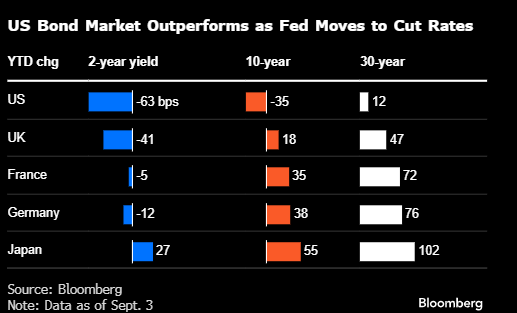
Group 1 - The U.S. Treasury market has shown remarkable resilience despite various pressures, including rising debt and aggressive tariff policies, unlike other countries' bond markets which have suffered due to fiscal concerns [1] - Year-to-date, the yield on 10-year U.S. Treasuries has decreased by over 0.3 percentage points, making it the only major bond market with a decline in 10-year yields [1][3] - The volatility of the U.S. bond market has been decreasing since April, with key volatility indicators nearing their lowest levels in three years [1] Group 2 - Recent data indicates a slowdown in job growth, which has contributed to a decline in 10-year Treasury yields, falling below 4.17% for the first time since early May [3] - Concerns regarding the independence of the Federal Reserve are reflected in rising inflation swap rates, which have reached a two-year high [5] - Despite concerns about the Fed's independence, U.S. bond investors have not shown significant alarm, allowing the Trump administration to breathe easier regarding the 10-year yield target [5] Group 3 - The U.S. Treasury Secretary hinted at limiting long-term bond issuance if buyer demand weakens, while data does not support claims of foreign capital fleeing U.S. assets, indicating strong demand for U.S. Treasuries [7] - The perception of the U.S. as a safe haven persists, with 5% being seen as a ceiling for 30-year Treasury yields, despite various challenges [8] - Market participants remain skeptical about the potential political influence on the Fed, with expectations that any new appointments will not drastically alter monetary policy [9] Group 4 - There is speculation that the White House may push the Fed to resume bond purchases, particularly long-term bonds, as a means to lower borrowing costs [10] - The current balance in the U.S. bond market is fragile, and without fiscal discipline from politicians, investors may express dissatisfaction through market actions [10] - The emergence of "bond vigilantes" in Europe and Japan could soon be mirrored in the U.S. if fiscal issues are not addressed [10]
一代人一遇的机会!基金经理高呼:现在是抄底的绝佳时机
Jin Shi Shu Ju· 2025-09-04 07:11
Group 1 - The bond market has become a focal point, with long-term bond yields reaching multi-decade highs, presenting a "once-in-a-generation opportunity" for UK government bonds [1] - The UK 30-year bond yield hit 5.723%, the highest since 1998, while the 10-year bond yield reached 4.835%, the highest since the beginning of the year [1] - The volatility in the UK bond market has been exacerbated by reduced demand from pension funds as they cut their holdings of 30-year bonds [1] Group 2 - The government has emphasized its fiscal rules in response to concerns about fiscal irresponsibility, which could provide buying opportunities for UK bonds if the market believes in this commitment [2] - If the Bank of England slows its quantitative tightening, it may further enhance the attractiveness of UK government bonds, especially at real yields of 2.5% to 3% [2] - The UK bond market is viewed as one of the most interesting interest rate markets for 2025, with long-end bonds considered cheap despite potential risks related to the budget [3]