国内国际双循环

Search documents
顶压前行!中国外贸增速逐季加快,9月增长8%
2 1 Shi Ji Jing Ji Bao Dao· 2025-10-13 12:13
Core Viewpoint - China's foreign trade has shown a steady and positive development trend in the face of a complex external environment, with a year-on-year growth of 4% in imports and exports for the first three quarters of the year [1] Trade Performance - In the first three quarters, China's total goods trade reached 33.61 trillion yuan, with exports at 19.95 trillion yuan (up 7.1%) and imports at 13.66 trillion yuan (down 0.2%) [1] - In September alone, the total trade volume was 4.04 trillion yuan, reflecting an 8% increase [1] Import Recovery - September marked a significant recovery in imports, with a year-on-year growth of 7.5%, the largest monthly increase this year [3] - Cumulative import decline has narrowed from 15.3% in January to just 0.2% by September, indicating a steady recovery in domestic demand [3][6] Export Structure and Growth - Exports of mechanical and electrical products reached 12.07 trillion yuan, growing by 9.6% and accounting for 60.5% of total exports [4] - High-tech product exports, including electronics and high-end equipment, saw significant growth rates of 8.1%, 22.4%, and 15.2% respectively [4] - Despite a 16.2% decline in exports to the U.S. over the first nine months, overall export resilience is evident [4] Market Diversification - Trade with Belt and Road Initiative countries reached 17.37 trillion yuan, up 6.2%, making up 51.7% of total trade [3] - Exports to ASEAN, Latin America, Africa, and Central Asia grew by 9.6%, 3.9%, 19.5%, and 16.7% respectively [3] Future Outlook - The outlook for exports remains optimistic, with expectations of continued growth driven by global economic integration and domestic policy support [5] - However, challenges remain, particularly regarding U.S. trade policies and the potential for increased export declines in the fourth quarter due to base effects from last year [5] Import Trends - The first three quarters saw a gradual increase in imports, with significant growth in raw materials and high-tech equipment driven by domestic industrial recovery [6][8] - The import of crude oil and metal ores increased by 4.9% and 10.1% respectively, reflecting rising domestic production and infrastructure investment [6][8] Policy and Market Access - China has expanded import access for 135 new agricultural products from 50 countries, and implemented zero tariffs on 100% of products from least developed countries with which it has diplomatic relations [9] - The upcoming China International Import Expo is expected to further enhance market access for global enterprises [10]

预计约140万亿元!中国经济总量接连突破新关口
Xin Hua She· 2025-10-13 10:41
Core Insights - China's economy is projected to reach approximately 140 trillion yuan by 2025, marking a significant milestone on the global stage [1] - The "14th Five-Year Plan" has seen China contribute about 30% to global growth, with its economy accounting for around 17% of the world's total [2] Economic Growth and Contributions - Over the "14th Five-Year Plan," China's economic increment is expected to exceed 35 trillion yuan, surpassing the GDP of the third-largest economy in the world [2] - Domestic consumption has played a crucial role, with an average contribution rate of over 86% to economic growth during the first four years of the "14th Five-Year Plan" [5] Innovation and Development - China has made significant strides in innovation, ranking among the top ten in the global innovation index for the first time, driven by advancements in artificial intelligence and aerospace [3] - The new development philosophy emphasizes innovation, coordination, green growth, openness, and shared benefits, which is essential for high-quality economic development [4] Social and Environmental Progress - The country has achieved notable social improvements, including the creation of over 12 million urban jobs annually and direct medical settlement benefits for 560 million people [3] - Renewable energy now accounts for one-third of total electricity consumption, with China leading the world in the production and sales of new energy vehicles for ten consecutive years [3] Future Outlook - The upcoming "15th Five-Year Plan" is anticipated to usher in another hopeful five years of growth and development for China [7]
新华鲜报·“十四五”亮点丨预计约140万亿元!中国经济总量接连突破新关口
Xin Hua Wang· 2025-10-13 10:34
Core Insights - By 2025, China's economy is projected to reach approximately 140 trillion yuan, marking a significant milestone on the global stage [1] - China accounts for about 17% of the world's economy and contributes around 30% to global growth, establishing itself as a reliable "engine" and "stabilizer" for the world economy [2] Economic Growth and Innovation - During the "14th Five-Year Plan," China's economic increment is expected to exceed 35 trillion yuan, surpassing the GDP of the third-largest economy in the world [2] - China has entered the top ten of the global innovation index for the first time, showcasing its enhanced creativity and advancements in fields such as artificial intelligence and aerospace [4] International Engagement and Green Development - The number of countries with visa-free access to China has expanded to 47, reflecting an increase in international engagement and tourism [4] - One-third of the electricity consumed in China is now clean energy, and the country has maintained the world's largest production and sales of new energy vehicles for ten consecutive years [4] Social Welfare and Employment - Over 12 million new urban jobs are created annually, and the direct settlement of cross-province medical expenses benefits 560 million people, indicating a focus on improving the quality of life for citizens [4] Development Philosophy and Domestic Market - The new development philosophy emphasizes innovation, coordination, green growth, openness, and shared benefits, driving high-quality economic development [4] - Domestic demand has contributed over 86% to economic growth on average during the first four years of the "14th Five-Year Plan," highlighting the strength of the domestic market [5] Future Outlook - The upcoming "15th Five-Year Plan" is anticipated to usher in another hopeful five years for China's economy, despite challenges [7]
33.61万亿元,再创新高!中国外贸再次展现“韧实力”
Yang Shi Wang· 2025-10-13 08:07
Core Insights - In the first three quarters of this year, China's goods trade import and export exceeded 33 trillion yuan, marking a historical high and the first time surpassing this threshold in the same period [2] - The overall trend of China's foreign trade remains positive, with a year-on-year growth of 4% in imports and exports [4] Trade Performance - The total import and export value reached 33.61 trillion yuan, with quarterly figures consistently exceeding 10 trillion yuan: 10.3 trillion in Q1, 11.49 trillion in Q2, and 11.82 trillion in Q3 [2] - Exports amounted to 19.95 trillion yuan, showing a year-on-year increase of 7.1%, maintaining growth for eight consecutive quarters [4] - Imports totaled 13.66 trillion yuan, reflecting a slight year-on-year decline of 0.2%, but the decline has narrowed compared to earlier months [6] Export Dynamics - High-tech product exports reached 3.75 trillion yuan, with a year-on-year growth of 11.9%, contributing over 30% to the overall export growth [4] - Exports to approximately 80% of trade partners experienced growth, indicating a broad-based recovery [4] Import Trends - Despite a decline in total import value, the quantity index for imports increased by 0.6%, with significant growth in crude oil and metal ores by 2.6% and 4.2%, respectively [8] - The import of consumer goods, including food and cultural products, also showed notable increases, with values rising by 10.2% and 9.4% [8] Private Sector Performance - Private enterprises' imports and exports reached 19.16 trillion yuan, growing by 7.8%, and have maintained growth for 22 consecutive quarters [10] - Private enterprises accounted for 57% of China's total foreign trade, contributing 4.3 percentage points to overall trade growth [10] - Exports of high-tech products by private enterprises increased by 15.3%, representing 54.2% of the total value of similar goods exported [10]

中国铁路国庆中秋假期累计发送旅客逾2亿人次
Zhong Guo Xin Wen Wang· 2025-10-11 14:11
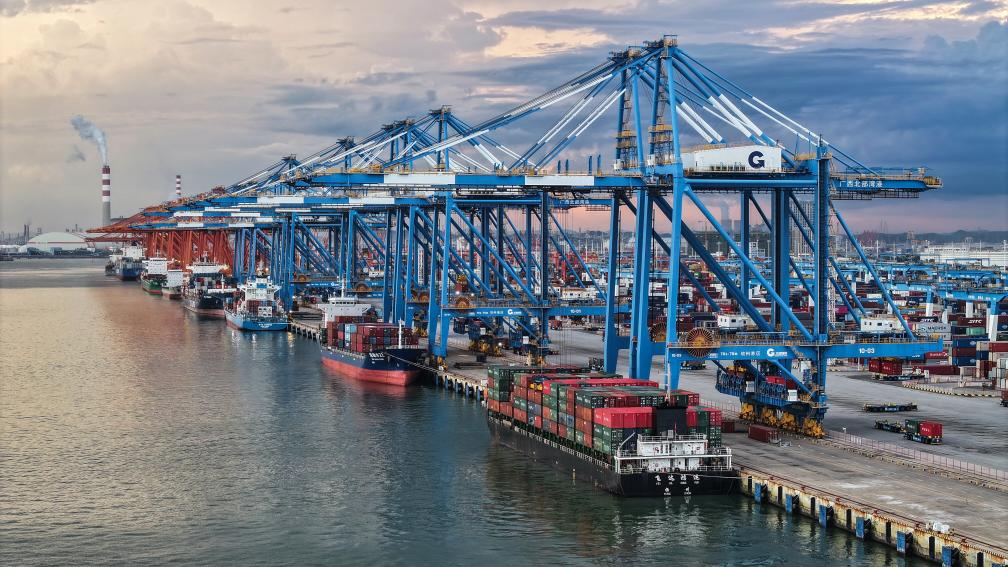
Core Insights - The Chinese railway system experienced a significant increase in passenger and freight transport during the National Day and Mid-Autumn Festival holiday period, with a total of 213 million passengers and 13.7 million tons of freight transported, indicating a robust performance in both sectors [1][2] Passenger Transport - A total of 213 million passengers were transported, averaging 17.76 million passengers per day, which represents an 8.6% year-on-year increase [1] - The average daily operation of passenger trains reached 12,899, a 9.1% increase compared to the previous year, with a peak of 14,196 trains on October 8, marking a historical high for single-day passenger capacity [1] - On October 1, a record 23.13 million passengers were sent, setting a new single-day record for passenger transport [1] Freight Transport - The railway system achieved an average of 189,000 freight cars loaded per day, with a total freight volume of 13.7 million tons during the holiday period, effectively supporting public travel and the stable operation of the national economy [2] - The railway department also facilitated the operation of China-Europe (Asia) freight trains and the Western Land-Sea New Corridor trains, providing reliable support for the smooth flow of domestic and international dual circulation [2]
宁波舟山港第三个千万箱级集装箱泊位群开工
Zhong Guo Xin Wen Wang· 2025-10-11 09:50
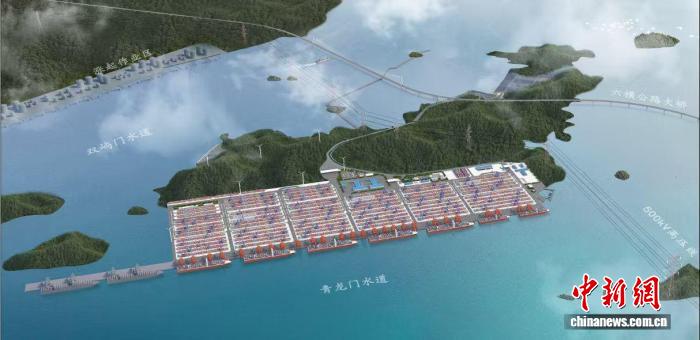
Core Insights - The construction of the first phase of the Fodu Container Terminal project at Ningbo-Zhoushan Port has officially commenced, marking a significant milestone in the development of a world-class port in Zhejiang Province [1][3]. Project Overview - The Fodu Container Terminal project is part of the ten landmark projects for building a world-class strong port in Zhejiang, featuring seven container berths of 200,000 tons and a planned annual throughput of 6.5 million TEUs [3]. - This project is the first hundred-billion-level terminal project initiated after the approval of the "Ningbo-Zhoushan Port Overall Planning (2035)" [3]. - The first phase includes the construction of two 200,000-ton container berths and related land facilities, with a designed annual throughput capacity of 2.01 million TEUs, expected to be completed by the end of 2027 [3][5]. Strategic Importance - The project aims to alleviate the bottleneck in container throughput capacity at Ningbo-Zhoushan Port, enhancing its ability to service ultra-large container ships and solidifying its position as a core global container hub [5]. - It is expected to stimulate the development of high-end shipping services, port manufacturing, and clean energy industries on Liuhong Island, attracting more upstream and downstream enterprises [5]. - The terminal will support the integrated development of the Yangtze River Delta and the construction of the Yangtze Economic Belt, providing more efficient maritime logistics channels for coastal and riverine areas [5].

14.79万亿粤港澳大湾区,冲刺世界最大经济中心
21世纪经济报道· 2025-10-11 06:28
Core Viewpoint - The article emphasizes the transformation of the Guangdong-Hong Kong-Macao Greater Bay Area (GBA) from a port economy to an innovation-driven economy, highlighting the importance of urban clusters in enhancing regional competitiveness and economic integration [2][9][12]. Group 1: Urban Cluster Development - The GBA is positioned as a key player in building world-class urban clusters, supported by the central government's policies aimed at high-quality urban development [2][4]. - The GBA's economic total is projected to reach 14.79 trillion yuan in 2024, surpassing New York and San Francisco, with an estimated per capita GDP of approximately 170,200 yuan [8][12]. - The internal dynamics of the GBA are shifting from traditional gateway cities like Hong Kong and Guangzhou to innovation-centric cities like Shenzhen, reflecting a change in development focus [4][10]. Group 2: Economic Transition - The GBA is transitioning from a geographical aggregation of cities to a chemically integrated urban cluster, emphasizing innovation as the new economic driver [5][9]. - The region has seen a 25% increase in internal talent mobility and a 30% increase in external exchanges over the past three years, indicating enhanced collaboration and resource sharing [6][7]. - The GBA's industrial system is becoming increasingly self-sufficient, with over 70% of the supply chain for certain industries, such as printing, now sourced from within the region [7][11]. Group 3: Future Prospects - The GBA is expected to become the world's largest economic and innovation center within the next decade, driven by its unique integration of development and reform mechanisms [8][13]. - The region is strategically positioned to link with Southeast Asian markets, enhancing its role in the "Belt and Road" initiative and serving as a hub for international trade [14][15]. - The combination of industry, finance, and innovation in the GBA could potentially surpass other global bay areas, establishing it as the largest and most multifunctional urban cluster [16].
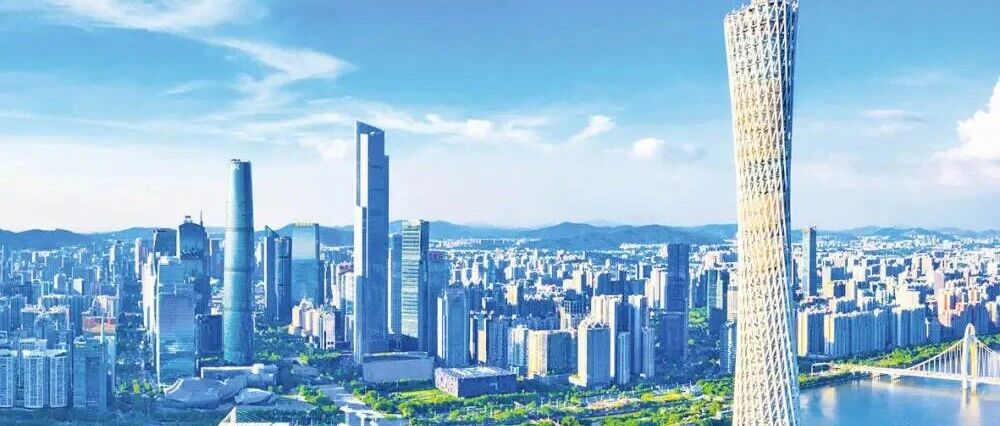
第138届广交会要来了 将首次举办外贸优品拓内销对接活动
Guang Zhou Ri Bao· 2025-10-11 05:54
Core Insights - The 138th Canton Fair will be held from October 15 to November 4 in Guangzhou, featuring a record exhibition area of 1.55 million square meters and over 74,600 booths, with more than 32,000 participating companies, including approximately 3,600 first-time exhibitors [1] Group 1: Exhibition Highlights - The fair will showcase 353,000 smart products, with over 10,000 high-quality enterprises recognized as high-tech, specialized, or champions in their fields, accounting for 34% of the total export exhibitors [2] - A new smart medical area will be introduced, featuring 47 companies showcasing advanced medical products and technologies, including surgical robots and wearable devices [2] - The fair has expanded its global partnerships to 227, covering 110 countries and regions, and aims to attract over 400 leading purchasing companies [2][4] Group 2: Trade Promotion Activities - The fair will host over 600 new product launch events and 13 thematic forums to assist companies in brand building and industry trend analysis [3] - Approximately 3,000 square meters will be dedicated to foreign trade product promotion for domestic sales, enhancing the integration of domestic and international trade [3] - The fair will provide comprehensive trade services through 240 trade service institutions, supporting companies in market expansion and order acquisition [3] Group 3: Enhanced Procurement Engagement - The number of pre-registered professional buyers has increased by 14.1%, with significant growth from the EU, the US, and Belt and Road countries [4] - Notable head procurement companies, including 270 from various sectors, have confirmed attendance, reflecting a 9.1% increase compared to the previous fair [4] - The fair aims to increase the proportion of professional buyers by targeting specific industry associations and media for direct invitations [4] Group 4: Service Improvements in Guangzhou - Guangzhou will implement optimized entry services, including dedicated channels at Baiyun International Airport and other ports, with multilingual support and smart robots for guidance [5] - A new "Departure Tax Refund Service Area" will be established within the exhibition hall, allowing for convenient tax refunds for international visitors [6] - Enhanced transportation connectivity will be provided, with new intercity rail and metro lines facilitating access to the fair venue from surrounding cities [5]
第138届广交会将于10月15日在广州开幕 参展企业超3.2万家
Nan Fang Ri Bao Wang Luo Ban· 2025-10-11 01:41
Core Insights - The 138th China Import and Export Fair (Canton Fair) will take place from October 15 to November 4, featuring over 10,000 high-quality enterprises recognized for their advanced technology and specialization, marking a historical high [1][2] - The exhibition area will cover 1.55 million square meters with a total of 74,600 booths and over 32,000 participating companies, also setting new records [1][2] - The fair will showcase 353,000 smart products across 18 dedicated smart zones, including a new smart medical area featuring 47 companies [2] Group 1 - The fair will feature over 1 million new products developed in the past year and nearly 1.1 million products with independent intellectual property rights [2] - A focus on green development will be emphasized, with 305 participating companies in the new energy sector, a 3% increase from the previous fair [2] - The fair aims to attract professional buyers, with 207,000 pre-registered from 217 export markets, a 14.1% increase compared to the previous year [1][2] Group 2 - The fair will host over 600 new product launch events and 13 thematic forums to assist companies in brand building and industry direction [3] - A total of 240 trade service institutions will be introduced to provide comprehensive trade services, including finance, logistics, and quality inspection [3] - The Canton Fair will continue to offer a 50% reduction in booth fees for export exhibitors and free services for all participating companies [3] Group 3 - Guangzhou has upgraded its city service measures to enhance the experience for international guests, including dedicated entry channels at the airport and port [4][5] - The metro system will now accept foreign bank cards for seamless access, and additional transportation options will be available during the fair [5][6] - The fair coincides with the preparation for the 15th National Games, aiming to improve the overall urban environment and host related shopping and food festivals [6]
粤港澳大湾区城市群进阶:迈向创新经济
2 1 Shi Ji Jing Ji Bao Dao· 2025-10-10 13:12
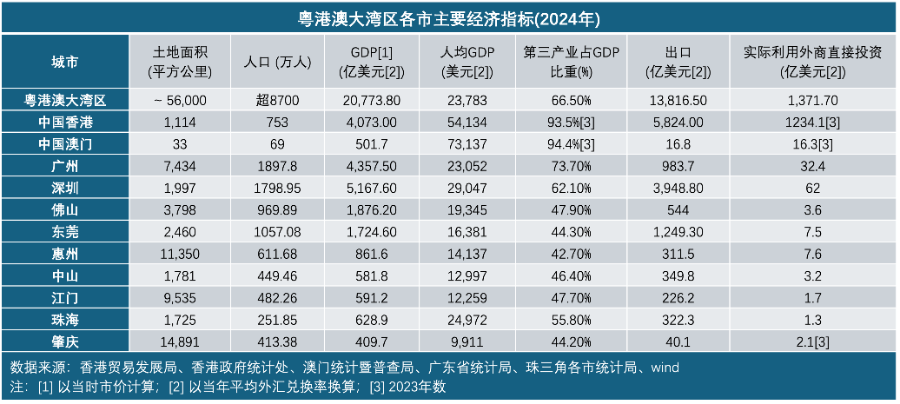
Core Insights - The development of the Guangdong-Hong Kong-Macao Greater Bay Area (GBA) is transitioning from a port-based economy to an innovation-driven economy, with a focus on technological integration and collaboration among cities [5][10][11] - The GBA is projected to surpass New York and San Francisco in economic output by 2024, with an estimated GDP of approximately 14.79 trillion yuan and a per capita GDP of about 170,200 yuan [9][12] - The GBA's urban cluster model is evolving, with a shift from reliance on traditional gateway cities like Hong Kong and Guangzhou to innovation hubs like Shenzhen [3][11] Economic Indicators - The GBA's total land area is approximately 56,000 square kilometers, with a population exceeding 87 million [4] - Key economic indicators for 2024 include: - Total GDP: 20,773.80 billion USD - Per capita GDP: 23,783 USD - Tertiary industry contribution to GDP: 66.50% [4] - Individual city GDPs for 2024 are projected as follows: - Shenzhen: 3.68 trillion yuan - Guangzhou: 3.10 trillion yuan - Hong Kong: 3.18 trillion HKD [12] Talent and Investment Flow - Talent mobility within the GBA has increased by 25% over the past three years, with external exchanges growing by 30% [6] - As of May 2024, the GBA has seen 115,571 participants in the "cross-border wealth management connect," with a total cross-border remittance amounting to 59.061 billion yuan [6][8] - The GBA has attracted over 300 research projects with a total funding exceeding 300 million yuan, highlighting its capacity for innovation and collaboration [8] Strategic Development - The GBA is positioned as a critical hub for linking Southeast Asian markets, leveraging its geographical and market advantages [14][15] - The region is expected to play a significant role in the "dual circulation" strategy, enhancing its function as a key node in both domestic and international supply chains [14][16] - Future development will focus on integrating industry, finance, and innovation to strengthen the GBA's global competitiveness [16]