存款搬家

Search documents
还有多少存款可以“搬家”到股市?
Hua Er Jie Jian Wen· 2025-09-21 12:00
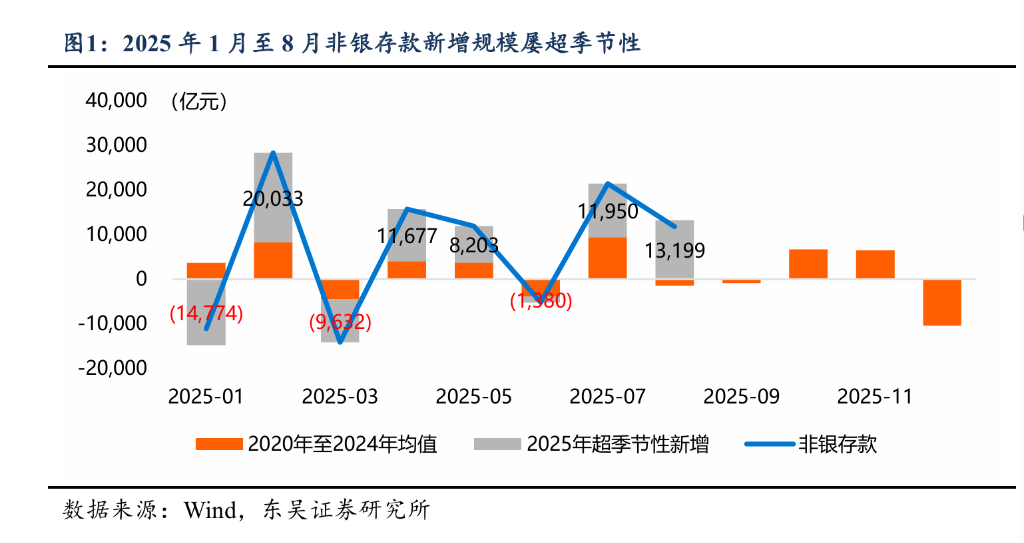
Group 1 - The core viewpoint is that a significant "deposit activation" process is underway in China, driven by the maturation of high-interest fixed deposits, leading to a shift towards more liquid forms of savings and non-bank deposits [1][11] - According to Dongwu Securities, from July to August 2025, non-bank deposits are expected to increase by 3.03 trillion yuan, with 1.42 trillion yuan attributed to the "migration" of deposits from residents and non-financial enterprises [1][6] - The report indicates that a substantial amount of fixed deposits will mature in 2025 and 2026, with 22.28 trillion yuan and 9.4 trillion yuan expected to mature respectively, including 11.08 trillion yuan and 4.05 trillion yuan of "excess" fixed deposits [1][11] Group 2 - Morgan Stanley suggests a gradual release of household savings potential through a three-phase roadmap, starting with guiding 6-7 trillion yuan of excess fixed deposits into risk assets over the next 2-3 years [2][15] - The second phase aims to reshape inflation expectations and release 30 trillion yuan of savings for consumption over the next 6-8 years, while the final phase focuses on long-term social security reforms to lower the overall savings rate [2][15] - The increase in non-bank deposits is driven by multiple factors, including the transfer of deposits by residents and enterprises, expansion of interbank business by banks, and conversion of other deposits not included in broad money statistics [3][6]

上市公司控存款、增理财,机构预测千亿资金将搬家
Di Yi Cai Jing· 2025-09-21 09:21
Core Viewpoint - The trend of "deposit migration" among residents is increasing, with a notable decline in bank deposit products and a slight rise in wealth management and stock investments [1][5] Group 1: Deposit Trends - Resident deposits have decreased for two consecutive months, with an addition of 110 billion yuan in August, down 60 billion yuan year-on-year [1] - Non-bank deposits increased by 1.18 trillion yuan in August, showing significant growth compared to the same period last year [1] - The proportion of deposit products among listed companies has declined, with a shift towards wealth management and stock investments [2][3] Group 2: Wealth Management and Investment Shifts - Listed companies have announced a total of 373.4 billion yuan in wealth management investments over the past year, with a notable increase in the proportion of wealth management products [2] - The amount allocated to wealth management products reached approximately 589.94 million yuan, accounting for 28% of total investment, compared to 15.16% in the previous period [3] - Some companies are extending their investment targets to the primary market, indicating a diversification in investment strategies [4] Group 3: Market Conditions and Institutional Response - The continuous decline in corporate deposit rates and the recovery of the equity market are driving companies to reduce deposit sizes and increase wealth management and stock investments [5][6] - Recent adjustments in deposit rates have seen significant reductions, with major banks lowering rates across various terms [6] - The average annualized yield for bank wealth management products is now higher than that of deposit products, prompting a shift in investment strategies among companies [7][8] Group 4: Future Outlook - Companies are expected to continue reallocating funds from deposits to wealth management, with estimates suggesting a potential migration of several hundred billion yuan in the coming year [8] - The interest in overseas wealth management products is also growing, indicating a broader diversification in asset allocation strategies [8]
申万宏观·周度研究成果(9.13-9.19)
赵伟宏观探索· 2025-09-21 03:14
Group 1: New Economic Dynamics - The high-tech manufacturing sector continues to show strong growth, indicating a new acceleration in economic dynamics [9][10] - Recent financial data shows a decline in credit balance and social financing, with M1 increasing slightly [17] - The impact of "anti-involution" is beginning to manifest in mid-to-lower production and investment sectors [21] Group 2: Gold Price Concerns - Recent trends indicate that gold price increases are primarily concentrated during U.S. trading hours, raising concerns about future price stability [12][11] - The differentiation in investment allocation among different regions may influence future gold price movements [12] Group 3: Fiscal Policy Insights - Broad fiscal spending is slowing down, prompting the need for potential countermeasures to address downward pressure on the economy [21][23] - The upcoming fiscal "second half" may focus on risk prevention, transformation promotion, and consumer protection [16] Group 4: Real Estate Market Trends - There is an improvement in new home transactions in first-tier cities, supported by industrial production recovery and high infrastructure investment [24] Group 5: International Cooperation - The BRICS summit emphasized the importance of multilateralism and international cooperation to address global challenges and promote economic development [29] Group 6: Monetary Policy Outlook - The recent FOMC meeting resulted in a 25 basis point rate cut, with increased expectations for further rate cuts in 2025 [30]

大规模的存款搬家,开始出现了?
大胡子说房· 2025-09-20 05:49
Core Insights - The article highlights a significant shift in deposit trends, with a notable outflow from traditional bank deposits to non-bank financial institutions, indicating a potential investment opportunity in the capital markets [2][9][10]. Group 1: Deposit Trends - In August, new corporate deposits increased by 299.7 billion yuan, a year-on-year decrease of 50.3 billion yuan, while new household deposits were 110 billion yuan, down 600 billion yuan compared to last year [3]. - In July, the stock of household deposits was approximately 1.11 trillion yuan, reflecting a year-on-year reduction of 780 billion yuan [4]. - Non-bank financial institutions, such as brokerages and funds, saw a significant increase in deposits, with non-bank deposits rising by 1.18 trillion yuan in August, a year-on-year increase of 550 billion yuan [6][8]. Group 2: Capital Market Dynamics - The outflow of deposits from banks to non-bank institutions suggests that capital is moving towards the capital markets, driven by increased market activity [9]. - The current trend of deposit migration is more rational compared to previous bull markets, with funds being directed towards stable financial products rather than high-risk investments [11][12]. - The bank wealth management market has seen a substantial increase, with the total scale exceeding 30 trillion yuan, indicating a shift of funds from traditional deposits to these products [14]. Group 3: Future Outlook - The speed of deposit migration is closely linked to the performance of stock indices, with a notable increase in new account openings in August, suggesting a growing interest in the market [19][20]. - The article posits that the current phase of deposit migration is just the beginning, with the potential for a larger scale of movement as market conditions improve [26][28]. - A slow bull market is characterized by the gradual entry of investors, with the article emphasizing the importance of timing and risk management in capital allocation [29][30].

申万宏观·周度研究成果(9.13-9.19)
申万宏源宏观· 2025-09-20 04:05
Group 1: New Economic Dynamics - The high-tech manufacturing sector continues to show strong growth, indicating a new acceleration in economic dynamics [9][10] - There is a notable increase in "deposit migration," reflecting shifts in consumer behavior [17] - The impact of "anti-involution" is beginning to manifest in mid-to-lower production and investment sectors [21] - Fiscal spending is showing signs of weakening, prompting potential measures to counteract downward pressure [21][23] - New housing transactions in first-tier cities are improving, supported by industrial production and high levels of infrastructure investment [24] Group 2: Gold Price Concerns - Recent gold price increases are primarily concentrated during U.S. trading hours, indicating regional investor behavior differences [12][11] - The article discusses potential implications of these trends on future gold pricing [12] Group 3: Fiscal Policy Insights - The fiscal landscape is shifting towards a "second half," focusing on risk prevention, transformation promotion, and consumer protection [16] - The broad fiscal revenue and expenditure growth rates are declining, suggesting a need for diverse tools to mitigate economic challenges [21][23] Group 4: Global Economic Cooperation - The BRICS summit emphasized multilateralism and the importance of a fair global governance system, aiming to enhance cooperation among member countries [29] - The summit highlighted the need for an open and win-win international economic order, resisting protectionism [29] Group 5: Interest Rate Outlook - The Federal Open Market Committee (FOMC) meeting indicated a potential interest rate cut of 25 basis points, with revised economic growth and inflation forecasts [30]

首次突破90亿元!连续19日“吸金”的证券ETF(159841)规模创新高,昨日净流入超5亿元,最新单日成交巨幅放量超10亿元!
Sou Hu Cai Jing· 2025-09-19 02:23
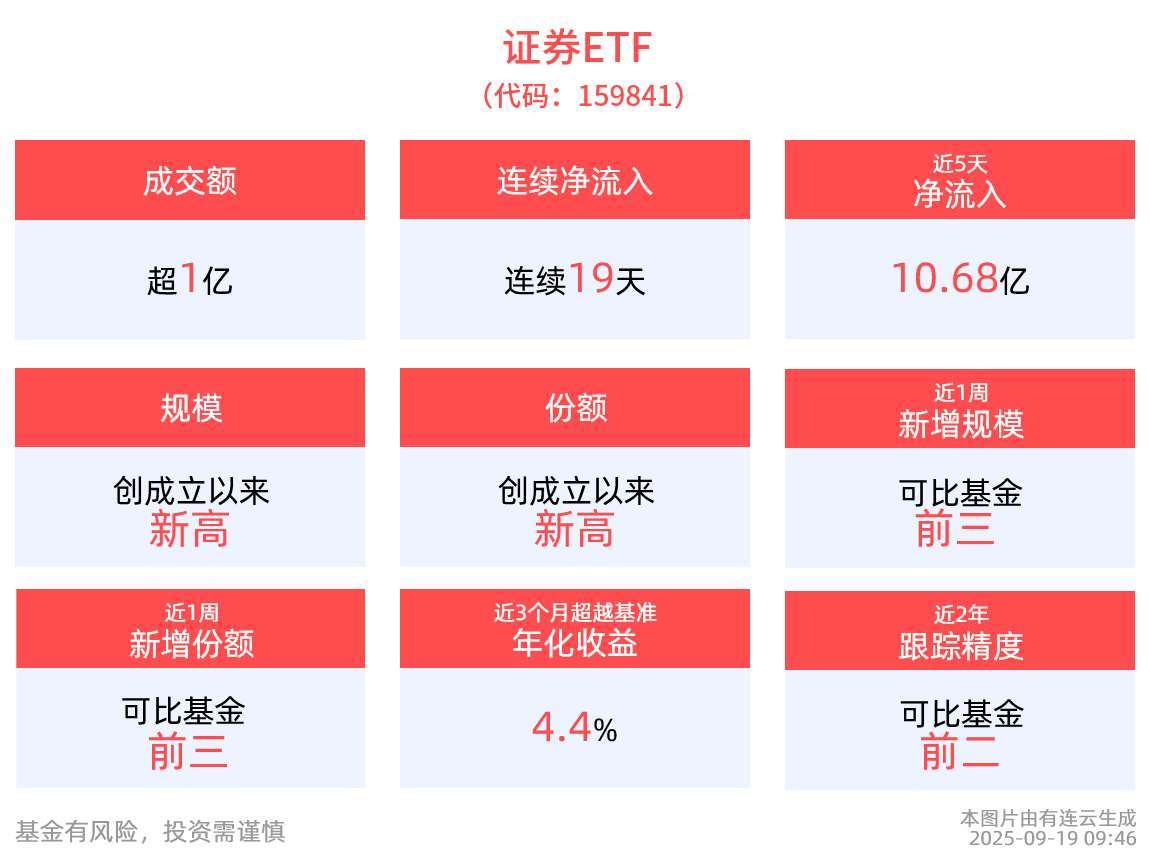
Group 1 - The Securities ETF (159841) has seen significant trading activity, with a single-day transaction volume reaching 1.04 billion yuan and a total volume of 10.48 billion yuan on September 18 [2] - The latest scale of the Securities ETF has surpassed 9 billion yuan, reaching 9.021 billion yuan, with the latest share count at 8.084 billion, both marking new highs since inception [2] - The Securities ETF has experienced continuous net inflows over the past 19 days, accumulating a total of 3.29 billion yuan [2] Group 2 - The A-share market has shown increased activity, with total trading volume exceeding 3 trillion yuan, reaching 3.17 trillion yuan on September 18 [3] - There is a noticeable "see-saw" effect between resident deposits and non-bank deposits, indicating a shift in asset allocation among residents, with a trend towards investing in the equity market [3] - The brokerage industry is expected to see a recovery in valuation and performance, supported by increased market activity and favorable regulatory conditions [3]
A股上市公司存款减少超千亿、理财产品增加
21世纪经济报道· 2025-09-18 14:13
Core Viewpoint - The article discusses the trend of "deposit migration" among residents and the shift in investment preferences of listed companies towards higher-yielding financial products due to declining deposit rates and a recovering equity market [1][6]. Group 1: Financial Data and Trends - In August, the central bank reported a significant drop in new resident deposits, totaling 110 billion yuan, down 600 billion yuan year-on-year, while new non-bank deposits increased by 1.18 trillion yuan, up 550 billion yuan year-on-year [1]. - The total subscription amount for listed companies' financial products has decreased to 1.1 trillion yuan over the past year, down 26.17% from the peak of 1.49 trillion yuan in 2022 [1]. - Cash holdings still dominate at over 70%, but their proportion is declining, while the shares of bank wealth management, securities asset management, and trust products are on the rise, with recent proportions of 9.93%, 6.87%, and 2.07% respectively [2]. Group 2: Investment Preferences of Listed Companies - Recent announcements from several listed companies indicate a shift towards wealth management products, with companies like China Resources Sanjiu Pharmaceutical planning to invest up to 10 billion yuan in bank wealth management products [5]. - The investment in wealth management products is primarily from self-owned funds, focusing on structured deposits and bank wealth management, typically with maturities of 6 months to 1 year [6]. - The demand for wealth management products is driven by the need for stable returns and liquidity, especially as companies with stable development seek to optimize their cash management [6]. Group 3: Market Dynamics and Opportunities - The continuous decline in deposit rates has made bank wealth management products more attractive, with average annualized yields for cash management products at 1.32% and fixed-income products showing varying yields [9]. - The investment scale in structured deposits remains the highest among listed companies, totaling approximately 681.12 billion yuan, although it has decreased by around 100 billion yuan year-on-year [10]. - The recovery in corporate profits is expected to lead to an increase in the total scale of funds used for wealth management by listed companies, as profits have begun to rebound in 2023 [12]. Group 4: Institutional Response and Strategy - Asset management institutions are actively positioning themselves in the corporate wealth management market, with several companies regularly promoting their products [12]. - The trend of increasing demand for corporate wealth management presents significant opportunities for banks, securities firms, and trust companies, necessitating a focus on customized, flexible, and transparent product offerings [13]. - The overall market for listed company wealth management is becoming more institutionalized and professional, requiring asset management firms to adapt and enhance their competitive capabilities [13].

8月非银存款新增1.18万亿,流向了哪儿?未来有何趋势?
Feng Huang Wang· 2025-09-18 12:52
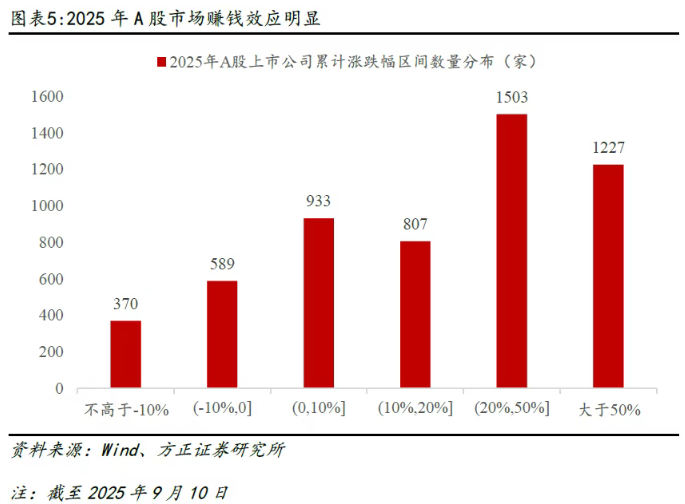
Core Viewpoint - The phenomenon of "deposit migration" among residents in China continues, with a notable decrease in household deposits and an increase in non-bank deposits, indicating a shift in asset allocation towards capital markets [1][2][6]. Group 1: Deposit Trends - In August, household deposits increased by 110 billion yuan, significantly lower than the 710 billion yuan increase in the same month last year [1]. - Non-bank deposits rose by 1.18 trillion yuan in August, surpassing the 630 billion yuan increase from the previous year, marking a new high for the same period since data collection began [1][2]. - The continuous decline in household deposits over the past two months reflects a shift in asset allocation, with a close relationship to capital market performance [1][6]. Group 2: Drivers of Deposit Migration - The sustained decline in deposit interest rates and the attractive returns from the capital markets are identified as primary drivers of the current deposit migration [2][6]. - The A-share market has shown significant profitability this year, further enhancing its appeal to depositors seeking higher returns [2][6]. Group 3: Asset Reallocation - The current trend of deposit migration is primarily towards asset reallocation, with a significant portion of funds likely flowing into the stock market [6][7]. - In August, over 2.65 million new A-share accounts were opened, representing a 48% increase compared to the same period last year, indicating strong investor interest [6][7]. - The margin trading balance in the A-share market reached a historical high of 2.3256 trillion yuan as of September 10, reflecting an increasing risk appetite among investors [6][7]. Group 4: Future Outlook - The deposit migration phenomenon is still in its early stages, with household deposit growth rates declining for two consecutive months [8]. - The ratio of household deposits to the total market capitalization of stocks continues to decrease but remains at historically high levels, suggesting that the impact of deposit migration on equity markets is just beginning [8]. - The low interest rate environment and various positive factors are expected to sustain the trend of deposit migration in the near future [8].

存款减少超千亿、理财产品增加,上市公司也在“存款搬家”?
2 1 Shi Ji Jing Ji Bao Dao· 2025-09-18 11:45
Core Insights - The significant decline in new resident deposits and the increase in non-bank deposits in August has sparked discussions about the phenomenon of "deposit migration" in the market [1] - The trend of asset allocation is shifting towards higher-yielding financial products due to declining deposit rates and a recovering equity market [1] - The overall scale of listed companies' financial management has shown a downward trend, with a 26.17% decrease from the peak in 2022 [1][3] Group 1: Financial Management Trends - Listed companies are increasingly investing in financial products, primarily using their own funds, with a focus on structured deposits and bank wealth management products [3] - The demand for corporate financial management is driven by the need for stable returns and liquidity, especially as companies stabilize and experience cash accumulation [3][4] - The proportion of cash holdings remains high at over 70%, but is declining, while the shares of bank wealth management, securities asset management, and trust products are on the rise [1][4] Group 2: Market Dynamics - The decline in deposit rates has heightened the demand for capital preservation and appreciation among companies, leading to a renewed interest in corporate wealth management [4][5] - The implementation of asset management regulations has facilitated the diversification and net value transformation of financial products, offering higher yields and flexibility compared to traditional deposits [4][5] - Companies are increasingly focused on optimizing their capital structure and improving asset return efficiency in response to uncertain operating environments [5] Group 3: Investment Performance - The average annualized yield of cash management products is currently at 1.32%, while fixed-income products have shown varying yields, generally outperforming traditional deposit products [7] - The investment scale in structured deposits remains significant, but has decreased by approximately 100 billion yuan year-on-year [7][8] - As corporate profits begin to recover, the total scale of funds used for financial management by listed companies is expected to improve [8] Group 4: Opportunities for Asset Management Institutions - Asset management institutions are recognizing the growing demand for corporate wealth management and are actively positioning themselves to meet this need [9][10] - Institutions are advised to enhance product customization, flexibility, and transparency to better serve corporate clients [10] - The market for corporate financial management is becoming more institutionalized and professionalized, necessitating asset management institutions to adapt and strengthen their competitive capabilities [10]

大规模的存款搬家,开始出现了?
大胡子说房· 2025-09-18 11:15
Core Viewpoint - The article highlights a significant shift in deposit trends, indicating a movement of funds from traditional bank deposits to non-bank financial institutions, driven by the rising interest in the capital market and a more rational approach to investment by residents and enterprises [2][9][10]. Summary by Sections Deposit Data - In August, new corporate deposits increased by 299.7 billion yuan, a year-on-year decrease of 50.3 billion yuan [3]. - New household deposits were 110 billion yuan, down 600 billion yuan compared to last year [3]. - In July, the stock of household deposits was approximately 1.11 trillion yuan, reflecting a year-on-year reduction of 780 billion yuan [4]. Non-Bank Financial Institutions - Non-bank financial institutions, such as brokerages, funds, and insurance companies, saw a significant increase in deposits, with an addition of 1.18 trillion yuan in August, a year-on-year increase of 550 billion yuan [6]. - In July, the increase in non-bank deposits was even higher at 2.14 trillion yuan [7]. - Cumulatively, non-bank deposits increased by 5.87 trillion yuan in the first eight months of the year, marking a historical high for the same period [8]. Fund Movement and Market Sentiment - The outflow of deposits from banks to non-bank institutions suggests a growing interest in the capital market, indicating a large-scale "deposit migration" [9]. - This migration is characterized by a more rational approach, with funds moving towards stable financial products rather than high-risk investments [12]. - Popular products include those with relatively fixed returns, which have attracted significant interest compared to traditional deposits [14]. Market Dynamics - The article notes that the current deposit migration is still in its early stages, with a substantial amount of funds yet to enter the market [16]. - The speed of deposit migration is closely linked to the performance of stock indices, with a notable increase in new account openings in August, reaching approximately 2.65 million, a 35.1% month-on-month increase and a 165% year-on-year increase [19][20]. - The article emphasizes that the attitude of the public towards the capital market is directly correlated with the market's performance [23]. Future Outlook - The potential acceleration of deposit migration will depend on the speed of index increases, with rapid gains likely to encourage more retail investors to enter the market [22][24]. - The article concludes that the current wave of deposit migration is expected to surpass previous instances, driven by a collective effort to restore asset prices and ensure widespread participation in market gains [26][28].