
全球化扩张

Search documents
泡泡玛特 新高!
Zhong Guo Ji Jin Bao· 2025-08-20 11:13
Group 1: Bubble Mart Performance - Bubble Mart reported a significant increase in net profit by 385.6% for the first half of 2025, reaching 4.68 billion RMB, driven by global expansion and IP matrix growth [11][14] - The company's revenue for the same period was 13.88 billion RMB, reflecting a year-on-year growth of 204.4% [11][13] - Bubble Mart's stock price surged to a new high of 316.00 HKD per share, with an increase of 12.54% on the day of the earnings announcement [9][11] Group 2: Financial Metrics - The gross profit for Bubble Mart was reported at 9.76 billion RMB, a 234.4% increase compared to the previous year [13] - The adjusted net profit was 4.71 billion RMB, showing a growth of 362.8% [11][13] - The net profit margin reached 33.7%, an increase of 12.5 percentage points year-on-year [11] Group 3: Market Reaction and Future Outlook - The stock trading volume for Bubble Mart was notable, with a total transaction value of 115.12 billion HKD [5] - Analysts from Xinda Securities have given a "buy" rating, projecting revenues of 30.996 billion RMB, 48.445 billion RMB, and 63.117 billion RMB for 2025 to 2027 [14] Group 4: Sunny Optical Technology Performance - Sunny Optical Technology reported a net profit increase of 52.56% for the first half of 2025, amounting to 1.646 billion RMB [16][19] - The company's total revenue was 19.652 billion RMB, reflecting a year-on-year growth of 3.56% [16] - The stock price of Sunny Optical rose by 9.74%, closing at 82.25 HKD per share [14][20] Group 5: Market Trends and Related Stocks - The semiconductor sector showed positive momentum, with stocks like SMIC rising by 3.40% due to a rebound in the A-share market [4] - The overall market saw mixed performance, with the industrial index up by 0.67% and healthcare down by 2.58% [5][7]


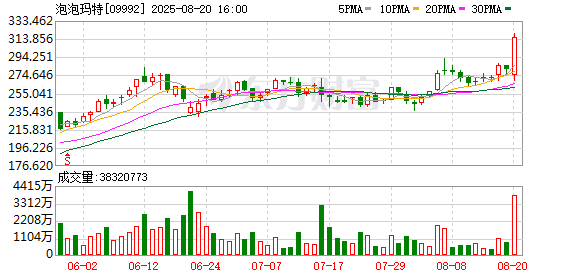
“封王”的LABUBU,让泡泡玛特全年剑指300亿
Hua Er Jie Jian Wen· 2025-08-20 10:44
Core Viewpoint - Pop Mart achieved its best performance ever in the first half of the year, with revenue of 13.88 billion yuan, a year-on-year increase of over 200%, and adjusted net profit of 4.71 billion yuan, a year-on-year increase of 362.8%, both exceeding the full-year levels of 2024 [1][8] Group 1: Financial Performance - The company had 13 IPs generating over 100 million yuan in revenue, with 5 IPs surpassing 1 billion yuan [1] - The LABUBU series demonstrated strong revenue generation, achieving 4.81 billion yuan, a year-on-year increase of 668%, and its revenue share increased from 13.7% to 34.7% [1][2] - The plush product category saw revenue increase by over 12 times, reaching 6.1 billion yuan, surpassing the sales of figurines for the first time [3] Group 2: Market Demand and Supply Chain - Despite not fully meeting market demand, the company reported a monthly production capacity of approximately 30 million plush toys, ten times that of the previous year [2] - The number of registered members in mainland China increased by 13.04 million, reaching 59.12 million, with stable sales contribution and repurchase rates from members [2] Group 3: International Expansion - The company is leveraging LABUBU's popularity to accelerate global expansion, with all four major regions (China, Asia-Pacific, Americas, Europe) achieving triple-digit growth [5] - The number of overseas stores doubled compared to the beginning of the year, with 70 new stores opened in the first half, and plans to exceed 200 stores by year-end [5][6] Group 4: Profitability and Margins - The gross margin increased to 70.3%, with the rise in overseas sales contributing 4 percentage points to this increase [7] - Adjusted net profit margin reached 33.9%, an increase of 11.6 percentage points year-on-year [7] Group 5: Future Outlook - The company is optimistic about achieving a full-year revenue target of 30 billion yuan, significantly higher than the initial guidance of 20 billion yuan [8] - Estimated full-year net profit could exceed 10 billion yuan, more than three times that of 2024 [9]
泡泡玛特,新高!
中国基金报· 2025-08-20 10:34
Core Viewpoint - Pop Mart's net profit surged over 385%, leading to a new high in stock price, reflecting strong performance driven by global expansion and IP matrix growth [10][12]. Financial Performance - For the first half of 2025, Pop Mart reported revenue of 13.88 billion RMB, a year-on-year increase of 204.4%, attributed to global expansion and IP matrix explosion [12][13]. - Net profit reached 4.68 billion RMB, up 385.6% year-on-year, with an adjusted net profit of 4.71 billion RMB, reflecting a 362.8% increase [12][13]. - The net profit margin improved to 33.7%, an increase of 12.5 percentage points compared to the previous year [12]. Market Reaction - Following the earnings report, Pop Mart's stock price opened lower but surged by 13.75%, closing at 316.00 HKD per share, marking a 12.54% increase and setting a new historical high [10][12]. Investment Highlights - Key investment highlights for Pop Mart include: 1. Plush product revenue surpassing figurines for the first time, driven by product innovation [15]. 2. Significant contributions from the membership system, enhancing repurchase rates and optimizing cost control [15]. 3. Notable growth in IP licensing fees, indicating deeper IP development and collaboration [15]. 4. Continuous expansion into new business areas, broadening operational boundaries [15]. Industry Performance - The Hang Seng Index saw mixed performance, with 45 stocks rising and 33 falling, indicating a varied market sentiment [4]. - Notable performers included Sunny Optical Technology, which reported a 52.56% increase in net profit, leading to a stock price rise of nearly 10% [16][19].

摩根大通:泡泡玛特二季报最大亮点:海外太猛了,“超级IP”Labubu之外,新IP也抢眼
美股IPO· 2025-08-20 01:49
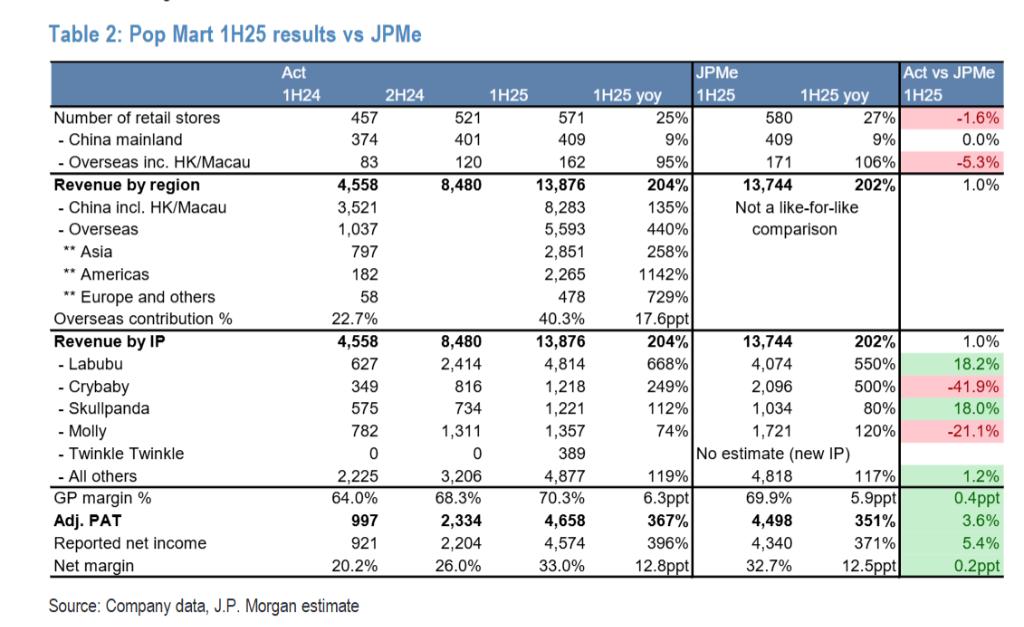
Core Viewpoint - Pop Mart's adjusted net profit for the first half of 2025 surged by 367% year-on-year to 4.66 billion RMB, driven by strong overseas market performance and the success of its IP matrix, particularly the new IP "Twinkle Twinkle" which generated 389 million RMB in sales within six months [1][2][9]. Group 1: Financial Performance - Adjusted net profit reached 4.66 billion RMB, exceeding previous forecasts by 4% [2]. - Total revenue increased by 204% to 13.9 billion RMB, aligning with market expectations [2]. - Gross profit margin improved to 70.3%, up 6.3 percentage points from the previous year, while net profit margin rose to 33.0%, an increase of 12.8 percentage points [11]. Group 2: Overseas Market Expansion - Overseas sales, including Hong Kong and Macau, skyrocketed by 440% to 5.59 billion RMB, contributing approximately 50% to total group sales [3][4]. - The average sales per store in overseas markets are estimated to be four times higher than those in mainland China [3]. - Online sales in overseas markets increased significantly, with the proportion rising from 23.2% to 45.8% [3]. Group 3: IP Performance - The flagship IP Labubu saw sales grow by 668% to 4.81 billion RMB, accounting for 34.7% of total sales [7]. - The new IP "Twinkle Twinkle" achieved remarkable sales of 389 million RMB within its first six months, outperforming previous new IP launches [9]. - Crybaby, another established IP, ranked fourth in sales but experienced a 248% year-on-year growth, making it the second-fastest growing IP [10]. Group 4: Future Catalysts - The company is set to launch a collaboration with Uniqlo on August 22, which is expected to drive further sales [12][14]. - Potential inclusion in the Hang Seng Index could increase demand significantly, with estimates suggesting around 420 million USD in increased demand if added [12][14]. - Upcoming releases include the first season of "Labubu & Friends" animation and new product launches, which are anticipated to boost sales [12][14].

泡泡玛特二季报最大亮点:海外太猛了,“超级IP”Labubu之外,新IP也抢眼
Hua Er Jie Jian Wen· 2025-08-20 00:23
Core Viewpoint - The impressive financial report of Pop Mart has drawn attention to its global expansion and the iterative capability of its IP matrix, with significant profit and revenue growth driven by overseas market expansion and strong performance of key IPs [1] Group 1: Financial Performance - Pop Mart's adjusted net profit for the first half of 2025 surged by 367% year-on-year to 4.66 billion RMB, exceeding previous profit forecasts by 4% [1] - Total revenue increased by 204% to 13.9 billion RMB, aligning with market expectations [1] - Gross profit margin reached 70.3%, up 6.3 percentage points from the previous year, while net profit margin rose from 20.2% to 33.0%, an increase of 12.8 percentage points [5] Group 2: Overseas Market Expansion - Sales in overseas markets (including Hong Kong, Macau, and Taiwan) skyrocketed by 440% year-on-year to 5.593 billion RMB, contributing approximately 50% to the group's total sales, up from 44% in the second half of 2024 [2] - The average sales per store in overseas markets are estimated to be about four times that of mainland China stores [2] - Online sales in overseas markets increased significantly, rising from 23.2% in the first half of 2024 to 45.8% in the first half of 2025 [2] Group 3: IP Performance - The super IP Labubu continued its strong growth, with sales in the first half of 2025 increasing by 668% to 4.814 billion RMB, accounting for 34.7% of total sales [4] - The new IP "Twinkle Twinkle" achieved sales of 389 million RMB within its first six months, showcasing its strong market entry [4] - The IP Crybaby, despite ranking fourth, saw a sales increase of 248%, making it the second-fastest growing IP [4] Group 4: Future Growth Catalysts - The company is expected to benefit from several catalysts, including the launch of Labubu-themed T-shirts in collaboration with Uniqlo, potential inclusion in the Hang Seng Index, and the premiere of the "Labubu & Friends" animated series [5]
纳芯微:增收不增利,国产模拟芯片龙头的困境
贝塔投资智库· 2025-08-18 04:16
Company Overview - Naxin Micro was established in 2013 and went public on the Sci-Tech Innovation Board in 2022 (688052.SH). The company submitted an application for H-share listing on the Hong Kong Stock Exchange in April 2025, aiming to raise funds for underlying technology upgrades, production line expansion, overseas sales network construction, and strategic investments, particularly in sensor companies [1]. - The company has developed automotive-grade chips that have been mass-produced for major manufacturers such as Dongfeng Motor, SAIC Maxus, BYD, and others, and has entered the supply chains of SAIC Volkswagen, FAW Group, and CATL [3]. Shareholder Information - As of the end of 2024, major shareholders include Wang Shengyang (10.86%) and Sheng Yun (10.12%), collectively holding 21% through a concerted action agreement. Notable pre-IPO shareholders include Xiaomi Changjiang, Shenzhen Capital Group, and a Middle Eastern sovereign fund. By Q1 2025, the top ten circulating shareholders included the National Social Security Fund and Hong Kong Central Clearing Limited [4]. Product and Operational Model - Naxin Micro's product range covers sensors, signal chains, and power management, with over 3,300 product models. Automotive-grade chips account for 36.88% of total sales, with products entering the supply chains of leading companies like BYD and NIO [5][6]. - The company operates on a fabless model, outsourcing wafer manufacturing to SMIC and TSMC, while packaging and testing are handled by Jiangsu Changjiang Electronics Technology Co. The sales model combines direct sales (40%) and distribution (60%), with major clients contributing 36.9% of revenue [6]. Financial Performance - Naxin Micro reported revenues of RMB 1.67 billion, RMB 1.31 billion, and RMB 1.96 billion for 2022, 2023, and 2024, respectively, with a 49.5% year-on-year growth in 2024. Q1 2025 revenue reached RMB 717 million, a 97.82% increase year-on-year, driven by growth in automotive electronics and recovery in consumer electronics and energy sectors [8][11]. - The company has experienced consecutive losses over the past two years, with net profits of RMB 250 million, -RMB 305 million, and -RMB 403 million for 2022, 2023, and 2024, respectively. R&D expenses accounted for 27.55% of revenue in 2024 [13]. Industry Competition Landscape - The global analog chip market is dominated by international giants such as Texas Instruments, ADI, and Infineon, which hold over 60% of the market share. A price war has emerged due to U.S. government subsidies allowing American companies to export chips to China at lower prices, impacting domestic manufacturers [17]. - Naxin Micro is positioned to benefit from a projected increase in domestic substitution rates in the automotive analog chip market, expected to rise from 5% to 20% by 2029 [18]. Competitive Advantages - Naxin Micro invests heavily in R&D, with 55% of its workforce dedicated to this area and a significant number of patents filed. The company has achieved a leading position in several segments, including automotive-grade chips and digital isolation chips [21][22]. - The company has established strong customer relationships, with a lengthy product development cycle that enhances customer stickiness. Major clients include BYD and NIO, with significant revenue contributions from these partnerships [23]. Future Outlook - Naxin Micro plans to expand into emerging fields such as eVTOL and humanoid robotics, and aims to acquire SiC manufacturers to enhance its ecosystem. The company targets a gross margin recovery to over 35% by 2025 through process iterations and scale procurement [35]. - The company is also focusing on increasing its overseas revenue share, which was 15.58% in 2024, with plans to reach 20% within three years. Collaborations with international partners are underway to enhance market penetration [36][37].


“跑鞋界苹果”,两年实现业绩翻倍
Di Yi Cai Jing Zi Xun· 2025-08-15 05:08
Core Viewpoint - On Holding AG, a Swiss sports brand known for its high-performance running shoes, has achieved significant growth, with revenue surpassing 1 billion Swiss francs in 2022 and projected to reach 2.318 billion Swiss francs in 2024, doubling its performance in just two years [2] Group 1: Financial Performance - The company aims for revenue of at least 3.55 billion Swiss francs (approximately 29.05 billion RMB) from fiscal year 2024 to 2026, with the Chinese market playing a crucial role in achieving this target [2] - In Q2 of fiscal year 2025, the company reported a net sales increase of 32% to 749 million Swiss francs, with the Asia-Pacific market seeing a remarkable 101.3% growth to 119 million Swiss francs [3] - Despite the sales growth, the company experienced a net profit decline of 232.7%, shifting from a profit of 30.8 million Swiss francs in the previous year to a loss of 40.9 million Swiss francs, attributed to foreign exchange losses due to the appreciation of the Swiss franc [3] Group 2: Market Strategy - The company has identified China as one of its top five global markets, with plans to expand its presence by opening more stores, aiming for 100 locations by 2026, particularly in first- and second-tier cities [3] - The management is prioritizing market share and brand strength over short-term profits, a strategy previously seen in companies like Nike and Lululemon [5] - The future challenge lies in managing expense growth, maintaining gross margins, and transitioning to a profit model as revenue growth slows [5]


港股再融资额1839亿,较去年增两倍,新经济巨头领跑
Sou Hu Cai Jing· 2025-08-12 23:11
Core Insights - The Hong Kong stock refinancing market is experiencing unprecedented prosperity, with over 240 companies completing refinancing totaling HKD 183.9 billion as of August 6, 2023, which is 2.17 times the total refinancing amount for the entire year of 2024, indicating strong market vitality [1] - New economy enterprises are the main players in this financing wave, with leading companies like BYD, Xiaomi Group, and WuXi AppTec leading the fundraising efforts [1][2] Group 1: Financing Details - BYD leads the pack with a placement amount of HKD 43.38 billion, followed closely by Xiaomi Group at HKD 42.6 billion, and WuXi AppTec at HKD 7.647 billion, together accounting for approximately 50% of the total placement amount in Hong Kong this year [2][3] - Other notable companies such as Horizon Robotics, ZhongAn Online, and China RuYi have raised over HKD 3 billion, while hard-tech firms like SenseTime and UBTECH also performed well [2] Group 2: Institutional Investor Participation - The participation of international institutional investors is a significant phenomenon in the Hong Kong refinancing market, with notable long-term fund Wujie Capital frequently making moves, including a planned investment of HKD 1.308 billion in Fourth Paradigm and HKD 2.5 billion in SenseTime [3][4] - Wujie Capital aims to establish a long-term presence in the Middle East, having obtained a financial license in Abu Dhabi, and is actively investing in new economy enterprises [3] Group 3: Strategic Partnerships and Value - The involvement of institutional investors brings strategic value beyond mere capital injection, enhancing market confidence in the companies' prospects and attracting more attention [5] - Institutional investors can help companies improve governance structures, increase transparency, and leverage their resources for business development, which is crucial for Chinese enterprises in the new economy sector as they expand globally [5] - BYD has announced a strategic partnership with Al-Futtaim Group to deepen collaboration in the electric vehicle sector, exploring growth opportunities based on regional cooperation [5][6] Group 4: Long-term Funding and R&D - The increased participation of long-term capital is expected to provide stable expectations for technology research and development in new economy enterprises [6] - Wujie Capital's collaboration with SenseTime and its spin-off Sunrise aims to explore strategic synergies in building a computing foundation for embodied intelligence and digital finance, promoting the globalization of AI chips and the construction of an AI capital ecosystem [6]



泡泡玛特(09992):重大事项点评:25H1业绩超预期,品牌势能持续增强
Huachuang Securities· 2025-07-21 13:42
Investment Rating - The report maintains a "Strong Buy" rating for the company, with a target price of HKD 321.9 [2][8]. Core Insights - The company's H1 2025 performance exceeded expectations, with revenue growth projected to be at least 200%, corresponding to revenue of at least HKD 13.67 billion. The group's profit growth is expected to be at least 350%, corresponding to a profit of at least HKD 4.34 billion, with a profit margin of approximately 31.7%, an increase of 10.6 percentage points year-on-year [2][8]. - The report highlights the ongoing enhancement of brand momentum and the successful expansion of the IP ecosystem, with new product launches receiving positive market feedback [2][8]. - The company is expected to continue its impressive performance in the domestic market while expanding its presence in overseas markets, supported by the influence of celebrity endorsements [2][8]. Financial Summary - Projected total revenue for 2024 is HKD 13.04 billion, with a year-on-year growth rate of 105.5%. By 2025, revenue is expected to reach HKD 30.05 billion, reflecting a growth rate of 130.5% [4][9]. - The projected net profit for 2024 is HKD 3.13 billion, with a year-on-year growth rate of 188.8%. By 2025, net profit is expected to increase to HKD 9.38 billion, with a growth rate of 200.1% [4][9]. - The report anticipates a steady increase in earnings per share (EPS), projected at HKD 2.33 for 2024, rising to HKD 6.98 in 2025 [4][9].
匠心家居(301061):点评:25H1业绩超预期,费率与拓客户视角下跨品类对比,重视公司成长加速
Changjiang Securities· 2025-07-15 10:12
Investment Rating - The report maintains a "Buy" rating for the company [9]. Core Insights - The company is expected to achieve a net profit attributable to shareholders of 4.1 to 4.6 billion yuan in the first half of 2025, representing a year-on-year growth of 44% to 61%. The net profit after deducting non-recurring items is projected to be between 4.0 and 4.5 billion yuan, with a growth of 55% to 75% [2][6]. - The second quarter of 2025 is anticipated to continue high revenue growth, with a profit growth rate exceeding expectations, driven by product structure optimization and cost reduction [2][8]. - The company's strong product capabilities and efficient channel development are highlighted as key factors in maintaining low expense ratios while rapidly expanding its customer base [8]. - The company is expected to enter a brand development phase, leveraging brand momentum to enhance sales performance [8]. - The estimated market share of the company in the U.S. functional sofa market is approximately 6%, with significant growth potential compared to historical benchmarks [8]. Financial Projections - The company forecasts net profits of approximately 9.8 billion yuan, 12.2 billion yuan, and 15.3 billion yuan for the years 2025, 2026, and 2027, respectively, with corresponding price-to-earnings ratios of 19x, 15x, and 12x [8]. - The revenue for 2024 is projected at 2.548 billion yuan, increasing to 3.522 billion yuan in 2025, and further to 4.412 billion yuan in 2026 [26]. Customer and Market Dynamics - The company has been actively expanding its customer base, with new partnerships with top U.S. furniture retailers increasing from 30 to 49 over recent years [12]. - The report emphasizes the importance of maintaining a strong product design focus, particularly in the mid-to-high-end market segment, to enhance customer loyalty and sales [8].