全球通胀

Search documents
机构:白银价格受全球通胀信号影响大幅上涨
Sou Hu Cai Jing· 2025-12-09 17:03
Group 1 - Silver futures prices have risen over 4%, currently trading above $60 per ounce [1] - The Federal Reserve's interest rate decision is the main focus of the market this week [1] - There are signs that Australia is entering a new phase in its fight against inflation, causing unease among investors [1] Group 2 - Analyst Peter Cardillo from Spartan Capital Securities believes the Reserve Bank of Australia will maintain interest rates and warn of inflation risks, with potential for future rate hikes [1] - This situation is described as a form of inflation panic [1]
山东招金梁永慧:黄金牛市没有结束,预计年底前将是一个震荡行情,长期应该是持续的稳步上涨
Sou Hu Cai Jing· 2025-11-27 03:54
Core Viewpoint - The long-term bull market for gold is not over, but a correction is expected in the short to medium term due to rapid price increases in 2025, leading to a forecast of a volatile market until the end of the year, followed by steady long-term growth [2][12]. Long-term Factors - Gold prices are influenced by long-term factors such as currency devaluation, global debt, and geopolitical issues, which are expected to have a lasting impact [7][8]. - The trend of de-dollarization is ongoing, with many countries increasing their gold reserves to support their currencies, which is likely to continue for over three years [8][12]. - Global debt and credit are expanding, particularly U.S. debt, with some countries selling U.S. bonds to buy gold, providing long-term support for gold prices [8][12]. - Historical inflation trends suggest that inflation may rise significantly after 2025, potentially leading to a substantial increase in gold prices [9][12]. - The global economy is entering a recession, which is expected to last for over a decade, further supporting gold as a safe-haven asset [9][10]. Medium-term Factors - The ongoing divergence in global monetary policies is expected to maintain a loose monetary environment, providing support for gold prices over the next three years [10][12]. - The uncertainty surrounding global economic recovery and the current economic cycle suggests that demand for gold as a safe asset will continue to rise [10][12]. Short-term Factors - The probability of interest rate cuts by the Federal Reserve is decreasing, which has led to a recent decline in gold prices, but the overall outlook remains bullish for the end of the year [10][12]. - Ongoing trade negotiations, particularly between the U.S. and China, have created short-term pressures on gold prices [11][12]. - Recent price movements indicate that gold is currently experiencing a downward adjustment, with key support levels identified at $3,900 and $3,520 [11][12]. Investment Recommendations - Investors and the general public are advised to consider allocating 5% to 30% of their asset portfolio to physical gold or gold ETFs, reflecting a long-term optimistic view on gold [6][13].


电动车补贴结束会影响钯金需求和价格吗?
Qi Huo Ri Bao Wang· 2025-11-26 02:23
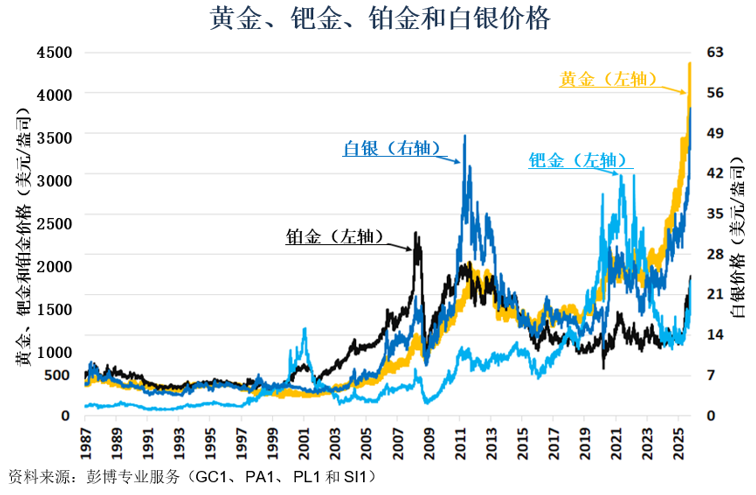
Core Insights - Palladium prices surged from $870 per ounce in early April 2025 to nearly $1,700 by October, marking an increase of over 95%, with a simultaneous rise in gold, silver, and platinum prices during the same period [1] - The global inflationary environment driving this surge is attributed to three main factors: significant budget deficits in multiple countries with limited control measures, core inflation rates exceeding target levels and trending upwards, and the easing of monetary policies by most central banks despite rising inflation [1] Price Correlation and Trends - Palladium typically shows a positive correlation with other precious metals, but this correlation is weaker compared to the relationships among gold and silver, which are primarily driven by jewelry demand [4] - The second strongest correlation among precious metals is between palladium and platinum, reflecting their applications in automotive catalytic converters, with palladium used in gasoline engines and platinum in diesel engines [4][8] Supply Dynamics - Palladium is rarely used in jewelry, with its primary application in the automotive industry, highlighting its price trend independence compared to other metals [10] - The supply of palladium is highly concentrated, particularly in Russia and South Africa, with overall global palladium production showing a declining trend since 2003 [15] - The demand for palladium surged due to stricter automotive emission laws and concerns over supply disruptions from Russia, leading to a parabolic price increase in the late 1990s [15] Market Shifts - Since 2021, palladium prices have returned to historical price ratio ranges relative to gold, silver, and platinum, coinciding with peak palladium usage per vehicle and a surge in electric vehicle sales [18] - In the U.S., electric vehicle sales are projected to account for 11.4% of total vehicle sales in 2024, while in China, the share is expected to approach 50% [20][18] Investment Considerations - Palladium presents research value as a potential diversification tool for investors looking to allocate precious metals, given its limited supply and the inability of central banks to print or digitally create such assets [23]
【环球财经】拉加经委会上调2025年拉美和加勒比地区经济增长预期至2.4%
Xin Hua Cai Jing· 2025-10-24 06:16
Core Insights - The United Nations Economic Commission for Latin America and the Caribbean (ECLAC) has raised its economic growth forecast for the region to 2.4% for 2025, maintaining a 2.3% growth forecast for 2026, with increased trade with China being a significant factor [1][2] Economic Growth Projections - ECLAC's upward revision reflects an improvement in the external environment affecting the region's economy, with major trading partners performing better than previously expected [1] - For South America, the growth forecast for 2025 is now 2.9%, up from the previous estimate of 2.7%, driven by increased trade with China and a rebound in prices of precious metals and other natural resources [1] - Central America and Mexico are expected to grow by 1.2%, slightly higher than before, mainly due to improved international trade conditions [1] - The Caribbean region (excluding Guyana) has a slightly raised growth forecast of 1.9%, benefiting from strong performance in the tourism sector [1] Recommendations for Regional Countries - ECLAC calls for regional countries to maintain macroeconomic stability, enhance productivity, promote export diversification, expand intra-regional trade, and encourage sustainable investment [2] - The importance of international cooperation and multilateralism is emphasized for consolidating economic recovery and mitigating geopolitical fragmentation [2]
拉加经委会上调2025年拉美和加勒比地区经济增长预期至2.4%
Xin Hua Wang· 2025-10-24 06:06
Core Viewpoint - The United Nations Economic Commission for Latin America and the Caribbean (ECLAC) has raised its economic growth forecast for the Latin America and Caribbean region to 2.4% for 2025, while maintaining the 2026 growth forecast at 2.3% [1][2]. Economic Growth Projections - The 2025 growth forecast for South America has been increased to 2.9%, up from the previous estimate of 2.7% in August, driven by increased trade with China and a rebound in prices of precious metals and other natural resources [1]. - Central America and Mexico are expected to see a growth of 1.2% [1]. - The Caribbean region (excluding Guyana) has a slightly raised growth forecast of 1.9%, primarily benefiting from better-than-expected performance in the tourism sector [1]. External Environment and Risks - The upward revision reflects a more favorable external environment impacting the region's economy, although multiple downward risks remain, such as slower-than-expected global inflation decline, potential severe adjustments in international financial markets, and rising fiscal sustainability pressures in developed economies [1]. Recommendations for Regional Countries - ECLAC calls for regional countries to maintain macroeconomic stability, enhance productivity, promote export diversification, expand intra-regional trade, and encourage sustainable investment [1]. - The organization emphasizes the importance of international cooperation and multilateralism in consolidating economic recovery momentum and mitigating geopolitical economic fragmentation [1].
别傻等了!黄金破1000元/克,不搞懂这些会亏惨!
Sou Hu Cai Jing· 2025-10-21 11:53
Core Viewpoint - The recent surge in gold prices, with international gold nearing $4,400 and domestic gold prices reaching ¥1,000 per gram, is driven by two main factors: the U.S. debt crisis and global inflation [2][4][6]. Group 1: U.S. Debt Crisis - The U.S. debt burden has become alarming, leading to concerns about the reliability of the dollar as a global currency, which in turn boosts gold's appeal as a safe haven [2][4]. - The total market value of gold has surpassed $30 trillion, nearly matching the scale of U.S. national debt and significantly exceeding the total market value of A-shares [2]. Group 2: Global Inflation - Gold serves as a measure of currency value, and its price increase reflects the devaluation of money due to excessive money printing by central banks worldwide [4][6]. - The current inflationary environment has made gold increasingly valuable as a hedge against currency depreciation [4][6]. Group 3: Investment Timing - Despite the long-term bullish outlook for gold, the recent 20% price increase over a month is historically rare and suggests caution for short-term investors [5][6]. - Historical patterns indicate that after previous surges, gold prices often experience a correction, making it risky for investors to chase prices during such volatile periods [5][6]. Group 4: Investment Strategy - Investors are advised to remain rational and wait for a more favorable entry point after the current surge subsides, rather than succumbing to market emotions [7]. - Gold is better suited for long-term holding rather than short-term speculation, emphasizing the importance of strategic asset allocation [6][7].
新一期《全球经济展望报告》发布
Shang Wu Bu Wang Zhan· 2025-10-18 15:58
Core Insights - The International Monetary Fund (IMF) has released its latest World Economic Outlook report, indicating that the global economy is adapting to a new landscape reshaped by recent policy changes [1] - The report has revised global growth expectations upward compared to the April 2023 forecast, but still reflects a downward adjustment compared to predictions made before the U.S. tariff policy changes [1] - Global economic growth is projected to slow from 3.3% in 2024 to 3.2% in 2025 and 3.1% in 2026, with developed economies growing at approximately 1.5% and emerging markets and developing economies slightly above 4% [1] - Global inflation is expected to continue declining, but the situation varies by country, with U.S. inflation remaining above target levels and risks skewed to the upside, while other regions experience more moderate inflation [1] - Current risks are tilted to the downside, with ongoing geopolitical uncertainties, rising protectionism, and labor supply shocks potentially undermining global economic growth [1] Recommendations - Governments are urged to implement credible, transparent, and sustainable fiscal policies to stabilize economic growth confidence [2] - Trade diplomacy should align with macroeconomic adjustments, and efforts should be made to rebuild fiscal buffers and maintain the independence of national central banks [2] - Structural reforms should be prioritized, taking into account the opportunity costs and trade-offs involved in industrial policy [2]
高地集团:当黄金站上4233美元:一场全球财富迁移的序幕
Sou Hu Cai Jing· 2025-10-17 03:37
Core Viewpoint - The current surge in gold prices is not just a market trend but signifies a new global consensus on the asset's value [1] Group 1: Gold Price Dynamics - Gold prices have reached $4200 per ounce, marking a new high, with market sentiment showing divergence between bearish and bullish perspectives [3] - The current market fluctuation is seen as a "digesting" phase rather than a reversal, supported by ongoing global inflation pressures, central bank gold purchases, low real interest rates, and weakening dollar attractiveness [3][5] - Structural factors ensure a robust long-term upward trend for gold, with short-term volatility unlikely to alter this trajectory [3] Group 2: Trading Structure - In the international gold market, the dynamics between long and short positions are asymmetric, with long positions incurring lower costs compared to short positions that face higher borrowing costs [4] - The expectation of Federal Reserve rate cuts is increasing the cost of short positions, thereby pushing more capital towards long positions and driving gold prices higher [5][6] Group 3: Institutional Consensus - Major financial institutions are uniformly bullish on gold, with Morgan Stanley, UBS, and Goldman Sachs projecting significant price increases, with Goldman Sachs raising its 12-month target to $4600 per ounce [7] - The World Gold Council notes that central banks in Asia and the Middle East continue to increase their gold reserves, indicating stable demand [7] Group 4: Federal Reserve Rate Cut Expectations - The probability of the Federal Reserve cutting rates in the next 15 days is as high as 96.7%, with expectations of multiple rate cuts in upcoming meetings [8] - Recent signals from Fed Chairman Jerome Powell suggest a potential end to quantitative tightening and a shift towards quantitative easing, which would enhance liquidity and favor gold and other inflation-hedged assets [8] Group 5: Conclusion - The current price level of $4200 per ounce is seen as a new starting point, with short-term fluctuations viewed as part of the market rhythm rather than risks [10] - The long-term bullish logic remains intact due to unresolved inflation pressures, an impending rate cut cycle, ongoing central bank purchases, and rising demand for safe-haven assets [10]
IMF上调全球增长预期,警告关税削弱增长前景
Xin Hua Cai Jing· 2025-10-14 23:57
Global Economic Outlook - The International Monetary Fund (IMF) has slightly raised the global real GDP growth forecast for 2025 to 3.2%, up from 3.0% in July, while maintaining growth rates for 2024 and 2026 at 3.3% and 3.1% respectively [1] - Despite a more accommodative financial environment and limited trade shocks, the IMF emphasizes significant downside risks to global growth, particularly from escalating trade tensions and policy uncertainties [1] Regional Economic Insights Latin America and the Caribbean - The growth forecast for Latin America and the Caribbean in 2025 has been increased from 2.2% to 2.4%, but the 2026 forecast has been lowered from 2.4% to 2.3% [2] - Mexico stands out with a growth forecast for 2025 raised from 0.2% to 1.0%, and for 2026 to 1.5% [2] - Brazil's growth forecast for 2025 is slightly up to 2.4%, but down to 1.9% for 2026, with a significant rise in debt-to-output ratio expected [2] - Argentina's growth forecast has worsened, with 2025 expectations lowered from 5.5% to 4.5% and further down to 4.0% in 2026 [2] - Inflation pressures in the region are expected to ease, with forecasts of 7.6% in 2025 and 5.0% in 2026, down from 16.6% in 2024 [2] Eurozone - The growth forecast for the Eurozone in 2025 has been raised from 1.0% to 1.2%, while the 2026 forecast has been reduced from 1.2% to 1.1% [3] - Current growth is achieved at a high fiscal cost, with debt-to-GDP ratio projected to rise from 87% in 2024 to 92% by 2030, driven by increased spending in defense and infrastructure [3] - The negative impacts of protectionist measures are beginning to show, with high costs associated with trade adjustments [3] Japan - Japan's growth forecast for 2025 has been significantly raised from 0.7% to 1.1%, with a 2026 forecast of 0.6% [4] - The Bank of Japan is expected to gradually raise interest rates to 1.5%, which is considered neutral for the economy and aligned with inflation targets [4] - The second quarter saw an annualized GDP growth of 2.2%, supported by robust capital spending and preemptive exports by automotive manufacturers [4] United Kingdom - The UK's growth forecast for 2025 has been increased by 0.1 percentage points to 1.3%, with the same forecast for 2026 [5] - The inflation rate is expected to remain the highest in the G7 at 3.4% in 2025 and 2.5% in 2026, limiting the Bank of England's ability to cut interest rates [5] - Per capita GDP growth is projected to be the weakest in the G7 at 0.5% in 2026 [5] Saudi Arabia - Saudi Arabia's GDP growth forecast for 2025 has been raised from 3% to 4%, with the same forecast for 2026 [6] - The upward revision is attributed to the faster-than-expected exit from oil production cuts, with non-oil sector growth reaching 4.8% in the first half of 2025, contributing over 55% to the overall GDP growth [7]
中国银行全球经济金融展望报告(2025年第4季度):全球经济增长显现韧性
Sou Hu Cai Jing· 2025-09-27 02:14
Economic Overview - The global economy showed signs of recovery in Q3 2025, with total demand slightly rebounding and total supply remaining stable. However, the growth outlook for Q4 is mixed, with increasing uncertainties and structural characteristics becoming more pronounced [1][10][11] - Major economies exhibited divergent performances: the US economy improved, Europe showed weak recovery, Japan faced growth pressures, and India exceeded expectations [10][11][12] Inflation and Trade - Global inflation is decreasing, but the pace of decline is slowing and becoming more differentiated. In August, the US CPI rose to 2.9% year-on-year, while the Eurozone HICP increased by 2.1% [1][22][23] - Trade policies have seen a reduction in their disruptive impact, with the WTO raising its 2025 goods trade growth forecast to 0.9% [1][26][27] Financial Market Adjustments - The financial markets have undergone significant adjustments, with the Federal Reserve adopting a dovish stance and cutting interest rates by 25 basis points in September. This led to a net inflow of $82.98 billion into emerging market securities in July and August [2][3][10] - The dollar index has been fluctuating at low levels, and global stock markets have generally trended upward, with the MSCI global index rising over 10% [2][3][10] Capital Flows and Investment Trends - International capital is returning to emerging markets, with foreign direct investment (FDI) in Southeast Asia and Mexico expected to continue growing. Emerging market securities are increasingly favored by investors seeking resilient economies [2][11][12] - The report highlights potential areas for deepening cooperation between China and Europe in trade, green transformation, investment agreements, and multilateral governance under the backdrop of Trump's second term [2][11] Fiscal Policies - Major economies are maintaining an expansionary fiscal stance, but fiscal pressures are becoming more pronounced. The US fiscal deficit for FY 2025 is projected to grow by 7.7% year-on-year [2][33][36] - The Eurozone's debt-to-GDP ratio has risen to 78.1%, indicating increasing fiscal challenges [2][33][36]