宏观审慎管理体系

Search documents
申万宏源晨会报告-20251217
Shenwan Hongyuan Securities· 2025-12-17 01:52
Group 1: Monetary Policy and Economic Outlook - The monetary policy in 2026 will continue to align with fiscal measures, supporting debt sustainability and fiscal health [2][12] - Interest rate cuts in 2026 may remain restrained due to reduced urgency from anti-involution trends, with a higher probability of one rate cut rather than two [2][12] - The international economic struggle will have financial implications, particularly for the internationalization of the RMB amid intensified US-China competition [2][12] Group 2: Misunderstandings about "Deposit Migration" - There are three main misunderstandings regarding "deposit migration": underestimating excess savings, the speed of market entry, and the investment attributes of excess savings [3][14] - The potential scale of excess savings is estimated to exceed 9.4 trillion, indicating significant funds could enter the stock market [3][14] - The speed of funds entering the market may be underestimated due to reliance on non-bank deposit tracking, which does not accurately reflect the migration of resident funds [3][14] Group 3: Huahai Pharmaceutical (600521) Analysis - Huahai Pharmaceutical is a leading domestic producer of specialty APIs, with a strong focus on global formulation strategies [4][13] - The company has applied for over 70 domestic and international patents in the field of biopharmaceuticals, particularly in immunology and oncology [4][17] - The projected revenue for Huahai Pharmaceutical from 2025 to 2027 is expected to be 8.632 billion, 9.413 billion, and 10.282 billion respectively, with a target market value indicating a potential upside of 30.04% [4][17]

申万宏源证券晨会报告-20251217
Shenwan Hongyuan Securities· 2025-12-17 00:42
Group 1: Monetary Policy and Economic Outlook - The monetary policy in 2026 will continue to align with fiscal measures, supporting debt sustainability and fiscal health [2] - Interest rate cuts in 2026 may remain restrained due to reduced urgency from anti-involution trends [2] - The international economic struggle will have financial implications, particularly for the internationalization of the RMB amid intensified US-China tensions [2][13] Group 2: Misunderstandings about "Deposit Migration" - There are three main misunderstandings regarding "deposit migration": underestimating excess savings, the speed of market entry, and the investment attributes of excess savings [3][15] - The potential scale of household savings entering the stock market could exceed one trillion yuan, driven by a significant increase in excess savings [3][15] - The speed of funds entering the market may be underestimated due to reliance on non-bank deposit tracking, which does not accurately reflect the migration of household funds [3][15] Group 3: Huahai Pharmaceutical (600521) Insights - Huahai Pharmaceutical integrates raw materials and formulations, establishing a solid foundation for growth, with a projected revenue of 5.759 billion yuan in 2024 [4][14] - The company is focusing on innovative drug development in immunology and oncology, with over 70 patents filed and several projects in clinical stages [4][18] - The target market capitalization for Huahai Pharmaceutical is estimated at 34.4 billion yuan, indicating a potential upside of 30.04% [4][18] Group 4: Zhongxin Innovation (03931) Overview - Zhongxin Innovation is positioned to benefit from the growing demand for energy storage and electric vehicle batteries, with a revenue of 16.4 billion yuan in the first half of 2025 [19][20] - The company is expanding its market share and enhancing its product offerings, with a focus on high-end battery products and a global production network [19][20] - The projected net profit for Zhongxin Innovation is expected to grow significantly, reaching 3.84 billion yuan by 2027 [20]
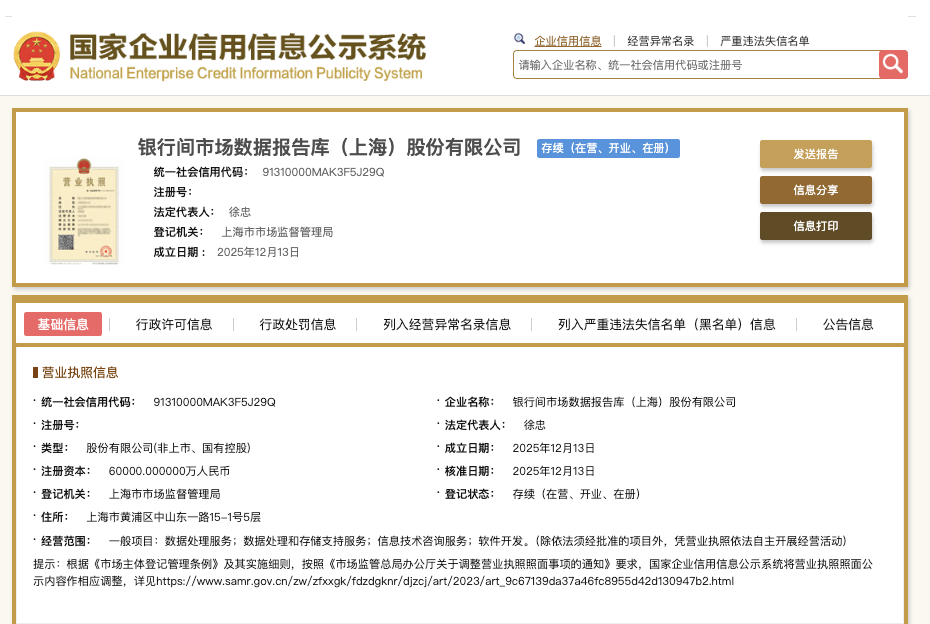
银行间市场数据报告库(上海)股份有限公司设立
Bei Jing Shang Bao· 2025-12-16 08:41
Core Viewpoint - The establishment of the Interbank Market Data Reporting Library (Shanghai) Co., Ltd. aims to enhance the collection and analysis of financial market transaction data, supporting financial institutions and regulatory oversight [1][2] Group 1: Company Establishment - The Interbank Market Data Reporting Library (Shanghai) Co., Ltd. was established on December 13 with a registered capital of 600 million yuan [1] - The company is located at 15-1 Zhongshan East Road, Huangpu District, Shanghai, and its business scope includes data processing services, IT consulting, and software development [1] - Key management includes Xu Zhong as Chairman and Tang Yingwei as Financial Officer, with Xu also serving as Vice President of the China Interbank Market Dealers Association [1] Group 2: Regulatory Context - The establishment aligns with the announcement made by the Governor of the People's Bank of China, Pan Gongsheng, at the 2025 Lujiazui Forum, emphasizing the need for a comprehensive interbank market transaction reporting library [1] - The library will focus on high-frequency collection and systematic analysis of transaction data across various financial sub-markets, including bonds, currency, derivatives, gold, and bills [1] - Pan Gongsheng highlighted the importance of strengthening the monitoring and assessment system for systemic financial risks, indicating the library's role in this framework [2]
银行间市场数据报告库公司在沪成立 交易商协会徐忠担任董事长
2 1 Shi Ji Jing Ji Bao Dao· 2025-12-16 06:18
Core Insights - The establishment of the Interbank Market Transaction Reporting Database in Shanghai is a significant development aimed at enhancing financial market transparency and risk management [1][2][4] - The database will aggregate and analyze high-frequency trading data across various financial sub-markets, including bonds, currencies, derivatives, gold, and bills, serving financial institutions and regulatory bodies [1][2] Group 1: Company Formation and Structure - The Interbank Market Data Reporting Database (Shanghai) Co., Ltd. was officially established on December 13, with a registered capital of 600 million RMB [1] - The company is jointly funded by seven entities, including the Shanghai Gold Exchange and the China Interbank Market Dealers Association, with contributions varying from 15 million to 100 million RMB [1][2] Group 2: Leadership and Expertise - Xu Zhong, an economist with extensive experience in financial research and market infrastructure, is appointed as the chairman of the company [2] - The financial officer, Tang Yingwei, has a strong background in the bill market and has been involved in the transition from paper-based to electronic systems [2] Group 3: Importance and Challenges - The database is viewed as a crucial infrastructure for building a strong financial system and promoting high-quality financial development, with its core value being the enhancement of transparency and systemic risk prevention [2][3] - Challenges such as data quality issues and the lack of standardized reporting mechanisms need to be addressed to maximize the database's effectiveness in risk monitoring and market services [3]

央行:完善中央银行制度,建设强大的中央银行
Feng Huang Wang· 2025-12-12 12:35
Core Viewpoint - The People's Bank of China emphasizes the need to enhance the central banking system and build a strong central bank, focusing on a scientific and robust monetary policy framework [1] Group 1: Monetary Policy - The meeting highlights the importance of constructing a scientific and robust monetary policy system, with dynamic assessment and improvement of the monetary policy framework [1] - There is a call to enrich the toolbox of monetary policy and strengthen the execution and transmission of monetary policy [1] Group 2: Financial Stability - The meeting stresses the need to coordinate efforts on the "five major articles" of finance, aiming to establish a comprehensive macro-prudential management system and a mechanism for systemic financial risk prevention and resolution [1] - It emphasizes the importance of enhancing macro-prudential management in key areas and improving the regulatory framework for systemically important financial institutions [1] Group 3: Financial Market Infrastructure - The construction of a regulated, transparent, open, vibrant, and resilient financial market system is highlighted as a priority [1] - The meeting also calls for the establishment of a safe and efficient financial infrastructure system [1] Group 4: Legal Framework - There is a focus on improving the legal foundation for the central bank's functions [1]
【宏观与债市周报】国债收益率分化,超长债利率上行,远东资信成为CBI认证机构
Xin Lang Cai Jing· 2025-12-08 12:25
(来源:远东资信) 宏观经济方面,据对全国流通领域9大类50种重要生产资料市场价格的监测显示,2025年11月下旬与11 月中旬相比,15种产品价格上涨,30种下降,5种持平。从全球来看,12月5日,10年期美债收益率较周 初上行5bp至 4.14%。有效联邦基金利率为3.89%,较前期上行1bp。9月份,美国经季节调整的非农就业 人数增加11.9万人,大幅超出市场预期值5.2万人。8月份非农就业人数从增加2.2万人修正至减少0.4万 人,7月份非农就业人数从增加 7.9万人修正至增加7.2万人,合计下修3.3万人。美国失业率升至4.4%, 为2021年10月以来最高值。欧元区基准利率维持2.15%,日本政策目标利率维持0.5%。 债券市场方面,从无风险收益率来看,上周10年期国债收益率上行后回落,2年期国债收益率有所下 行,超长债抛压明显。12月5日,10年期国债到期收益率较周初上行1bp至1.8480%,2年期国债到期收 益率较周初下行2bp至1.4036%;从流动性情况来看,10月末M2余额335.13万亿元,同比增长8.2%。7天 期逆回购操作利率为1.40%,12 月5日,央行在公开市场开展1398 ...
【债市点评】买债规模低于预期,债市大幅调整
Sou Hu Cai Jing· 2025-12-07 16:46
(1)中国人民银行行长潘功胜在人民日报发表署名文章,文中提到,中央银行以维护币值稳定和金融稳定为双目标,货币政策 体系和宏观审慎管理体系是中央银行实施宏观管理的两项基础性工具,是实现双目标的双支柱。构建科学稳健的货币政策体系 和覆盖全面的宏观审慎管理体系,有利于把维护币值稳定和金融稳定更好结合起来,对于支撑金融强国建设具有重要的意义。 (2)国家金融监督管理总局发布关于调整保险公司相关业务风险因子的通知。其中提出:保险公司持仓时间超过三年的沪深 300指数成分股、中证红利低波动100指数成分股的风险因子从0.3下调至0.27。该持仓时间根据过去六年加权平均持仓时间确 定。 三、债市展望 债市的快速调整彰显出,配置型机构目前参与市场的力度较弱,超长债供需关系阶段性的失衡。同时万科事件、公募赎回新 规、临近年末等因素加大了交易性资金的波动,债市正处于易上难下的阶段,债市企稳仍需观察。虽然目前点位从利差角度 看,超长债有一定的博弈价值,但建议还是以快进快出为主,相比较下10年期以内参与交易的安全边际较高。未来可等待货币 宽松预期逐步升温,配置资金开始加大配置力度,再择机参与超长债期限的交易配置。 来源:市场投研资讯 ...

“十五五”深度研究系列报告(七):如何建立“金融强国”?
ZHESHANG SECURITIES· 2025-12-05 07:26
Group 1: Central Bank Objectives - The "14th Five-Year Plan" emphasizes the need to "improve the modern central banking system," with a notable shift to explicitly include "economic growth" as a primary goal alongside currency stability and financial stability[1] - The dual-pillar framework will provide tools and institutional support for both currency stability and financial stability, marking a significant evolution in the central bank's objectives[3] - The adjustment in primary objectives reflects a structural recalibration, aligning legal requirements with modern central banking discourse, enhancing consistency between law and practice[19] Group 2: Macro-Prudential Management - The macro-prudential framework is expected to evolve along three main lines: objectives, tools, and mechanisms, focusing on systemic stability rather than individual risk management[3] - The macro-prudential toolbox will be systematized, with increased attention to stock, bond, and foreign exchange markets, enhancing the central bank's ability to manage systemic risks[3] - The central bank's focus will shift from temporary crisis management to regular expectation management and emergency arrangements, improving its crisis response capabilities[26] Group 3: Interest Rate Marketization - China's interest rate marketization has progressed through three stages: price liberalization, establishment of a rate transmission system, and refined price control[31] - The future evolution of the interest rate corridor is expected to tilt operational target rates from DR007 towards DR001, enhancing liquidity management and tool innovation[38] - The central bank is likely to explore conditional liquidity tools for non-bank institutions to provide support during extreme market fluctuations, preventing irrational spikes in short-term rates[5] Group 4: Capital Market Development - The "Five Major Articles" will shift focus towards three main lines: from tool coverage to institutional construction, from credit-led to a balanced approach between equity and debt financing, and from central bank-led initiatives to collaborative efforts across multiple policies[8] - The emphasis on direct financing through equity and bond markets aims to enhance the capital market's functionality, aligning it with the needs of the real economy[9] - The development of a direct financing system centered on technology enterprises will focus on deepening equity financing and thickening bond markets[9]
每日市场观-20251205
Caida Securities· 2025-12-05 04:57
Market Overview - On December 4, the Shanghai Composite Index fell by 0.06%, while the Shenzhen Component Index rose by 0.4%, and the ChiNext Index increased by 1.01%[2] - The total trading volume on December 4 was 1.56 trillion yuan, a decrease of approximately 130 billion yuan compared to the previous trading day[1] Sector Performance - The main sectors that saw inflows of capital were semiconductors, military electronics, and aerospace equipment, while the sectors with the largest outflows included liquor, small metals, and marine equipment[3] - The technology sector showed signs of stabilization, particularly in the STAR Market and ChiNext, which experienced notable gains[1] Investment Trends - The first national major scientific infrastructure in the information and communication field, the Future Network Experimental Facility, has officially commenced operations, enhancing China's capabilities in network technology innovation[5] - The eSports industry in China is projected to generate revenues of 29.331 billion yuan in 2025, reflecting a year-on-year growth of 6.40%[11] Fund Dynamics - The first batch of Beijing Stock Exchange thematic funds has seen an average cumulative return of over 100% in the past two years, indicating strong interest in this investment area[12] - Private equity product registrations surged by nearly 30% in November, marking the second-highest monthly registration volume of the year, with stock strategy products accounting for 66.07% of the total[14]
潘功胜最新发声!
券商中国· 2025-12-04 05:16
Core Viewpoint - The article emphasizes the importance of constructing a scientific and robust monetary policy system and a comprehensive macro-prudential management system to support high-quality financial development and the establishment of a financial power in China [3][4][5]. Group 1: Importance of Monetary Policy and Macro-Prudential Management - The dual objectives of maintaining currency stability and financial stability are foundational for the central bank's macro-management tools [4]. - The construction of these systems is essential for adapting to changes in social contradictions and promoting high-quality development [4][5]. - The need for a robust monetary policy and macro-prudential management framework is highlighted as a response to the complexities of the current economic environment [5][6]. Group 2: Building a Scientific and Robust Monetary Policy System - The monetary policy system aims to achieve a balance between currency stability, economic growth, full employment, and international balance of payments [7]. - Key tasks include optimizing the mechanism for basic currency issuance, improving market-based interest rate formation, and enhancing the structural monetary policy tool system [9][10]. - The focus is on maintaining reasonable growth in financial totals and ensuring effective financing for the real economy [9][10]. Group 3: Comprehensive Macro-Prudential Management System - The macro-prudential management system aims to monitor and assess systemic financial risks and implement preventive measures [11][12]. - It emphasizes the need for a comprehensive approach to cover macroeconomic operations, financial markets, and systemically important financial institutions [12][13]. - The system should also address external economic and financial market risks, ensuring resilience against external shocks [12][13]. Group 4: Key Tasks for Macro-Prudential Management - Strengthening the monitoring and assessment of systemic financial risks is crucial for proactive risk management [13][14]. - Implementing risk prevention measures in key sectors and enhancing the regulatory framework for systemically important financial institutions are essential [14][15]. - The article calls for a rich toolbox of macro-prudential policy instruments to address various financial challenges effectively [15][16].