绿色交通

Search documents
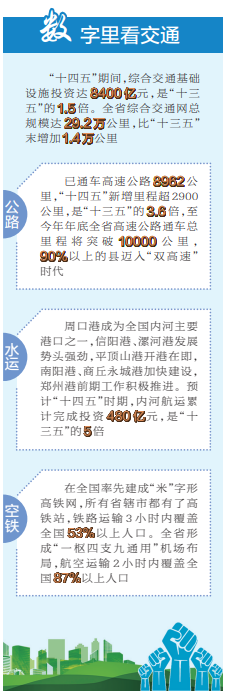
河南“121”便捷出行格局基本形成
Zheng Zhou Ri Bao· 2025-10-14 00:50
Core Insights - The article discusses the progress and achievements of Henan Province in building a strong transportation network during the "14th Five-Year Plan" period, highlighting significant investments and infrastructure developments [2][3][4]. Transportation Infrastructure Development - The total scale of the comprehensive transportation network in Henan has reached 292,000 kilometers, with an investment of 840 billion yuan, which is 1.5 times that of the previous five-year plan [3]. - The province has added 14,000 kilometers to its transportation network since the end of the "13th Five-Year Plan" [3]. - The total length of highways has reached 8,962 kilometers, with over 2,900 kilometers added during the "14th Five-Year Plan," marking a 3.6 times increase compared to the previous period [3]. Water and Rail Transport Expansion - The inland waterway network has expanded to 1,825 kilometers, with significant investments in ports and shipping infrastructure, including a projected investment of 48 billion yuan during the current plan [4]. - The railway network has reached 6,810 kilometers, including 2,263 kilometers of high-speed rail, covering over 53% of the national population within a three-hour travel radius [4]. Air Transport and Logistics - The air transport network has been enhanced, with 87% of the population within a two-hour flight radius, and the establishment of a comprehensive airport layout [4]. - The cargo volume at Zhengzhou Airport has surpassed 800,000 tons, with significant improvements in logistics efficiency, including a 50% reduction in shipping time for certain goods [5]. Urban and Rural Transportation Improvements - Urban rail transit has increased by 220 kilometers, with a 107% growth compared to the end of the previous plan, making public transport more accessible [6]. - Rural transportation has been bolstered with 7,715 new rural bus routes, achieving full coverage of scenic spots and villages [6]. Freight and Logistics Efficiency - The total freight volume is projected to reach 2.93 billion tons in 2024, with a 34% increase compared to the end of the previous plan [7][8]. - The logistics sector has seen the establishment of 16 five-star logistics companies, enhancing the overall efficiency of the freight system [8]. Technological and Environmental Advancements - The province is focusing on smart transportation solutions, with over 1,000 kilometers of smart highways and the implementation of electronic ticketing systems [9]. - Efforts are being made to promote green transportation, including the transition to electric and hydrogen fuel vehicles, with a significant increase in charging infrastructure [9].

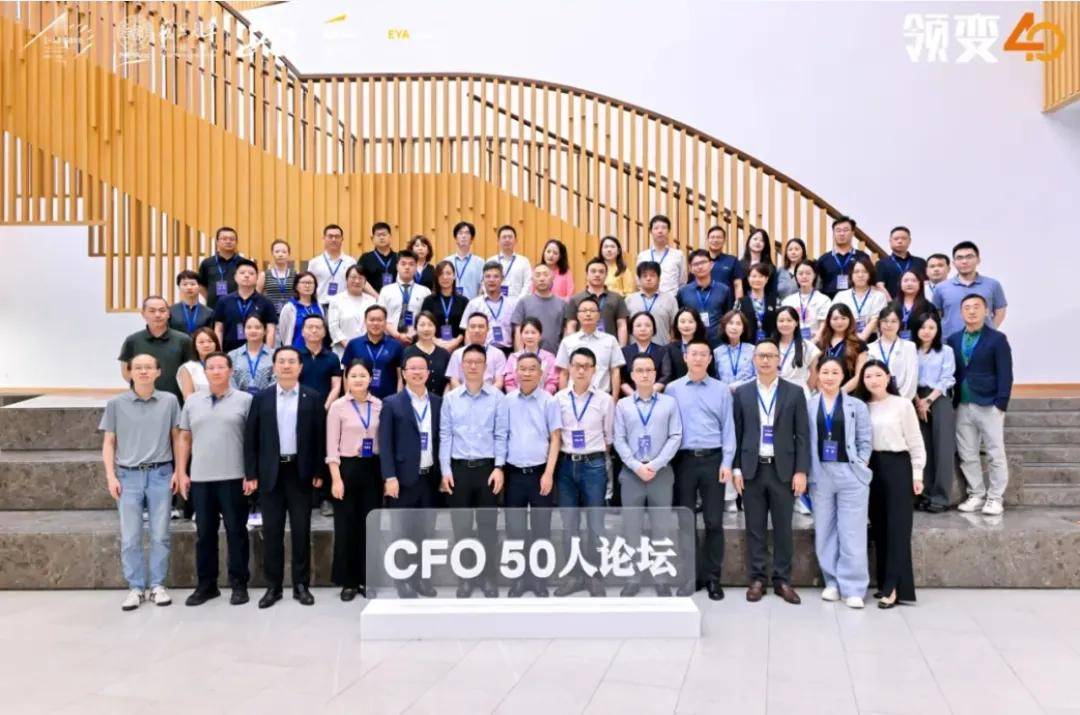
聚焦“变革与转型”,顶尖CFO齐聚探讨“韧性增长” CFO 50人+论坛(第二季)回顾
Sou Hu Cai Jing· 2025-10-13 10:08
Core Insights - The forum "CFO 50+ Forum" focused on exploring resilient growth strategies amid global economic turbulence and industrial restructuring [1] - Keynote speaker Li Zhiguo emphasized the dual-track development of advanced manufacturing and high-level services in China's economic transformation towards becoming a moderately developed country by 2035 [3][5] Group 1: Industry Transformation and Corporate Strategy - Li Zhiguo identified three major labels for future industrial development: technology, health, and green initiatives [5] - Chinese companies' global competitiveness is defined by market control, resource allocation, talent integration, and cultural influence [5] - The "outbound strategy 3.0" for Chinese enterprises emphasizes a shift towards "demand thinking" and "high-end value output," focusing on customer-centric approaches [7] Group 2: AI Integration in Finance - The "2025 AI Application Status Report" highlighted the widespread adoption of AI in financial processes, particularly in operational tasks like invoice recognition and financial reporting [11] - Despite high acceptance of AI tools among finance professionals, there is a noted lack of AI penetration in strategic forecasting and complex decision-making [11] - Future trends indicate a deepening integration of AI with finance, moving from automation to intelligence, and emphasizing human-machine collaboration [13] Group 3: CFO Role Evolution - CFOs are transitioning from traditional roles focused on control to becoming growth drivers, actively participating in business decisions like pricing and market expansion [26] - The need for CFOs to design flexible financial plans in response to macroeconomic scenarios was emphasized, particularly in managing risks related to currency fluctuations and geopolitical tensions [26] - The forum underscored the importance of CFOs in navigating uncertainties and leveraging technology to enhance financial management [30] Group 4: Financial Strategies for Global Expansion - The discussion highlighted the necessity for companies to utilize financial tools to build robust industry ecosystems and manage cash flow effectively [18][20] - CFOs are encouraged to establish a "global financial hub" for centralized data management and to adopt a dual approach of localization and standardization in financial structures [31] - The emphasis on creating agile and sustainable global financial systems was reiterated as a key strategy for navigating the complexities of international markets [30]
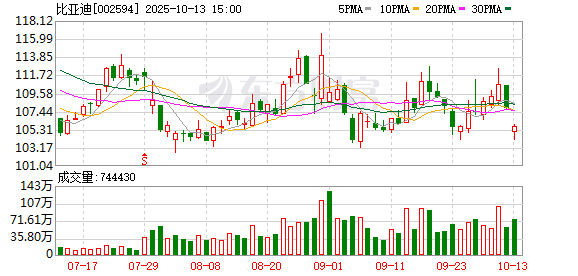
比亚迪第1400万辆新能源汽车在巴西下线 巴西“比亚迪路”正式命名
2 1 Shi Ji Jing Ji Bao Dao· 2025-10-13 09:40
Core Points - BYD's 14 millionth electric vehicle rolled off the production line in Brazil, marking a new phase in the company's globalization and accelerating its international expansion [2] - The road in front of BYD's factory in Bahia was officially renamed "Avenida BYD," becoming the third road globally named after the company, following similar honors in the United States and Thailand [3] - The Brazilian governor emphasized the law's approval as a step towards creating jobs and income for the region, highlighting BYD's contribution to green transportation and sustainable development in Brazil [3]

狂揽七奖 宇通多项黑科技引爆比利时车展!| 头条
第一商用车网· 2025-10-04 10:16
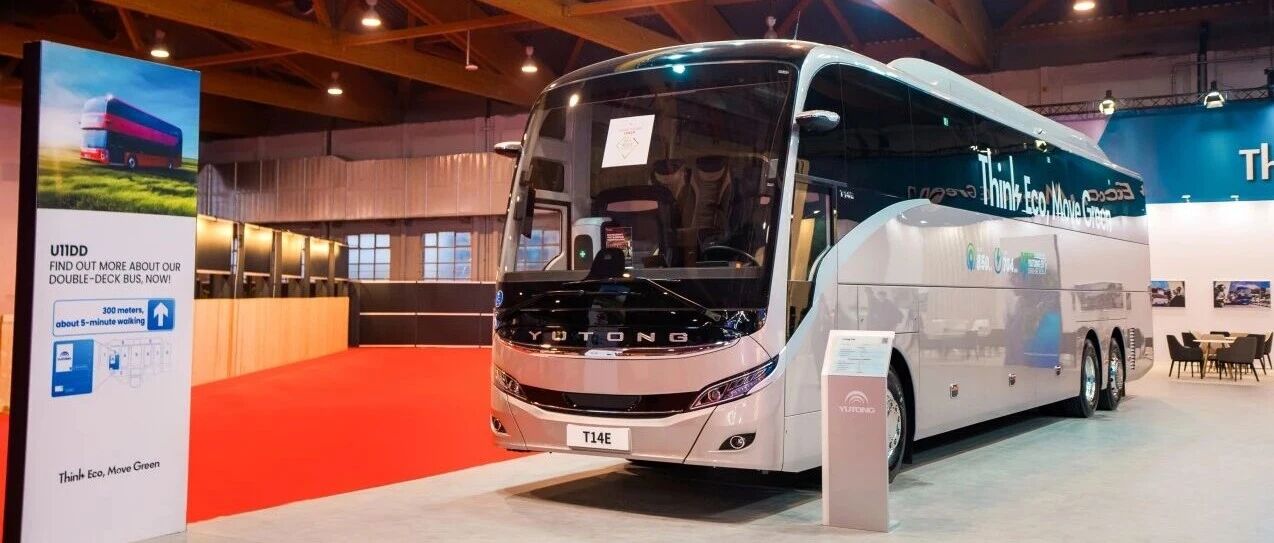
Core Viewpoint - The article highlights the significant achievements of Yutong at the Busworld exhibition in Belgium, showcasing its advanced electric bus models and innovative technologies, which underline the company's commitment to green transportation and its growing influence in the European market [1][4][18]. Group 1: Awards and Recognition - Yutong won a total of seven Busworld awards, including the "Best Bus of the Year" and "Best Coach of the Year," marking the highest number of awards received by a Chinese bus brand at this event [1][4]. - The T14E luxury electric tourist bus won the "Best Coach of the Year" award, recognized for its impressive range of up to 850 kilometers and innovative charging system [6]. - The U15 high-end city bus received four awards, including "Best Bus of the Year," "Safety Award," "Eco-Friendly Award," and "Design Award," highlighting its advanced safety features and smart management systems [8]. Group 2: Product Innovations - Yutong showcased multiple high-end electric models, including the T14E, U15, IC12E, and U11DD, each designed to meet specific operational needs in various transportation scenarios [4][12]. - The IC12E intercity electric bus, with a range of up to 675 kilometers, was awarded the "Eco-Friendly Award," demonstrating Yutong's commitment to sustainability [10]. - The U11DD double-decker sightseeing bus can carry up to 87 passengers and has a range of 750 kilometers, making it suitable for peak tourist seasons [12]. Group 3: Technological Advancements - Yutong introduced the "Vehicle-Battery Co-Lifetime" technology, which ensures that the vehicle and battery have synchronized lifespans of 15 years or 1.5 million kilometers, reducing operational concerns for users [13][14]. - The Link+ fleet management system, which won the "Digital Gold Award," enhances operational efficiency by providing real-time data monitoring and predictive analytics [12][16]. - The integration of AI and big data in the Link+ system transforms service from reactive to proactive, maximizing operational value throughout the vehicle's lifecycle [16]. Group 4: Market Presence and Future Outlook - Yutong has been operating in the European market for over 20 years, with its buses deployed in more than 25 countries, reflecting the brand's deep-rooted presence and recognition [18]. - The company aims to continue its commitment to green transportation, leveraging technology to create a zero-emission future in collaboration with global customers [18].

国网甘肃电力:高效供电护航充电桩项目 贴心服务助力居民绿色出行
Zhong Guo Neng Yuan Wang· 2025-09-19 09:18
Core Points - The successful commissioning of the new energy charging pile project in Lanzhou New District addresses the charging difficulties faced by residents with electric vehicles [1][2] - The project was supported by the State Grid Lanzhou New District Power Supply Company, which provided comprehensive service throughout the construction process [1] - The project aligns with the State Grid Gansu Electric Power Company's commitment to enhancing power supply services and supporting the growth of new energy infrastructure [2] Group 1 - The last box-type distribution room in the parking lot of the Rui Ling Xin Yuan community was successfully energized on September 18, marking the project's readiness for operation [1] - The power supply company engaged proactively with the construction party to understand electricity needs and construction timelines, ensuring a well-planned power supply scheme [1] - During construction, the team adhered to safety production requirements and overcame challenges such as high temperatures, ensuring the core tasks were completed accurately [1] Group 2 - The project is a practical implementation of the State Grid Gansu Electric Power Company's principle of "People's Electricity for the People" [2] - The company plans to continue optimizing power supply processes and the business environment in response to the increasing number of electric vehicles in the region [2] - This initiative aims to provide robust electrical support for the development of new energy charging facilities and green transportation [2]
【联合发布】新能源商用车周报(2025年9月第2周)
乘联分会· 2025-09-15 08:39
Policy and Regulations - The Ministry of Transport has issued guidelines for the construction of a strong transportation country, focusing on smart logistics and data sharing [8][10] - Shanghai's updated vehicle replacement subsidy policy requires new cars purchased from September 11, 2025, to be registered in Shanghai [15][19] - Henan Province has introduced new regulations to facilitate residents' access to electric vehicle charging [20][21] Market Insights - From January to August 2023, domestic sales of new energy light trucks increased by 60.5%, with a penetration rate of 33.5% [23][28] - The main battery capacity for new energy light trucks is concentrated in the 96-110 kWh range, with pure electric vehicles being the mainstream choice [29][35] - Sales of new energy light trucks are primarily concentrated in the South China, Southwest, and East China regions, accounting for 78.8% of total sales [31][36] Company Monitoring - SAIC-GM-Wuling launched the "Wuling Yangguang Champion Edition," equipped with CATL's battery system [39] - Scania has obtained independent production qualifications in China, marking a significant step in its localization strategy [41] - Supao Technology has partnered with Karl Power to explore L4-level autonomous driving for new energy heavy trucks [47] - Qingling Motors has collaborated with Yuntai Hydrogen Energy to promote the Qingling M600 hydrogen fuel cell refrigerated truck [50]
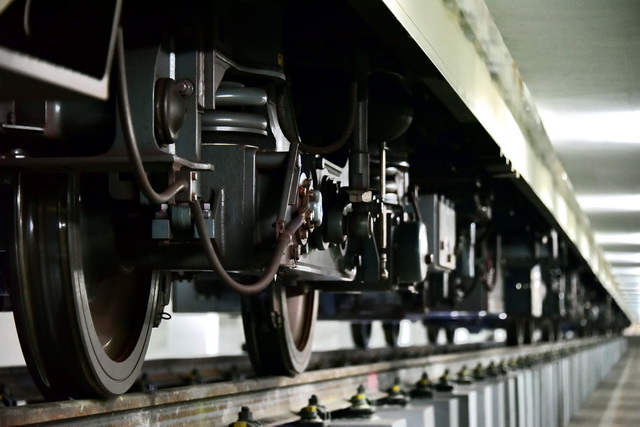
16个领域52个方向,交通强国建设试点指引释放诸多机遇
Di Yi Cai Jing· 2025-09-15 02:11
Group 1 - The core focus of the pilot program is to accelerate the construction of a strong transportation nation by addressing key tasks and challenges in the sector, with 16 application areas and 52 directions outlined in the guidelines [1][2] - The pilot tasks are expected to have strong innovation, representativeness, and demonstration effects, with a typical implementation period of around 3 years, not exceeding 5 years [2] - The guidelines emphasize the integration of new technologies such as big data, the Internet, and artificial intelligence in the railway sector, promoting the development of new railway transport tools and equipment technology upgrades [2][5] Group 2 - The guidelines highlight the construction of high-speed maglev systems, aiming to break through technical bottlenecks and establish a test line for 600 km/h maglev trains in urban agglomerations [3] - The pilot program will focus on the digital transformation of transportation infrastructure, promoting smart expansion, safety enhancement, and industry integration through the application of information communication technology [5][6] - The guidelines propose the development of a free-flow tolling system, with at least 100 demonstration lanes to improve vehicle passage efficiency and user satisfaction [5][6] Group 3 - The guidelines encourage the establishment of a comprehensive transportation system in modern urban areas, promoting cross-departmental collaboration and information sharing to alleviate congestion [6] - The initiative aims to cultivate internationally competitive new logistics integrators by fostering long-term strategic partnerships between transportation logistics companies and manufacturing industries [6][7] - The guidelines also advocate for the integration of transportation and tourism infrastructure, enhancing the service functions of transportation facilities related to tourism [7]
周末利好!福建,重磅部署!
Zheng Quan Shi Bao· 2025-09-14 14:07
Core Viewpoint - Fujian Province is accelerating the development of various industries, including wind power, nuclear power, photovoltaics, marine economy, and prefabricated buildings, as part of its comprehensive green transformation plan outlined in the recent action plan by the provincial government [1][3]. Industry Development - The action plan aims to promote the growth of green and low-carbon industries, focusing on areas such as optoelectronic information, integrated circuits, and new energy, with the goal of cultivating national-level strategic emerging industry clusters [3]. - By 2030, the scale of the energy-saving and environmental protection industry is expected to reach approximately 300 billion yuan [3]. New Energy Sector - The plan emphasizes the development of non-fossil energy sources, including the upgrade of onshore wind power and the construction of offshore wind power projects [3]. - By 2030, the proportion of non-fossil energy consumption is targeted to exceed 30% [3]. Transportation Sector - The plan promotes low-carbon transportation tools, including the expansion of electric vehicles and the development of electric ships and aircraft [4]. - By 2030, the carbon emission intensity of operational transportation tools is expected to decrease by approximately 9.5% compared to 2020 [4]. Marine Economy - The marine economy is highlighted as a key driver of Fujian's economic development, with a projected marine GDP of 1.25 trillion yuan in 2024, reflecting a year-on-year growth of 6.1% [7]. - Fujian ranks first in several marine-related metrics, including per capita seafood consumption and seafood export value [7]. Market Mechanisms - The action plan includes the establishment of a carbon emissions trading market and the promotion of market-oriented mechanisms for natural resource asset utilization [8]. - The national marine economy has shown significant growth, with a marine GDP exceeding 10 trillion yuan, contributing to 7.8% of the national GDP [8].
平安产险:预估2020-2030年绿色交通领域保费约2万亿元
Jin Rong Shi Bao· 2025-09-13 03:20
Core Insights - The event themed "Digital Intelligence Drives Open Win-Win" was held in Beijing, focusing on financial services, where Ping An Property & Casualty Insurance Co., Ltd. showcased its innovative achievements and strategic partnerships [1] - The "Blue Book" on insurance supporting green transportation development was jointly released by Ping An Property & Casualty, Central University of Finance and Economics, China Academy of Actuarial Science, and the Transportation Research Institute [3] Group 1: Blue Book Overview - The "Blue Book" emphasizes "carbon peak and carbon neutrality" and systematically reviews the current state, policy evolution, risk mapping, and insurance innovation across five sectors: new energy vehicles, low-altitude economy, green logistics, green shipping, and rail transit [3][4] - It highlights that the insurance industry is becoming a crucial driver for the high-quality development of green transportation, serving as a foundational infrastructure for green transportation systems [4] Group 2: Market Data and Trends - From 2020 to 2030, the premium scale in the green transportation sector is estimated to reach approximately 2 trillion yuan [4] - The number of new energy vehicles in China is projected to increase from less than 5 million in 2020 to 31.4 million by 2024, accounting for over 60% of the global total [4] - The insurance premium for drone insurance is expected to grow from less than 100 million yuan in 2015 to 700 million yuan by 2024, with a compound annual growth rate of 15% [4] Group 3: Insurance Industry Evolution - The insurance sector has transitioned from "marginal compensation" to "deep co-construction" in the green transportation field over the past decade [4] - From 2015 to 2023, the premium for new energy vehicle insurance increased from 3.4 billion yuan to 100.1 billion yuan, while the cumulative risk coverage for rail transit engineering insurance exceeded 1 trillion yuan [4][5] - The insurance depth in the green transportation sector rose from 0.2% to 11.5%, establishing itself as an indispensable partner in capital and risk management for green transportation construction [4] Group 4: Innovation and Future Directions - Ping An Property & Casualty has been exploring innovations in green insurance, including forest carbon sink index insurance and intelligent assisted driving liability insurance [5] - The company aims to integrate its operations with national strategies and contribute significantly to high-quality economic and social development [5]

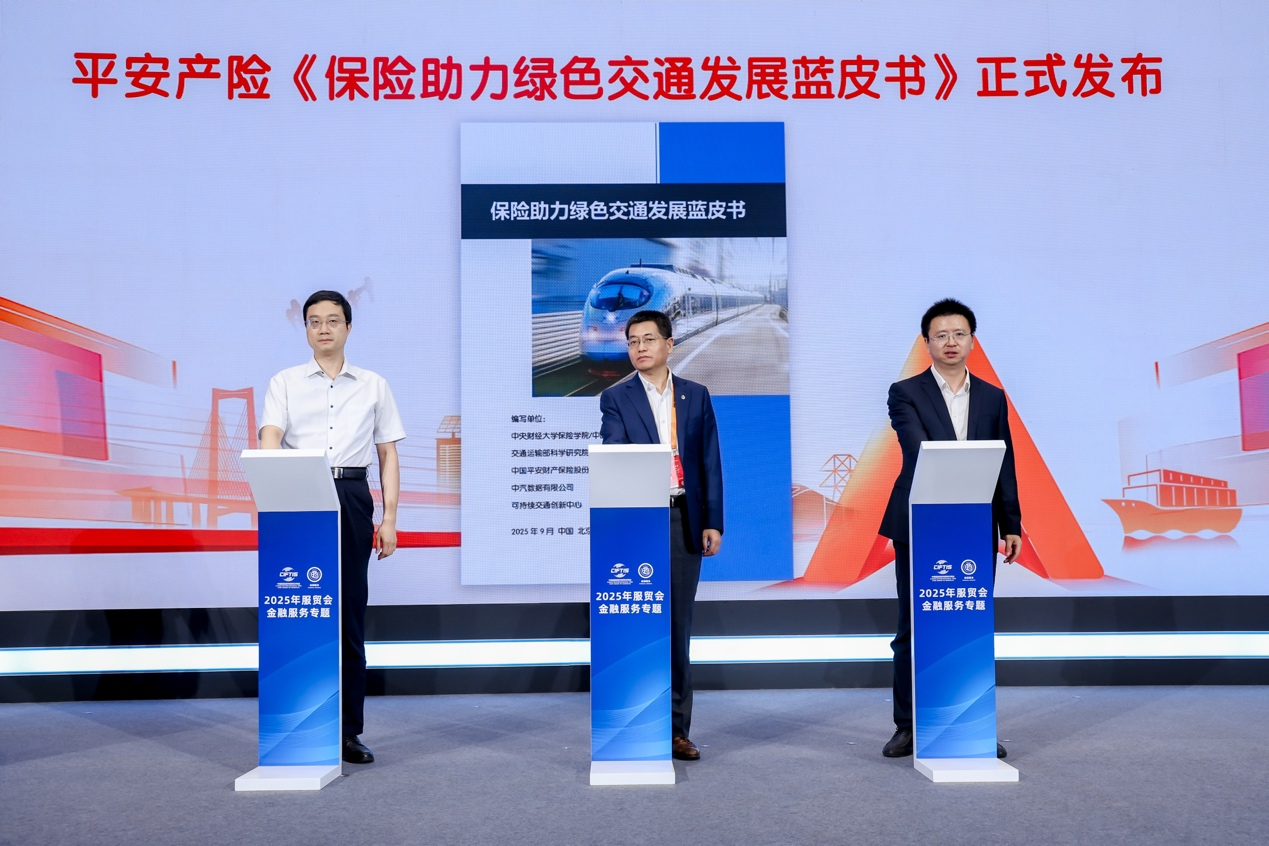
行业首部《保险助力绿色交通发展蓝皮书》:预估2020-2030年绿色交通领域保费约2万亿元|银行与保险
清华金融评论· 2025-09-12 11:09
Core Viewpoint - The insurance industry is becoming a crucial driver for the high-quality development of green transportation, serving as a foundational infrastructure for green transportation systems, and is expected to see a premium scale of approximately 2 trillion RMB in the green transportation sector from 2020 to 2030 [4]. Group 1: Industry Overview - The "Blue Book" outlines the current state, policy evolution, risk landscape, and insurance innovations across five key sectors: new energy vehicles, low-altitude economy, green logistics, green shipping, and rail transportation, all centered around the "carbon peak and carbon neutrality" strategy [3][4]. - The transition from "incremental expansion" to "green quality improvement" in green transportation presents unprecedented development opportunities, with the number of new energy vehicles in China expected to rise from less than 5 million in 2020 to 31.4 million by 2024, accounting for over 60% of the global total [6]. Group 2: Insurance Role and Market Dynamics - The insurance sector has evolved from a marginal compensatory role to a deep collaborative role in green transportation, with new energy vehicle insurance premiums increasing from 3.4 billion RMB in 2015 to 100.1 billion RMB in 2023 [7]. - The insurance function has shifted from simple compensation to a comprehensive service model encompassing risk identification, process control, and intelligent claims management [8]. Group 3: Sector-Specific Insights - In the low-altitude economy, insurance premiums are projected to exceed 5 billion RMB by 2030, with drone insurance being a significant growth driver [10]. - The new energy vehicle insurance market is expected to exceed 500 billion RMB by 2030, becoming a key growth point in the auto insurance market, with a noted correlation between vehicle torque levels and accident rates [10]. - The green shipping insurance market is anticipated to grow from approximately 430 million RMB in 2024 to over 1.9 billion RMB by 2030, with a focus on developing a risk-sharing mechanism for various fuel types [11]. Group 4: Policy and Regulatory Framework - The top-level design has positioned insurance as a critical institutional support for the green transportation system, as highlighted in various government action plans and guidelines [6][8]. - The "Blue Book" emphasizes the need for the insurance industry to transition from traditional post-event compensation to a proactive role in comprehensive risk governance to support the sustainable development of green transportation [8].