
资本市场改革

Search documents
睿远基金旗下产品2025年四季报:傅鹏博减仓阿里巴巴-W(09988) 华润万象生活(01209)首进赵枫前十大重仓股
智通财经网· 2026-01-23 03:07
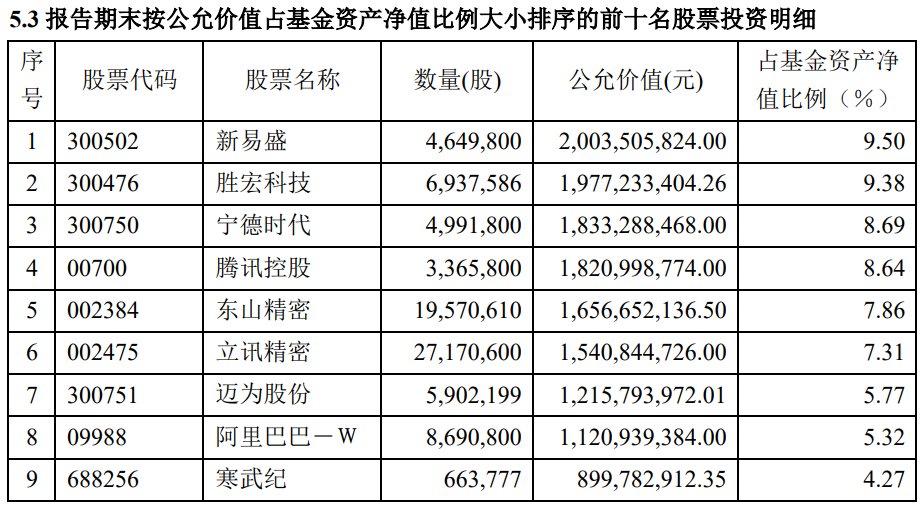
Core Viewpoint - Ruiyuan Fund disclosed its Q4 2025 report, indicating strategic adjustments in its portfolio, including increased positions in specific sectors while reducing exposure to others, reflecting a proactive approach to investment management [1][3]. Group 1: Portfolio Adjustments - The Ruiyuan Growth Value Mixed Fund increased its holdings in Cambricon (688256.SH) while reducing positions in Xinyisheng (300502.SZ), Alibaba-W (09988), and Dongshan Precision (002384.SZ) [1]. - The top ten holdings saw a shift away from telecommunications stocks, replaced by solar energy and high-end semiconductor equipment manufacturers, indicating a focus on sectors with strong performance in Q4 [1]. - The fund aims to minimize investment uncertainties in Q1 2026 while maintaining a focus on prominent sectors and stocks [1]. Group 2: Performance Metrics - As of the report's end, the net asset value per share of Ruiyuan Growth Value Mixed A Fund was 1.9685 yuan, with a growth rate of 0.57%, underperforming its benchmark by 1.37% [2]. - The net asset value per share of Ruiyuan Growth Value Mixed C Fund was 1.9159 yuan, with a growth rate of 0.47%, also underperforming its benchmark by 1.37% [2]. Group 3: Future Strategy - The fund managers, Fu Pengbo and Zhu Lin, prepared for 2026 by reducing holdings in companies with weak fundamentals and increasing investments in data center liquid cooling and computing power-related companies, based on industry trends and individual stock research [3]. - Ruiyuan's other fund, managed by Zhao Feng, has reached its highest stock position in three years, reintroducing holdings in Midea Group (000333.SZ) and other companies while reducing exposure to certain stocks [3]. Group 4: Market Outlook - Zhao Feng noted a favorable macroeconomic cycle for equity assets, with expectations of improved corporate earnings quality as China gradually moves out of deflationary expectations [4]. - The focus will remain on companies with solid fundamentals and strong competitive barriers, aiming for excess returns through structural allocation [4]. - Attention is directed towards domestic leading companies expanding overseas, which are expected to drive performance growth through enhanced product quality and brand recognition over the next five to ten years [4].

炸锅!冯德莱恩宣言:旧秩序已死,欧洲从此不再听从美国指挥!
Sou Hu Cai Jing· 2026-01-22 01:51
Core Viewpoint - The European Union (EU) is asserting its sovereignty and independence in response to U.S. tariffs and demands regarding Greenland, signaling a shift in transatlantic relations and a move towards strategic autonomy [1][3][5]. Group 1: EU's Response to U.S. Actions - EU President Ursula von der Leyen emphasized that Greenland's sovereignty is non-negotiable and criticized the U.S. for using tariffs to pressure allies into selling territory [1][3]. - The EU plans to invest in Greenland's infrastructure to strengthen economic ties and reduce reliance on the U.S. [3][5]. - A proposed "Arctic Security Group" involving the UK, Canada, Norway, and Iceland aims to enhance regional security without U.S. involvement [3][5]. Group 2: Internal EU Dynamics - There are differing opinions within the EU, with France advocating for immediate retaliatory tariffs against U.S. products, while Nordic countries prefer negotiation [3][5]. - A summit is scheduled for January 22 to decide on the EU's response strategy [3]. Group 3: Strategic Initiatives - The EU is looking to expand trade agreements with countries in South America, India, Indonesia, and Mexico to diversify its economic partnerships [5]. - A new plan focusing on decarbonization and competitiveness aims to lower energy costs in Europe, making it less attractive for companies to relocate to the U.S. [5]. - Increased defense spending and military collaboration are planned, with a focus on developing indigenous capabilities in response to perceived U.S. neglect [5][7]. Group 4: Market Reactions - Following von der Leyen's speech, European stock indices remained stable, indicating market anticipation for the upcoming summit and further developments [7].

ETF 及指数产品网格策略周报(2026/1/20)
华宝财富魔方· 2026-01-21 08:39
Core Viewpoint - The article discusses the potential investment opportunities in various ETFs, particularly focusing on the Hong Kong stock market and sectors such as pharmaceuticals, entertainment, and finance, driven by favorable economic conditions and government policies [3][4][5][8][11]. Group 1: Hong Kong Stock Market ETFs - The Hong Kong Stock Connect 50 ETF (159712.SZ) is expected to see a net buy of 1,404.84 billion HKD from southbound funds in 2025, a 73.89% increase from 2024, indicating strong inflows into the Hong Kong market [3]. - This ETF tracks the CSI Hong Kong Stock Connect 50 Index, covering over 57% of the market capitalization of Hong Kong stocks, balancing traditional and new economy sectors [4]. Group 2: Pharmaceutical Sector ETFs - The Hang Seng Pharmaceutical ETF (159892.SZ) is positioned to benefit from lower financing costs for pharmaceutical companies due to the Federal Reserve's interest rate cuts, enhancing their R&D capabilities [5]. - China holds approximately 30% of the global new drug pipeline, with 76 innovative drugs approved in 2025, indicating a robust domestic pharmaceutical industry [5]. Group 3: Entertainment Sector ETFs - The Film and Television ETF (159855.SZ) is anticipated to gain from the upcoming Spring Festival, which may boost market expectations and lead to a short-term rally in the sector [8]. - Government initiatives, such as the "China Film Consumption Year," aim to stimulate cultural consumption, potentially increasing audience engagement and spending in the film industry [8]. Group 4: Financial Sector ETFs - The Securities and Insurance ETF (512070.SH) is expected to benefit from active market trading, with a record turnover of 3.12 trillion RMB on January 9, 2026, positively impacting brokerage and margin financing businesses [11]. - Recent regulatory changes are likely to enhance capital efficiency for leading brokerages and relax investment restrictions for insurance companies, further supporting growth in the financial sector [11].

纵深推进改革 巩固资本市场稳中向好势头
Xin Lang Cai Jing· 2026-01-20 18:52
Core Viewpoint - The main theme of the capital market reform in 2026 is to seek progress while maintaining stability, focusing on consolidating the market's positive momentum and preventing significant fluctuations [1] Group 1: Market Stability and Regulation - The China Securities Regulatory Commission (CSRC) emphasizes the importance of maintaining a stable market environment as a foundation for reform and high-quality development [2] - Recent regulatory actions include enhanced market monitoring, timely counter-cyclical adjustments, and strict enforcement against market manipulation, with significant penalties imposed on violators [2][3] - The CSRC plans to deepen public fund reforms and broaden channels for long-term capital, promoting a market ecosystem that encourages long-term, rational, and value-based investments [3] Group 2: Enhancing Market Inclusivity and Adaptability - In response to global technological competition and economic restructuring, there is a need to enhance the inclusivity and adaptability of the multi-tiered equity market [4] - Recommendations include establishing differentiated listing standards and financing channels for hard-tech companies, allowing unprofitable firms with core technologies to raise funds on platforms like the Sci-Tech Innovation Board [4][5] - The focus is on optimizing the approval process for financial services related to technological innovation to support small and medium-sized enterprises in emerging fields [5] Group 3: Strengthening Bond and Futures Markets - The meeting highlights the necessity of improving the quality, structure, and total volume of the bond market, alongside promoting the stable development of the futures market [6] - In the past year, the IPO and refinancing totaled 1.26 trillion yuan, with bond issuances reaching 16.3 trillion yuan, indicating a robust multi-tiered capital market [7] - The introduction of commercial real estate REITs is seen as a significant step in enhancing financial services for the real economy and supporting structural economic transformation [7]

长城基金汪立:市场行稳致远,结构加速轮动
Xin Lang Cai Jing· 2026-01-20 08:00
Group 1: Market Overview - The A-share market exhibited a structured differentiation and active trading pattern, with a rapid shift in structure under margin trading regulations, where commercial aerospace and AI application themes weakened while electronic semiconductors and machinery strengthened [1][5] - In December, China's export growth rate was 6.6% in USD terms, up from 5.9% previously, indicating strong resilience despite high base effects from 2024 [1][5] - Exports to the US decreased by 30.0%, while exports to ASEAN and Latin America increased by 11.1% and 9.8%, respectively, showcasing a shift in trade dynamics [1][5] Group 2: Monetary Policy - On January 15, the central bank announced eight optimization policies for structural monetary policy tools, including a 0.25 percentage point reduction in interest rates and lowering the minimum down payment for commercial property loans to 30% [2][6] - The core objective of these policies is to reduce the cost of targeted funding, expand the coverage of structural tools, and enhance support for private, small, technology, and green sectors, with a moderate impact on overall liquidity [2][6] Group 3: Investment Strategy - The investment strategy emphasizes emerging technology as a main focus, with cyclical consumption undergoing transformation [3][7] - The regulatory environment in China's capital market is improving, which is expected to enhance the market's investability and allow more investors to benefit from transformation and reform dividends [3][7] - Key investment directions include: 1) Technology growth, particularly in semiconductor manufacturing, driven by strong global AI computing demand [3][7] 2) Non-bank financials, benefiting from increased wealth management demand and capital market reforms [3][7] 3) Cyclical sectors, which are expected to improve due to domestic demand expansion policies [3][7]
2026年资本市场改革“施工图”明确
Jin Rong Shi Bao· 2026-01-20 01:39
Group 1: Capital Market Reform Directions - The China Securities Regulatory Commission (CSRC) has outlined five major directions for capital market reform and development in the new year, emphasizing the need to enhance service quality for high-quality development [1] - A key focus is on the reform of the ChiNext board, with plans to deepen reforms and improve the inclusiveness and adaptability of the multi-tiered equity market [2] Group 2: ChiNext and Sci-Tech Innovation Board Reforms - The ChiNext board will implement deeper reforms, building on previous practices since 2025, including the introduction of a third listing standard to support high-quality, unprofitable innovative companies [2] - The Sci-Tech Innovation Board (STAR Market) will continue to advance its "1+6" policy measures, aimed at enhancing its role in supporting technological innovation [3] Group 3: North Exchange and New Third Board Development - The North Exchange has focused on serving innovative small and medium-sized enterprises, with nearly 80% of its listed companies being small enterprises and over 90% being high-tech companies [4] - The integration and high-quality development of the North Exchange and the New Third Board are also highlighted as key areas for 2026 [3] Group 4: Bond Market and REITs Expansion - The bond market is set for innovation, with goals to improve quality, adjust structure, and expand total volume, alongside the smooth rollout of commercial real estate REITs [5][6] - In 2025, the bond market issued various bonds totaling 16.3 trillion yuan, underscoring its significant role in the capital market [6] Group 5: Futures Market Development - The futures market will focus on quality improvement and risk prevention, with an emphasis on enhancing the linkage between spot and futures markets [7] - The CSRC plans to strengthen cross-market risk monitoring and establish long-term mechanisms to stabilize the market [7]
股债期市场协同改革 提升服务高质量发展质效
Zhong Guo Zheng Quan Bao· 2026-01-19 21:57
Group 1: Core Views - The China Securities Regulatory Commission (CSRC) has outlined a clear roadmap for deepening capital market reforms in 2026, focusing on enhancing the service quality of the stock, bond, and futures markets to support high-quality economic development [1][2]. Group 2: Equity Market - The primary focus is on improving the inclusiveness and adaptability of the multi-tiered equity market, which is crucial for linking technological innovation with industrial transformation [2][3]. - Key reforms include the implementation of deeper reforms for the Growth Enterprise Market (GEM) and continued promotion of the Science and Technology Innovation Board (STAR Market) to better align with the needs of emerging and future industries [2][3]. - The reform aims to enhance the financing mechanisms, making them more flexible and market-oriented, which is expected to boost the capital market's financing capabilities [3]. Group 3: Bond Market - The bond market is tasked with "improving quality, adjusting structure, and expanding total volume," emphasizing the need for continuous growth and structural optimization [4]. - Innovative bond types such as technology innovation bonds and green bonds are expected to expand, supported by additional incentive measures [4]. - The public REITs market is anticipated to expand into the commercial real estate sector, which will help revitalize existing assets and explore new development models [4][5]. Group 4: Futures Market - The futures market reform is focused on "steady advancement" and "quality development," with an emphasis on strengthening the regulation of the linkage between futures and spot markets [7][8]. - The reform aims to enhance the price discovery and risk management functions of the futures market, ensuring better service to the real economy and national strategies [7]. - There is a push to expand the variety of futures products and increase internationalization, allowing foreign investors to participate more easily in the market [7][8].
股债期市场协同改革提升服务高质量发展质效
Zhong Guo Zheng Quan Bao· 2026-01-19 21:11
Core Viewpoint - The China Securities Regulatory Commission (CSRC) 2026 work meeting outlines a clear roadmap for deepening capital market reforms, focusing on enhancing the service quality of the stock, bond, and futures markets to support high-quality economic development [1][2]. Equity Market: Enhancing Inclusiveness and Adaptability - The primary focus is on improving the inclusiveness and adaptability of the multi-tiered equity market, which is crucial for linking technological innovation with industrial transformation [1][2]. - The meeting emphasizes the need to deepen reforms in the ChiNext and STAR Market, aligning financing reforms with the demands of industrial transformation and technological innovation [2]. - The reform approach is characterized by differentiated progress and collaborative efforts, shifting from "institutional construction" to "deepening execution" and "releasing effectiveness" [2]. Bond Market: Improving Quality, Adjusting Structure, and Expanding Scale - The bond market is tasked with the mission of improving quality, adjusting structure, and expanding total volume, highlighting its role in optimizing structure and enhancing service precision for national strategies [3]. - Innovative bond types such as sci-tech bonds and green bonds are expected to continue expanding, with supportive measures likely to increase [3]. - The public REITs market is set to expand into the commercial real estate sector, which is anticipated to provide strong support for revitalizing existing assets and exploring new development models [3][4]. Futures Market: Strengthening Regulation and Quality Development - The futures market reform is aimed at steady progress and quality development, with a particular emphasis on strengthening the regulation of the linkage between futures and spot markets [5][6]. - The meeting highlights the need to enhance the pricing mechanism and risk management functions of the futures market to better serve the spot industry and national strategies [5]. - There is a focus on expanding the range of specific futures products and increasing internationalization while ensuring risk control [5][6].
资本市场赋能西部陆海新通道建设的策略探析
Jin Rong Shi Bao· 2026-01-19 01:49
Core Viewpoint - The release of the "Opinions" marks a new phase in the financial support system for regional development strategies, emphasizing the role of capital markets in supporting enterprises along the Western Land-Sea New Corridor [2][3]. Group 1: New Opportunities for Chengdu-Chongqing Region - The Western Land-Sea New Corridor construction provides new opportunities for high-quality development in the Chengdu-Chongqing region, with a focus on enhancing capital market functions [2]. - The region's strategic positioning as a dual hub (Chengdu International Railway Port and Chongqing International Logistics Hub) is highlighted by its significant trade volume, which exceeded 2.8 trillion yuan in 2023, with 35% of freight volume attributed to the new corridor [2]. - Chengdu-Chongqing region has 257 listed companies as of 2024, with direct financing exceeding 1.2 trillion yuan, accounting for 38% of the total in the western region [2]. Group 2: New Mission for Chengdu-Chongqing Region - The financial support for the Western Land-Sea New Corridor faces challenges such as regional development imbalances, weak financial infrastructure, and cross-border financial rule conflicts [3]. - To address these challenges, a systematic strategy is needed to leverage capital markets for resource allocation, risk diversification, and value discovery [3]. - The focus is on market-oriented reforms, enhancing the vitality and service capacity of capital markets, and improving policy coordination [3]. Group 3: Capital Market as a Pillar for Financial Support - The Chengdu-Chongqing capital market has become a cornerstone for transforming financial support policies into development momentum, with significant achievements in multi-level capital market systems [4]. - The establishment of the "Land-Sea New Corridor Special Board" aims to enhance direct financing to 30% by 2025, while a 100 billion yuan "Land-Sea New Corridor Science and Technology Fund" supports innovation in logistics and cross-border e-commerce [4]. - A collaborative regulatory platform between Sichuan and Chongqing is being developed to unify information disclosure standards and risk management processes [4]. Group 4: Diverse Financing Channels - The construction of the Western Land-Sea New Corridor requires substantial funding, characterized by large scale, long cycles, and high risks [6]. - Capital markets are innovating financing tools, with over 8 billion yuan raised by companies like Chongqing Port and Chengdu Road and Bridge for infrastructure projects [6]. - The issuance of "Land-Sea New Corridor Special Bonds" and the first green REITs by Chongqing Water Group raised 1.5 billion yuan for ecological logistics park construction [6]. Group 5: Optimizing Institutional Supply - The integration of innovation chains, industry chains, and funding chains is essential for driving development [7]. - The gradual release of registration system reform benefits is guiding capital towards core areas of the corridor economy, with 12 new companies listed on the Science and Technology Innovation Board in 2023 [7]. - The establishment of a data asset market is underway, with a projected issuance of 5 billion yuan in data asset securitization products by 2024 [7]. Group 6: Mergers and Acquisitions for Industry Integration - Capital market functions are facilitating vertical integration of industries along the corridor, with companies like Tongwei Co. acquiring assets to form a complete industry chain [8]. - A joint investment fund of 50 billion yuan is being established to focus on multi-modal transport and cross-border e-commerce [8]. - Companies are also pursuing green transformation initiatives, such as Chongqing Iron and Steel's fundraising for environmental upgrades [8]. Group 7: Risk Prevention Mechanisms - A comprehensive risk prevention system is being developed to address cross-border and market risks associated with the corridor [9]. - The establishment of a regulatory sandbox for corridor-related listed companies aims to manage risks effectively [9]. - Financial risk stress testing is being expanded to the logistics sector, ensuring supply chain stability [9]. Group 8: Policy Coordination and Implementation - A four-dimensional implementation system is proposed to transform policy dividends into new development momentum, focusing on policy coordination, empowerment of entities, factor upgrading, and open cooperation [10]. - A collaborative financial regulatory mechanism is being established to streamline policies related to enterprise listings and cross-border financing [10]. - The introduction of a green channel for listings aims to facilitate the financing of corridor-related enterprises [10].
证监会研究部署2026年五方面任务 深化改革强监管巩固市场稳中向好势头
Chang Jiang Shang Bao· 2026-01-19 01:46
Core Viewpoint - The China Securities Regulatory Commission (CSRC) emphasizes the overall stability and positive trend of the capital market, while acknowledging the complex challenges posed by intertwined internal and external risks. The focus for 2026 will be on enhancing market stability and supporting employment, enterprises, and market expectations [1][3]. Group 1: Market Performance and Developments - In 2025, the total cash dividends and buybacks by Chinese listed companies reached 2.68 trillion yuan, indicating a further accumulation of high-quality development momentum [1][2]. - The CSRC reported that despite multiple risks, the capital market showed resilience and vitality, with significant breakthroughs in attracting medium- and long-term funds, leading to a warming market trend [1][3]. - The total amount raised through IPOs and refinancing in 2025 was 1.26 trillion yuan, while the bond market saw the issuance of various bonds totaling 16.3 trillion yuan [2]. Group 2: Regulatory Reforms and Initiatives - The CSRC plans to deepen comprehensive reforms in investment and financing in 2026, focusing on improving the inclusiveness, adaptability, competitiveness, and attractiveness of the regulatory framework [3]. - Five key areas of work for 2026 were outlined, including maintaining market stability, enhancing service quality for high-quality development, strict law enforcement, promoting corporate governance, and advancing capital market openness [3][4]. - The CSRC will implement reforms in the Sci-Tech Innovation Board, including the introduction of a growth tier and the resumption of listing standards for unprofitable companies, aimed at better serving high-quality tech enterprises [2][4]. Group 3: Market Monitoring and Compliance - The CSRC will strengthen market monitoring and early warning systems, ensuring timely counter-cyclical adjustments and enhancing transaction and information disclosure supervision [3]. - There will be a focus on maintaining fairness in trading and strictly addressing market manipulation and excessive speculation [3][4]. - The CSRC aims to improve the operational standards of listed companies and will expedite the introduction of new regulations to enhance governance and compliance [4].